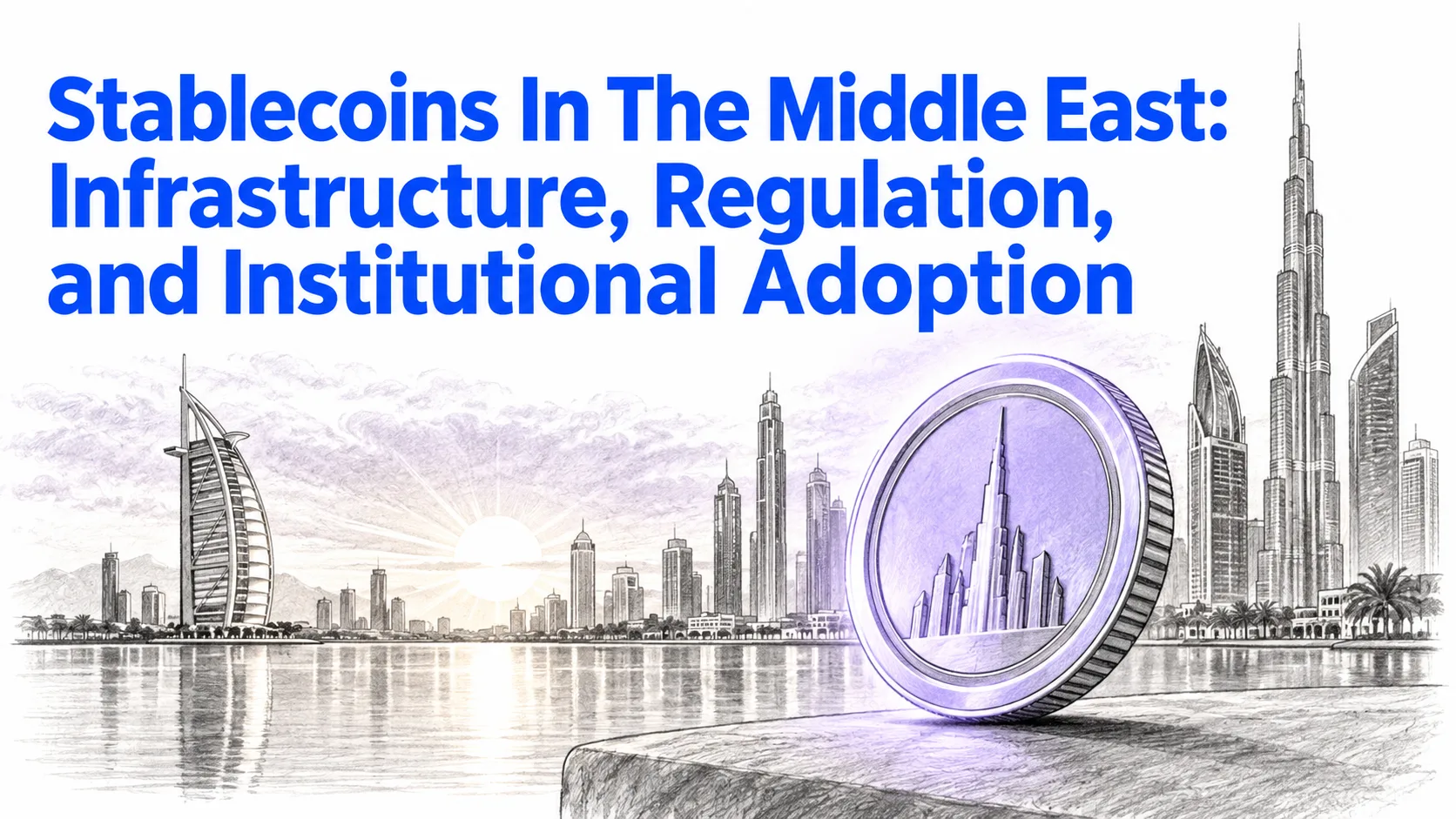
Stablecoins in the Middle East are moving from widely used offshore dollar tokens, mainly USDT, toward regulated local-currency issuance led by UAE banks and holding companies. Disclosure quality and central bank licensing are now the main points of difference between issuers. For US treasurers and allocators, that shift matters more than any single launch. It turns a grey-market dollar habit into a licensed settlement layer, and it raises a practical question: which tokens can you actually verify?
Definition: What Middle East Stablecoins Are

A Middle East stablecoin is a fiat-referenced token, issued on a blockchain, designed to hold a fixed value against a reference currency, typically through 1:1 reserve backing in cash or money-market instruments. The regional market splits into two layers: offshore dollar tokens used informally, and locally regulated issuance denominated in dirhams, lira or dollars.
The first layer is large and unlicensed in local terms. According to a regional analysis of stablecoins and geopolitics, stablecoins are already widely used in the region, mainly USDT, but there is as yet no widespread network compliant enough for official use. The second layer is small, new and supervised.
In plain language
A stablecoin here is a digital dirham, lira or dollar that should always be redeemable one-for-one, and the question is who issues it and who checks the reserves.
Takeaway: treat the region as two markets, a passive-supply USDT market built on habit and an active-supply licensed market built by regulation.
How the Regional Market Works: Issuers, Reserves and Chains
The licensed layer is a hot-start market. Supply is not bootstrapped by DeFi incentives; it is seeded by banks, sovereign-linked holding companies and a central bank register.
Issuer comparison table
| Coin | Issuer | Peg | Regulatory status | Disclosure |
|---|---|---|---|---|
| AE Coin | AED Stablecoin LLC, Abu Dhabi | 1 AEC = 1 AED | CBUAE licence for Dirham Payment Token Issuance, first entry in the register | Website states the peg; no reserve or attestation report published |
| TRYB | BiLira | Turkish lira | Operates under Turkish rules; payment use of crypto barred | Dated reserve reports 2020 to 2026; 2026 reports signed by an external auditor |
| USDU | Universal Digital | US dollar | Described by its issuer as the first USD-backed stablecoin registered by the CBUAE | Cash and money-market backing listed; see issuer for reports |
| DDSC | Ecosystem launched by IHC, First Abu Dhabi Bank and Sirius International Holding | UAE dirham | Recent UAE central bank approval | See issuer |
| RAKBANK AED token | RAKBANK | 1:1 AED | In-principle CBUAE approval, subject to final readiness | Reserves expected in segregated, supervised accounts |
The disclosure column is the one that moves capital. AE Coin holds the stronger licence and publishes the weaker evidence.
Worked example: the IHC 110 million dirham transfer
International Holding Company executed a 110 million dirham (about $30 million) transaction using DDSC on ADI Chain, a layer-2 blockchain developed by ADI Foundation. IHC described it as one of the largest disclosed stablecoin transactions executed in the UAE.
Mechanically, the flow reads like this:
- Dirhams sit in reserve with the issuing ecosystem backed by IHC, First Abu Dhabi Bank and Sirius.
- DDSC is minted against those dirhams on ADI Chain.
- The recipient holds DDSC or redeems it to dirhams through the issuer.
The point was demonstration: IHC said the transaction was meant to show DDSC and ADI Chain can support institutional-scale activity, with future plans focused on corridors linking the Middle East to global markets.
Takeaway: the licensed layer launches with balance-sheet backers, not liquidity mining. That solves trust but not distribution.
Regulation: UAE Payment Token Services and Regional Divergence
Central bank approval path
The CBUAE Payment Token Services Regulation took effect on 31 August 2024. Its core terms:
- A Dirham payment token must be denominated only in dirhams.
- A licensed issuer may issue Dirham payment tokens only to UAE residents.
- Algorithmic stablecoins are prohibited.
RAKBANK's in-principle approval to issue a 1:1 AED-backed payment token shows the sequencing: approval first, then final regulatory and operational readiness. Commentary on that approval notes the framework prioritises onshore settlement and payments over speculative trading, and draws a line between domestic fiat-backed tokens and foreign-currency or unbacked tokens, which face tighter usage constraints.
Turkey and the lira
Turkey runs the opposite logic. A central bank regulation in force since 30 April 2021 bars crypto assets in payments, while Law 7518 of July 2024 places crypto asset service providers under Capital Markets Board permission. TRYB exists and is well documented, yet it cannot serve as a payment instrument domestically.
Takeaway: the UAE licenses stablecoins as payment rails; Turkey tolerates them as assets and blocks them as payments.
Why It Matters: Institutional Use Cases

Treasury and trade settlement
DDSC is explicitly designed for treasury operations, trade settlement and cross-border payments. For a US multinational with Gulf subsidiaries, a supervised dirham token could compress intercompany settlement onto a single ledger. Commentary on RAKBANK's approval adds that bank-issued payment tokens could enable atomic delivery-versus-payment for tokenised securities.
Cross-border corridors
IHC's stated next step is payment corridors between the Middle East and global markets. That is the real test: a domestic-only token has limited value to a US counterparty until it connects to dollar rails.
Expatriate remittances
The UAE's demographics favour stablecoin use. According to one regional analysis, nearly 90% of the population are expatriates, which implies persistent outbound remittance demand.
Takeaway: the opportunity is corridor plumbing, not domestic retail.
Common Misconceptions
Misconception: All regional stablecoins are dollar-pegged
Reality: AE Coin is pegged to the dirham and TRYB to the lira. Dollar tokens like USDU coexist with local-currency issuance.
Misconception: Regulated means transparent
Reality: AE Coin holds the first CBUAE dirham issuance licence but its website carries no reserve report, while BiLira publishes signed auditor reports. Licence and disclosure are separate diligence items.
Misconception: Usage is driven by regulation
Reality: USDT is the token people actually use, and a widely accepted compliant network has not yet formed. Licensed supply still faces a cold-start distribution problem.
Takeaway: verify reserves yourself; a register entry is necessary, not sufficient.
Related Concepts
Payment token
The UAE regulatory term for a fiat-backed stablecoin used for payments, issued by a licensed entity under the Payment Token Services Regulation.
Reserve attestation
A dated report confirming tokens outstanding against reserves held.
Layer-2 settlement chain
A network that executes transactions off a base layer while inheriting its security. ADI Chain, which hosts DDSC, is one example.
CBDC
A central bank digital currency is a direct central bank liability, unlike a payment token issued by a private bank or company. See our global CBDC adoption roadmap.
Tokenization
Representing securities, funds or other assets on-chain, which payment tokens can settle against atomically.
How to Get Started
- Read issuer reserve reports. Start with BiLira's indexed archive as a benchmark for what good disclosure looks like.
- Check the CBUAE Register of Licensed Financial Institutions for the issuer's exact licence category.
- Map corridor needs: which currencies, counterparties and residency constraints apply, given dirham tokens are issued only to UAE residents.
FAQ: Frequently Asked Questions
Which stablecoins are used most in the Middle East?
USDT. Regional analysis describes stablecoins as already widely used across the region, mainly USDT, while noting that a widespread network compliant enough for official use has not yet emerged. Licensed local tokens remain early.
Is there a dirham stablecoin?
Yes. AE Coin is pegged 1:1 to the UAE dirham and holds a CBUAE issuance licence. DDSC is also dirham-backed, and RAKBANK has in-principle approval for a 1:1 AED payment token.
What is DDSC?
DDSC is a dirham-backed stablecoin from an ecosystem launched by IHC, First Abu Dhabi Bank and Sirius. It runs on ADI Chain and processed a 110 million dirham, roughly $30 million, IHC transaction.
Is there a Turkish lira stablecoin?
Yes. TRYB, issued by BiLira, tracks the Turkish lira and publishes dated reserve reports from 2020 to 2026. Turkey bars crypto assets in payments, so it functions as an asset rather than payment money.
Who regulates stablecoins in the UAE?
The Central Bank of the UAE, under its Payment Token Services Regulation effective 31 August 2024. It licenses issuers, restricts dirham token issuance to UAE residents and prohibits algorithmic stablecoins.
What is ADI Chain?
ADI Chain is a layer-2 blockchain developed by ADI Foundation. It hosts the DDSC dirham stablecoin and is positioned for institutional uses including cross-border payments, treasury operations and trade settlement.
Conclusion: Licence Solved, Distribution Open
What it has not answered is distribution. USDT still carries the region's real flows, and the best-licensed dirham coin publishes the least reserve evidence. The open question for US institutions is whether licensed dirham tokens can win corridor volume before USDT's network effects harden further, and whether disclosure will become the competitive edge regulators have not yet required.