The strongest US crypto Visa cards pair a clear rewards rate with a low or zero annual fee. Everything else is structure: credit versus debit versus prepaid, tier fees, and who holds the keys. This shortlist applies one set of criteria to every card.
How We Ranked These Crypto Visa Cards

Every card here was judged on the same five criteria, in this order:
- US availability. The card must be marketed to US users.
- Card type. Credit, debit or prepaid. This decides whether you spend borrowed dollars, converted crypto or a preloaded fiat balance.
- Reward rate. The headline rate and, more importantly, the rate an ordinary cardholder actually reaches.
- Annual or tier fees. A 3.5% card with a monthly subscription is a different product from a 2% card with none.
- Custody model. Whether funds sit with the issuer or stay in a self-custody wallet until settlement.
Takeaway: rank on net rewards and custody, not on the largest number in the marketing copy.
Quick Summary: Ranked Crypto Visa Cards
- Fold Bitcoin Rewards Credit Card: Flat Bitcoin rewards, no token lock-ins. Best Overall
- Crypto.com Visa Signature Credit Card: Tiered BTC or CRO rewards, $0 annual fee. Best for High Spenders
- Coinbase Card: Visa prepaid debit spending cash or crypto. Best for Coinbase Users
- Oobit Crypto Card: Spends from self-custody wallets via Visa. Best for Self-Custody
- Crypto.com Prepaid Visa Card: Preloaded fiat balance from converted holdings. Best for Budget Control
At a Glance: Fees and Rewards Compared
| Rank | Card | Pricing | Best for | Standout |
|---|---|---|---|---|
| 1 | Fold Bitcoin Rewards Credit Card | See vendor | Bitcoin accumulation | Unlimited 2% in Bitcoin |
| 2 | Crypto.com Visa Signature | - | Users willing to pay or stake for tiers | - |
| 3 | Coinbase Card | See vendor | Existing Coinbase holders | Prepaid debit, cash or crypto |
| 4 | Oobit Crypto Card | See vendor | Self-custody users | Wallet connection, Visa Platinum |
| 5 | Crypto.com Prepaid Visa | See vendor | Fixed spending budgets | Manual top-up model |
Worked example: $2,000 of monthly spend
Assume a cardholder puts $2,000 of purchases on a card each month. Using the published rates:
| Scenario | Gross rewards | Net monthly |
|---|---|---|
| Fold base | - | - |
| Fold with checking repayment | $70 | $70 |
| Crypto.com Midnight (CRO) | $70 | $65.01 |
| Crypto.com Basic (CRO) | $30 | $30 |
Two caveats change the picture. Fold's 3.5% depends on repaying through Fold's checking account, per reporting on the Fold launch.
Takeaway: the denomination of the reward shifts the ranking. CRO maximizes the rate; BTC caps compress it.
1. Fold Bitcoin Rewards Credit Card
Fold is the cleanest structure in the set. The card runs on Visa's network with Stripe Issuing behind it, according to the September 2025 launch coverage.
- Base rate: unlimited 2% paid instantly in Bitcoin.
- Boost: an additional 1.5% when purchases are repaid through Fold's checking account, for up to 3.5%.
- Partners: up to 10% back at partner merchants such as Amazon, Target, Home Depot, Uber and Starbucks.
- No lock-ins: the program is reported to have no token lock-ins or staking requirements.
The same coverage notes Fold had processed over $3.1 billion in transaction volume and distributed more than $83 million in Bitcoin rewards.
Caveat: rewards are Bitcoin-only. That is passive accumulation of a volatile asset, so a reward worth $40 today can be worth materially less next quarter.
2. Crypto.com Visa Signature Credit Card
This is a tiered credit product layered on Crypto.com's Level Up program. Spending is in dollars; rewards arrive in BTC or CRO.
According to Crypto.com's card page:
- Annual fee: $0 in annual credit card fees.
- Basic tier: free, 1.5% rewards, $100 CRO welcome bonus after $1,500 spend in 90 days.
- Midnight tier: $4.99 a month, $49.90 a year, or $500 of CRO staked for 12 months; 3.5% rewards; $200 CRO bonus after $2,000 spend in 90 days.
- Ceiling: up to 6% back at the top tier.
Caveat: the top rates are bought, not given. Higher tiers require a subscription or a CRO stake, which converts a payments decision into a token-exposure decision.
3. Coinbase Card
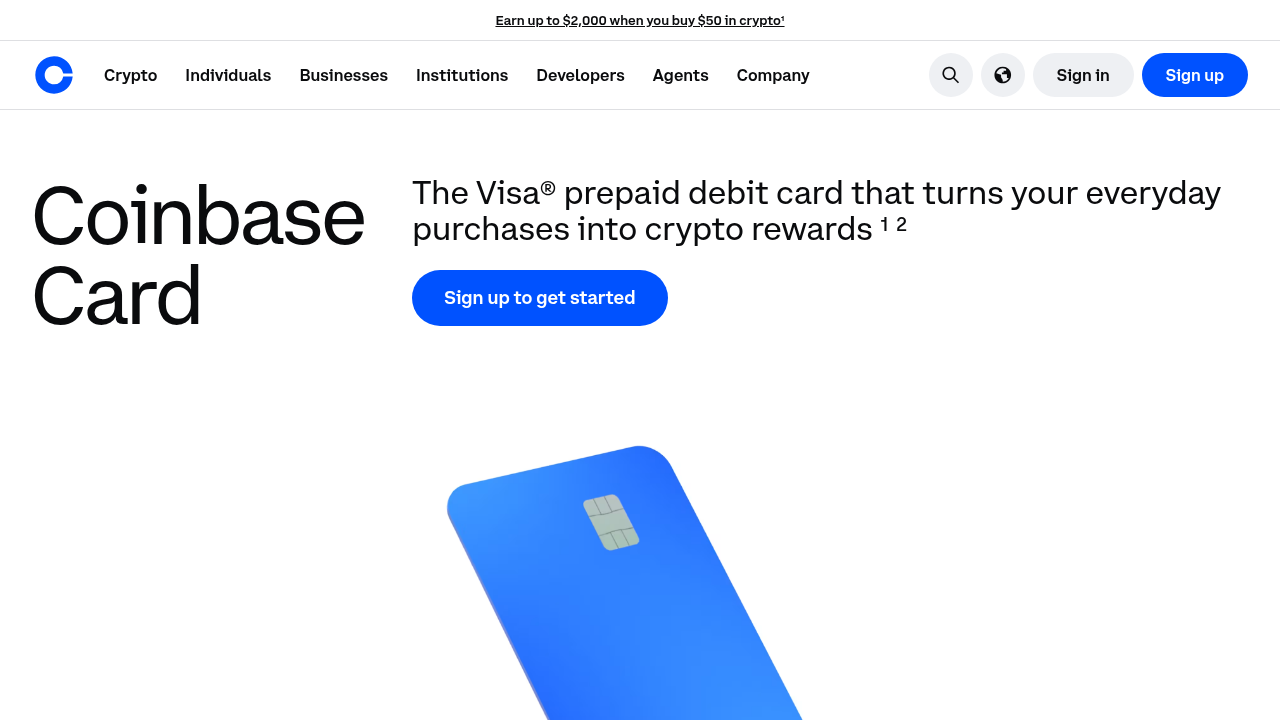
Coinbase describes its card as a Visa prepaid debit card for spending cash or crypto wherever Visa debit cards are accepted. For users already holding assets on Coinbase, it removes a transfer step: the balance you hold is the balance you spend.
Caveat: this is a debit structure. There is no credit line, no credit history building and no float between purchase and payment, so every swipe is a potential taxable disposal if spent in crypto.
4. Oobit Crypto Card
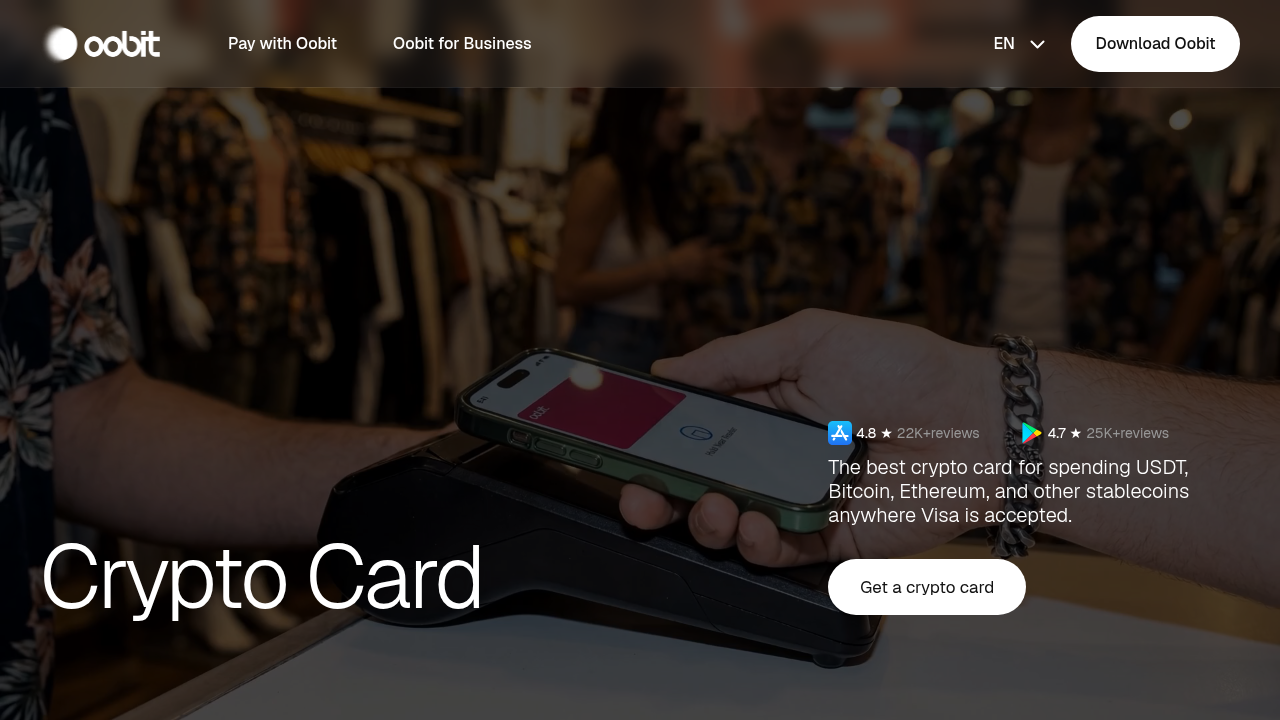
Oobit takes the opposite custody stance. According to Oobit, the card uses digital assets as collateral, runs over the Visa network and settles in local currency, so merchants are paid normally.
- Connects to self-custody wallets such as MetaMask, Trust Wallet, Phantom and Base.
- Issued as a Visa Platinum card, with price protection, purchase protection and extended warranty per Oobit.
- Supports USDT, Bitcoin, Ethereum and other stablecoins.
Caveat: the model is app-dependent. Wallet connection, funding and card provisioning all route through the Oobit app.
5. Crypto.com Prepaid Visa Card
A January 2026 roundup describes it as a prepaid method where you convert holdings into local currency and then spend or withdraw. Crypto.com still points users who prefer prepaid to this card.
Caveat: Reddit users describe it as functioning like a debit card that needs manual top-ups, which some find inconvenient. The friction is the feature: you cannot overspend a balance you have not loaded.
How to Choose a Crypto Visa Card

Start with card type. A credit card defers settlement and pays rewards on dollars; a debit or auto-conversion card sells crypto at the point of sale; a prepaid card requires you to convert first and spend second. Next, compute net rewards after tier fees at your real monthly spend, as in the example above, rather than comparing headline rates. Finally, decide on custody: issuer-held balances are simpler, while wallet-connected cards like Oobit, or the model covered in our ether.fi card review, keep assets on-chain until settlement. For stablecoin-funded spending, the issuers behind the dollar tokens matter too; see our overview of stablecoin companies.
The structural question is whether crypto cards become rewards products on fiat rails or settlement products on crypto rails. Fold and Crypto.com credit point to the first.
FAQ: Frequently Asked Questions
Is there such a thing as a crypto debit card?
Yes. A crypto debit card links to a crypto balance and converts it to fiat at the point of sale. Coinbase Card, for example, is a Visa prepaid debit card that spends cash or crypto where Visa debit is accepted.
What crypto is Visa working with?
Visa works with issuers such as Fold, Crypto.com, Coinbase and Oobit, whose cards cover Bitcoin, CRO, Ethereum and stablecoins like USDT. Visa reports that crypto card activity on its network is growing.
What is the difference between crypto credit, debit and prepaid cards?
Credit cards let you spend dollars on a credit line and earn crypto rewards. Debit or auto-conversion cards sell crypto at purchase. Prepaid cards require you to convert crypto into fiat and top up beforehand.
How does a crypto card convert crypto at purchase?
An auto-conversion card draws from your crypto balance and converts it to fiat at current exchange rates when you pay. The merchant receives ordinary currency, and the card provider handles the swap in real time.
Do crypto cards charge annual fees?
It varies by card. Crypto.com's Visa Signature card lists $0 annual fees, but its Midnight tier costs $4.99 a month or a CRO stake. Check each issuer's current fee schedule before applying.
Can I earn rewards paid in Bitcoin?
Yes. Fold's credit card pays an unlimited 2% instantly in Bitcoin, up to 3.5% with checking repayment. Crypto.com lets you choose BTC or CRO, though BTC rewards are capped monthly on lower tiers.
Conclusion: Net Rewards Over Headline Rates

Fold leads on simplicity and Crypto.com leads on ceiling, provided you accept CRO exposure or tier fees. The open question for 2026 is whether issuers keep subsidizing rewards in their own tokens, or whether flat Bitcoin and stablecoin payouts become the default.