Some links on this page are referral links. They never affect our verdicts.
Verdict
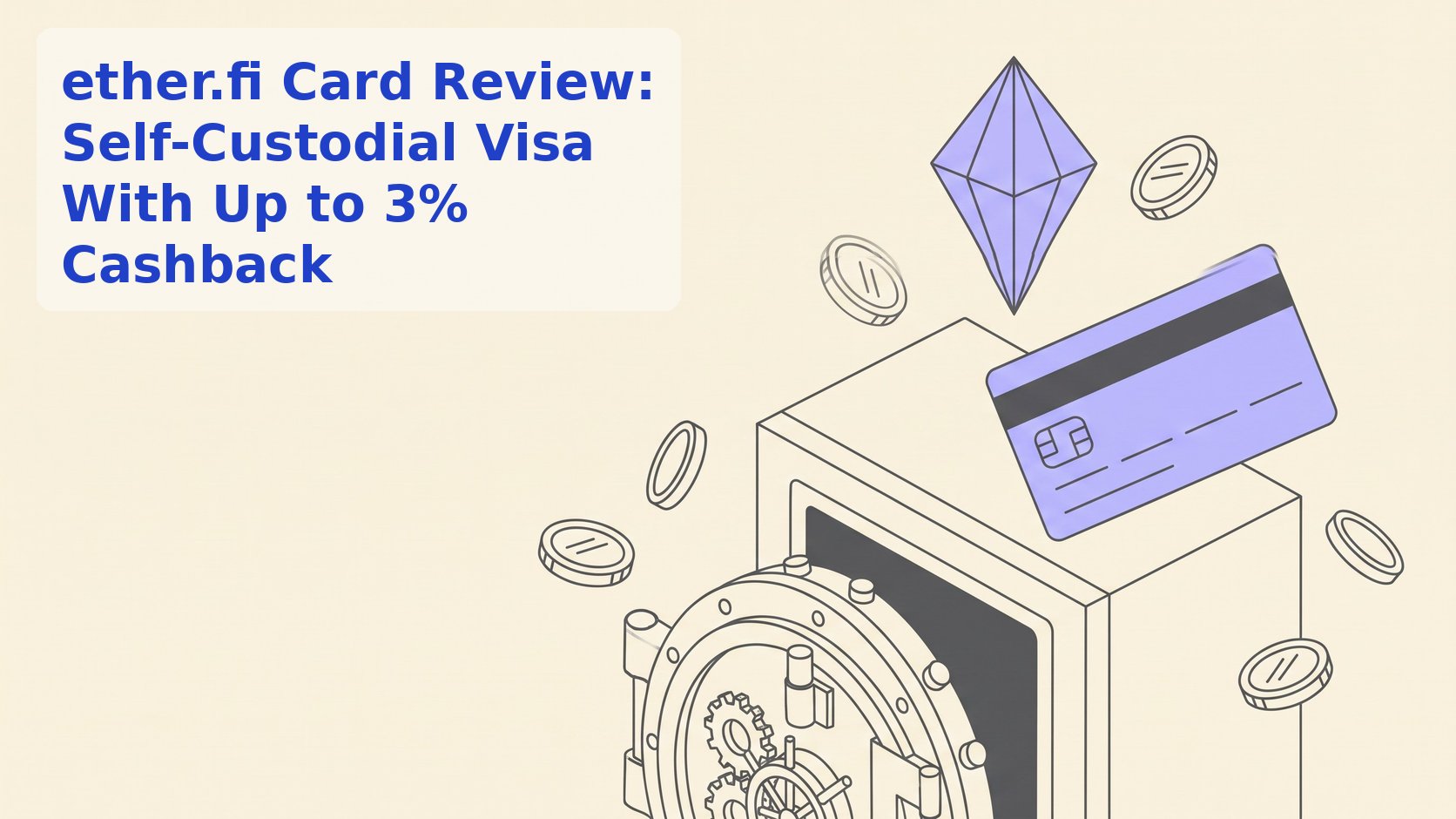
The ether.fi Card, part of ether.fi Cash, is a Visa card that spends from a self-custodial account, either directly in stablecoins or by borrowing against your crypto. Its free Core tier pays 3% cashback on the first $2,000 of monthly spend, the strongest free-tier rate among major crypto cards. The honest catch: cashback steps down sharply above that band, and Cash is unavailable in about 20 US states.
What is the ether.fi Card?
ether.fi started as a liquid restaking protocol on Ethereum, best known for its weETH token, and has expanded into a crypto banking app. ether.fi Cash is the spending product: a Visa card with virtual and physical versions, Apple Pay and Google Pay support, and an account you control rather than a platform custodian.
That custody model is the differentiator. With most crypto cards, you deposit funds with the card company. With ether.fi Cash, your assets sit in a non-custodial account, and the card draws on them when you pay. You keep the keys; the card is the interface.
The product is available in many countries and much of the US, but not everywhere. ether.fi publishes a list of restricted jurisdictions, including roughly 20 US states such as Arizona, Georgia, Nevada, Ohio, Oregon, and Washington, plus several countries including the Netherlands.
How the ether.fi Card works
After identity verification, you open Cash in the ether.fi app and add a virtual or physical card. Purchases settle in the merchant's currency through Visa, and the card pulls value from your account in one of two ways.
Direct Pay spends stablecoins, mainly USDC, from your account. It works like a debit card funded in digital dollars, with no loan and no interest.
Borrow Mode spends against crypto collateral such as weETH. Instead of selling your ETH, the card draws on a credit line secured by it, and you repay later. There is no credit check and no fixed repayment schedule, but the loan carries interest and liquidation risk if your collateral falls in value.
You fund the account with crypto or through supported bank transfer rails. Because the account is self-custodial, ether.fi cannot freeze your onchain assets the way a custodial exchange can, though card access itself still depends on ether.fi's issuing partner and compliance checks.
Membership tiers raise the monthly spend band that earns the top cashback rate. Core is free. Higher tiers, Luxe and Pinnacle, unlock through monthly points from spending or by staking ETHFI tokens, and a VIP tier sits above them.
ether.fi Card fees and cashback
There is no annual fee on the Core tier and no top-up fee. The main costs are foreign transaction fees on non-USD spending, ATM withdrawals, and Borrow Mode interest.
| Item | Core (free) | Luxe | Pinnacle | VIP |
|---|---|---|---|---|
| Top cashback rate | 3% | 3% | 3% | 4% |
| Monthly spend earning top rate | First $2,000 | First $10,000 | First $50,000 | First $50,000 |
| Rate above the band | 1% to $3,000, then 0.5% | Steps down progressively | ||
| Annual fee | $0 | Tier unlocked by points or staked ETHFI | ||
| FX fee | 0% on USD; EUR at 0% with a lower cashback rate; about 1% on other currencies | |||
| ATM withdrawals | Fee applies, around 2% in independent tests | |||
Checked October 2026 against ether.fi's published terms and independent reviews. ether.fi has changed the asset cashback is paid in more than once, with sources describing USDC, ETHFI, and SCR at different times, so confirm the current payout asset in the app. Treat cashback paid in a volatile token as worth less than its face value.
Pros and cons
Pros
- 3% cashback on the free tier, the best free-tier rate among major crypto cards.
- Self-custodial: your assets stay in an account you control.
- Borrow Mode lets ETH holders spend without selling or triggering a sale.
- No annual fee on Core, no top-up fee, and no FX fee on USD spending.
- Available in most US states, unlike the Nexo Card.
Cons
- The 3% rate covers only the first $2,000 a month on Core; above $3,000 you earn 0.5%.
- Restricted in about 20 US states and several countries.
- Cashback terms and the payout asset have changed repeatedly, which makes long-term value hard to predict.
- Borrow Mode carries liquidation risk and interest, like any crypto-backed loan.
- More complex than a custodial card for users new to DeFi.
Who should use the ether.fi Card
Ideal user: a US or European crypto holder who spends up to about $2,000 a month in USD or EUR, wants self-custody, and holds ETH or stablecoins they would rather not move to an exchange.
Acceptable user: a heavier spender willing to earn tier points or stake ETHFI to lift the 3% band, accepting the token exposure that comes with staking.
Wrong user: residents of restricted states and countries, frequent spenders in non-USD currencies who will pay FX fees, and anyone who wants a simple card with no wallet management. A custodial card is easier for that profile.
Alternatives worth considering
Nexo Card: a dual credit and debit Mastercard for European Nexo users, with cashback only in Credit Mode. Read our Nexo Card review.
Gnosis Pay: another self-custodial card, spending directly from an onchain account, with a strong footprint in Europe.
Crypto.com Visa: custodial and widely available, but the best rates require locking CRO or a subscription.
Keeping long-term holdings offline alongside a spending card? See our Ledger wallet review and our guide to the best self-custody wallets.
FAQs
Is the ether.fi Card legit?
Yes. The ether.fi Card is a Visa card issued through ether.fi's card partner and accepted wherever Visa is. ether.fi itself is one of the largest restaking protocols on Ethereum. The card is self-custodial, so your assets stay in an account you control rather than with the company.
Is the ether.fi Card available in the US?
Yes, in most states. ether.fi Cash is unavailable in roughly 20 US states, including Arizona, Georgia, Nevada, Ohio, Oregon, and Washington. Check ether.fi's current restricted-jurisdiction list before applying, because it changes.
How much cashback does the ether.fi Card pay?
The free Core tier pays 3% on the first $2,000 of monthly spend, 1% from $2,001 to $3,000, and 0.5% above that. Luxe and Pinnacle raise the 3% band to $10,000 and $50,000, and VIP pays 4% on the first $50,000.
What is the difference between ether.fi Cash and the ether.fi Card?
ether.fi Cash is the spending account inside the ether.fi app; the ether.fi Card is the Visa card attached to it. People use the names interchangeably. Search results and older reviews often say "ether.fi Cash card" for the same product.
ether.fi Card vs Nexo Card: which is better?
For US residents, ether.fi, because the Nexo Card is not available in the US. For everyone else, choose ether.fi for self-custody and higher free-tier cashback, or Nexo for a custodial credit line with cashback on credit spending.
Last updated: October 13, 2026. Terms checked at publication; confirm current cashback rates and eligibility in the ether.fi app before applying.