What Is Tokenized Collateral? How It Works in Real Markets
Last updated: October 12, 2026
TL;DR
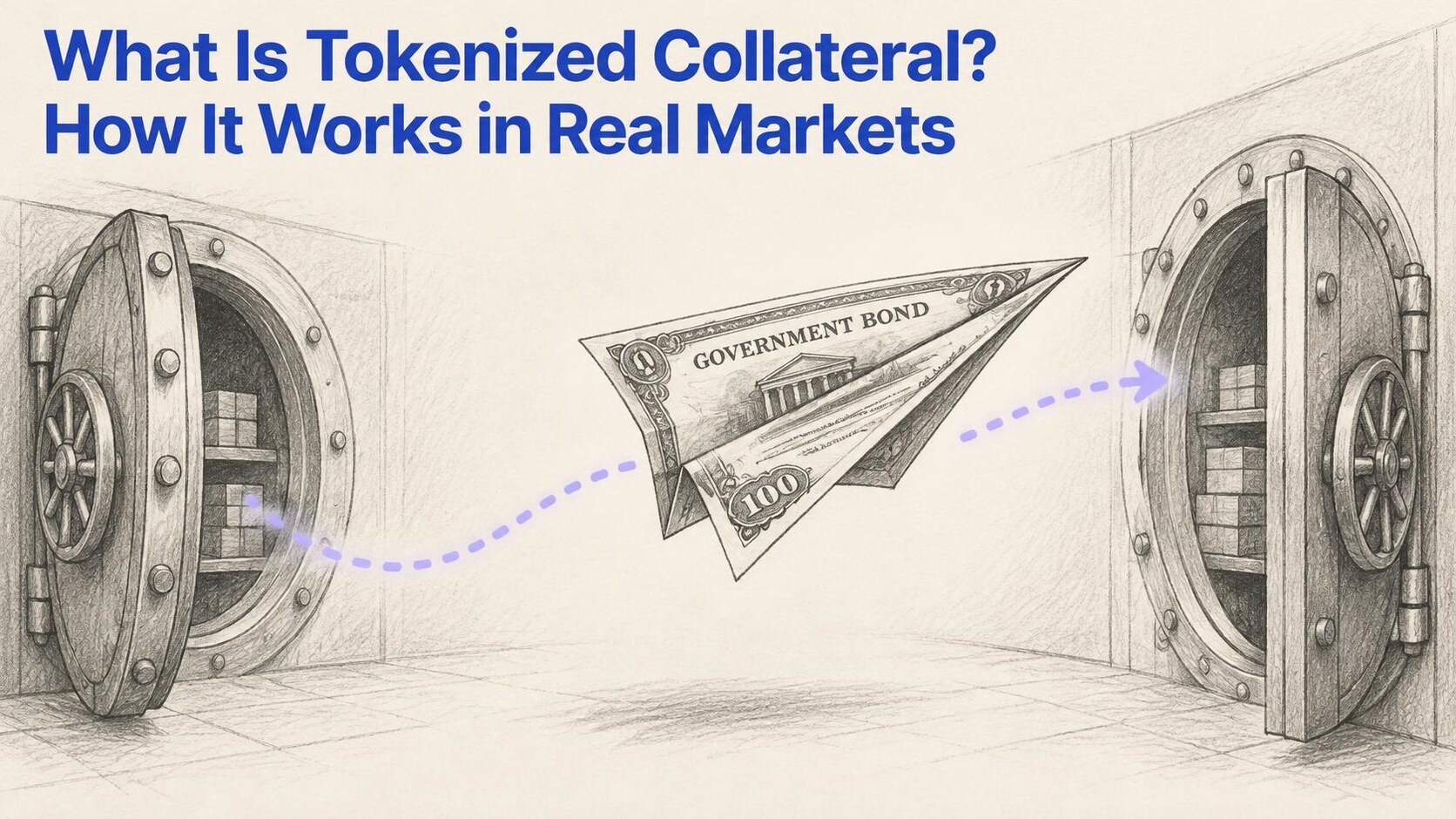
Tokenized collateral is an asset that already backs loans and trades, such as Treasuries, money market fund shares or cash, recorded as a token on a blockchain so it can be pledged and moved in minutes, 24/7. The point is collateral mobility, not new assets. US derivatives regulators began allowing tokenized Treasuries and payment stablecoins as margin in December 2025, and banks now run tokenized repo and collateral networks in production.
Tokenized collateral: definition and positioning
Collateral is what one party pledges to another to secure an obligation: margin for a futures position, securities for a repo loan, assets backing a credit line. Today that collateral moves through custodians and settlement systems that close at night and on weekends, so firms hold extra buffers to cover gaps.
Tokenized collateral changes the plumbing, not the asset:
| Traditional collateral | Tokenized collateral | |
|---|---|---|
| What it is | Treasuries, MMF shares, cash, equities | The same assets, issued or represented as tokens |
| How it moves | Custodian and settlement system transfers | Onchain transfer between approved wallets |
| Operating hours | Business hours and settlement cycles | Continuous, including weekends |
| Settlement | Separate legs, often T+1 | Can be atomic: delivery versus payment in one step |
| Yield while pledged | Often lost when converted to cash | Tokenized funds keep earning while posted |
The distinction that matters, and the one the CFTC itself drew: tokenization does not make an asset eligible collateral. A tokenized Treasury is acceptable because a Treasury is acceptable. The token is a faster way to move it.
How tokenized collateral works
- Tokenize the asset. A fund manager issues tokenized money market fund shares, a bank issues tokenized deposits, or a custodian tokenizes Treasuries it holds.
- Post it as collateral. The holder transfers tokens to the secured party or a control account, often with smart contracts enforcing who can move them.
- Value and margin it. Oracles or the secured party price the collateral and apply haircuts, as with any margin.
- Substitute or release it. Collateral can be swapped intraday, for example replacing cash with a yielding token, without waiting for a settlement window.
- Liquidate on default. If the pledgor defaults, the secured party takes control of the tokens and redeems or sells them.
Tokenized collateral in practice
US derivatives markets. The CFTC launched a tokenized collateral and stablecoins initiative in September 2025. On December 8, 2025, staff issued guidance allowing tokenized versions of already-eligible margin, such as Treasuries and money market fund shares, plus a pilot letting futures commission merchants accept bitcoin, ether and payment stablecoins as customer margin. That relief was reissued in February 2026. Follow-up FAQs in March 2026 clarified that clearinghouses may accept payment stablecoins as initial margin if they meet minimal-risk standards, with haircuts reviewed at least monthly, but that crypto assets including stablecoins are not eligible margin for uncleared swaps.
Bank and repo networks. J.P. Morgan's Tokenized Collateral Network on Kinexys lets clients tokenize money market fund shares and post them as collateral. On the Canton Network, Broadridge's distributed ledger repo platform processes hundreds of billions of dollars in repo daily, and DTCC has been bringing tokenized Treasuries onto the same network. Nasdaq has supported tokenized collateral trades on Canton involving Vanguard and Wellington Management.
Crypto exchanges. Tokenized Treasury funds, led by BlackRock's BUIDL, are accepted as off-exchange collateral by several crypto trading venues, letting institutions earn Treasury yield on margin. Our tokenized Treasuries guide covers the funds themselves.
The framing I keep coming back to: the prize is not tokenization, it is idle collateral put back to work. Every hour a Treasury sits trapped in a settlement queue or a weekend is an hour a firm over-collateralizes to stay safe. Collateral that moves continuously shrinks those buffers.
Benefits of tokenized collateral
- 24/7 mobility. Meet margin calls on weekends and across time zones without pre-funding.
- Atomic settlement. Delivery versus payment removes the risk of one leg failing.
- Yield retention. Tokenized MMF shares keep earning while posted, unlike cash.
- Capital efficiency. Faster substitution means smaller buffers and less trapped liquidity.
- Automation. Smart contracts can enforce eligibility, haircuts and release conditions.
Trade-offs and limitations
Tokenized collateral is only as good as its legal wrapper. The key open issues:
- Enforceability. A token transfer must create a valid, perfected security interest under the governing law, or a secured party may not get the asset in insolvency.
- Settlement finality. Which event, onchain or off, legally completes the transfer must be clear.
- Interoperability. Collateral on one ledger cannot easily move to another, recreating the silos it was meant to remove.
- Concentration and stablecoin risk. Industry proposals have included caps on tokenized collateral as a share of margin, and stablecoin collateral needs a plan for a depeg.
- Operational and cyber risk. Key management and smart contract bugs become collateral risks.
FAQs
What is tokenized collateral?
Tokenized collateral is a financial asset, such as a Treasury bill, money market fund share or cash deposit, that is represented as a token on a blockchain and used to secure a loan, trade or margin requirement. Tokenization lets it be pledged, substituted and released in minutes at any hour instead of through slower settlement systems.
Can stablecoins be used as collateral?
Yes, in growing contexts. Under CFTC staff relief, US futures commission merchants can accept payment stablecoins as customer margin, and clearinghouses may accept them as initial margin if they meet risk standards. Crypto exchanges and DeFi lending protocols have long accepted stablecoins as collateral. They are not eligible margin for uncleared swaps.
What assets can be tokenized as collateral?
The most common are assets already accepted as collateral: US Treasuries, money market fund shares, cash in the form of tokenized deposits or stablecoins, and high-grade bonds. US regulators have encouraged firms to focus on tokenized versions of assets that already qualify as margin rather than new asset types.
What are the risks of tokenized collateral?
The main risks are legal enforceability of the pledge, unclear settlement finality, lack of interoperability between blockchains, smart contract and key management failures, and, for stablecoin collateral, the risk of a depeg. Concentration limits and haircuts are used to manage exposure while frameworks mature.
How is tokenized collateral different from tokenized Treasuries?
Tokenized Treasuries are a product: tokens representing government debt or funds holding it. Tokenized collateral is a use: pledging tokenized assets, including tokenized Treasuries, to secure obligations. A tokenized Treasury becomes tokenized collateral when it is posted as margin or used in a repo.
The takeaway
Tokenized collateral is where tokenization meets the core plumbing of finance: the same safe assets, moving at software speed instead of settlement speed. The open question is legal rather than technical, whether courts and regulators across jurisdictions treat an onchain transfer as a final, enforceable pledge, which will decide how much of the collateral market moves onchain.