What Is Canton Network? Institutional Blockchain Explained
Last updated: October 12, 2026
TL;DR
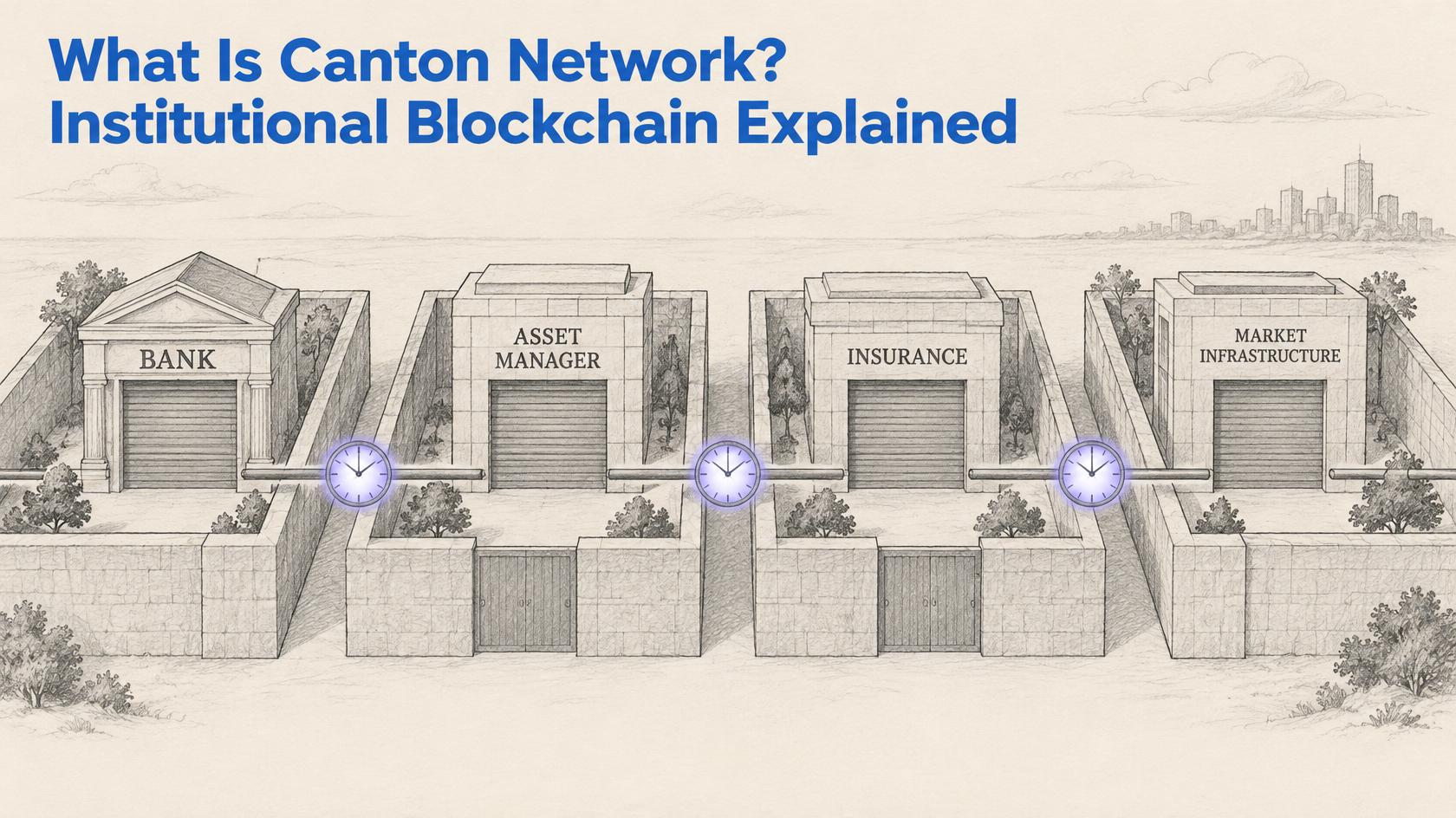
Canton Network is a blockchain built for regulated financial institutions. Each party sees only the transactions it is involved in, while a shared Global Synchronizer lets separate applications settle atomically with one another. It was developed by Digital Asset, launched its public synchronizer and Canton Coin (CC) in July 2024, and hosts some of the largest live tokenization deployments, including Broadridge's repo platform and DTCC's tokenized Treasuries.
Canton Network: definition and positioning
Canton is best understood as the institutional answer to a problem public blockchains created: banks want shared settlement, but they cannot broadcast every trade, position and counterparty to the world.
| Canton Network | Ethereum | Private permissioned ledger | |
|---|---|---|---|
| Who sees a transaction | Only the parties to it | Everyone | Members of that ledger |
| Can separate applications settle together | Yes, through the Global Synchronizer | Yes, on one shared state | No, each ledger is an island |
| Smart contract language | Daml | Solidity and others | Varies |
| Native token | Canton Coin (CC) | ETH | Usually none |
| Typical users | Banks, market infrastructure, asset managers | Anyone | A single consortium |
The distinction that matters: older permissioned ledgers solved privacy by building walled gardens, which then could not talk to each other. Canton's pitch is privacy and interoperability at the same time. Whether it fully delivers the second is the main debate around it.
How Canton Network works
Canton separates three things that a public blockchain bundles together.
- Applications and their own ledgers. Each institution or application runs its own node and stores only the contracts it is party to. A bank's repo positions never sit on a node belonging to a competitor.
- Daml smart contracts. Contracts are written in Daml, a language that defines up front who can see and act on each contract. Privacy is enforced at the sub-transaction level, not added afterward.
- The Global Synchronizer. When a transaction touches several applications, such as a tokenized Treasury moving against tokenized cash, the Global Synchronizer orders and confirms it so every leg settles at once or not at all. It is operated by a group of Super Validators and governed by the Canton Foundation.
Canton Coin (CC) pays for use of the Global Synchronizer. Its model is a burn-mint equilibrium: fees paid in CC are burned, and new CC is minted as rewards to validators and to applications that generate network activity. Canton promotes CC as a fair launch with no pre-mine or pre-sale, so tokens enter circulation by being earned through participation.
Canton Network in practice
Canton's case rests on production volume, and the numbers are large.
| Deployment | What it does | Reported scale |
|---|---|---|
| Broadridge Distributed Ledger Repo (DLR) | Tokenized intraday and same-day repo between institutions | An average of $365 billion in daily repo in January 2026 (Cantor8) |
| DTCC tokenized Treasuries | Minting a subset of DTC-custodied US Treasuries on Canton | MVP targeted for the first half of 2026; limited production trades from July 2026, broader launch planned for October 2026 |
| JPMorgan Kinexys | Bringing the JPM Coin deposit token natively to Canton | Announced January 2026 |
| Goldman Sachs GS DAP and other platforms | Tokenized asset issuance and settlement | Connected to the same synchronizer |
Sources: Ledger Insights, Cantor8, Genfinity.
The DTCC decision was the inflection point. DTCC also became co-chair of the Canton Foundation alongside Euroclear, two of the most systemically important names in post-trade infrastructure. The governance roster now includes more than 50 Super Validators, among them Visa.
The framing I keep coming back to: Canton is winning the workflows where the counterparties already know each other. Repo, collateral movement and Treasury settlement happen between a few hundred regulated firms that need confidentiality more than openness. Those are exactly the flows where public chains have struggled to win institutional business.
Stablecoins are joining the same rails. A tokenized Treasury is only useful if there is cash to settle against, which is why deposit tokens and stablecoins on Canton matter as much as the assets themselves. Our guide to tokenized deposits covers the bank-issued side.
Trade-offs and limitations
- Openness is contested. Canton describes itself as a public, permissionless network, but critics in the crypto community argue that institution-run validators and private data make it closer to a consortium chain. DL News reported that many had hoped DTCC would choose a public chain such as Ethereum instead.
- Composability with crypto is limited. Assets on Canton do not interact natively with Ethereum or Solana DeFi; bridges and connectors are still developing.
- Volume is concentrated. A large share of reported activity comes from one application, Broadridge's repo platform.
- Scale is still small relative to the market. Canton's reported daily activity is meaningful but modest next to the total US repo market, as Cantor8 notes.
- Canton Coin carries market risk. CC trades like any crypto asset. CryptoSlate listed it at about $0.13 with a market value near $5 billion in mid-October 2026, well below earlier levels.
FAQs
What is Canton Network used for?
Canton Network is used by banks and financial market infrastructure to tokenize and settle assets privately. Its largest live uses are Broadridge's tokenized repo platform, DTCC's tokenized US Treasuries and tokenized cash such as JPMorgan's deposit token. Each party sees only its own transactions, while settlement across applications happens atomically.
Is Canton Network a public blockchain?
Canton describes itself as a public, permissionless blockchain: anyone can build on it, and its Global Synchronizer is run by an independent set of Super Validators under the Canton Foundation. Critics argue its privacy model and institution-heavy validator set make it closer to a consortium network than a fully open chain like Ethereum.
What is Canton Coin (CC)?
Canton Coin (CC) is the native utility token of Canton Network. It pays fees on the Global Synchronizer, and those fees are burned. New CC is minted as rewards to validators and to applications that generate network activity. It launched in July 2024 with no pre-mine or pre-sale.
Does Canton Network use Ethereum?
No. Canton is a separate network with its own architecture and its own smart contract language, Daml. It does not run on Ethereum or settle to it. Connections to Ethereum and other public chains depend on bridges and integration projects, which remain limited compared with native activity on Canton.
Who is behind Canton Network?
Canton Network was developed by Digital Asset, the company co-founded by CEO Yuval Rooz. The network's Global Synchronizer is governed by the Canton Foundation, with DTCC and Euroclear as co-chairs, and is operated by more than 50 Super Validators, including major financial firms and Visa.
Is Canton Coin a good investment?
That depends on your risk tolerance; this is not investment advice. CC's value is tied to network usage through its burn-mint model, which links it to institutional adoption. It is also a volatile crypto asset, and most of Canton's real activity, such as repo and Treasury settlement, does not require holding large amounts of CC.
The takeaway
Canton Network has become the leading blockchain for regulated institutions by putting confidentiality first and connecting private ledgers through a shared synchronizer, and DTCC's choice turned that positioning into market structure. The open question is whether Canton stays the default for institutional flows, or whether public chains close the privacy gap and pull those flows into open ecosystems. If you are building settlement or cash infrastructure that needs to reach Canton, reach out.