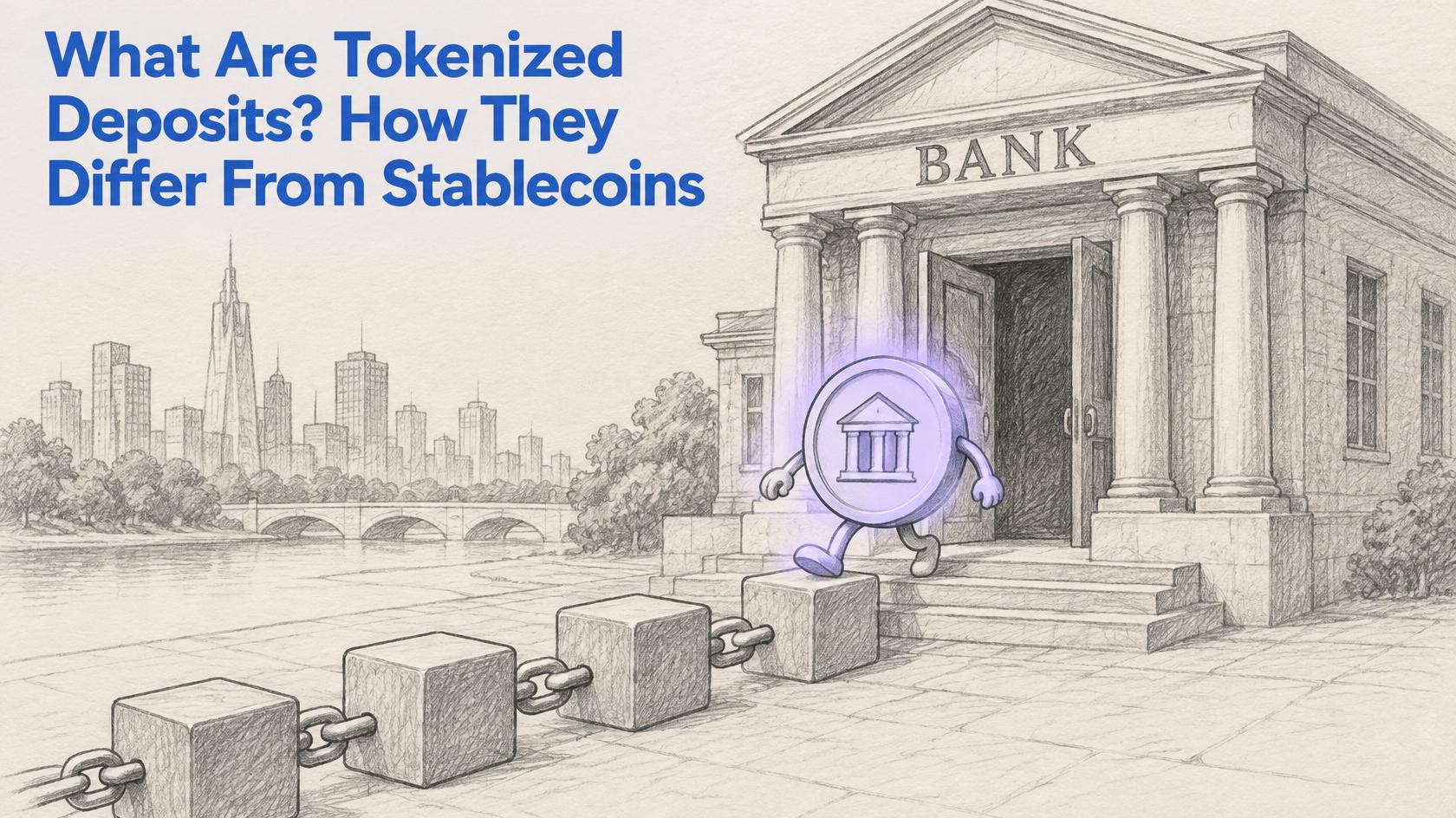
What Are Tokenized Deposits? How They Differ From Stablecoins
Last updated: October 9, 2026
TL;DR
A tokenized deposit is a commercial bank deposit recorded as a token on a blockchain. It is still a claim on the issuing bank, carries the same credit risk and regulatory treatment as an ordinary deposit, and can settle 24/7 between the bank's clients. Unlike a stablecoin, it sits on the bank's balance sheet and stays inside the banking system. JPMorgan, Citi, HSBC and BNY run live services.
Tokenized deposits: definition and positioning
Tokenized deposits are the banking industry's answer to stablecoins. Both put dollars on a blockchain. They are built on opposite balance sheets.
| Tokenized deposit | Payment stablecoin | |
|---|---|---|
| Issuer | A licensed bank | A stablecoin issuer (bank subsidiary or non-bank) |
| What you hold | A deposit claim on that bank | A claim on a segregated reserve pool |
| Backing | The bank's balance sheet, fractional reserve | 1:1 reserves in cash and short-term Treasuries |
| Deposit insurance | Remains a deposit, so standard deposit insurance rules apply | Not deposit-insured |
| Interest | Can pay interest like any deposit | GENIUS Act bars issuers from paying interest |
| Who can hold it | Usually the issuing bank's vetted clients | Anyone with a compatible wallet, subject to screening |
| US framework | Existing banking law | GENIUS Act |
The distinction matters because money that stays a deposit can still be lent out. That is the banking industry's core argument for tokenized deposits over stablecoins, and the reason banks fought the stablecoin rewards provisions in the CLARITY Act so hard: a dollar that leaves for a stablecoin no longer funds a loan.
How tokenized deposits work
The mechanics are simple once you see where the ledger sits.
- A client funds the account. Dollars arrive by wire or internal transfer, as they would for any deposit.
- The bank issues tokens. The bank mints deposit tokens equal to the balance and records them on a blockchain, either a permissioned ledger it controls or a public chain with access restrictions.
- Tokens move on-chain. Clients transfer tokens to each other around the clock. Smart contracts can attach conditions: release on delivery, sweep at a set time, pay out when a milestone is met.
- The bank redeems. When a client wants ordinary money back, the bank burns the tokens and credits the conventional account at par.
Two design choices separate the products on the market:
- Ledger. JPMorgan's Kinexys platform began on a private blockchain; its JPMD deposit token runs on Base, Coinbase's public Ethereum layer 2. Citi Token Services uses a permissioned chain.
- Reach. Most live products are intrabank: a JPMorgan token moves between JPMorgan clients. Interbank networks, where one bank's token settles against another's, are the next phase.
Tokenized deposits in practice
The live products are wholesale and institutional, and the volumes are already material.
| Bank or network | Product | Status |
|---|---|---|
| JPMorgan | Kinexys and JPMD deposit token | Kinexys averages more than $7 billion a day; JPMD generally available on Base since November 2025 |
| Citi | Citi Token Services for Cash | Live for institutional clients since 2024 in the US, UK, Singapore and Hong Kong; Japan targeted for as early as end of 2026 |
| BNY | Tokenized deposit service for institutions | Launched January 2026 |
| The Clearing House network (JPMorgan, Citi, Bank of America, Wells Fargo and others) | Shared interbank tokenized deposit network | Targeting first half of 2027 |
| Cari Network (regional banks including Huntington, KeyCorp and M&T) | Retail-facing tokenized deposits | Pilot in Q3 2026, customer launch targeted for Q4 2026 |
Sources: Forbes, CoinDesk, Unchained, Yahoo Finance on Citi Japan.
Scale is the honest caveat. Citi moves roughly $6 trillion a day; tokenized deposits account for about $1 billion of that, according to reporting on its Japan expansion. The technology works. Adoption is still a rounding error inside the banks that run it.
The use cases cluster around corporate treasury:
- Cross-border cash management. Moving funds between a multinational's entities in different countries outside correspondent banking hours.
- Intraday liquidity. Sweeping balances in minutes instead of waiting for batch settlement.
- Atomic settlement. Delivering cash and a tokenized asset, such as a Treasury or money market fund share, in the same transaction.
- Programmable payouts. Conditional releases for escrow, trade finance and milestone payments.
Regulators are carving out a distinct category. Japan's amended Payment Services Act separates tokenized deposits from stablecoins, which is part of why Citi chose it as its next market.
Tokenized deposits vs stablecoins: which wins?
The framing I keep coming back to: tokenized deposits win inside the bank, stablecoins win between strangers.
A treasurer moving cash between subsidiaries that all bank with JPMorgan has no reason to touch a stablecoin. The deposit token is insured, interest-bearing and already on the balance sheet. But the moment a payment crosses to a counterparty at another bank, or to a wallet outside the banking system, a walled-garden token stops working and a stablecoin that moves on any public chain does not.
That is why The Clearing House network matters more than any single bank's product. If US banks can make their tokens interoperate, they close the gap where stablecoins currently have no competitor. If they cannot, stablecoins keep the open-network use cases by default.
Trade-offs and limitations
- Walled gardens. Most tokens only move between one bank's clients, which limits network effects.
- Credit risk on the bank. A deposit token is only as good as the bank. Balances above insurance limits carry the same exposure they always have.
- Interoperability is unsolved. Shared networks are still in build, and tokens from different banks do not yet settle against each other at scale.
- Access. Live products serve vetted institutional clients. Retail tokenized deposits are only now entering pilots.
- Fragmentation across ledgers. Banks have chosen different chains, private and public, so a common standard has not emerged.
FAQs
What is the difference between tokenized deposits and stablecoins?
A tokenized deposit is a bank deposit recorded on a blockchain: a claim on the issuing bank that stays on its balance sheet and can pay interest. A stablecoin is a token backed one-to-one by segregated reserves, held off any bank's lending book, and, under the GENIUS Act, issuers may not pay interest on it.
Are tokenized deposits FDIC insured?
Tokenized deposits remain deposits under the law, so the standard rules for deposit insurance apply to them up to the usual limits, as they would for the same balance in an ordinary account. Payment stablecoins are not deposits and are not deposit-insured. Confirm the specific product's terms with the issuing bank.
Which banks offer tokenized deposits?
JPMorgan offers Kinexys and its JPMD deposit token on Base. Citi runs Citi Token Services for Cash for institutional clients. BNY launched a tokenized deposit service in January 2026, and HSBC markets tokenized deposits for treasury. A shared US bank network through The Clearing House targets the first half of 2027.
Are tokenized deposits crypto?
They use blockchain technology, but they are not cryptocurrency in the speculative sense. A tokenized deposit is a dollar claim on a regulated bank, redeemable at par, with no price that floats. It is closer to a digital bank balance than to bitcoin or a trading token.
How do tokenized deposits work?
A client deposits money with a bank, the bank issues tokens equal to the balance on a blockchain, and clients transfer those tokens between each other at any hour. Smart contracts can add conditions to transfers. When a client wants ordinary money back, the bank burns the tokens and credits a conventional account.
What are the main use cases for tokenized deposits?
The main uses are corporate treasury: moving cash between a company's entities across borders outside banking hours, managing intraday liquidity, settling cash against tokenized assets in one transaction, and programmable payments for escrow and trade finance. Retail uses are only now entering pilots.
The takeaway
Tokenized deposits give banks a blockchain-native product that keeps money on their balance sheets, and the wholesale volumes are real even if they remain small relative to total flows. Their limit is reach: they work inside one bank far better than between banks.
The open question is whether The Clearing House network delivers true interbank settlement in 2027, or whether stablecoins entrench across the open-network use cases first. For the yield side of the bank versus stablecoin debate, see how stablecoin yield works. If you are building treasury infrastructure that needs to settle across both, reach out.