What Is CCTP? Circle's Cross-Chain Transfer Protocol Explained
Last updated: October 9, 2026
TL;DR
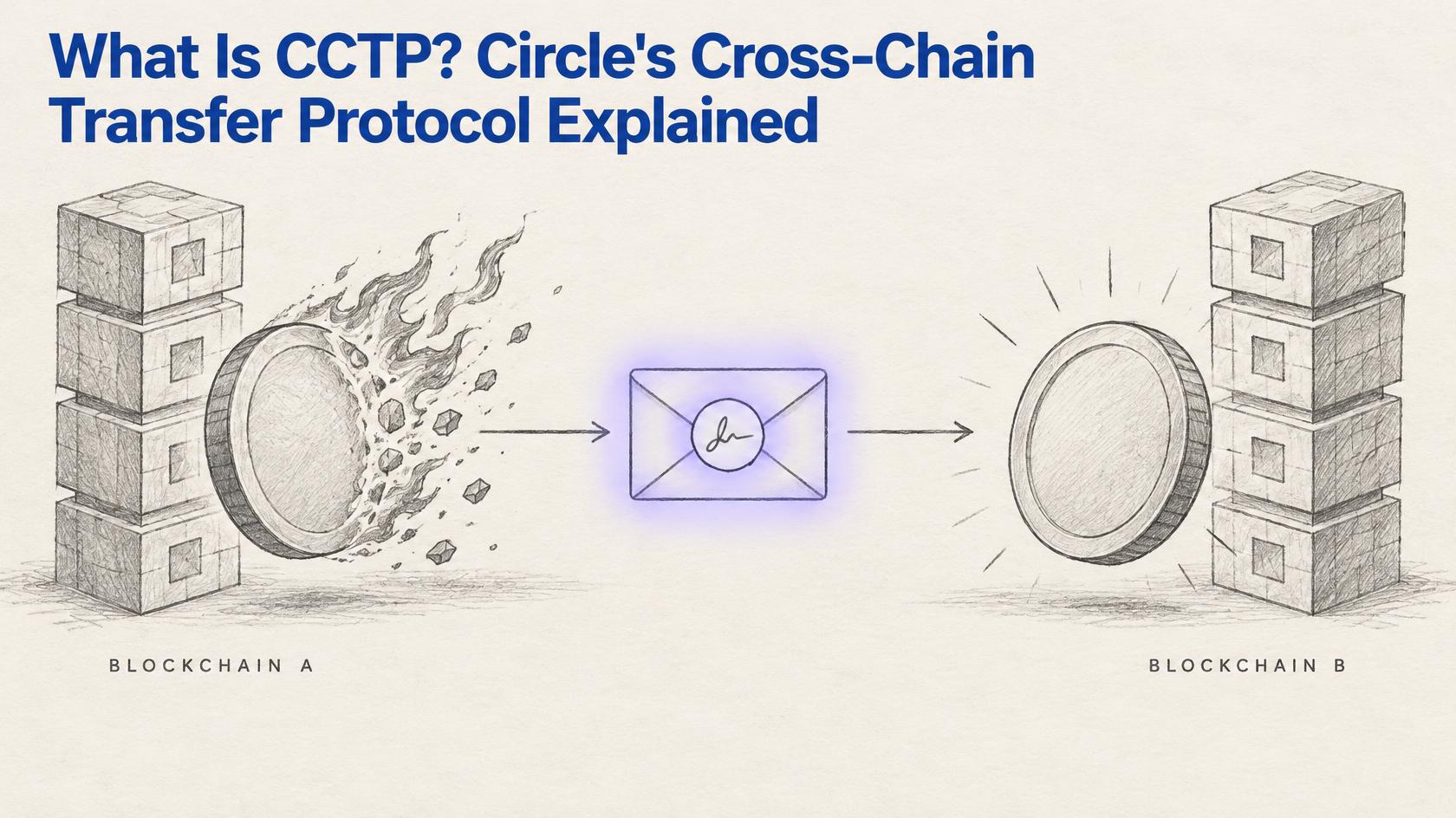
CCTP (Cross-Chain Transfer Protocol) is Circle's permissionless protocol for moving native USDC between blockchains. It burns USDC on the source chain, Circle signs an attestation, and the same amount is minted on the destination chain. No wrapped tokens and no liquidity pools are involved. CCTP V2 adds Fast Transfer, which settles in roughly 8 to 20 seconds for a small fee.
Not to be confused with the Certified Clinical Trauma Professional (CCTP) credential, which shares the acronym. This guide covers Circle's crypto protocol.
CCTP: definition and positioning
CCTP is canonical bridging for one issuer's tokens. Circle issues USDC natively on dozens of chains, and CCTP is the official route between them. It supports USDC, EURC and, according to Circle's developer documentation, registered third-party tokens.
The distinction from a generic bridge is the whole point:
| CCTP | Lock-and-mint bridge | Liquidity network bridge | |
|---|---|---|---|
| What arrives on the destination | Native USDC, minted by Circle's contracts | A wrapped IOU token | Native tokens from a relayer's inventory |
| Liquidity required | None; supply is burned and re-minted | Locked collateral in the bridge | Pools or relayer capital |
| Who you trust | Circle's attestation service | Bridge validators or a multisig | Relayers and the protocol's settlement logic |
| Typical cost | Gas only (Standard), small fee (Fast) | Often a percentage of the transfer | Usually a basis-point spread |
Locked collateral backing wrapped tokens has been the target of several of crypto's largest bridge exploits, because one pool of funds makes a single honeypot. CCTP removes that pile. The trade-off is that you rely on Circle, but if you hold USDC you already rely on Circle.
How CCTP works
A CCTP transfer has four steps:
- Burn. The user or app calls the CCTP contract on the source chain, which burns the USDC and emits a message naming the destination chain and recipient.
- Attest. Circle's attestation service observes the burn and signs a message confirming it.
- Relay. Anyone holding the message and attestation can submit them to the destination chain. Most apps do this automatically.
- Mint. The destination contract verifies Circle's signature and mints the same amount of native USDC to the recipient.
Total USDC supply never changes during the process. It simply moves.
Standard Transfer vs Fast Transfer. The speed difference is about when Circle attests:
| Standard Transfer | Fast Transfer (V2) | |
|---|---|---|
| When Circle attests | After the source chain reaches hard finality | Immediately, before finality |
| Time from Ethereum | About 13 to 19 minutes | About 8 to 20 seconds |
| Circle fee | None, gas only | Small per-transfer fee in USDC |
| Who absorbs reorg risk | Nobody; finality has already happened | Circle, backed by a fee buffer |
Sources: Circle V2 launch announcement, Circle migration guide.
V2 also introduced Hooks: instructions attached to a transfer that run on arrival, such as swapping the USDC or depositing it into a lending market. That turns a bridge into a single cross-chain transaction.
CCTP in practice
The adoption numbers show why CCTP became the default USDC rail. According to Circle's 2026 product vision, USDC was natively available on 30 blockchains as of December 2025, CCTP connected 19 of them, and the protocol had processed $126 billion in cumulative volume. V1 alone handled more than $36 billion between its April 2023 launch and the V2 release in March 2025.
Coverage has kept widening. Eco, summarizing Circle's supported chains page, counted 27 mainnet chains on CCTP V2 as of August 17, 2026, with Fast Transfer available as a source on chains including Ethereum, Arbitrum, Base, Solana, Linea and Unichain.
Who uses it:
- Bridges and aggregators such as LI.FI, Wormhole, Mayan and Socket route USDC through CCTP rather than holding their own wrapped supply.
- Exchanges and wallets use it to rebalance USDC between chains without keeping idle float on each one.
- Payment and treasury teams use it to move settlement balances to whichever chain a counterparty uses.
- End users can use Circle's own USDC Bridge, launched in April 2026 for EVM chains, which runs on CCTP V2.
The framing I keep coming back to: CCTP turns chain choice into a routing decision instead of a liquidity decision. A business no longer needs to pre-fund USDC on every chain it supports. It needs one balance and a CCTP integration.
Deadline: CCTP V1 deprecation
Builders still on CCTP V1 have weeks, not months. Circle's documentation states that V1 (Legacy) deprecation begins October 31, 2026 and completes December 1, 2026. V2 contracts are not drop-in replacements: they use new addresses, new API endpoints and a finalityThreshold parameter to choose Fast or Standard speed. Any integration that has not migrated will stop working once deprecation completes.
Trade-offs and limitations
CCTP removes bridge liquidity risk but concentrates trust in Circle in three ways:
- Attestation dependency. If Circle's attestation service is down, transfers wait. It is a single operator, not a decentralized validator set.
- Censorship capability. Circle can decline to attest, and USDC itself is freezable at the contract level. For regulated businesses this is a feature; for censorship-resistant applications it is a constraint.
- Fast Transfer is a credit decision. Pre-finality attestation means Circle is underwriting the risk of a source-chain reorg, and the fee prices that.
It also only moves Circle-supported tokens. USDT, for example, needs a different route. And chain coverage, while broad, is not universal; check Circle's supported chains page before assuming a route exists.
FAQs
What does CCTP stand for in crypto?
CCTP stands for Cross-Chain Transfer Protocol. It is Circle's protocol for moving native USDC, and certain other tokens, between blockchains by burning tokens on one chain and minting the same amount on another. Outside crypto, CCTP also abbreviates the Certified Clinical Trauma Professional credential.
How does CCTP work?
CCTP burns USDC on the source chain, Circle's attestation service signs a message confirming the burn, and that signed message is submitted to the destination chain, which mints the same amount of native USDC. Supply stays constant, and no wrapped token or liquidity pool is involved at any point.
Are there fees for using CCTP?
Standard Transfer charges no Circle fee; you pay only network gas on each chain. Fast Transfer, introduced with CCTP V2, adds a small per-transfer fee charged in USDC at the time of the burn, in exchange for settlement in roughly 8 to 20 seconds instead of waiting for source-chain finality.
Is CCTP secure?
CCTP avoids the main weakness of lock-and-mint bridges, a large pool of locked collateral, because USDC is burned rather than held. Its security instead rests on Circle's smart contracts and attestation service. Users accept Circle as a trusted party, which is the same trust they already extend by holding USDC.
Does CCTP require signing up with Circle?
No. CCTP is permissionless: anyone can call the contracts directly, and anyone holding a burn message and its attestation can complete a transfer. Most people use CCTP through a wallet, bridge or exchange that has integrated it, or through Circle's USDC Bridge app for EVM chains.
Is Circle CCTP different from the USDC Bridge?
Yes. CCTP is the underlying protocol: smart contracts plus Circle's attestation service. The USDC Bridge is a Circle-operated app, launched in April 2026, that gives users a front end for moving USDC across EVM chains. The bridge runs on CCTP V2, as do many third-party apps.
The takeaway
CCTP made native USDC portable across chains without the liquidity pools and wrapped tokens that made bridges dangerous, at the cost of trusting Circle's attestation. For anyone building on it, the immediate priority is the V1 deprecation that completes on December 1, 2026.
The open question is whether other issuers follow with their own canonical burn-and-mint rails, or whether CCTP's support for third-party tokens makes Circle the interoperability layer for issuers beyond itself. If you are building a multi-chain stablecoin payments product, reach out.