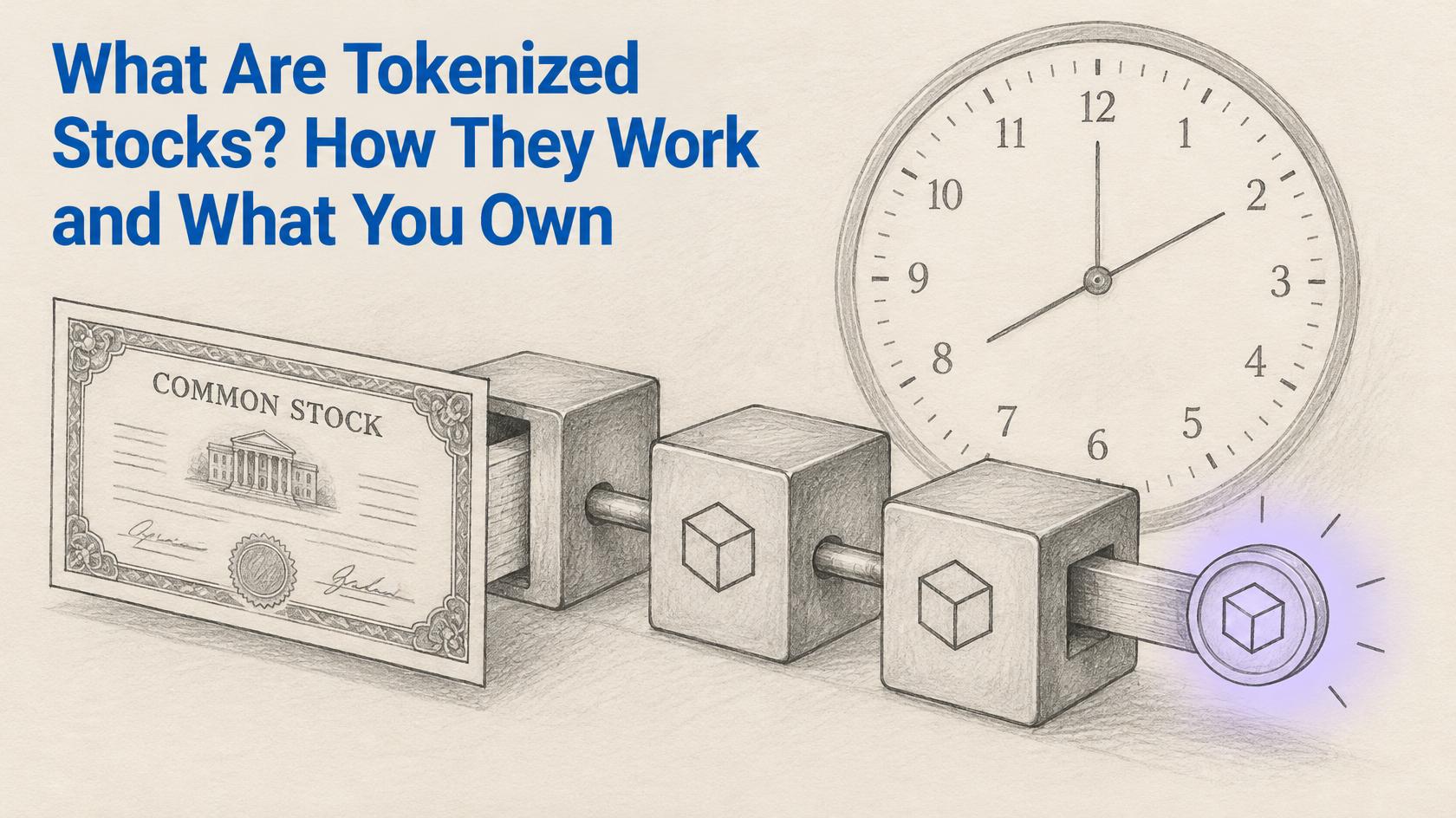
What Are Tokenized Stocks? How They Work and What You Own
Last updated: October 9, 2026
TL;DR
Tokenized stocks are blockchain tokens that either are, or track, shares of a public company. Some are the actual share recorded on-chain with full shareholder rights. Others are third-party wrappers that give price exposure but no ownership or voting rights. The difference decides what you own. Tokenized stocks passed $3 billion in on-chain value in September 2026, and the SEC opened a five-year path for US trading that month.
Tokenized stocks: definition and positioning
"Tokenized stock" covers two products that look identical in a wallet and are legally very different. The SEC's January 2026 staff statement drew the same line: issuer-sponsored versus third-party-sponsored tokenized securities.
| Issuer-backed or market-infrastructure tokens | Third-party wrapper tokens | |
|---|---|---|
| What you own | The share itself, recorded in token form | A claim on the wrapper's issuer, which holds the share |
| Shareholder rights | Same rights as the conventional share | Usually none: no vote, dividends passed through as an equivalent payment |
| Who stands between you and the company | The normal broker and depository chain | The token issuer, plus its custodian |
| Main risk | Market risk | Market risk plus the issuer's credit and operational risk |
| Examples | Nasdaq and DTC pilot, issuer-sponsored tokens | xStocks, Robinhood Stock Tokens in the EU, Crypto.com's EEA product |
The framing line for anyone buying: a token that tracks Apple is not the same as owning Apple. Check which column you are in before you check the price.
How tokenized stocks work
The two models move through different plumbing.
Market-infrastructure model. The SEC approved a Nasdaq rule change on March 18, 2026 allowing tokenized versions of Russell 1000 stocks and index ETFs to trade on its existing order book. As Ledger Insights explains, the trade still clears and settles conventionally on T+1 through DTC; tokenization happens as a post-trade step. The token is a new record of ownership, not a new market.
Wrapper model. A company buys real shares, holds them with a custodian, and mints tokens one-for-one against them. Holders get price exposure and can move the token on public blockchains, often trading 24/7 against stablecoins. Backed Finance's xStocks used this model and tokenized around 200 companies shortly after its mid-2025 launch.
The innovation exemption model. On September 17, 2026, the SEC granted a five-year Innovation Exemption allowing Tokenized Securities Venues to trade tokenized National Market System stocks using permissioned automated market makers and liquidity pools. It is the first US path for on-chain trading venues rather than tokenized records on old ones. The OKX and ICE joint venture, OKXICE, has filed to trade 63 tokenized US stocks on X Layer under it.
Every model needs a cash leg. Round-the-clock stock trading only works with round-the-clock money, which is why most on-chain stock trades settle against stablecoins or, increasingly, tokenized deposits.
Tokenized stocks in practice
Growth has come in two waves: offshore wrappers in 2025, then US market infrastructure in 2026.
| Milestone | Detail |
|---|---|
| June 2025 | Robinhood launched tokenized US stocks for EU customers; xStocks launched on Solana |
| End of 2025 | Tokenized stock market value reached roughly $1.2 billion, up from under $30 million at the start of the year (Forbes) |
| December 2025 | SEC no-action letter allowed DTC to pilot tokenization of securities entitlements |
| March 18, 2026 | SEC approved Nasdaq's tokenized trading rule for Russell 1000 stocks and index ETFs |
| September 17, 2026 | SEC Innovation Exemption for Tokenized Securities Venues |
| September 2026 | On-chain tokenized stocks topped $3 billion (The Block) |
Sources: Forbes, Dechert, The Block.
Activity runs ahead of value: Forbes reports xStocks alone passed $25 billion in cumulative transaction volume during 2025. Tokenized stocks trade far more than they are held, which tells you current demand is mostly access and trading, not long-term ownership.
Distribution is the competitive frontier. Kraken partnered with Nasdaq to distribute tokenized stocks globally, ICE invested in OKX, and Crypto.com launched an EEA product covering around 1,500 underlyings. The question is no longer whether stocks can be tokenized but who owns the customer when they are.
Trade-offs and limitations
Tokenized stocks solve real problems, including 24/7 access, fractional ownership, access for investors outside the US, and faster settlement, and they introduce new ones:
- No ownership in the wrapper model. As CryptoTicker's review of Crypto.com's product notes, wrapper holders typically get no voting rights and rank as creditors of the issuer in an insolvency.
- Issuer and custodian risk. A wrapper is only as good as the entity holding the real shares.
- Off-hours pricing. When the primary market is closed, a token can trade at a spread to the last real price, with thin liquidity.
- Legal availability. Many wrapper products are not offered to US persons. The Innovation Exemption is new and venue-specific.
- Regulatory gaps abroad. Tokenized shares are financial instruments, so the EU's MiCA regulation does not cover them; they fall under securities law such as MiFID II instead.
Wall Street is not uniformly on board either. The World Federation of Exchanges urged regulators to keep exemptions narrow, arguing wrapper products lacked investor protections.
FAQs
What are tokenized stocks?
Tokenized stocks are blockchain tokens linked to shares of a public company. Some are the actual share recorded in token form with full shareholder rights. Others are third-party wrappers backed by shares held with a custodian, which give price exposure without ownership or voting rights. The model determines what the holder actually owns.
Are tokenized stocks legal in the US?
Yes, within specific channels. The SEC approved Nasdaq trading of tokenized Russell 1000 stocks and index ETFs in March 2026, and in September 2026 granted a five-year Innovation Exemption for Tokenized Securities Venues. Many offshore wrapper products, however, are not available to US investors.
Is it safe to buy tokenized stocks?
It depends on the model. Tokens that are the actual share carry ordinary market risk. Wrapper tokens add the credit and operational risk of the issuer and its custodian, usually without voting rights. Before buying, check who issues the token, where the underlying shares are held, and what happens if the issuer fails.
Do tokenized stocks pay dividends?
Tokens that represent the actual share carry the same dividend rights as the conventional share. Third-party wrappers usually pass through a dividend-equivalent payment or adjust the token balance instead, but this depends on the product's terms. Read the issuer's product documentation for the exact mechanism.
Where can you buy tokenized stocks?
Outside the US, crypto platforms including Kraken, Robinhood's EU offering and Crypto.com in the EEA sell tokenized stocks, typically as wrapper products. Inside the US, access runs through broker-dealers participating in the Nasdaq and DTC pilot, and venues operating under the SEC's Innovation Exemption as they launch.
Can tokenized stocks trade 24/7?
Wrapper tokens on public blockchains can trade around the clock, though liquidity thins and spreads widen when primary markets are closed. Tokenized stocks on Nasdaq trade during exchange hours and settle on T+1 like ordinary shares. Venues under the Innovation Exemption are designed to support continuous trading.
The takeaway
Tokenized stocks are moving from offshore wrappers toward regulated US market infrastructure, and the legal distinction between owning a share and owning a claim on a wrapper is the single most important thing a buyer can understand.
The open question is where liquidity settles: on incumbent exchanges that tokenize their existing order books, or on new on-chain venues trading against stablecoins around the clock. For the broader context, see our guide to tokenizing real-world assets. If you are building the cash leg for tokenized markets, reach out.