Tokenizing Real World Assets Explained: Process And Players
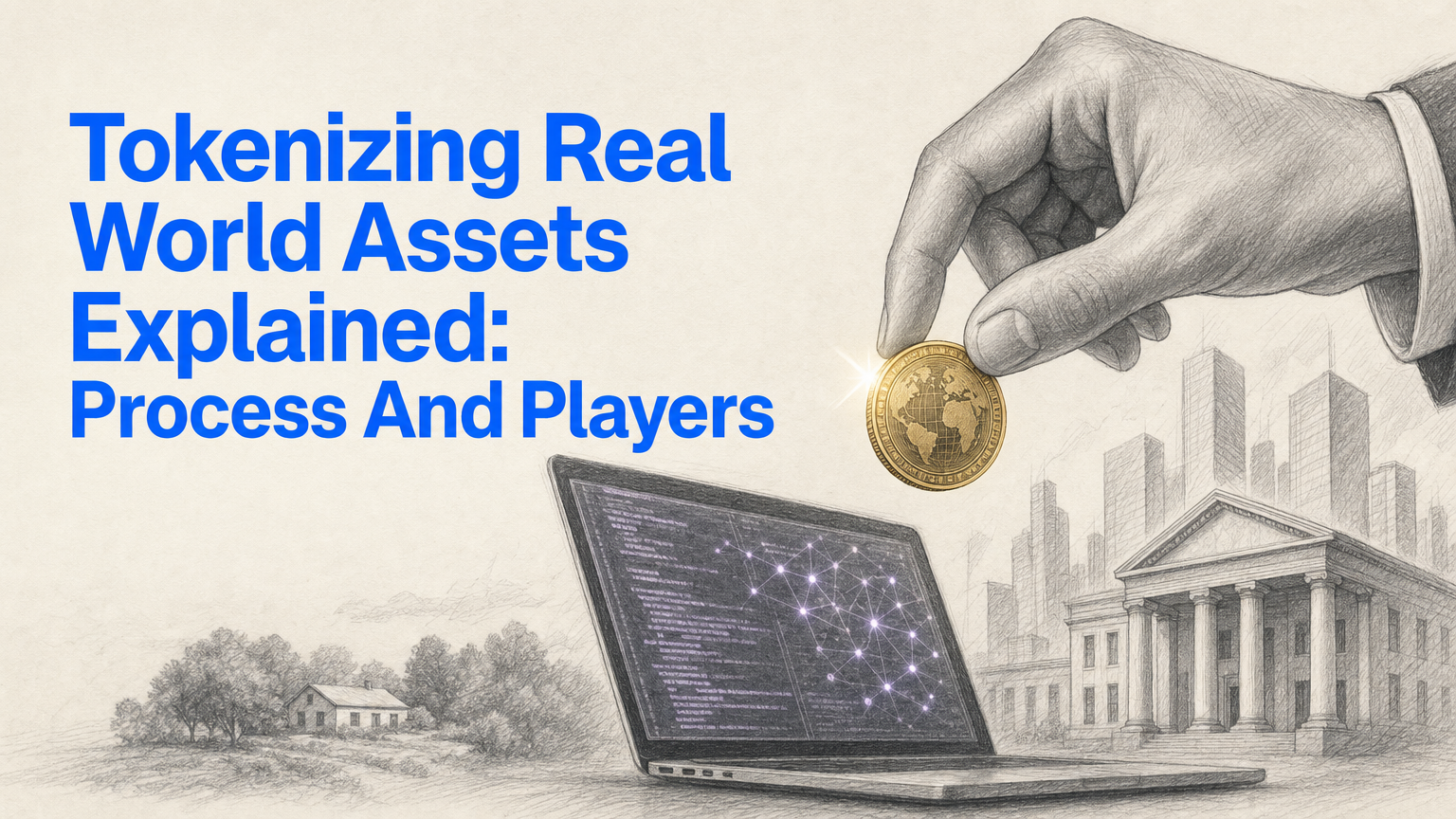
Tokenizing real world assets is the process of wrapping ownership rights in offchain assets, Treasury bills, gold, real estate, private credit, into transferable tokens governed by smart contracts. The thesis is simple: programmable ownership rails compress settlement, fractionalize access, and route yield without a broker in the middle. The execution is not. Stablecoin.nyc covers the mechanics, players, and structural risk of the RWA stack, and this brief unpacks the process end to end.
What Are Real World Assets (RWAs)?

An RWA is a token that represents a claim on an asset that lives outside the blockchain. The token is the record of ownership; the value lives in a vault, an SPV, or a custody account. This is the key mental model to hold, because it dictates every risk and every design choice downstream. For readers tracking the broader institutional shift toward tokenized collateral, the silent pivot to digital collateral in sovereign debt markets frames why this category matters beyond crypto-native use cases.
Tangible vs. Intangible Assets
RWAs split cleanly into two categories. Tangible assets include real estate, gold, commodities, art, and machinery. Intangible assets include government debt, corporate equity, private credit, and intellectual property. Per Ethereum Foundation documentation, both categories are actively being tokenized, though intangibles, particularly Treasuries and private credit, dominate current onchain volume. The primary market dynamics driving RWA tokenization show issuance concentrated where valuation is unambiguous and legal wrappers already exist.
How Token Value Is Tied to the Underlying Asset
RWA tokens have no intrinsic value. Their price tracks the offchain asset by construction. Paxos, for example, translates 400-ounce gold bars into 400 ERC-20 tokens on Ethereum, each redeemable for one troy ounce. Tether Gold pushes granularity further, subdividing tokens to 0.000001. This 1:1 backing model is what separates an RWA from a native crypto asset like ETH, whose value derives from network utility rather than a custodial arrangement. The great decoupling between Treasury-backed assets and crypto-native yield illustrates how this backing model has redefined yield expectations across the stack.
In plain English: an RWA token is a receipt. The receipt is programmable and globally transferable, but if the vault or the SPV holding the underlying asset fails, the receipt is worth what a court says it is.
How Tokenization Works: The Step-by-Step Process

Tokenization is not one action. It is a pipeline that bridges legal structuring, custody, and smart contract engineering. Each stage has different operators and different failure modes. Readers who want the market context around this pipeline can start with the fundamentals category on Stablecoin.nyc for a broader baseline.
Asset Origination and Legal Structuring
Issuers begin by selecting an asset with clear title, an established valuation method, and workable custody. They then create a Special Purpose Vehicle, typically incorporated in a jurisdiction with favorable treatment for digital securities, Delaware, Luxembourg, the Cayman Islands, Switzerland, and Singapore are common venues. The SPV holds the asset and issues tokens as fractional claims against the pool. This is the load-bearing legal wrapper: without it, the token is a technology artifact with no enforceable claim. The SEC's evolving custody rules for digital asset managers directly affect how these structures are built.
Smart Contract Deployment and Minting
Once the SPV is live, the issuer deploys a smart contract, most commonly an ERC-20 on Ethereum, with additional logic for compliance. Contracts typically encode transfer restrictions, allowlist gating for KYC-verified addresses, and controlled mint and burn functions. Tokens are minted only when the SPV confirms new assets are custodied. Distribution moves through direct sale, regulated DEXs, or brokerage integrations. As MetaMask's guide to tokenized real-world assets notes, the ERC-20 standard is dominant because it maximizes wallet, exchange, and DeFi protocol compatibility from day one.
Ongoing Administration and Yield Distribution
After issuance, someone still has to service the asset. For Treasuries, that means collecting coupon payments and passing yield through to token holders. For real estate, that means collecting rent, paying property expenses, and distributing net income. Distribution runs either through automated smart contract logic, common for cash-yielding assets like tokenized Treasuries, or through manual offchain workflows managed by the issuer. Design choice here dictates counterparty exposure. See the analysis category for coverage of how different protocol designs handle this trade-off.
Key Benefits of Tokenizing Real World Assets

The pitch for RWAs is not novelty. It is structural improvement across three dimensions: access, liquidity, and operational cost. Each dimension has real data behind it, though the gains are unevenly distributed across asset classes. For the macro backdrop shaping this shift, the psychology of the current bull cycle frames why institutional demand is arriving now rather than three cycles ago.
Fractional Ownership and Democratized Access
Fractional ownership is the most cited benefit and the easiest to verify. Private credit, commercial real estate, and pre-IPO equity have historically been gated by minimum check sizes that exclude most retail. Tokenization compresses those minimums. According to Ethereum Foundation documentation, RealT has returned over $15 million USD in net rental income to holders of tokenized real estate shares, and LABS Group allows entry into tokenized real estate from $100 USD. That is a two-to-three-order-of-magnitude reduction in the capital barrier for the asset class. The institutions category tracks how allocators are responding to this access shift.
Liquidity and Global Market Reach
Tokenized assets settle onchain, which enables 24/7 transferability and cross-border reach without corresponding banking rails. Traditional equities operate on fixed session windows and T+2 settlement; a tokenized equivalent settles atomically. The caveat is that technical possibility does not equal realized liquidity, more on that below, but the addressable investor pool expands materially. See Stablecoin.nyc's resources hub for practitioner references on liquidity infrastructure.
Operational Efficiency Through Programmability
Programmability compresses cost. Automated cap tables, allowlist enforcement, and coupon distribution remove intermediary layers, transfer agents, paying agents, some custodian functions, that traditional issuance requires. For a treasurer weighing tokenized cash management, the operational savings compound against a baseline where every settlement touches multiple back offices. Coverage of record monthly volumes in spot ETF markets provides useful comparison points for what happens when traditional wrappers face onchain equivalents.
Risks and Limitations to Understand
Every benefit has a corresponding failure mode. The honest reading of the RWA space is that tokenization moves risk around rather than eliminating it. Traders and treasurers should track where the risk now sits. The de-pegging paradox and shortening liquidity cycles offers a useful lens on how quickly RWA-adjacent liquidity can move.
Counterparty and Custodial Risk
The token is a claim; the claim depends on offchain custody. If the SPV becomes insolvent or the custodian is compromised, token holders enter a legal recovery process, not a direct asset-seizure workflow. This is the single largest structural difference from native crypto. Institutional buyers should stress-test custodian solvency and SPV bankruptcy remoteness before allocating. The macro category tracks conditions that stress custodial arrangements at scale.
Regulatory and Legal Uncertainty
Regulatory classification of RWA tokens varies materially across jurisdictions. Some regulators treat them as securities requiring registration and accredited-investor gating; others operate under bespoke digital-asset frameworks. The EU MiCA 2.0 phase and its implications for funds is the current reference point for how mature regimes are approaching this, while the Stablecoin Act's progress in Senate committee tracks the US side.
Smart Contract and Liquidity Risk
Smart contract vulnerabilities have no equivalent in traditional custody. An exploited transfer function can move ownership records irrecoverably in ways a paper-based custody workflow simply cannot replicate. Separately, secondary market liquidity for many tokenized assets remains thin. Exit prices may not reflect the underlying asset's fair value, particularly for niche real estate or private credit tokens. Valuation itself is subjective for illiquid underlyings, so mark-to-market discipline is harder than it looks. The liquidity trap analysis of stalling yields is worth reading in this context.
The RWA Ecosystem: Key Players and Their Roles
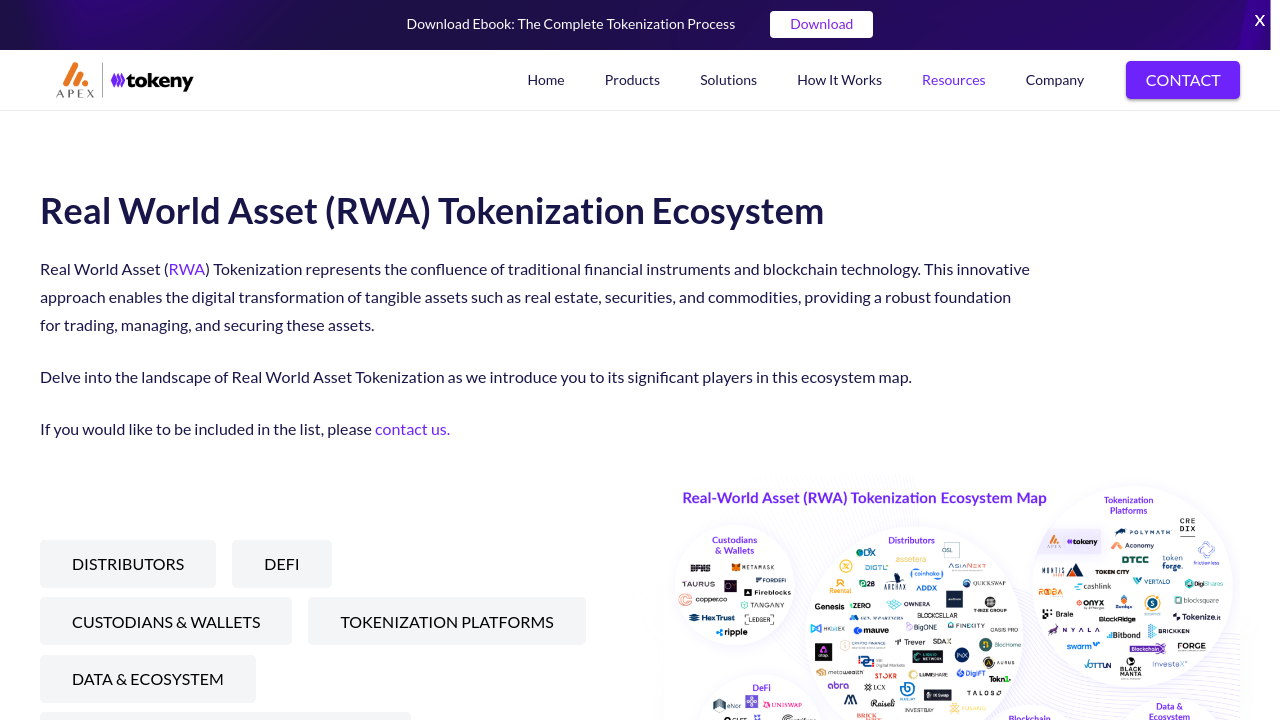
RWA tokenization is not a single-vendor business. It is a stack, and each layer has meaningful concentration risk. Mapping the players is the first step to understanding where value accrues. Stablecoin.nyc's partnerships page tracks the operators building at each of these layers.
Tokenization Platforms and Issuers
Platforms handle the SPV wiring, contract deployment, and lifecycle administration. Securitize is the anchor example: in 2024 it partnered with BlackRock to launch an RWA fund, and BlackRock CEO Larry Fink has publicly stated plans to eventually tokenize $10 trillion USD in assets. That target sets the ceiling of institutional intent. Goldman Sachs's expansion of its asset tokenization desk points in the same direction from a different corner of the market.
Distributors and Trading Venues
Distributors connect issuers to investors. ADDX, Archax, and tZERO provide regulated brokerage, listing, and secondary trading. Per the Tokeny RWA tokenization ecosystem map, venues span EU-regulated infrastructure (Assetera, D2X), Singapore-regulated platforms (SBI Digital Markets), and Asian markets (HKbitEX, AsiaNext). Fragmentation is a feature, not a bug: regulatory scope defines the venue.
Custodians, Data Providers, and Blockchain Networks
Custodians manage both offchain asset custody and onchain key management. Data providers supply price oracles, compliance tooling, and identity verification, without which allowlist logic cannot function. Blockchain networks act as settlement rails; Ethereum and Polygon dominate current issuance, while newer L1s and L2s compete on cost and throughput. Readers evaluating platform choice can start from the Stablecoin.nyc about page for framing on how the editorial team approaches these trade-offs.
| Layer | Role | Example Players |
|---|---|---|
| Tokenization Platforms | SPV setup, contract deployment, lifecycle | Securitize, Tokeny |
| Issuers | Asset origination, token issuance | BlackRock, Franklin Templeton, Ondo |
| Distributors | Regulated brokerage, listing, trading | ADDX, Archax, tZERO, SDX |
| Custodians | Offchain asset custody, onchain keys | Regulated qualified custodians |
| Data & Compliance | Oracles, KYC, identity | Chainlink, Fireblocks, KYC vendors |
| Settlement Rails | Blockchain infrastructure | Ethereum, Polygon, select L2s |
Common Misconceptions About RWA Tokenization
RWA marketing outruns RWA reality. Three misconceptions in particular distort how new entrants evaluate the space. For a broader editorial lens, the interviews category contains operator conversations that puncture several of these assumptions in practice.
Misconception: Tokens Eliminate All Intermediaries
Smart contracts automate specific functions, cap table, transfer, distribution, but do not remove the need for custodians, legal counsel, and compliance officers who service offchain obligations. The intermediary set changes; it does not disappear. The arbitrage loops in automated market makers piece is a useful reminder that even in fully onchain systems, market operators still play a structural role.
Misconception: Tokenization Guarantees Liquidity
Putting an asset onchain creates technical availability. It does not create demand. Thin secondary markets for niche tokenized real estate or private credit persist regardless of onchain status. Liquidity is a function of investor interest and market-maker economics, not token standard. The global CBDC adoption roadmap is worth reading for parallel dynamics on the sovereign side.
Misconception: Any Asset Can Be Tokenized Immediately
Not every asset has clear title, workable valuation, or favorable regulatory treatment. Assets with contested ownership, opaque provenance, or restrictive transfer rules face legal preparation that can dwarf the technical work. Blockchain ownership records do not automatically confer legal ownership; enforceability depends on local law. Even RWA-listing DEXs often require KYC allowlists, making them functionally regulated venues rather than permissionless DeFi. For readers evaluating vendors on this axis, Stablecoin.nyc's work-with-us page is a useful starting point for institutional dialogue.
Frequently Asked Questions
What is the difference between tokenized real world assets and cryptocurrency?
Cryptocurrencies like ETH derive value from onchain network utility and exist natively on the blockchain. RWA tokens derive value from an offchain asset held by a custodian or SPV, and function as a programmable claim rather than a native digital asset.
What types of assets can be tokenized?
Both tangible and intangible assets can be tokenized. Tangible includes real estate, gold, commodities, art. Intangible includes Treasuries, corporate equity, private credit, and intellectual property. Practical viability depends on clear title, established valuation, and workable regulatory treatment.
How do investors earn yield from tokenized real world assets?
Yield flows from the underlying asset. Tokenized Treasuries pass through coupon payments, tokenized real estate distributes net rental income, tokenized private credit distributes loan interest. Distribution is either automated through smart contracts or managed offchain by the issuer, depending on protocol design.
Is tokenizing real world assets legal?
Yes, in most jurisdictions, but the regulatory classification varies. Many RWA tokens are treated as securities, requiring registration, accredited-investor gating, or licensed venues for secondary trading. Issuers structure SPVs in jurisdictions with clear digital-asset frameworks to reduce ambiguity.
What is a Special Purpose Vehicle (SPV) in RWA tokenization?
An SPV is a legal entity, usually an LLC or equivalent, incorporated to hold the underlying asset and issue tokens representing fractional claims. It provides bankruptcy remoteness from the issuer and gives token holders a defined legal claim on the assets it holds.
Which blockchain networks are most commonly used for RWA tokenization?
Ethereum dominates current issuance because of ERC-20 compatibility, deep tooling, and wallet support. Polygon is widely used for cost-sensitive workflows. Several institutional L1s and L2s compete on throughput and permissioned features, but Ethereum remains the default settlement rail.
What are the biggest risks of investing in tokenized real world assets?
The primary risks are custodial and SPV failure, regulatory reclassification, smart contract exploits, and thin secondary market liquidity. Valuation for illiquid underlyings is also subjective, meaning quoted token prices may diverge from realizable value at exit.
How large is the tokenized real world asset market?
Onchain tokenized RWAs, primarily Treasuries and private credit, have grown to multiple billions in outstanding value across major issuers. BlackRock CEO Larry Fink has publicly targeted eventual tokenization of $10 trillion USD in assets, framing the institutional ceiling rather than the current base.
Conclusion
Tokenizing real world assets is not a single innovation. It is a re-plumbing of how ownership, custody, distribution, and yield move across the capital stack. The technology is workable today. The bottleneck is legal, custodial, and regulatory, and that is where the operative players compete. For treasurers, allocators, and builders evaluating the space, the practical work is mapping which layer of the stack you interact with and where counterparty risk actually sits. Stablecoin.nyc continues to track the issuers, distributors, and infrastructure providers shaping how this category matures.