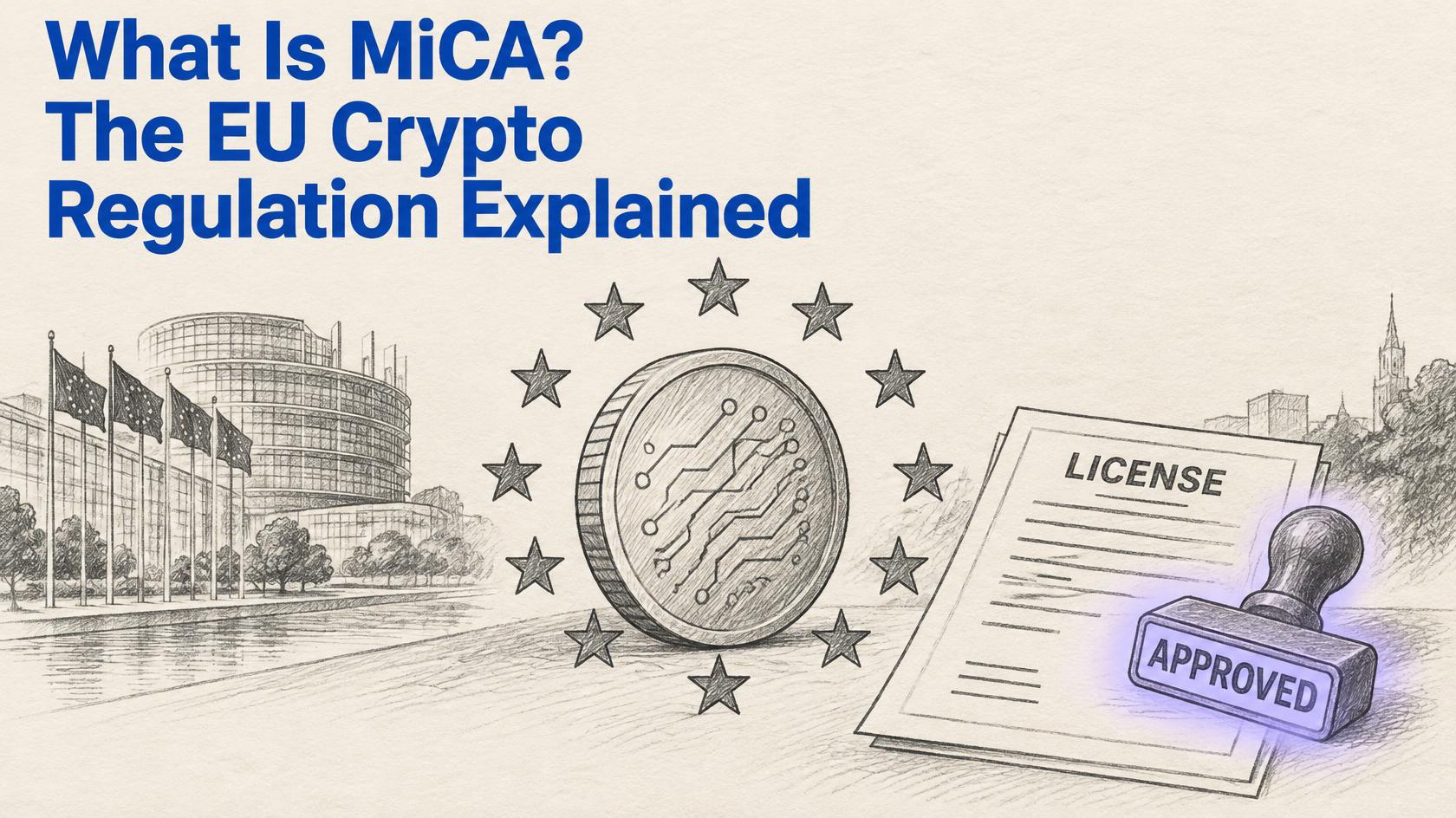
What Is MiCA? The EU Crypto Regulation Explained
Last updated: October 6, 2026
TL;DR
MiCA (the Markets in Crypto-Assets Regulation, EU 2023/1114) is the European Union's single rulebook for crypto. It licenses crypto-asset service providers (CASPs), sets reserve and redemption rules for stablecoins, and requires disclosure white papers for token offerings. One license passports across all 27 member states. The final transitional period ended on July 1, 2026, so unlicensed firms can no longer serve EU clients.
MiCA: definition and positioning
MiCA is a regulation, not a directive. That legal form is the whole point: it applies directly in every member state instead of being re-written 27 times, which is how the EU ended the era of national crypto registrations in France, Germany, Lithuania and elsewhere.
It covers crypto-assets that existing financial law does not already capture. What it is not matters just as much:
| In scope | Out of scope |
|---|---|
| E-money tokens (EMTs): stablecoins pegged to one official currency, such as EURC or USDC | Tokens that qualify as financial instruments under MiFID II, such as tokenized shares |
| Asset-referenced tokens (ARTs): tokens pegged to a basket, a commodity or another value | Unique, non-fungible NFTs |
| Other crypto-assets, including utility tokens and assets like BTC when offered or traded by a CASP | Services provided in a fully decentralized way with no intermediary |
| Crypto-asset service providers: exchanges, brokers, custodians, transfer services, advisers | Central bank digital currencies |
The framing that matters for a business: MiCA regulates activities and issuers, not coins. Bitcoin has no issuer to license, but an exchange that lets EU residents buy it needs CASP authorization.
How MiCA works
MiCA runs on three tracks, each with its own obligations.
1. Stablecoin issuers (Titles III and IV). These rules applied first, from June 30, 2024. An EMT issuer must be an authorized credit institution or e-money institution. Holders have a right to redeem at par at any time, and issuers may not pay interest. Reserve assets must be segregated and held mostly in highly liquid instruments. Stablecoins that grow large enough to be classified as "significant" move under direct supervision by the European Banking Authority.
2. Crypto-asset service providers (Title V). The full CASP regime applied from December 30, 2024. Authorization requires an EU legal entity, minimum capital that scales with the services offered (from €50,000 up to €150,000 for operating a trading platform), fit-and-proper management, client asset segregation, and governance and complaints procedures. Once a national competent authority grants the license, the firm can passport services across the EU.
3. Token offerings and market abuse (Titles II and VI). Anyone offering a crypto-asset to the public or seeking admission to trading must publish a white paper with prescribed disclosures, and the issuer is liable for its accuracy. MiCA also brings insider dealing and market manipulation rules to crypto for the first time.
Two adjacent EU laws run alongside it. The Transfer of Funds Regulation applies the Travel Rule to crypto transfers with no minimum threshold, so a CASP must transmit originator and beneficiary data on every transfer. DORA, the Digital Operational Resilience Act, adds ICT risk and incident reporting duties.
MiCA in practice: what the transition actually did
MiCA's real test was not its publication but its deadlines. Firms that were operating legally under national rules before December 30, 2024 could keep going during a transitional period, capped at 18 months. Several countries chose shorter windows: the Netherlands, Finland, Latvia, Hungary and Slovenia closed theirs on June 30, 2025, according to Elliptic.
ESMA confirmed on April 17, 2026 that there would be no extensions. On June 23, 2026, it told unauthorized providers to stop onboarding EU clients and wind down in an orderly way. Since July 1, 2026, operating without authorization is a breach of EU law.
The numbers show how much consolidation that forced:
| Metric | Figure | Source |
|---|---|---|
| Authorized CASPs, July 26, 2026 | 338 across 26 EEA home states | Penning MiCA register, from ESMA data |
| Share of pre-MiCA registered firms authorized, May 2026 | About 17% | CCN, via Coinpaprika |
| Maximum transitional period | 18 months, ended July 1, 2026 | ESMA |
The stablecoin market felt MiCA earliest. USDT does not have EMT authorization, so EU-regulated venues restricted it for European users, while Circle's euro and dollar stablecoins, EURC and USDC, are issued under an e-money license and remain available. That single licensing decision is reshaping which dollar stablecoin European businesses hold. Our guide to euro stablecoins covers the EUR side.
What comes next for MiCA
The next phase is about who supervises, not what the rules say. The European Commission's Market Integration Package, published in December 2025, proposed transferring authorization and supervision of all CASPs from national regulators to ESMA. The European Central Bank backed the plan in April 2026, arguing it would reduce fragmentation. Malta, a major licensing hub, has pushed back. DLA Piper expects the legislative process to run at least until the end of 2026.
If it passes, the practical effect is an end to licensing arbitrage between member states with faster or slower regulators.
MiCA compared with US crypto rules
| EU: MiCA | US: GENIUS Act and CLARITY Act | |
|---|---|---|
| Stablecoin issuers | Licensed as banks or e-money institutions; no interest | GENIUS Act: federal or state license; no issuer interest |
| Exchanges and brokers | Single CASP license, passported EU-wide | CLARITY Act would have created CFTC registration; stalled in the Senate |
| Token classification | Three categories by peg type | CLARITY Act's commodity vs investment contract split; not law |
| Status | Fully in force since July 1, 2026 | Stablecoin law in force; market structure law pending |
The contrast is the story: the EU finished its market structure regime while the US CLARITY Act stalled.
Trade-offs and limitations
MiCA delivers legal certainty and a passport into a market of about 450 million people. The costs are real. Compliance budgets favor large incumbents, and with roughly one in six pre-MiCA firms authorized by May 2026, many smaller operators simply left. DeFi, lending and staking sit largely outside the text, so the hardest questions are deferred rather than answered. Stablecoin rules that forbid interest and impose strict reserves make euro stablecoins safe but give holders little reason to prefer them to a bank account. And national regulators still interpret the same rules at different speeds, the gap the ESMA centralization proposal is meant to close.
FAQs
What is MiCA in simple terms?
MiCA is the European Union's law for crypto. It requires crypto exchanges, brokers and custodians serving EU customers to hold a license, sets strict reserve and redemption rules for stablecoins, and makes token issuers publish a disclosure document. One license from any member state covers the whole EU.
When did MiCA take effect?
MiCA entered into force in June 2023. Its stablecoin rules applied from June 30, 2024, and the full regime for crypto-asset service providers applied from December 30, 2024. The final transitional period for firms licensed under older national rules ended on July 1, 2026.
Is USDT MiCA compliant?
No. Tether has not obtained authorization to issue USDT as an e-money token under MiCA, so EU-regulated platforms restricted USDT trading for European users. USDT still exists and trades elsewhere. Circle's USDC and EURC are issued under an e-money license and are available on MiCA-licensed venues.
Does MiCA regulate Bitcoin?
Not directly, because Bitcoin has no issuer to license. MiCA regulates the businesses around it. Any exchange, broker or custodian offering Bitcoin services to EU clients needs CASP authorization and must follow MiCA's custody, conduct and market abuse rules.
What is a CASP under MiCA?
A crypto-asset service provider (CASP) is a company that provides crypto services such as custody, running a trading platform, exchange, order execution, transfers or advice. Under MiCA it needs authorization from a national regulator, after which it can serve clients across the EU through passporting.
Is XRP MiCA compliant?
MiCA does not certify individual tokens as compliant. XRP is not a stablecoin, so it needs no e-money or asset-referenced token authorization. What MiCA requires is that platforms offering XRP in the EU hold CASP licenses and that a compliant white paper exists for its admission to trading.
The takeaway
MiCA turned EU crypto from 27 national regimes into one license and one stablecoin standard, and the end of the transition in July 2026 made that real. The open question is supervisory: whether ESMA takes over CASP oversight directly, which would end the race to the most accommodating national regulator.
If you need help choosing counsel for an authorization, see our guide to the best MiCA lawyers in Europe. If you are building a payments product that touches EU stablecoins, reach out.