The Ripple Mastercard Partnership Explained: What It Means for Institutions
Ripple and Mastercard are not one partnership but two linked initiatives: a November 2025 collaboration with WebBank and Gemini to explore RLUSD settlement on the XRP Ledger for Gemini Credit Card transactions, and Ripple's inclusion in Mastercard's March 2026 Crypto Partner Program. Most coverage merges these with unrelated pilots and price commentary. That blurring matters, because a settlement integration and a partner framework carry very different operational and compliance consequences for institutions.
Definition: What the Ripple and Mastercard Relationship Actually Is

The relationship has two layers.
In plain language: one item moves money between a card network and a bank using a stablecoin; the other is a membership in a program for building future payment products.
A third item often gets folded in. Investing.com reported a separate pilot transaction involving Ripple, JPMorgan, Mastercard and Ondo. It is a different workflow with different parties.
| Initiative | Date | Parties | What is settled or targeted | Status as stated by source |
|---|---|---|---|---|
| RLUSD | - | - | - | - |
| Mastercard Crypto Partner Program with Ripple | Mar 11, 2026 | Mastercard, with named participants including Ripple, Binance, Circle, PayPal, Gemini, Paxos | Cross-border transfers, B2B payments, global payouts, settlements | Program launched by Mastercard; participants work with Mastercard teams on products |
| JPMorgan and Mastercard pilot (independent report) | Reported May 2026 | Ripple, JPMorgan, Mastercard, Ondo | Redemption of tokenized U.S. Treasuries with USD settlement across borders | Reported by Investing.com as a completed pilot transaction |
The takeaway: treat the card settlement collaboration as the operational item, the partner program as strategic positioning, and the JPMorgan pilot as a separate data point.
How the RLUSD Card Settlement Works

The design leaves the consumer experience unchanged and alters the back end. A cardholder still pays with a Mastercard-branded card. What changes is how the issuing bank and the network settle the obligations those purchases create.
According to Ripple's announcement coverage and Ripple's own press release, the initiative is designed to let RLUSD, operating on the XRPL, facilitate blockchain-based settlement processes between Mastercard and WebBank. Ripple's release frames this as exploration, and states that once implemented it would mark one of the first collaborations where a regulated U.S. bank settles traditional card transactions using a regulated stablecoin on a public blockchain.
Participants and roles
- Mastercard: the card network. Its Global Head of Digital Commercialization, Sherri Haymond, described the aim as bringing regulated, open-loop stablecoin payments into the financial mainstream.
- WebBank: the issuer of the Gemini Credit Card and the bank-side settlement counterparty.
- Gemini: the card program operator. Gemini's CFO described the work as applying stablecoin settlement to an active card program.
- Ripple: the company behind RLUSD, the stablecoin proposed for settlement on the XRPL.
Worked example: a Gemini card purchase
Example: a cardholder buys a laptop with a Gemini Credit Card.
- The merchant's acquirer submits the transaction over the Mastercard network, as with any card payment.
- WebBank, as issuer, authorizes the charge and records the cardholder's balance.
- At settlement, the obligation between WebBank and Mastercard is the one the collaboration targets. Instead of only conventional fiat rails, RLUSD transfers on the XRPL can carry that settlement leg.
- The cardholder sees no difference. The change sits in interbank and network treasury flows.
The point is narrow. This is not consumer crypto spending; it is a stablecoin used as a settlement asset between regulated institutions. No volumes or fee changes have been disclosed in the announcements cited here, so any efficiency claim should be read as a stated goal.
The Crypto Partner Program: Scope and Limits
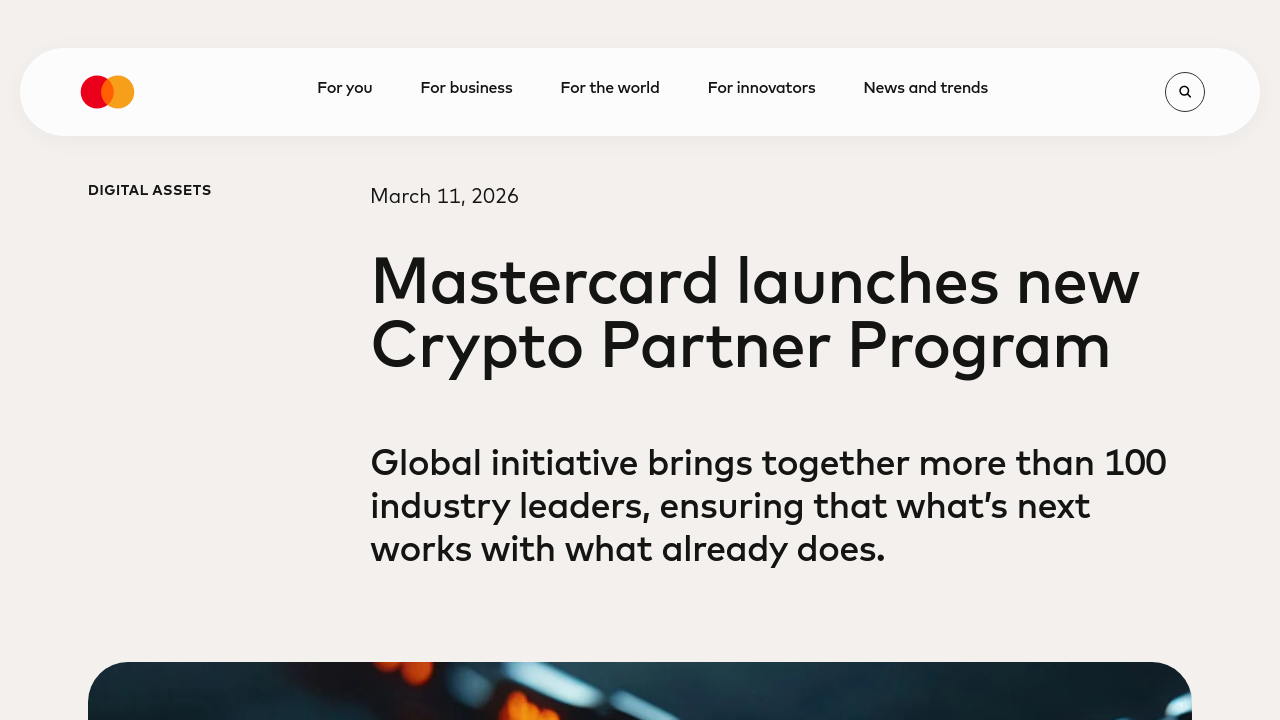
Mastercard launched its Crypto Partner Program on March 11, 2026. Per Yahoo Finance's report on Ripple joining, named participants include Binance, Circle, Ripple, Gemini, PayPal and Paxos, and the program targets cross-border transfers, B2B payments, global payouts and settlements.
Mastercard describes participants working with its teams on products that combine programmable digital assets with existing payment networks. It also positions the program as building on earlier efforts such as its Start Path accelerator and the Engage platform's Crypto Card program.
Membership is not an integration. Being named in a program is a cold-start position: access to forums and teams, not live flows. The RLUSD card settlement work is closer to a hot-start case, attached to an existing card program with an active issuer.
The takeaway: judge each program member by announced integrations, not by the membership list.
Why It Matters for Institutions

Mastercard framed its stablecoin approach around strong consumer protections, a level playing field and full regulatory compliance. Those three phrases are the useful lens.
Settlement and treasury operations
A public-ledger settlement leg changes how treasury teams observe funds in motion. RLUSD transfers on XRPL are recorded on a public ledger, which may change how teams reconcile settlement between network and issuer. It also introduces new operational dependencies: wallet controls, ledger availability and stablecoin redemption.
Takeaway: treasurers at issuers and processors should model stablecoin settlement as an additional rail with its own liquidity and custody requirements, not a replacement.
Compliance and issuer considerations
The structure keeps a regulated U.S. bank, WebBank, at the center. That matters for supervisors and counsel: the compliance perimeter remains the bank's, while the settlement asset is a regulated stablecoin. WebBank's CEO framed banks as bridging blockchain technology with the stability of traditional finance.
Takeaway: the regulated issuer, not the blockchain, is the accountable party. Diligence should start with the bank.
Open-loop versus closed-loop stablecoin payments
Closed-loop stablecoin payments run inside one platform. Open-loop payments run across a network any participant can reach. Mastercard explicitly used the phrase "open-loop stablecoin payments," meaning RLUSD settlement attached to a network that already connects many issuers and acquirers.
Takeaway: open-loop settlement is where stablecoins compete with correspondent banking, which raises both the opportunity and the supervisory bar.
Common Misconceptions
Misconception: Mastercard now holds or promotes XRP / Reality: the pilot concerns RLUSD settlement
The November 2025 collaboration concerns RLUSD, a dollar stablecoin, on the XRPL. XRP is the native asset of that ledger, but the announced settlement asset is RLUSD. The Gemini XRP Credit Card is a separate card edition; the announced settlement asset is RLUSD, not XRP.
Misconception: Membership in the program means a product launch / Reality: it is a partner framework
The Crypto Partner Program creates collaboration forums. Listed members include competitors such as Circle and Paxos. A seat at the table is not a shipped product.
Misconception: Partnership headlines predict XRP price moves / Reality: the sources describe payment infrastructure, not price outcomes
Outlets such as U.Today paired the announcement with market commentary. The primary announcements describe settlement processes and program scope. They make no price claims, and neither should an institutional reading.
Misconception: The JPMorgan item is the same deal / Reality: separate pilot reported independently
Investing.com reported a pilot where Ondo processed an OUSG redemption on the XRPL, Mastercard's Multi-Token Network routed instructions to JPMorgan's Kinexys, and USD was sent to Ripple's bank account in Singapore. It involves tokenized Treasuries, not card settlement.
Related Concepts
RLUSD
Ripple USD, Ripple's dollar stablecoin, described by Ripple as a regulated digital asset. Its distribution across ledgers is covered in our explainer on RLUSD multichain expansion.
XRP Ledger (XRPL)
A public blockchain built for fast and secure payments, per Ripple. XRP is its native digital currency.
Open-loop stablecoin settlement
Stablecoin settlement that runs across a shared network of issuers and acquirers rather than inside a single platform.
Card issuer versus network
The issuer (here WebBank) extends credit and holds the cardholder relationship. The network (Mastercard) routes transactions and coordinates settlement among participants.
Crypto Partner Program
Mastercard's program connecting digital asset firms with its payments infrastructure. Mastercard describes a growing ecosystem of issuers, crypto-native companies and partners focused on on-chain money movement.
How to Get Started: Evaluating Exposure to This Model
- Read the primary announcements. Start with Ripple's November 5, 2025 release and Mastercard's March 11, 2026 program announcement. Separate stated plans from secondary interpretation.
- Map settlement counterparties and issuer banks. For any card program you depend on, identify the issuer bank and how it settles with the network. That is where stablecoin settlement would appear.
- Ask providers which rail and stablecoin they settle on. Request specifics: which ledger, which stablecoin, which bank, and what fallback exists. Our review of stablecoin payment infrastructure for regulated institutions frames those vendor questions.
The takeaway: exposure runs through counterparties, not headlines.
FAQ: Frequently Asked Questions
Is Mastercard partnering with XRP?
Not directly. Mastercard collaborated with Ripple, WebBank and Gemini to explore settling Gemini Credit Card transactions with RLUSD on the XRP Ledger. The settlement asset is the RLUSD stablecoin, not XRP itself.
Is Mastercard partnering with Ripple?
Yes, in two ways. Ripple joined the November 2025 RLUSD card settlement collaboration with Mastercard, WebBank and Gemini, and Mastercard named Ripple among participants in its Crypto Partner Program launched March 11, 2026.
What is RLUSD?
RLUSD, or Ripple USD, is Ripple's dollar stablecoin. In the Mastercard collaboration it is the asset intended to settle card transactions between Mastercard and WebBank on the XRP Ledger, a public blockchain.
Who is WebBank in this arrangement?
WebBank is the issuer of the Gemini Credit Card and the bank-side settlement counterparty. Ripple describes the collaboration as enabling blockchain-based settlement processes between Mastercard and WebBank using RLUSD on the XRPL.
Which companies joined the Crypto Partner Program?
Named participants reported at launch include Ripple, Binance, Circle, PayPal, Gemini and Paxos. Mastercard describes the program as bringing together exchanges, blockchain developers, fintech companies and banks across the digital asset ecosystem.
Is XRP backed by Trump?
The Ripple and Mastercard announcements discussed here say nothing about political backing. They describe payment infrastructure and a partner program. Questions about political links fall outside what these primary sources address.
Conclusion: Settlement Rails Versus Headlines
Strip away the price chatter and the Ripple and Mastercard story is small and specific: one regulated bank, one card program, one stablecoin, one public ledger, plus a program seat shared with Circle, Paxos and others. That specificity is the signal. The open question is whether RLUSD settlement between WebBank and Mastercard becomes routine network practice that other issuers adopt, or remains a showcase pilot. The answer will show up in issuer settlement disclosures before it shows up in headlines.