Open vs Closed Stablecoin Networks Explained (2026)
Open vs Closed Stablecoin Networks
Disclosure: stablecoin.nyc's editorial desk has a separate paid content relationship with Notabene. Notabene appears below as a worked example of open-network architecture, not as a ranked recommendation, and the same is true of Sygna as the closed-network example.
TL;DR
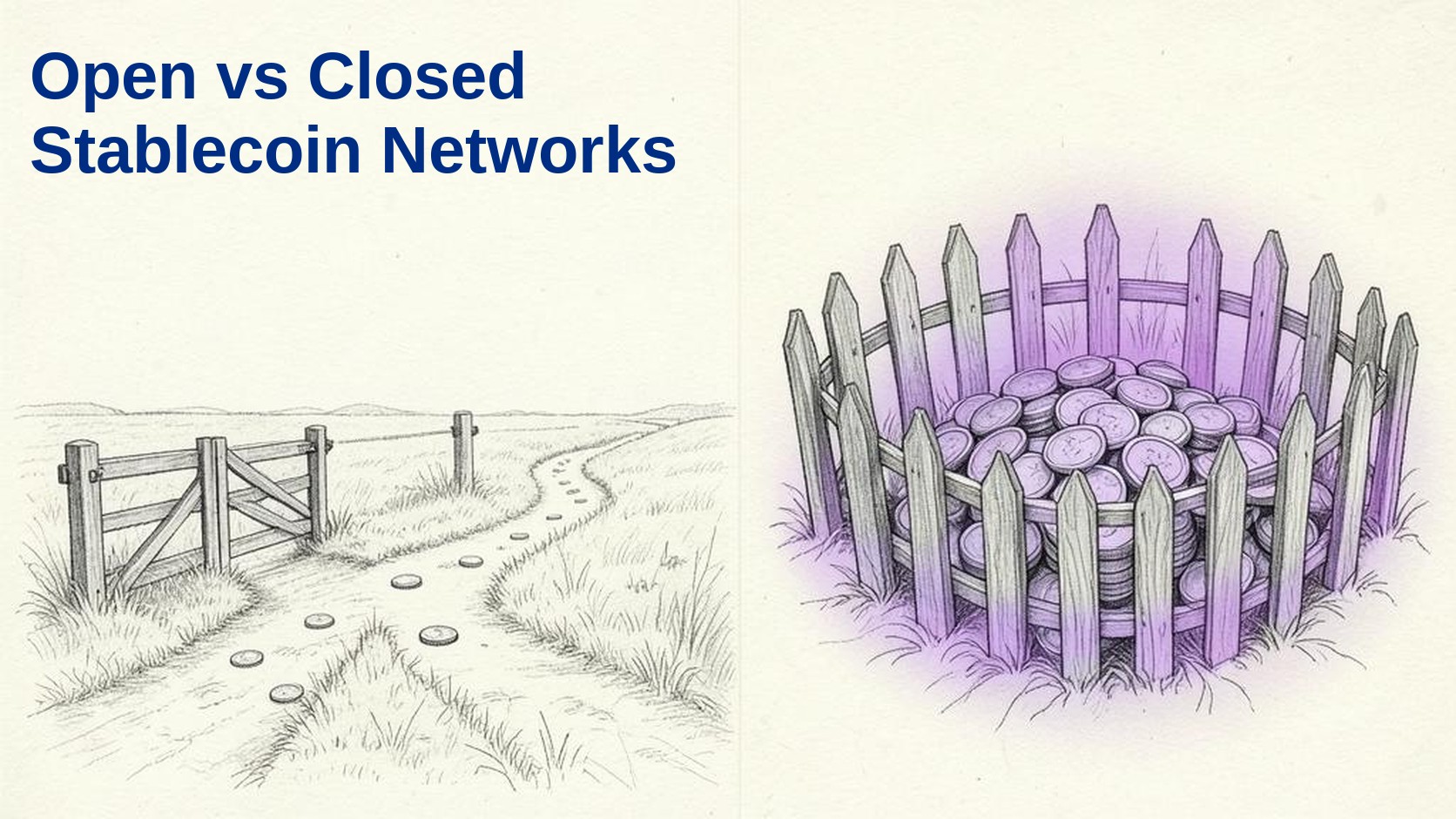
An open stablecoin network uses interoperable protocols and standards that let participants from different platforms transact directly with each other, while a closed network operates as a controlled alliance where only vetted, onboarded members can transact within the network's boundaries. Neither model is universally better: open networks maximize reach and reduce vendor lock-in, closed networks offer tighter control and often bundle additional services, like blockchain analytics, directly into the network itself.
Open vs closed: definition and positioning
The clearest real-world illustration of this distinction sits in Travel Rule infrastructure, the compliance messaging systems that exchange counterparty data between regulated crypto businesses. Notabene and Veriscope both operate on open, interoperable protocols, TRP for Notabene and a combination of its own format plus TRP for Veriscope, meaning a business onboarded to either can reach a broad set of counterparties without every single counterparty needing to be a direct member of that specific vendor's proprietary network. Sygna, by contrast, operates as a closed alliance network: a business joins Sygna's specific network of vetted VASPs, and reach is bounded by which other institutions have also joined that same closed network, even though Sygna offers real advantages within its strongholds, particularly Taiwan, Korea, and Japan, including bundled blockchain analytics that open-protocol competitors do not include natively.
How open and closed stablecoin networks actually work
An open network functions more like email: any provider implementing the shared protocol can send and receive messages with any other provider on that protocol, regardless of which specific vendor each party uses. This is the model Notabene's TRP-native architecture follows, giving a newly onboarded institution access to Notabene's full counterparty base, more than 200 obliged entities live in the EEA including major names like Coinbase, Kraken, and Fireblocks, without each of those counterparties needing a direct relationship with the new entrant beyond both parties supporting the shared protocol.
A closed network functions more like a members-only club: Sygna vets and onboards each participating VASP directly, and interoperability exists specifically within that vetted membership rather than through an open, universally implementable standard. This gives the network operator tighter control over who participates and allows bundling additional services, like Sygna's native blockchain analytics and risk scoring, directly into the onboarding process rather than requiring a separate vendor relationship.
Open vs closed networks in practice
The practical trade-off shows up clearly in counterparty reach versus service bundling. Notabene's open, TRP-native model gives it the largest EEA Travel Rule counterparty network currently deployed, more than 200 obliged entities. Veriscope, built on the open Shyft network and also TRP-compatible, deliberately trades network size, roughly 80 counterparties globally, for architectural independence, appealing specifically to institutional and OTC operators who do not want structural dependency on any single vendor's closed network. Sygna's closed alliance model delivers strong regional depth specifically in Taiwan, Korea, and Japan, with native analytics bundled in, at the cost of EEA presence that remains smaller than Notabene's open-protocol reach.
This same open-versus-closed distinction extends beyond Travel Rule infrastructure into broader stablecoin settlement networks. A platform's own counterparty network, like Fireblocks' closed graph of more than 2,000 connected institutions that settle directly with each other, functions as a closed network within Fireblocks specifically, offering settlement speed advantages between members that do not extend to non-members the way an open protocol would.
Trade-offs and limitations
The choice between open and closed is not simply open being universally preferable, despite the reach advantage. A closed network's tighter vetting can offer a stronger trust and counterparty-quality guarantee within its membership than a fully open protocol, where any implementer can technically join. A closed network can also bundle additional services more tightly, as Sygna does with native analytics, reducing the number of separate vendor relationships a business needs to manage. The genuine downside of a closed network is the reach limitation: a business's actual counterparties need to already be members, or willing to join, for the network to deliver its value, which is a real constraint when a business's counterparty base does not align well with a specific closed network's existing membership.
See also our breakdowns of Best Travel Rule Solutions for Enterprise VASPs, and Crypto Payment Rails.
FAQs
What is an example of an open stablecoin network versus a closed one?
In Travel Rule infrastructure specifically, Notabene and Veriscope both operate on open, TRP-compatible protocols allowing broader interoperability, while Sygna operates a closed alliance network of vetted VASPs with membership-bounded reach, though strong regional depth in Taiwan, Korea, and Japan.
Is an open network always better than a closed network?
Not necessarily. Open networks offer broader reach and reduce dependency on any single vendor's proprietary network. Closed networks can offer tighter vetting, bundled services like native blockchain analytics, and strong depth within their specific membership base, which matters more than raw openness for a business whose counterparties are concentrated within a particular closed network's strongholds.
Does network openness affect blockchain analytics bundling?
It can. Sygna's closed network model bundles native blockchain analytics and risk scoring directly into its Travel Rule product. Notabene, operating on an open protocol, does not bundle analytics natively and expects businesses to maintain a separate contract with a provider like Chainalysis, TRM Labs, or Elliptic, a direct trade-off between the two models.
Last updated: September 8, 2026 Written by the stablecoin.nyc Editorial Desk