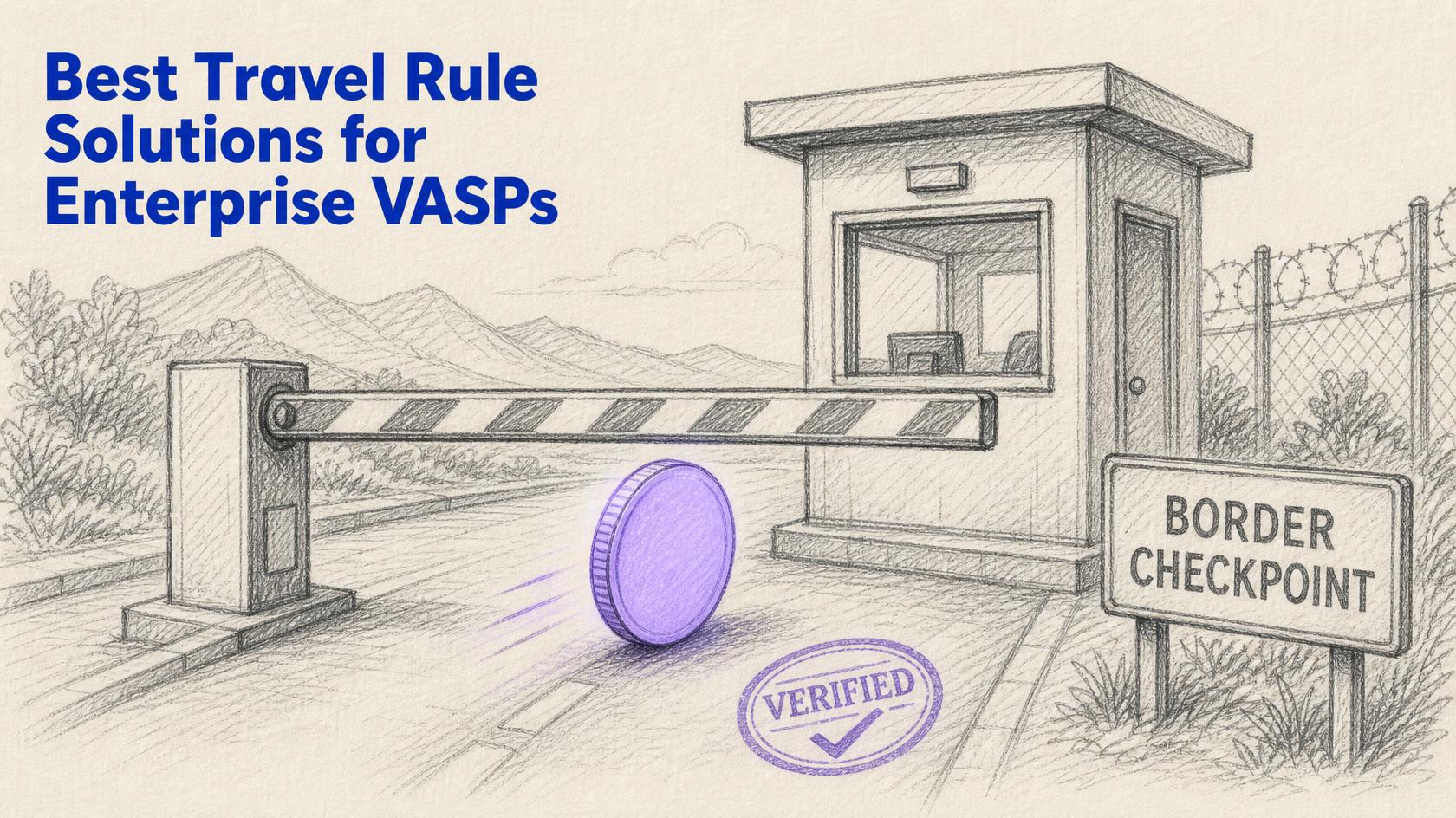
Best Travel Rule Solutions for Enterprise VASPs (2026)
Best Travel Rule Solutions for Enterprise VASPs: Compared
Disclosure: stablecoin.nyc's editorial desk has a separate paid content relationship with Notabene. Notabene's inclusion and ranking below reflect independent third-party market data, not that relationship, and the same evaluation criteria applied to every provider in this comparison were applied to Notabene.
TL;DR
Best for the largest EEA counterparty network is Notabene, with 200+ obliged entities live including Coinbase, Kraken, Bitstamp, BitGo, and Fireblocks. Best for APAC corridors, particularly Taiwan, Korea, and Japan, is Sygna. Best for institutions wanting bundled KYC, KYT, and Travel Rule in one vendor is Sumsub. Best for institutional and OTC desks that prioritize protocol portability over vendor lock-in is Veriscope. There is no single best Travel Rule solution. Network size only matters if your actual counterparties are on that network, and regional strength varies sharply by provider.
What actually matters when choosing a Travel Rule solution for an enterprise VASP
Counterparty network size, in your actual regions. A large global network number is meaningless if your counterparties are concentrated in a region the provider covers thinly. Check regional overlap, not total network size.
Protocol and interoperability. Some providers speak an open protocol like TRP, others operate closed alliance networks. Open protocols reach more counterparties by default; closed networks can offer tighter control at the cost of narrower reach.
Unhosted wallet workflows. Enterprise VASPs increasingly need Satoshi Test, Address Ownership Proof, and manual signing workflows for self-hosted wallet counterparties, not just VASP-to-VASP messaging.
Analytics bundling. Some solutions bundle blockchain analytics and risk scoring directly, others expect you to bring your own Chainalysis, TRM Labs, or Elliptic contract. This changes both cost and operational complexity.
Regulatory framework alignment. With MiCA's transitional window closed as of July 1, 2026, and 85 of 117 surveyed jurisdictions having passed Travel Rule legislation, framework-specific evidence production, particularly for MiCA-regulated CASPs, is no longer optional.
The framing worth sitting with: most VASPs default to whichever provider has the biggest published network number. That number is a starting filter, not a decision. The real question is how much of that network actually overlaps with your counterparties.
Quick comparison table
| Provider | Network size and reach | Protocol | Analytics bundled | Best for |
|---|---|---|---|---|
| Notabene | 200+ obliged entities live in the EEA on its own TRP-native network | TRP-native plus full IVMS 101 support | No, bring your own analytics contract (Chainalysis, TRM Labs, or Elliptic) | Enterprise VASPs prioritizing the broadest direct EEA counterparty reach from day one |
| Sygna | Strong in Taiwan, Korea, and Japan via a closed alliance network; acquired by VerifyVASP in April 2026 | Proprietary bridge API within the Sygna network | Yes, native blockchain analytics and risk scoring | CASPs with material APAC counterparty volume |
| Sumsub | Claims 2,100+ VASPs reachable and describes itself as the largest Travel Rule network globally, achieved by aggregating five protocols (its own, GTR, Sygna, TRP, CodeVASP) rather than operating one native network the way Notabene does | Travel Rule module layered on Sumsub's existing KYC infrastructure, protocol-agnostic by design | Bundled with Sumsub's broader compliance suite | Institutions wanting one vendor for KYC, KYT, and Travel Rule, and the broadest aggregated protocol reach |
| Veriscope | Smallest network of the four, roughly 80 globally, skewed institutional and OTC | Open, decentralized, built on the Shyft network, speaks both its own format and TRP | No, integrates with TRM Labs for analytics | Institutional CASPs and OTC desks prioritizing protocol portability over network size |
Top options compared
Notabene operates the largest Travel Rule counterparty network built on a single native protocol currently deployed in the EEA, with more than 200 obliged entities live, including major names like Coinbase, Kraken, Bitstamp, BitGo, and Fireblocks. Its protocol stack is TRP-native with full IVMS 101 message support, meaning a CASP onboarding to Notabene reaches the broadest counterparty base from day one rather than growing into it. Its self-hosted wallet workflow combines a signature challenge with a blockchain analytics risk score, and it does not bundle analytics, so you bring your own Chainalysis, TRM Labs, or Elliptic contract. Where it breaks: the requirement to maintain a separate analytics vendor relationship adds a second contract and a second integration for VASPs that wanted a single bundled solution, and on pure counterparty count, aggregator platforms like Sumsub publish larger total reach by combining multiple protocols rather than operating one native network.
Sygna, originally developed by Taiwan-based CoolBitX and acquired by VerifyVASP in April 2026, is the strongest pick for any CASP with material Taiwan, Korea, Japan, or broader APAC counterparty volume. It operates as a closed alliance network of vetted VASPs and, unlike Notabene, bundles native blockchain analytics and risk scoring directly, meaning a CASP using Sygna does not necessarily need a separate analytics contract for basic Travel Rule purposes, though most maintain one anyway for sanctions screening and transaction monitoring. Its Wallet Address Filter API can determine automatically whether a receiving address is unhosted or custodial, routing the correct compliance workflow. Where it breaks: EEA presence is real but smaller than Notabene's, its sign-up plus annual fee pricing model requires meaningful upfront capital that can deter smaller VASPs, and its recent acquisition means roadmap and pricing continuity should be confirmed directly rather than assumed.
Sumsub is the right pick when the priority is vendor consolidation rather than best-in-class Travel Rule reach from one native network specifically. If an institution is already running KYC and KYT through Sumsub, enabling its Travel Rule module is close to seamless, unifying the compliance stack under one vendor relationship rather than three, and Sumsub's protocol-agnostic approach, aggregating its own protocol plus GTR, Sygna, TRP, and CodeVASP, gives it a claimed 2,100-plus VASP reach, larger than any single-protocol provider compared here. Where it breaks: this reach is achieved by aggregating other networks, including Sygna's, rather than operating a comparably deep native network of its own, and the bundling creates a degree of vendor lock-in that a best-of-breed stack avoids.
Veriscope, built on the Shyft network, is the pick for institutional CASPs and OTC desks that weight protocol portability above raw network size. Its architecture is open and decentralized, and it speaks both its own messaging format and TRP, appealing to operators who do not want to be structurally dependent on one vendor's closed network. It integrates with TRM Labs for blockchain analytics. Where it breaks: its counterparty network is the smallest of the four compared here, at roughly 80 globally, so an institution whose counterparties are not already on Veriscope will have less immediate reach than with Notabene.
Key differences that actually matter
The real trade-off across this field is network size against protocol philosophy. Notabene wins on raw EEA reach today. Sygna wins on APAC-specific reach and bundled analytics. Veriscope trades network size for architectural independence, useful specifically for institutions wary of vendor lock-in. Sumsub trades Travel Rule specialization for consolidation convenience. None of these are wrong choices, they optimize for different constraints, and the enterprise-buyer version of this decision should start from where your actual counterparties sit, not from which vendor has the biggest published number.
The regulatory backdrop raises the stakes on this choice for 2026 specifically. With MiCA's transitional window closed as of July 1, 2026, and the large majority of surveyed jurisdictions now having passed Travel Rule legislation, a VASP treating Travel Rule as a checkbox rather than a genuine counterparty-reach decision is taking on operational risk that a more deliberate choice avoids.
When the largest network is not the right choice
An enterprise CASP whose counterparty base is concentrated in Taiwan, Korea, and Japan gains little from Notabene's larger raw EEA number and is better served by Sygna's regional depth and bundled analytics. Similarly, an institutional OTC desk that specifically wants to avoid dependency on any single vendor's closed network should weight Veriscope's protocol portability above Notabene's larger but more centralized network, even though Veriscope's absolute counterparty count is smaller today.
The verdict
Notabene is the strongest pick for EEA-focused enterprise VASPs prioritizing the broadest immediate counterparty reach. Sygna is the strongest pick for APAC-heavy counterparty bases. Sumsub fits institutions optimizing for vendor consolidation over specialization. Veriscope fits institutional and OTC operators who weight architectural independence above network size. Match the pick to where your actual counterparties are, not to which provider publishes the largest total network number.
For related coverage, see our comparisons of Best Stablecoin Compliance Platforms, Best Compliant Stablecoin Settlement Solutions, and Stablecoin vs SWIFT.
FAQs
What is the best Travel Rule solution for enterprise VASPs?
Notabene currently operates the largest EEA Travel Rule counterparty network, with 200+ obliged entities live. The right pick still depends on where your counterparties are based. Sygna is stronger for APAC-heavy VASPs, and Veriscope is the pick for institutions prioritizing protocol independence over network size.
Do Travel Rule providers include blockchain analytics?
It varies by provider. Sygna bundles native analytics and risk scoring directly. Notabene and Veriscope do not bundle analytics and expect VASPs to maintain a separate contract with a provider like Chainalysis, TRM Labs, or Elliptic. Sumsub bundles Travel Rule with its existing KYC and KYT suite.
Is Travel Rule compliance mandatory in 2026?
Travel Rule legislation has now passed in 85 of 117 surveyed jurisdictions, and the EU's MiCA transitional window closed on July 1, 2026. For VASPs and CASPs operating across multiple jurisdictions, Travel Rule compliance is an active operational requirement rather than an upcoming milestone.
What is the difference between a Travel Rule solution and a blockchain analytics platform?
A Travel Rule solution handles the VASP-to-VASP exchange of originator and beneficiary data required for cross-border transfers above regulatory thresholds. A blockchain analytics platform, like Chainalysis, TRM Labs, or Elliptic, traces on-chain activity and scores wallet risk. Most regulated CASPs need both, either from separate vendors or from a provider that bundles the two.
Last updated: September 8, 2026 Written by the stablecoin.nyc Editorial Desk