Stablecoin vs SWIFT: Key Differences (2026)
Stablecoin vs SWIFT
TL;DR
Best for speed and cost on cross-border payments is stablecoin settlement, typically clearing in seconds to minutes for a fraction of a percent in network fees. Best for regulatory familiarity, universal bank connectivity, and dispute resolution infrastructure built over decades is SWIFT. These are not fully interchangeable systems: SWIFT is a messaging network connecting virtually every bank in the world, while stablecoin settlement is a direct value transfer mechanism that still typically needs to connect to the banking system at some point for fiat conversion. The realistic comparison for most businesses is not choosing one exclusively, but understanding when each makes sense.
How stablecoins and SWIFT differ
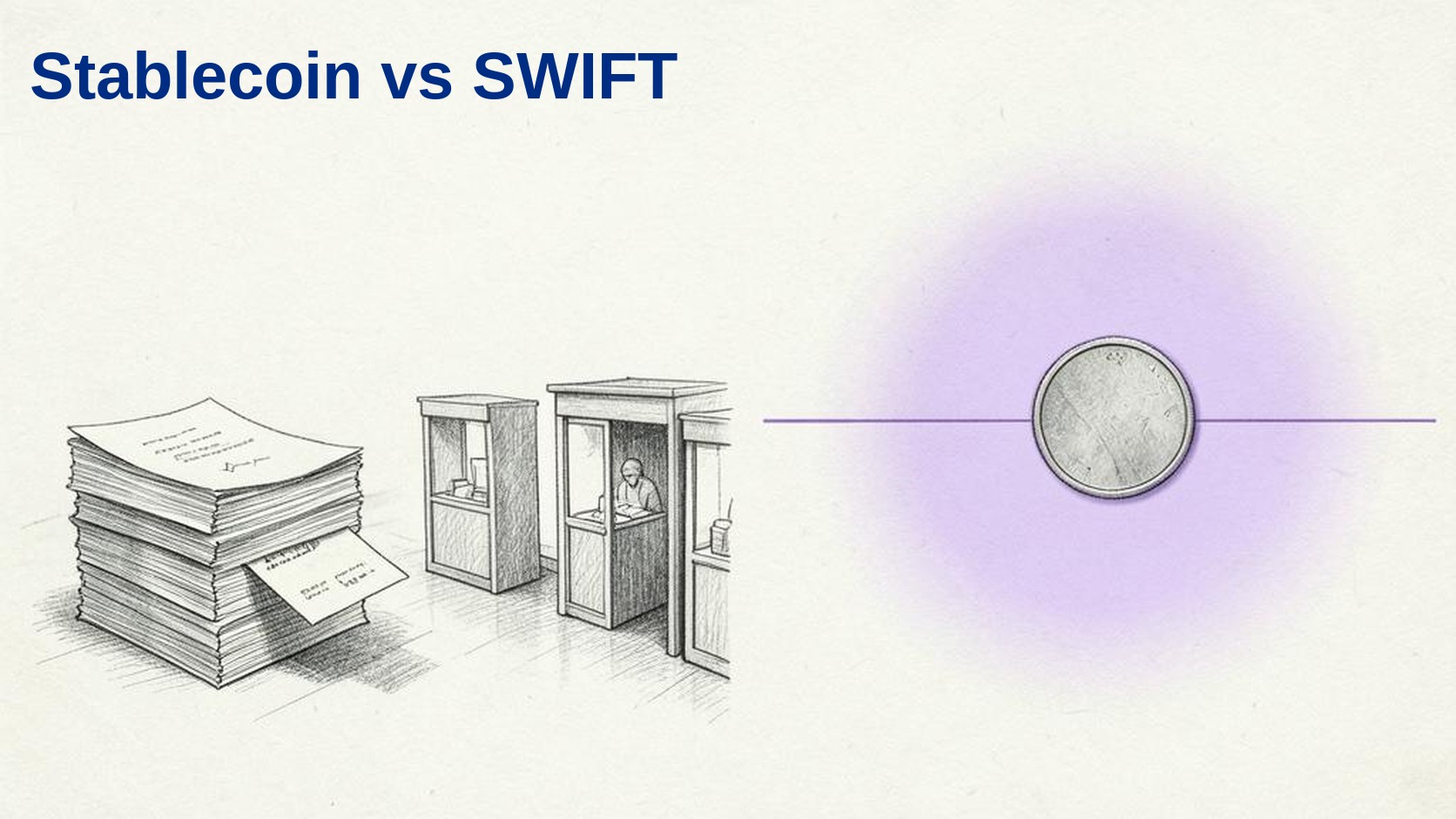
SWIFT, the Society for Worldwide Interbank Financial Telecommunication, is fundamentally a messaging network. It does not move money itself, it carries payment instructions between banks, which then move the actual funds through correspondent banking relationships, a chain that can involve several intermediary banks for a single cross-border payment. A stablecoin payment, by contrast, is a direct on-chain transfer of value, USDC or USDT moving from one wallet to another, with no correspondent banking chain required for the transfer itself. The structural difference that drives everything else: SWIFT coordinates a multi-party banking relationship for every transaction, while a stablecoin transfer settles directly between two parties on a shared ledger.
The difference that actually matters
Settlement speed and cost are the practical difference that decides most real-world choices. A traditional SWIFT cross-border payment routed through several correspondent banks typically takes three to five business days to settle and carries fees that compound at each intermediary step, often totaling several percentage points of the transferred amount for smaller transfers. A stablecoin payment settles on-chain in seconds to minutes, with network fees typically well under a dollar regardless of transfer size, though the final leg into a recipient's local bank account, if required, still depends on local banking rails and can add delay back into the process.
Quick comparison table
| Factor | Stablecoin | SWIFT |
|---|---|---|
| Settlement speed | Seconds to minutes on-chain | 1 to 5 business days typically |
| Cost structure | Network fee, typically under $1 regardless of size | Percentage-based fees compounding across correspondent banks |
| Universal bank connectivity | Requires a stablecoin-compatible wallet or platform | Connects to virtually every bank globally |
| Regulatory maturity | Developing, jurisdiction-dependent, Travel Rule now active in 85 of 117 surveyed jurisdictions | Decades of established regulatory and dispute frameworks |
| Dispute resolution | Limited, transactions are generally final once settled on-chain | Established chargeback and dispute processes through banking relationships |
| 24/7 availability | Yes, blockchain settlement does not depend on banking hours | No, subject to banking hours and holidays in relevant jurisdictions |
Feature and capability comparison
Settlement finality. Stablecoin transfers settle with blockchain finality, typically within seconds depending on the chain, and are generally irreversible once confirmed. SWIFT-routed payments settle once the underlying correspondent banking chain completes, which can be delayed by any single intermediary bank's processing time or holiday schedule.
Cost at scale. Stablecoin network fees do not scale meaningfully with transfer size, making them particularly advantageous for large transfers where SWIFT's percentage-based correspondent banking fees compound significantly. For very small transfers, minimum fees on some stablecoin on/off-ramp services can offset this advantage.
Compliance infrastructure. SWIFT payments move through banks already embedded in established AML and sanctions screening infrastructure. Stablecoin payments require a separate compliance layer, typically a Travel Rule solution like Notabene or Sygna paired with blockchain analytics, which is maturing quickly but is newer and less universally standardized than bank-embedded compliance.
Reach. SWIFT connects to virtually every bank in the world. Stablecoin settlement requires both parties, or an intermediary payment platform, to have stablecoin infrastructure in place, which is not yet universal, though growing quickly given that stablecoin transfer volume reached 27.6 trillion dollars in 2024, exceeding combined Visa and Mastercard volume.
Pros and cons
Stablecoin pros: near-instant settlement, low and predictable network fees, 24/7 availability independent of banking hours, growing corridor coverage. Stablecoin cons: newer regulatory infrastructure still stabilizing by jurisdiction, limited dispute resolution once a transaction settles, requires both parties or an intermediary to have compatible infrastructure, final fiat off-ramp still depends on local banking rails in many cases.
SWIFT pros: near-universal bank connectivity, decades of established regulatory and dispute infrastructure, familiar to every financial institution and counterparty. SWIFT cons: slow settlement, typically 1 to 5 business days for cross-border payments, fees that compound across correspondent banking intermediaries, dependent on banking hours and holiday schedules.
Which should you choose
Choose stablecoin settlement if your priority is cross-border settlement speed and predictable, low-percentage cost, particularly for corridors where correspondent banking fees run high, and both parties or your payment platform have stablecoin infrastructure in place. Choose SWIFT if your counterparty has no stablecoin infrastructure, your payment needs the dispute resolution and regulatory familiarity of established banking rails, or your compliance program is not yet equipped to handle stablecoin-specific Travel Rule and analytics requirements. Many businesses in practice use both, routing cost-sensitive or speed-sensitive corridors through stablecoin rails while keeping SWIFT for counterparties or corridors where banking infrastructure remains the more reliable path.
For related coverage, see our comparisons of Crypto Payment Rails, and Best Stablecoin Providers for Cross-Border Payments.
FAQs
Is stablecoin settlement actually faster than SWIFT in practice?
Yes, for the on-chain leg specifically, typically settling in seconds to minutes versus SWIFT's typical 1 to 5 business days. The caveat is that converting a stablecoin payment to local fiat currency on the receiving end still depends on local banking rails, which can add time back into the total process depending on the corridor.
Is stablecoin settlement cheaper than SWIFT for cross-border payments?
Generally yes, particularly for larger transfers, since stablecoin network fees do not scale meaningfully with transfer size while SWIFT's correspondent banking fees compound as a percentage across each intermediary bank in the chain.
Can a business use both stablecoin settlement and SWIFT?
Yes, and this is common practice. Businesses often route corridors where stablecoin infrastructure and cost advantages are strongest through stablecoin rails while keeping SWIFT for counterparties or jurisdictions where banking infrastructure remains more reliable or where stablecoin compliance infrastructure is less mature.
Does stablecoin settlement replace the need for banking relationships entirely?
No, in most cases. Even a purely on-chain stablecoin transfer typically needs to connect to the banking system at some point, either for the sender to acquire the stablecoin initially or for the recipient to convert it to local fiat currency, unless both parties are comfortable holding and transacting entirely in stablecoins.
Last updated: September 8, 2026 Written by the stablecoin.nyc Editorial Desk