What Are Crypto Payment Rails? Explained (2026)
What Are Crypto Payment Rails?
TL;DR
Crypto payment rails are the blockchain networks and settlement infrastructure that move stablecoins and other digital assets from one party to another, functioning as an alternative to traditional banking rails like SWIFT, ACH, or card networks. A payment rail in this context includes the underlying blockchain, the stablecoin moving across it, and the infrastructure layer, wallets, custody, compliance, that makes a transfer usable for a business rather than just technically possible.
Crypto payment rails: definition and positioning
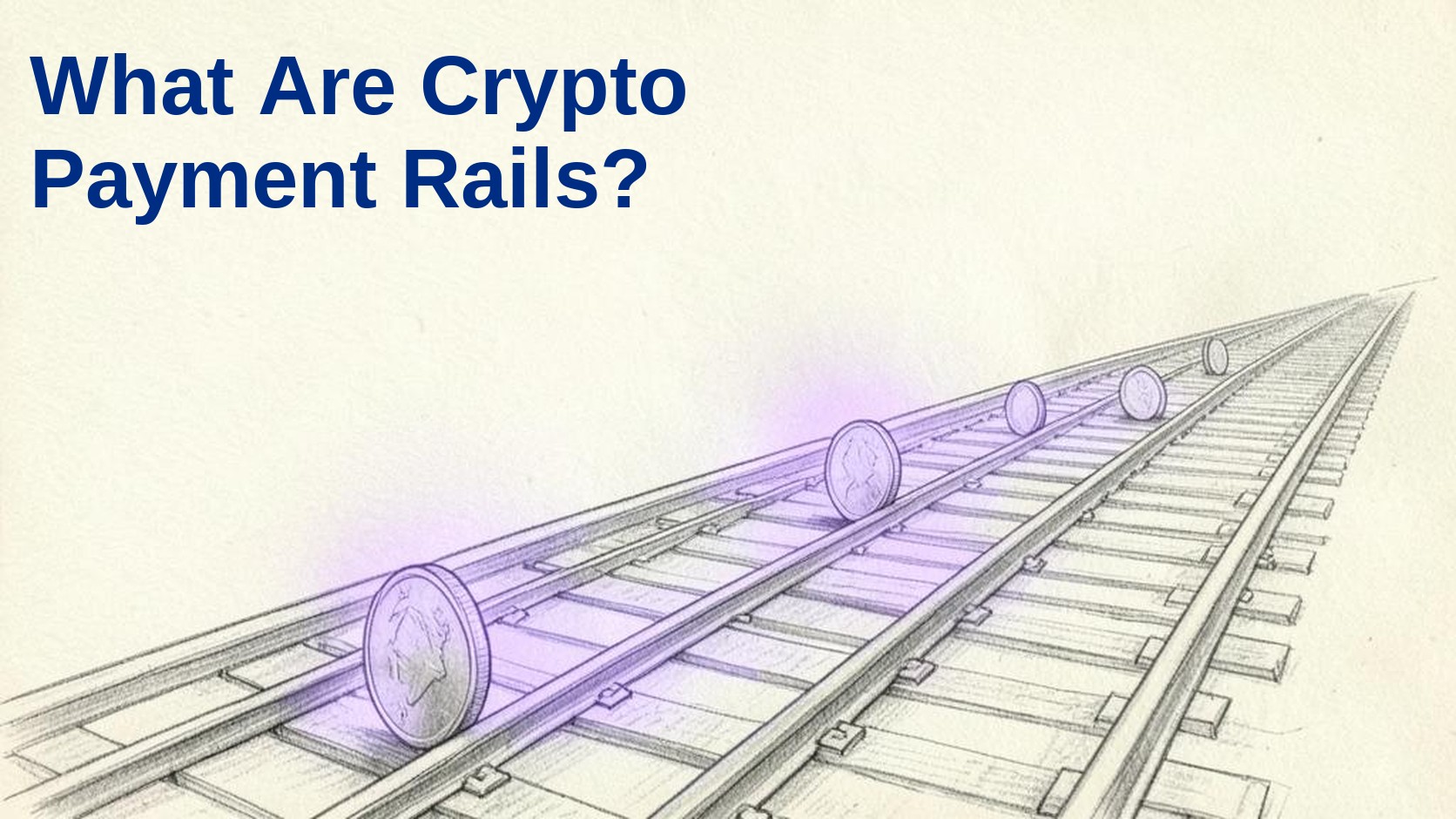
The term "rail" borrows directly from traditional finance, where ACH, wire transfer, and card networks are each considered separate rails with different speed, cost, and reach characteristics. Crypto payment rails extend this concept to blockchain networks: Ethereum, Solana, Polygon, Base, and others each function as a distinct rail with its own speed, cost, and finality characteristics for moving stablecoins. This differs from a stablecoin itself, which is the asset moving across a rail, not the rail. USDC can move across Ethereum, Solana, or several other chains, each a different rail with different settlement speed and cost, even though the underlying stablecoin is the same.
How crypto payment rails work
A transaction on a crypto payment rail moves through a sequence distinct from traditional banking. First, the sender's wallet initiates a transfer, specifying the recipient's address and amount. Second, the transaction broadcasts to the blockchain network, where validators or miners confirm it according to that chain's consensus mechanism. Third, the transaction achieves finality, the point at which it is considered irreversible, which varies significantly by chain, from roughly six seconds on Solana to longer confirmation windows on other networks. Fourth, if the recipient needs local fiat currency rather than the stablecoin itself, a separate off-ramp step converts the stablecoin to fiat through a licensed provider.
This differs meaningfully from a traditional rail like SWIFT, where a payment message travels through a chain of correspondent banks that each process and forward the instruction, with actual settlement happening through banking relationships rather than a shared public ledger.
Crypto payment rails in practice
Real businesses now route meaningful volume through crypto payment rails specifically because of measurable cost and speed advantages in certain corridors. Stablecoin transfer volume reached 27.6 trillion dollars in 2024, exceeding the combined volume of Visa and Mastercard, according to Artemis and Dune data published in January 2025. Institutions moving large positions increasingly rely on over-the-counter desks like Cumberland, B2C2, and Wintermute specifically because public exchange order books cannot absorb nine-figure transfers without meaningful price impact, with the Bank for International Settlements estimating that OTC crypto desks intermediate 60 to 65 percent of institutional spot flow above 1 million dollars.
Different rails serve different needs in practice. Ethereum offers the deepest liquidity and broadest institutional infrastructure support but carries higher network fees during periods of congestion. Solana offers materially faster settlement, roughly six seconds for USDC transactions, at lower cost, making it attractive for high-frequency or microtransaction use cases like gaming payments. Layer 2 networks built on Ethereum, including Base and Arbitrum, aim to combine Ethereum's security with lower transaction costs.
Trade-offs and limitations
No single crypto payment rail is universally optimal, and this is where genuine trade-offs matter for a business choosing infrastructure. A rail with the deepest institutional liquidity and infrastructure support, typically Ethereum, is not the fastest or cheapest for every transaction size. A rail optimized for speed and low cost, like Solana, has a shorter institutional track record and less mature custody and compliance tooling in some respects compared to Ethereum's ecosystem. Multi-chain support, the ability to move a stablecoin across several rails depending on the specific transaction's needs, has become the practical answer for most serious infrastructure providers rather than betting on a single rail.
Crypto payment rails also do not eliminate the need for banking relationships entirely in most cases. A business typically still needs a licensed on-ramp to acquire stablecoins initially and a licensed off-ramp to convert back to fiat, meaning the rail itself is one piece of a larger payment stack rather than a complete replacement for banking infrastructure.
See also our breakdowns of What Is Payment Orchestration, Digital Asset Payments, and Open vs Closed Stablecoin Networks.
FAQs
What is the difference between a crypto payment rail and a stablecoin?
A stablecoin, like USDC or USDT, is the asset being transferred. A crypto payment rail is the underlying blockchain network the transfer moves across, such as Ethereum, Solana, or Base. The same stablecoin can move across multiple different rails, each with different speed and cost characteristics.
Which crypto payment rail is fastest for settlement?
Settlement speed varies by chain. Solana is commonly cited for particularly fast USDC settlement, around six seconds, making it attractive for high-frequency use cases. Actual speed and finality guarantees should be confirmed for the specific chain and stablecoin combination relevant to your use case, since this changes as networks upgrade.
Do businesses need banking relationships if they use crypto payment rails?
In most cases, yes. A business typically still needs a licensed on-ramp to convert fiat into stablecoins and a licensed off-ramp to convert back to fiat for any recipient who needs local currency rather than the stablecoin itself, meaning crypto payment rails function as one component of a broader payment stack rather than a full replacement for banking infrastructure.
Last updated: September 8, 2026 Written by the stablecoin.nyc Editorial Desk