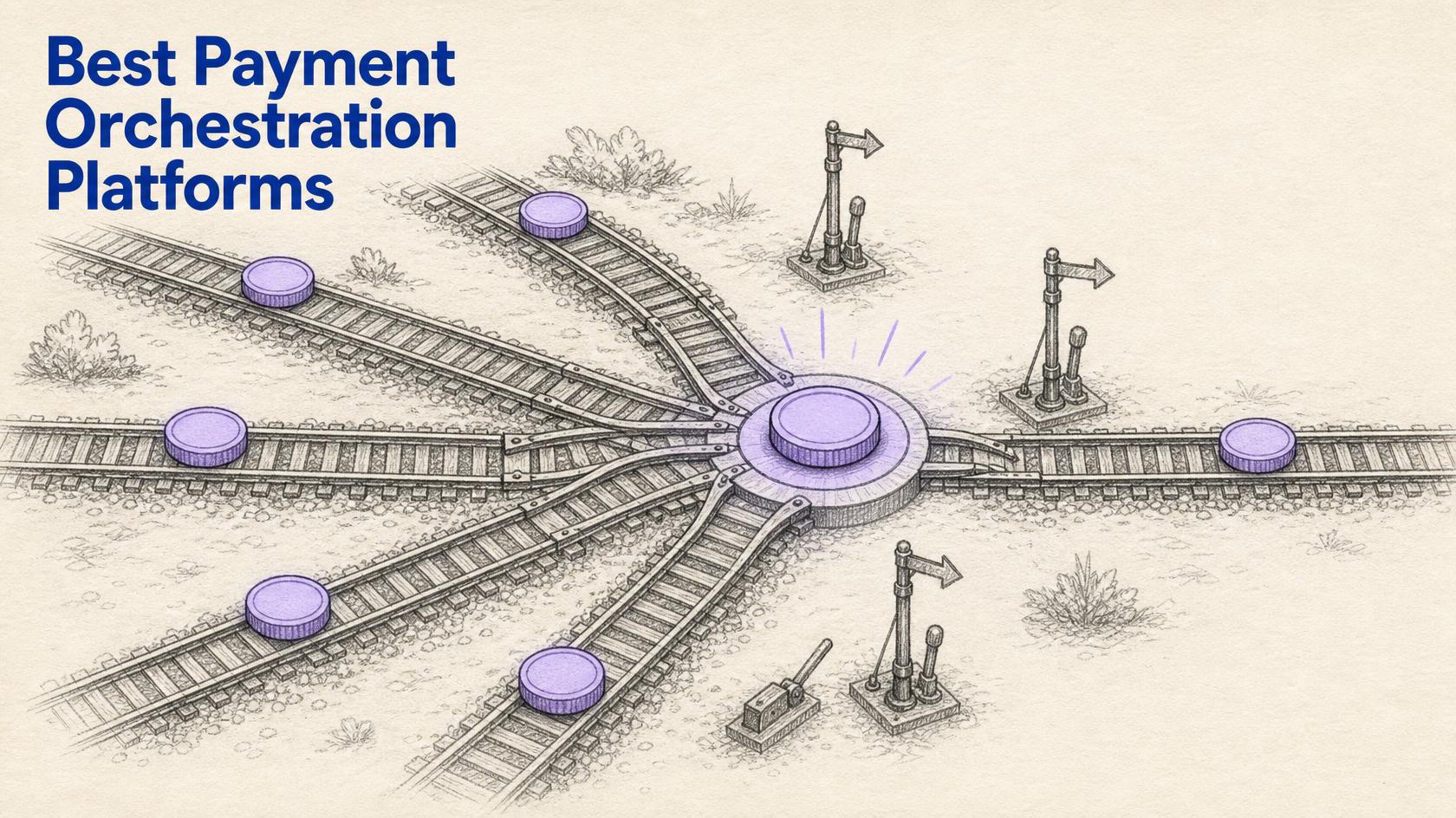
Best Payment Orchestration Platforms: Top 6 (2026)
Best Payment Orchestration Platforms: Top Options Compared
TL;DR
Best overall for enterprise buyers is BVNK, on licensing depth and its pending acquisition by Mastercard. Best for developer-first teams building custom flows is Bridge, now part of Stripe. Best for Latin American corridor coverage is Conduit. Best for institutional custody integration is Zero Hash. There is no single best payment orchestration platform. The right pick depends on which corridors you need, whether you want a routing layer or a full regulated stack, and how much acquisition risk you are willing to carry.
What actually matters when choosing a payment orchestration platform
Five criteria decide most of these evaluations, in order of how often they eliminate a candidate.
Licensing and jurisdictional coverage. A platform that is not licensed in your target market means you are either blocked or relying on a sub-license you do not control. Check the actual license list, not marketing copy that says "global."
Corridor depth. Broad blockchain support does not equal broad payout support. A platform can move stablecoins across ten chains and still have no local payout rail into Mexico or Nigeria. Ask which fiat corridors are live, not planned.
Custody model. Some platforms hold funds themselves, others let you self-custody and only route. This changes your regulatory exposure and your balance sheet treatment.
Settlement and reconciliation. Instant on-chain settlement is the easy part. What matters is whether the platform gives you clean, exportable reconciliation data that survives a financial audit.
Vendor concentration risk. Building your entire payment stack on one provider, especially one that was recently acquired, means your roadmap now depends on someone else's priorities.
The framing worth sitting with: most teams evaluate orchestration platforms on chain coverage first. That is the wrong first filter. Chain coverage is table stakes. Licensing and corridor depth are what actually block a launch.
Quick comparison table
| Platform | Licensing | Corridor strength | Custody model | Best for |
|---|---|---|---|---|
| BVNK | MiCA licensed, 25+ licenses/approvals across 130+ countries | Broad enterprise coverage, SWIFT/SEPA/Faster Payments/FedWire plus stablecoin rails | Managed or self-hosted via Layer1 | Enterprise buyers wanting contractual SLAs |
| Bridge (Stripe) | Operates under Stripe's regulatory stack in the US; coverage varies by product | Strong US dollar-denominated disbursements | Bridge-managed | Teams already on Stripe wanting a single dashboard |
| Conduit | FinCEN MSB (Montana) and FINTRAC MSB (Canada); no banking charter, settles through roughly 30 partner banks worldwide | Deep Latin American corridor coverage (pay-in and pay-out), with PIX and SPEI confirmed live | Conduit-managed | Businesses moving money into and out of Latin America |
| Zero Hash | FinCEN MSB, money transmitter licenses in 51 US jurisdictions, NYDFS BitLicense, North Carolina trust charter, plus MiCA authorization via the Dutch AFM and a DNB EMI license | Institutional and embedded fintech flows | Zero Hash-managed custody | Fintechs embedding crypto without building custody in-house |
| Circle | Regulated USDC issuer, Circle Mint for institutional mint/redeem | Protocol-level, not corridor-specific | Reserve-backed issuance, not payment custody | Teams standardizing on USDC at the protocol layer |
| Crossmint | Not independently verified in this comparison; confirm current licensing directly, its own positioning emphasizes developer-friendly SDKs for consumer apps over published multi-jurisdiction licensing detail | Wallets, payments, orchestration, and compliance in one API | Crossmint-managed with self-custody options | Teams wanting to consolidate a wallet provider and an orchestration layer into one vendor |
Top options compared
BVNK is the enterprise pick right now, and the reason is not just product depth. BVNK holds a MiCA license, reports more than 25 licenses and regulatory approvals across over 130 countries, and in March 2026 agreed to be acquired by Mastercard for up to 1.8 billion dollars, including 1.5 billion fixed plus 300 million in performance-based contingent payments, the largest stablecoin infrastructure acquisition to date, surpassing Stripe's 1.1 billion dollar purchase of Bridge. The deal is expected to close by the end of 2026 pending regulatory approval, and is not yet finalized as of this writing. BVNK's clients include Worldpay, Deel, and Flywire, and it processed roughly 30 billion dollars in payments over the past year, a signal that changes how a CFO reads the vendor risk column. Its Layer1 engine bundles smart treasury automation, a digital asset engine for stuck transaction retries and gas optimization, a multi-venue trading engine, configurable custody, and an embedded compliance engine covering AML, Travel Rule, and sanctions checks. Where it breaks: this depth comes with more implementation surface area than a narrow orchestration API, so a small team wanting to ship in two weeks may find BVNK is more platform than they need.
Bridge, acquired by Stripe for 1.1 billion dollars in a deal that closed in February 2025, remains the most developer-friendly orchestration API on the market. Its abstraction over blockchain complexity is genuinely good, and it now sits inside a broader Stripe stack that includes Privy for embedded wallets. Where it breaks: roadmap decisions, pricing changes, and API deprecations now flow through Stripe's priorities rather than standalone stablecoin infrastructure priorities. Teams building a payment stack they expect to run for years should treat single-vendor concentration on a recently acquired product as a real risk, not a footnote.
Conduit is the strongest pick for Latin American corridor depth specifically, connecting named accounts, wallets, and payouts through one API into a region where most orchestration platforms have thin coverage. Where it breaks: outside its core corridors, coverage depth has not been independently verified to the same degree as BVNK's, so confirm current licensing and payout coverage directly before committing a build.
Zero Hash is built for fintechs that want to embed crypto conversion, custody, and monitoring behind their own interface rather than send users to a separate platform. Its documentation is unusually explicit about exception handling and reconciliation, which matters more than it sounds once a payment fails midway through a flow. Where it breaks: Zero Hash is optimized for embedding, not for teams that want a standalone dashboard and minimal integration work.
Circle is not a general orchestration platform and should not be evaluated as one. It is the right choice specifically for teams standardizing on USDC at the protocol level, minting and redeeming through Circle Mint, or building on Circle's Arc settlement chain. Where it breaks: Circle does not solve fiat corridor payout the way BVNK or Conduit do.
Crossmint covers the widest surface area of any platform on this list, combining wallets, payments, orchestration, and compliance in a single API, which makes it the closest match for teams that want to replace both an orchestration vendor and a separate wallet provider with one integration. Where it breaks: breadth of surface area is not the same as depth in any one corridor, so teams with a narrow, high-volume corridor need are often better served by a specialist.
Key differences that actually matter
The real split in this market is not chain coverage, it is regulatory posture. BVNK and Conduit hold and operate under their own licenses across dozens of markets. Bridge inherits Stripe's regulatory stack, which is deep in the US and less transparent internationally. Zero Hash and Crossmint sit in between, holding specific state and federal licenses while depending on partners for some markets. If your business needs to say, in an audit, exactly which entity is licensed to move money in which country, that answer takes one phone call with BVNK and several more with platforms that route through partners.
The second real split is acquisition exposure. Bridge is inside Stripe. BVNK's Mastercard acquisition is agreed but not yet closed, expected by year-end 2026. Both changes are recent enough that pricing, support responsiveness, and roadmap priorities have not fully settled under new ownership, and BVNK's deal specifically could still be affected by regulatory review before closing. Teams that need stability over the next two years should ask both vendors directly what changes, if anything, in their contract terms post-acquisition.
When the number one pick is not the right choice
BVNK is not the right choice for an early-stage startup that needs to ship a stablecoin payout flow in two weeks with a two-person engineering team. That team is better served by Bridge's simpler developer experience, accepting the concentration risk as a conscious trade-off rather than an oversight. Similarly, a business whose only real need is Latin American pay-in and pay-out should not default to BVNK's broader platform when Conduit's narrower, deeper corridor coverage solves the actual problem with less implementation overhead.
The verdict
BVNK is the strongest overall pick for enterprise buyers who need licensing depth, SLA guarantees, and a platform built to survive a financial audit. Bridge remains the fastest path to shipping for developer-first teams already comfortable with Stripe as a dependency. Conduit is the specialist pick for Latin American corridors. Zero Hash and Crossmint both fit teams that want to embed rather than integrate a standalone dashboard, with Zero Hash stronger on institutional custody and Crossmint stronger on combining wallets and orchestration in one contract.
For related coverage, see our comparisons of Stripe Stablecoin Alternatives, Best Stablecoin Infrastructure for Fintechs, and What Is Payment Orchestration.
FAQs
What is the best payment orchestration platform for a fintech?
BVNK is the strongest overall pick for regulated fintechs due to its licensing depth across 130+ countries and enterprise SLA guarantees. Teams prioritizing fast developer onboarding over licensing breadth often choose Bridge instead, accepting Stripe concentration risk as a trade-off.
Is Bridge still independent after the Stripe acquisition?
No. Stripe acquired Bridge for 1.1 billion dollars in a deal that closed in February 2025. Bridge now operates as part of Stripe's broader stack, which also includes the Privy wallet infrastructure Stripe acquired separately in 2025.
What is the difference between payment orchestration and a stablecoin issuer like Circle?
Payment orchestration platforms route, convert, and settle payments across rails and corridors. Circle issues and redeems USDC itself. A business can use Circle for the underlying stablecoin and still need an orchestration layer like BVNK or Bridge to actually move that stablecoin through fiat corridors.
Which payment orchestration platform has the deepest licensing?
BVNK currently reports the broadest licensing footprint among the platforms compared here, with more than 25 licenses and regulatory approvals across over 130 countries, plus a MiCA license.
Last updated: September 8, 2026 Written by the stablecoin.nyc Editorial Desk