7 Stripe Stablecoin Alternatives Compared (2026)
Stripe Stablecoin Alternatives: 7 Options Compared
TL;DR
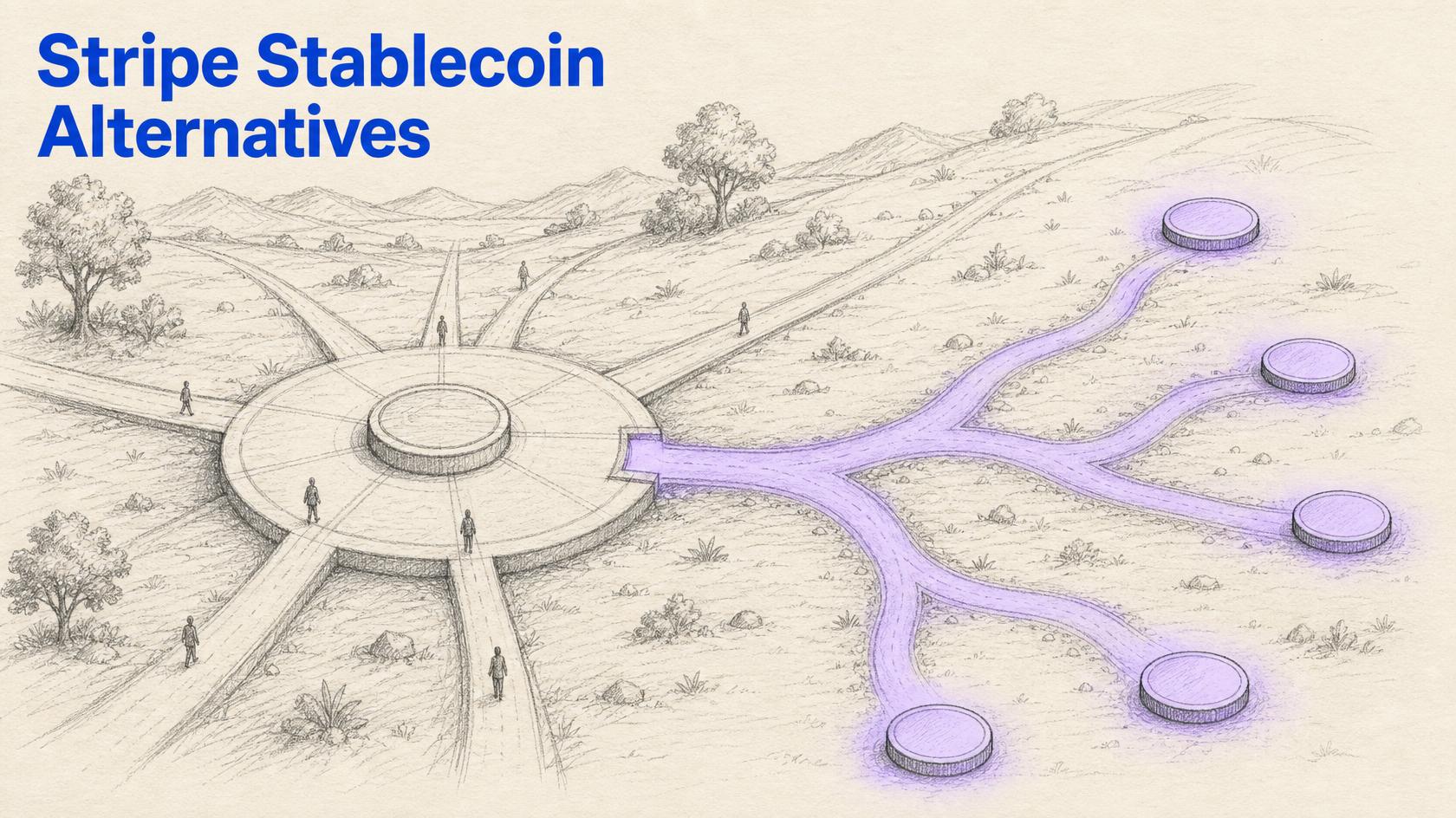
Stripe added stablecoin payments through its 1.1 billion dollar acquisition of Bridge, closed in February 2025, layering stablecoin pay-ins onto its existing card and ACH stack. The real limitation is not the product, it is concentration: teams building on Stripe's stablecoin rail are building on a single vendor whose roadmap, pricing, and API decisions now serve Stripe's broader business rather than standalone stablecoin infrastructure priorities. Stripe's own strength, deep US integration for businesses already on its dashboard, is real and worth acknowledging before looking elsewhere.
What actually matters when replacing Stripe's stablecoin stack
Independence from a single acquirer. The core reason teams look for a Bridge alternative is not a feature gap, it is exposure. A provider that is not owned by a larger payments company carries a different kind of roadmap risk, for better and worse.
Corridor coverage beyond the US. Stripe's stablecoin stack is strongest for US dollar-denominated flows. Teams with cross-border payout needs, particularly into Latin America or Southeast Asia, often find the corridor depth elsewhere.
Compliance ownership. Some alternatives hold their own licenses across dozens of jurisdictions. Others route through partners. This changes what you can say in an audit about who is actually regulated to move the money.
Multi-chain routing. Bridge's cross-chain movement capability is narrower than a dedicated routing layer. If your flow spans several chains rather than settling primarily in one, this matters.
Quick comparison table
| Platform | vs Stripe/Bridge on independence | Corridor strength | Compliance model | Best for |
|---|---|---|---|---|
| Stripe (Bridge) | N/A, baseline | Strong US dollar disbursements | Inherits Stripe's regulatory stack | Businesses already on Stripe wanting one dashboard |
| BVNK | Fully independent, MiCA licensed | Enterprise-wide, 130+ countries | 25+ direct licenses and approvals | Enterprise buyers wanting contractual SLAs |
| Conduit | Independent | Deep Latin American corridors | FinCEN MSB registration (Montana) and FINTRAC MSB registration in Canada; no banking charter, client funds held across roughly 30 partner banks worldwide | Businesses with LatAm pay-in/pay-out needs |
| Zero Hash | Independent | Institutional and embedded fintech flows | FinCEN MSB, money transmitter licenses in 51 US jurisdictions, NYDFS BitLicense, North Carolina trust charter, plus MiCA authorization from the Dutch AFM and an EMI license from DNB as of 2026 | Fintechs embedding crypto without building custody |
| Sphere | Independent | Crypto-native, API-first flows | Not independently verified in this comparison; confirm current licensing directly | Teams wanting a lighter-weight, developer-first API |
| Mural Pay | Independent | B2B cross-border payouts | Not independently verified in this comparison; confirm current licensing directly | Businesses paying international contractors and vendors |
| Bitso Business | Independent | Strong Latin American coverage via Bitso's exchange footprint | Licensed across multiple LatAm jurisdictions | Businesses needing LatAm on/off-ramp alongside payouts |
Top options compared
BVNK is the strongest full independence play on this list, and the timing matters: in March 2026 BVNK agreed to be acquired by Mastercard for up to 1.8 billion dollars, including 300 million in contingent payments, a deal not yet closed and expected to complete by year-end 2026 pending regulatory approval. That is a different kind of ownership story than Stripe's. A payments network acquirer signals BVNK stays focused on payments infrastructure rather than becoming a feature inside a broader consumer or SaaS product, though the deal's own regulatory review is worth watching before treating the acquisition as settled. BVNK holds a MiCA license and reports more than 25 licenses and approvals across over 130 countries, plus enterprise features like smart treasury automation and an embedded compliance engine. Where it breaks: more implementation surface area than Bridge's simpler API, so teams optimizing purely for speed to launch may find Stripe's existing dashboard still faster to ship against.
Conduit solves the specific problem Stripe does not: deep Latin American corridor coverage, along with meaningful Africa exposure, Nigeria and Kenya together accounted for roughly 20 percent of its volume as of August 2024. It operates as a registered MSB with FinCEN in the US and FINTRAC in Canada rather than under a banking charter, running daily net settlement against a network of nearly 30 partner banks worldwide, including six active in the US. If the reason you are looking for a Stripe alternative is that your payout flow into Mexico, Brazil, or Argentina does not work well through Stripe's stack, Conduit is the direct answer, with PIX and SPEI confirmed as live local rails. Where it breaks: it holds no banking charter itself, settling instead through its partner bank network, worth understanding for institutions with a specific charter requirement, and coverage outside LatAm and Africa is not independently verified to the same degree.
Zero Hash fits teams that want to embed stablecoin conversion and custody behind their own interface rather than route through a third-party dashboard the way Stripe's product works, backed by a genuinely broad regulatory footprint: FinCEN MSB status, money transmitter licenses across 51 US jurisdictions, a NYDFS BitLicense, a North Carolina trust charter, and international registrations spanning Canada, Australia, Bermuda, and Argentina, plus MiCA authorization from the Dutch AFM and an EMI license from DNB, the first case of a MiCA firm adding e-money issuer status specifically for stablecoin settlement across the EEA. Its reconciliation and exception-handling documentation is notably explicit. Where it breaks: it is built for embedding, not for a team wanting Stripe's plug-and-play dashboard experience with minimal integration work.
Sphere is the pick for crypto-native, API-first teams who found Stripe's stablecoin layer felt like a bolt-on to a card-first product rather than a purpose-built stablecoin API. Where it breaks: its licensing footprint was not independently verifiable to the depth of BVNK's or Zero Hash's for this comparison, confirm directly before positioning it as an enterprise-grade Stripe replacement rather than a lighter developer tool.
Mural Pay and Bitso Business round out the field for more specific use cases. Mural Pay is built around B2B cross-border payouts specifically, a narrower and often better fit than a general orchestration platform for finance teams paying international vendors. Bitso Business leans on Bitso's existing exchange and licensing footprint across Latin America, which gives it a different kind of corridor depth than a pure orchestration API. Where either breaks: neither publishes licensing detail as extensively as BVNK, Conduit, or Zero Hash, so confirm current regulatory status directly for the specific jurisdictions your flow touches.
Key differences that actually matter
The single decision that should drive this choice is whether your primary payout need is US-based or cross-border. If it is US-based and you are already deep in Stripe's ecosystem, the honest answer is that switching away from Bridge trades a real convenience for a reduction in concentration risk that may not matter to your business yet. If your payout need is cross-border, particularly into Latin America, Stripe's stablecoin stack was never built for that corridor depth, and Conduit or Bitso Business solve a problem Stripe does not.
The second decision is how much you weight acquisition risk. Building on a single Stripe-owned rail means roadmap decisions, pricing, and API changes now flow through Stripe's priorities. That risk is not theoretical. Multi-provider redundancy is increasingly standard practice for stablecoin payment stacks precisely because switching costs grow the deeper you integrate, so the decision to diversify is easier made early.
When Stripe is still the right choice
A business already running its card and ACH processing through Stripe, whose stablecoin need is limited to accepting USDC pay-ins from US customers, gains real value from staying in one dashboard rather than adding a second vendor relationship for a use case Stripe already covers adequately. The switching cost of adding BVNK or Conduit only pays off once your corridor, compliance, or independence needs exceed what Stripe's stack was built for.
See also our breakdowns of Best Payment Orchestration Platforms, Circle Payment Network Alternatives, and Best Stablecoin Infrastructure for Fintechs.
FAQs
What is the best Stripe stablecoin alternative?
BVNK is the strongest overall alternative for enterprise buyers, on the strength of its licensing depth and its pending acquisition by Mastercard rather than a payments-adjacent tech company. For Latin American corridors specifically, Conduit or Bitso Business are stronger fits than a general-purpose alternative.
Is Bridge part of Stripe now?
Yes. Stripe acquired Bridge for 1.1 billion dollars in a deal announced in October 2024 and closed in February 2025. Bridge's stablecoin orchestration and issuance products now operate as part of Stripe's broader payments stack.
Why would a business look for a Stripe stablecoin alternative if Stripe already supports USDC?
The most common reasons are corridor coverage outside the US, a desire to avoid concentrating payment infrastructure on a single acquirer, and multi-chain routing needs that go beyond Bridge's core design. None of these reasons imply Stripe's stablecoin product is broken, they reflect different priorities.
Do these alternatives require giving up Stripe entirely?
No. Most businesses run these platforms alongside Stripe rather than as a full replacement, using Stripe for card and ACH processing and a dedicated stablecoin platform for crypto-specific corridors or compliance needs Stripe does not cover.
Last updated: September 8, 2026 Written by the stablecoin.nyc Editorial Desk