
Stablecoin News: Key Developments to Watch in 2026
The stablecoin story to watch in 2026 is US implementation of the GENIUS Act, with issuers expected to need a federal or state license from Jan. 18, 2027. Around that clock sit two parallel threads: bank payment rails reaching stablecoin wallets, and a policy debate over whether dollar-pegged tokens entrench dollar dominance. Most stablecoin news arrives as scattered headlines.
How we ranked these stablecoin news sources
A news source is only useful if it matches the decision you have to make. A trader, a compliance officer and a newcomer need different inputs, so we scored sources on five criteria:
- Stablecoin depth. Does the source treat stablecoins as their own category, or as a footnote to token prices?
- Institutional rigor. Is the framing suitable for treasurers, allocators and counsel?
- Regulatory coverage. Does it track legislation and agency rulemaking, not only market moves?
- Timeliness. How quickly does coverage follow events?
- US relevance. Does it address the US framework where most implementation pressure now sits?
A short list of distinct roles beats a long list of overlapping feeds.
Quick summary of the three sources
- CoinDesk: crypto-native tag page with policy video coverage. Best for timeliness.
- J.P. Morgan Global Research: bank-authored explainer on stablecoins. Best for institutional framing.
- US News: plain-language topic hub for stablecoins. Best for newcomers.
Key 2026 stablecoin developments timeline

The year has three anchor events. Each touches a different constituency.
| Date | Development | Who is affected | Source |
|---|---|---|---|
| Mar 17, 2026 | - | Banks, remittance and payroll operators | PR Newswire release |
| May 31, 2026 | ECB board member Isabel Schnabel warns stablecoins could reinforce dollar dominance | Central banks, non-US policymakers, euro-area treasurers | Reuters via Yahoo Finance |
| Aug 17, 2026 | US Treasury proposes definitions for issuing a payment stablecoin in the US and offering one to US customers | Issuers, offshore issuers, digital asset platforms | crypto.news |
| Jan 18, 2027 | Expected GENIUS Act effective date; issuers generally need a federal or state license | US payment stablecoin issuers | crypto.news |
| Jul 18, 2028 | - | - | - |
The sequencing matters more than any single row. Distribution and issuance are being pulled into the regulated perimeter at the same moment bank rails open to stablecoin endpoints.
GENIUS Act licensing window
President Trump signed the GENIUS Act on July 18, 2025. That compresses the preparation window to roughly five months. For more background, see GENIUS Act means for stablecoin regulation.
Patrick Gerhart, president of Telcoin Digital Asset Bank, told the outlet that the hard part is operational: customer identification, tracing funds, transaction monitoring, reserve management and redemptions must function as one system. The OCC's draft framework covers reserves, redemptions, custody, liquidity, capital, audits and reporting. Treasury is also weighing customer and location checks that could reach offshore issuers.
For the statutory baseline, see our summary of GENIUS Act key provisions.
Takeaway: a reserve account and a written policy are not a license. Integrated controls are.
Bank rails reach stablecoin wallets
Thunes' March announcement is a hot-start distribution play.
The implication is that stablecoins become an endpoint on the correspondent network, not a parallel system. Salary payouts and remittances are the stated use cases.
Takeaway: distribution through incumbent rails favors the largest dollar stablecoins, which reinforces concentration.
Dollar dominance and monetary policy
Schnabel argued at a Bank of Korea conference that dollar dominance could be reinforced through network effects, scale and first-mover advantages rather than stronger fundamentals. Reuters noted IMF data showing the dollar's share of FX reserves fell below 57% last year, from 70% at the turn of the century.
The mechanism is straightforward. Most stablecoins are dollar-pegged. In countries with weak monetary credibility, demand for dollar tokens can weaken policy transmission, which can drive further demand.
Takeaway: stablecoin growth is now a monetary sovereignty question, not only a crypto market question.
At a glance: comparison of the three sources
| Rank | Source | Pricing | Best for | Standout |
|---|---|---|---|---|
| 1 | CoinDesk | Check current access terms | Traders, crypto operators | Stablecoin tag page plus policy video |
| 2 | J.P. Morgan Global Research | Check current access terms | Institutional allocators | Bank-authored explainer framing |
| 3 | US News | Check current access terms | Newcomers | Plain-language definitions |
CoinDesk: fastest crypto-native coverage
CoinDesk runs a dedicated stablecoin tag page aggregating news, analysis and video.
Key features. The tag mixes reporting with shows such as CoinDesk Daily and The Policy Protocol, which has covered the politics of the CLARITY Act and the state-versus-federal fight over prediction markets. The feed also carried the KAST funding round and on-chain analysis of World Liberty Financial's use of its own stablecoin as DeFi collateral.
Who it's for. Traders, protocol teams and anyone who needs same-day awareness of market structure and policy moves.
Caveat. The framing is crypto-native. Stablecoin stories sit beside Bitcoin price items, so compliance readers must filter for what touches their perimeter.
J.P. Morgan Global Research: institutional framing
J.P. Morgan Global Research publishes a "What to Know About Stablecoins" explainer within its currencies research.
Who it's for. Institutional investors and corporate treasurers who want stablecoins framed in the language of currencies, liquidity and payments.
Strength. The vantage point is a global bank with its own payments and markets businesses, which gives readers a sense of how incumbents view the category.
Caveat. It is bank-authored and periodic. It is a reference layer, not a daily news feed, and readers should weigh the author's commercial position in payments.
US News: general-audience explainer
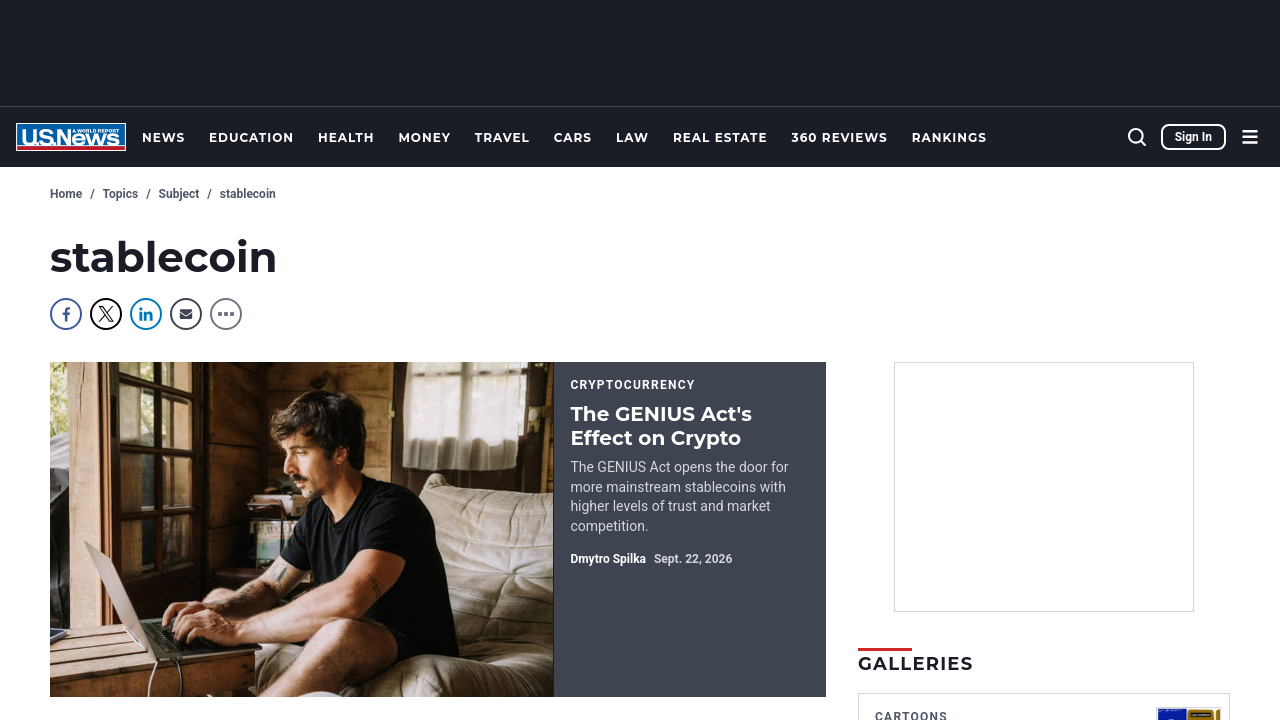
US News maintains a stablecoin topic page that defines stablecoins as lower-volatility digital assets intended to preserve purchasing power, and notes that a popular one collapsed.
Who it's for. Newcomers, or colleagues outside crypto who need the basic definition and the core risk: pegs can fail.
Caveat. Limited regulatory and market depth. It will not help you model reserve composition or licensing timelines.
What else to watch: research and policy signals

News outlets are lagging indicators. Research and capital flows lead.
- MIT Digital Currency Initiative. Its April to June 2026 newsletter flagged new papers on stablecoins in Africa and public blockchains. MIT DCI notes accelerating adoption with significant implications for African markets, where cross-border payments remain costly.
- Capital into compliance. CoinDesk reported KAST raised $80 million at a $600 million valuation, with funding directed to product expansion, licensing and compliance. Capital is pricing licensing as a moat.
- Builder ecosystem. As payout rails open, integration demand rises; our review of web3 development companies is relevant for teams scoping that work.
Takeaway: follow where research and venture money concentrate; it usually precedes the headline.
How to choose a stablecoin news source
Map the source to your role. Traders and operators need CoinDesk's timeliness; compliance and legal teams need primary documents plus a source that tracks agency rulemaking; newcomers should start with the US News definitions before moving to institutional research. Allocators benefit from J.P. Morgan's framing but should read it knowing who wrote it. For any outlet, check editorial independence and whether sponsors and partner content are disclosed.
FAQ: Frequently Asked Questions
What's happening with stablecoins?
The US is implementing the GENIUS Act, with licensing expected from Jan. 18, 2027. Banks are gaining payout access to stablecoin wallets through Swift, and central bankers are debating effects on dollar dominance and monetary policy.
What are the top 5 stablecoins?
Rankings shift with market capitalization, so check a live data provider. USDC and USDT are the two named in recent bank infrastructure news, supported by Thunes' Pay-to-Stablecoin-Wallets solution for Swift-connected banks.
Is stable coin a good investment?
Stablecoins are designed to hold a steady value, not appreciate, so they function as payment and settlement instruments rather than growth assets. Pegs can fail, as past collapses show. This is not investment advice.
Is XRP going to be a stablecoin?
No. XRP is a floating-price token, not one pegged to a fiat currency. A stablecoin targets a fixed value, typically one dollar, backed by reserves. A separate token would be required to serve that function.
When do GENIUS Act license rules take effect?
The expected effective date is Jan. 18, 2027, when issuers generally need a federal or state license. Restrictions on US platforms distributing unapproved stablecoins follow from July 18, 2028.
Which stablecoins do bank payout rails support?
Thunes' Pay-to-Stablecoin-Wallets solution supports USDC and USDT. Through Swift connectivity, institutions on that network can send real-time payouts to stablecoin wallets in over 140 countries without additional integration.
Implication: compliance becomes the competitive variable
The 2026 developments point one direction. Issuance is being licensed, distribution is being restricted to approved tokens, and incumbent rails are routing volume to the largest dollar stablecoins. In that structure, the scarce asset is not reserves or a token contract; it is an operating model regulators will certify.
The open question is whether licensing concentrates the market further around dollar incumbents, accelerating the network effects Schnabel described, or whether compliant challengers can use the same rails to cold-start against them.