Genius Act Summary: The Key Provisions Explained
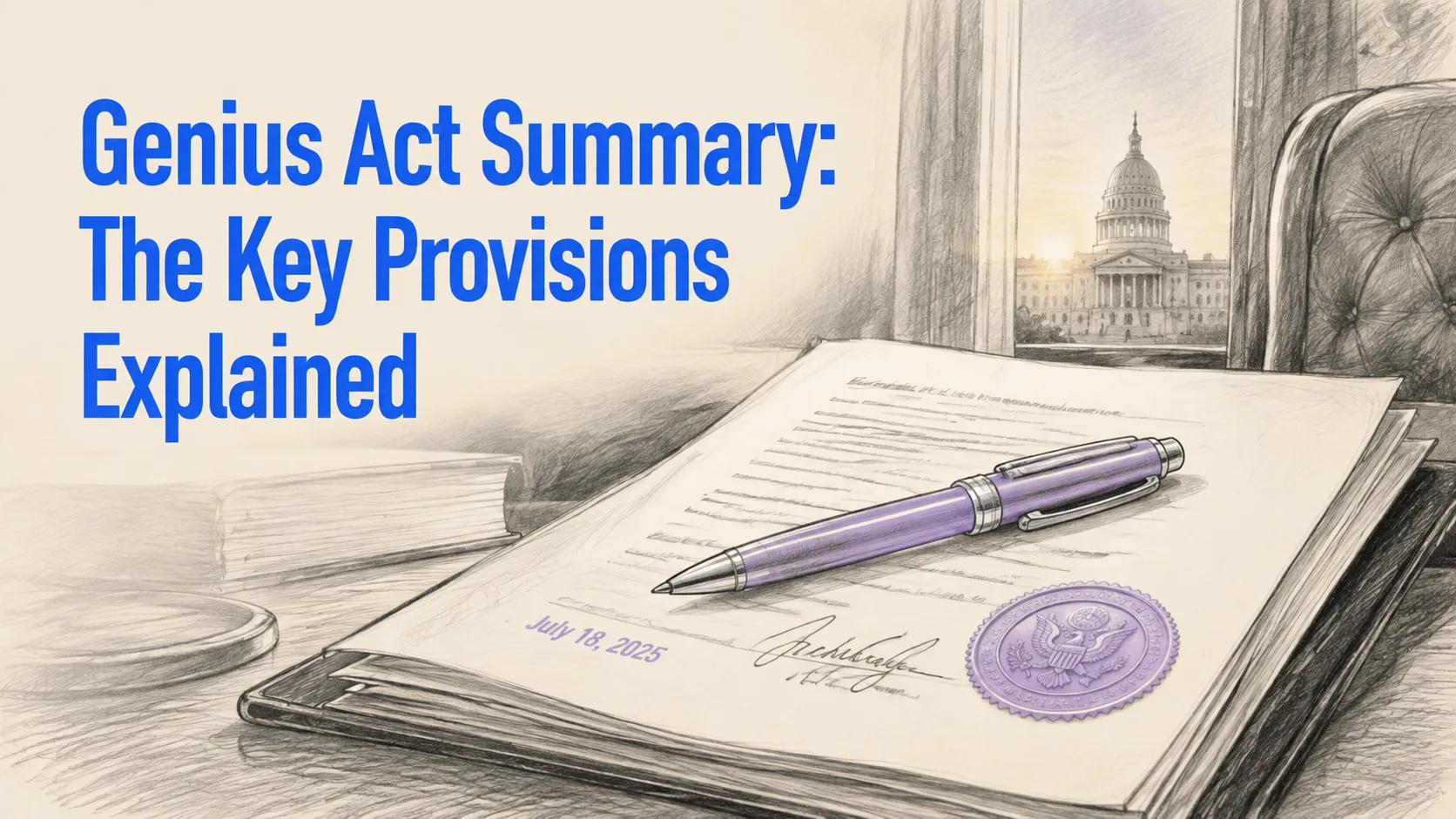
The GENIUS Act, signed into law on July 18, 2025, is the first comprehensive federal statute governing payment stablecoins in the United States. Passed with bipartisan margins of 68-30 in the Senate and 308-122 in the House, it defines who may issue a dollar-pegged token, how reserves must be structured, and which agencies hold oversight authority. For regulators and policy researchers tracking this new perimeter, Stablecoin.nyc publishes ongoing analysis of the statute and its downstream rulemaking.
The thesis in one sentence: stablecoins are now a bank-adjacent product line, ring-fenced from securities and commodities law, backed one-for-one by cash and short-dated Treasuries, and structurally forbidden from paying yield. Everything below unpacks that framing.
Definition: What Is the GENIUS Act
The GENIUS Act, formally the Guiding and Establishing National Innovation for US Stablecoins Act, was introduced in the Senate on February 4, 2025 as S.1582. It became the first federal digital asset law when the President signed it on July 18, 2025. The statute replaces a patchwork of state trust charters and enforcement-by-guidance with a defined federal perimeter for payment stablecoins, and it does so without touching the broader crypto asset stack. Readers tracking the legislative history alongside adjacent bills should review our earlier coverage of prior stablecoin bills in committee.
Full Name and Legislative History
The bill cleared the Senate 68-30 on June 17, 2025, then passed the House 308-122 on July 17 during what House leadership branded "Crypto Week." According to the Latham & Watkins client alert, the President signed it into law the following day, closing the gap between an executive order framing the US as a hub for digital assets and durable statutory authority. For a broader read on the legislative arc, our fundamentals archive collects prior coverage of the bill's negotiation.
What Is a Payment Stablecoin Under the Act
A "payment stablecoin" is defined narrowly: a digital asset designed for payment or settlement, pegged to a fixed monetary value, and explicitly not a national currency, bank deposit, or security. The Act removes compliant payment stablecoins from the definitions of "security" under federal securities law and "commodity" under the Commodity Exchange Act, stripping the SEC and CFTC of primary jurisdiction over these instruments. Non-permitted stablecoins get the opposite treatment: they cannot be treated as cash equivalents, used as margin or collateral, or accepted as settlement assets between banking organizations. Our analysis desk has tracked how this bifurcation reshapes the on-ramp economics for issuers.
Takeaway: the statute's scope is deliberately narrow. It regulates one instrument class, defines it precisely, and cleanly excises it from the securities and commodities regimes.
How It Works: Licensing and Regulatory Oversight

The Act operates through a permissioning regime. Only "permitted payment stablecoin issuers" may issue stablecoins to US persons, and every other issuer is prohibited outright. Enforcement flows through the digital asset service providers that would otherwise distribute non-compliant tokens, tightening the funnel at the exchange and custodian layer. Our institutions coverage tracks how large custodians are already restructuring their listing frameworks in anticipation.
Federal vs. State Regulatory Pathways
Issuers with more than $10 billion in outstanding stablecoins must obtain federal oversight. Below that threshold, an issuer may opt into a state regime, but only if the state framework is certified as "substantially similar" to the federal standard. This is the structural compromise that got the bill across the aisle: it preserves state trust charters while capping their reach. Readers watching how state regimes will be measured should read our note on SEC custody rules and adjacent state frameworks.
Oversight by the OCC and Primary Regulators
Federally licensed nonbank stablecoin issuers fall under the Office of the Comptroller of the Currency. Insured depository institution subsidiaries remain with their primary financial regulator, which preserves the existing bank supervision perimeter for bank-issued tokens. This split matters for capital treatment, examination cadence, and, ultimately, the cost of issuance. For related supervisory context, see our macro category.
Restrictions on Non-Permitted Issuers
A public company not predominantly engaged in enumerated financial activities must obtain clearance from a newly created Stablecoin Certification Review Committee before it may issue a payment stablecoin. Digital asset service providers are barred from offering or selling stablecoins issued by non-permitted issuers, with a narrow exception for qualifying foreign issuers that meet compliance standards comparable to those of domestic permitted issuers. That gating requirement is likely to be one of the most-litigated provisions in the statute, as noted in our work-with-us research notes.
Takeaway: the licensing regime is a three-tier structure (federal nonbank, bank subsidiary, state-regulated small issuer) with a purpose-built committee acting as gatekeeper for non-financial public company applicants.
Reserve Requirements and Consumer Protections

The reserve and disclosure regime is where the Act does its heaviest lifting. It converts stablecoins from a category defined by market convention into one defined by statute, with bank-style prudential mechanics grafted on. Our fundamentals hub has ongoing coverage of how issuer balance sheets are being restructured to comply.
One-to-One Reserve Backing
Issuers must maintain reserves backing outstanding stablecoins on at least a 1:1 basis, held only in US dollars, short-term US Treasuries, or similarly specified high-quality liquid assets. Monthly public disclosures of reserve composition are mandatory, alongside routine reserve audits. The mechanics resemble a narrow-bank balance sheet, and the second-order effect on Treasury demand is discussed in our note on Treasury-backed assets and yield.
Yield Ban and Marketing Restrictions
Issuers may not pay any form of interest or yield to holders simply for holding the stablecoin. This is a structural design choice, not a disclosure rule: it separates payment stablecoins from bank deposits and money market funds as a matter of legal identity. Issuers also cannot claim their tokens are backed by the US government, federally insured, or legal tender. Our macro desk has explored how the yield ban reshapes competition with tokenized money market funds.
Insolvency Protections for Holders
In an issuer insolvency, stablecoin holders hold priority claims over all other creditors against the issuer's reserve assets, superseding existing bankruptcy law. That is a material departure from the general priority regime in Chapter 11 and functions as a final backstop for retail and institutional holders. According to the White House fact sheet on the signing, this provision was central to the consumer protection framing. Related market-plumbing analysis lives in our liquidity trap piece.
Takeaway: the reserve rules define what the token is, the yield ban defines what it is not, and the insolvency priority defines what happens when the wrapper breaks.
Why It Matters: Macroeconomic and National Security Implications
The Act is being read as much through a Treasury-demand lens as a consumer-protection lens. Policymakers understand that mandating dollar and short-Treasury backing creates a durable, price-insensitive buyer of US government debt. Our sovereign debt and digital collateral piece frames this as a quiet fiscal channel.
Strengthening US Dollar Reserve Currency Status
By constraining permissible reserves to dollars and short-dated Treasuries, the statute directs any growth in stablecoin float into US government debt. If the outstanding float scales from roughly $250 billion into the trillions over the next decade, as several policy analyses project, the marginal buyer of T-bills becomes a compliance-driven issuer rather than a foreign central bank. That dynamic reinforces dollar demand at the settlement layer. Our CBDC roadmap coverage contrasts this private-sector channel with sovereign digital currency efforts.
Anti-Money Laundering and Sanctions Compliance
Permitted issuers are classified as "financial institutions" under the Bank Secrecy Act. That obligation triggers AML programs, customer identification, sanctions list verification, and Suspicious Activity Report obligations. All issuers must maintain the technical capability to seize, freeze, or burn payment stablecoins when legally required, and must comply with lawful orders to do so. Foreign issuers may serve US customers through digital asset service providers only under comparable compliance standards. For adjacent enforcement architecture, see our interviews with policy counsel.
Takeaway: the Act does two things simultaneously that rarely coexist in one statute. It creates a fiscal tailwind for Treasury demand and it embeds the sanctions perimeter directly into the token protocol layer.
Common Misconceptions About the GENIUS Act
The statute is narrow, its yield ban is absolute, and its effective date is not immediate. Each of those points is routinely misstated in secondary coverage. Readers looking for a clean primary-source companion to this section should visit our resources page.
Misconception: All Crypto Is Now Regulated / Reality: Scope Is Limited to Payment Stablecoins
The Act governs payment stablecoins only. Bitcoin, Ethereum, utility tokens, governance tokens, and yield-bearing digital assets sit outside its four corners. Market-structure legislation covering those instruments continues to work through Congress on a separate track. Our analysis category has been mapping that adjacent legislative flow.
Misconception: Stablecoin Holders Earn Yield / Reality: Yield Is Explicitly Banned
The yield ban is not a disclosure or licensing hurdle; it is a categorical prohibition on issuers paying interest or yield of any kind to holders. Distribution partners are exploring reward and rebate structures that route around the ban, but the issuer-to-holder economic relationship is designed to look nothing like a deposit. Our note on de-pegging and liquidity cycles discusses how the ban interacts with secondary-market pricing.
Misconception: The Act Takes Effect Immediately / Reality: There Is a Phased Implementation Timeline
The Act takes effect on the earlier of 18 months after enactment (January 18, 2027) or 120 days after primary federal stablecoin regulators issue final implementing regulations. State regimes are not automatically grandfathered; each must be certified as substantially similar to the federal framework before it can host sub-$10 billion issuers. Rulemaking pace is the binding constraint on the timeline, as tracked in our primary market dynamics note.
Takeaway: the Act is narrower, stricter on yield, and slower to bind than the popular framing suggests.
How to Get Started: What the GENIUS Act Means for Policy Researchers and Regulators
For researchers, the practical work is triaging primary sources and tracking the rulemaking sequence. The statute itself is only the anchor document; most of the operational detail will come out of Treasury, OCC, and banking regulator rulemakings between now and January 2027. Our partnerships desk coordinates with academic and policy groups building compliance research libraries.
Key Documents and Primary Sources to Review
The full text of the GENIUS Act is published as S.1582, 119th Congress, on congress.gov, and it is the authoritative source for all provisions. Secondary summaries, including the Fidelity explainer and major law firm client alerts, are useful cross-references but should not substitute for the statutory text. For structural background on how the bill fits with tokenized asset infrastructure, see our Goldman Sachs tokenization desk note.
Monitoring the Rulemaking Process
The Treasury Department issued a notice of proposed rulemaking in April 2026 regarding oversight principles. Researchers should track subsequent final rules from Treasury, the OCC, and banking regulators, as well as certification decisions on state regimes. The Stablecoin Certification Review Committee's decisions on non-financial public company applicants will be the most consequential early proving ground, with obvious litigation risk. Our MiCA 2.0 comparison offers a useful transatlantic lens on how these certification processes tend to develop.
Takeaway: the statute is set; the operational shape of US stablecoin regulation will be written in rulemaking dockets between now and the January 18, 2027 backstop.
Frequently Asked Questions
What does the GENIUS Act stand for?
GENIUS stands for Guiding and Establishing National Innovation for US Stablecoins. It is the first federal law creating a comprehensive regulatory framework for payment stablecoins in the United States, signed into law on July 18, 2025.
When does the GENIUS Act take effect?
The Act takes effect on the earlier of 18 months after enactment, which sets a backstop of January 18, 2027, or 120 days after primary federal stablecoin regulators issue final implementing regulations. Rulemaking cadence controls the actual effective date.
Who can issue stablecoins under the GENIUS Act?
Only permitted payment stablecoin issuers may issue stablecoins to US persons. That includes federally licensed nonbank issuers overseen by the OCC, subsidiaries of insured depository institutions, and state-regulated issuers below the $10 billion threshold under substantially similar frameworks.
What assets are allowed as reserves under the GENIUS Act?
Reserves must back outstanding stablecoins on at least a 1:1 basis and may consist only of US dollars, short-term US Treasuries, or similarly specified high-quality liquid assets. Monthly public disclosures and routine reserve audits are mandatory.
Does the GENIUS Act regulate Bitcoin or Ethereum?
No. The Act's scope is limited to payment stablecoins. Bitcoin, Ethereum, utility tokens, and governance tokens fall outside its perimeter. Broader market-structure legislation covering non-stablecoin digital assets remains on a separate legislative track in Congress.
Can stablecoin issuers pay interest to holders under the GENIUS Act?
No. Issuers are explicitly prohibited from offering any form of interest or yield to holders in exchange for holding the stablecoin. The yield ban is categorical and is designed to structurally distinguish payment stablecoins from bank deposits and money market funds.
What happens to stablecoin holders if an issuer goes bankrupt?
In an issuer insolvency, stablecoin holders hold priority claims over all other creditors against the issuer's reserve assets. That priority supersedes existing bankruptcy law and functions as a final backstop for consumer protection alongside the 1:1 reserve rule.
How does the GENIUS Act affect foreign stablecoin issuers?
Foreign issuers may serve US customers only through digital asset service providers, and only if they meet compliance standards comparable to those required of domestic permitted issuers. Non-compliant foreign stablecoins cannot legally be offered or sold to US persons.
Conclusion
The GENIUS Act closes the definitional debate over what a US payment stablecoin is and starts a longer debate over how the licensing, reserve, and sanctions machinery will actually run. Between now and the January 18, 2027 backstop, the substance moves from the statute into rulemaking dockets at Treasury, the OCC, and the primary bank regulators, plus state certification decisions and Stablecoin Certification Review Committee rulings. For allocators, treasurers, and policy researchers tracking that operational buildout, Stablecoin.nyc will continue publishing primary-source-anchored analysis as the rules land.