What Is Dark Pool Liquidity and Its Role in Onchain Markets
Dark pool liquidity is trading volume from large institutional orders executed on private venues without pre-trade display of order size or price, with prints reported only after execution. Onchain markets reproduce the same need through private order flow and off-venue execution. The mechanism matters because the problem it solves, information leakage on large orders, does not disappear when settlement moves to a public ledger. If anything, a transparent mempool makes it sharper.
Definition: Dark Pool Liquidity as Non-Displayed Institutional Volume
A dark pool is a private trading venue where orders are entered anonymously and neither size nor price is shown to other participants before execution. In the US, these venues operate as alternative trading systems (ATSs) under the watch of the Securities and Exchange Commission, though with looser rules than public exchanges. Dark pool liquidity is the volume that clears inside them.
The core property is what is withheld. Depending on the venue, the parties, the prices and the volumes are hidden from outside view until the trade is complete. Access is typically limited to eligible participants rather than the general public.
In plain language
A dark pool is a room where large buyers and sellers can match trades without announcing to the market what they intend to do.
Takeaway: the defining feature is the absence of pre-trade transparency, not the absence of regulation or reporting.
How Dark Pools Work and How They Map Onchain

The original motive was simple. Institutions wanted to buy or sell large quantities of stock without moving the price against themselves, and so get better execution, as Business Insider's explainer on dark pools recounts.
Order lifecycle
The lifecycle runs in five stages:
- Routing decision. A broker decides whether to send an order to a dark venue. Routing can follow payment for order flow arrangements or indications of interest (IOIs) from the pool, which may carry ticker, side, price or size but are not firm public quotes.
- Non-displayed resting. The order sits in the pool. Other participants cannot see its size or price.
- Matching. A contra-side order arrives and the trade crosses, often at the midpoint of the public bid and ask.
- Execution. The fill occurs off-exchange.
- Post-trade print. The trade is reported after the fact. Pre-trade information stays hidden, but the post-trade prints are publicly available.
Worked example. Business Insider gives a concrete pricing case: if a stock's exchange bid is $10.00 and the ask is $10.10, a typical dark pool prices the cross at $10.05, the midpoint. Now extend it. For example, suppose a pension fund needs to sell 500,000 shares and the visible bid supports only a fraction of that size. Posting the full order on a lit exchange tells every market maker and fast trader that a large seller is present; the bid steps down before the order fills. Routed to a dark pool, the same order waits unseen. When a buy-side institution arrives with matching interest, both sides cross at $10.05. The seller captures five cents above the bid, the buyer pays five cents below the ask, and the market learns about the trade only when the print appears.
The cost is time and certainty. The order may sit unfilled because, inside the pool, a trader does not know whether anyone wants the other side.
Equity versus onchain comparison table
The equity column reflects the cited US market descriptions. The onchain column is our analytical interpretation of functional analogues, not a description of any single protocol.
| Feature | US equity dark pool | Onchain analogue (analyst interpretation) |
|---|---|---|
| Pre-trade transparency | Order size and price not displayed; orders entered anonymously | Private order flow routed away from the public mempool; RFQ and OTC desks quoting off-venue |
| Post-trade visibility | Prints reported after execution and publicly available | Settlement lands on a public ledger, so the transfer is visible once confirmed, though counterparties may be pseudonymous |
| Regulatory status | ATSs under SEC watch, more loosely regulated than exchanges | Varies by venue and jurisdiction; regulated desks coexist with permissionless protocols |
| Main motive | Trade large blocks without moving the market; price improvement | Avoid front-running and adverse price movement on large swaps |
| Who participates | Institutional investors such as pension and mutual funds; broker-dealers and bulge bracket banks | Funds, treasuries, market makers and solvers handling large orders |
The structural difference is the default. Equity markets start opaque off-exchange and add mandated reporting. Public blockchains start fully transparent and require privacy to be engineered in. That inversion is why hidden execution onchain looks like a routing and infrastructure problem rather than a venue category.
Takeaway: the motive maps one to one; the mechanics invert.
Why Dark Liquidity Matters: History, Share and Market Impact
Origins in the 1980s and Regulation NMS
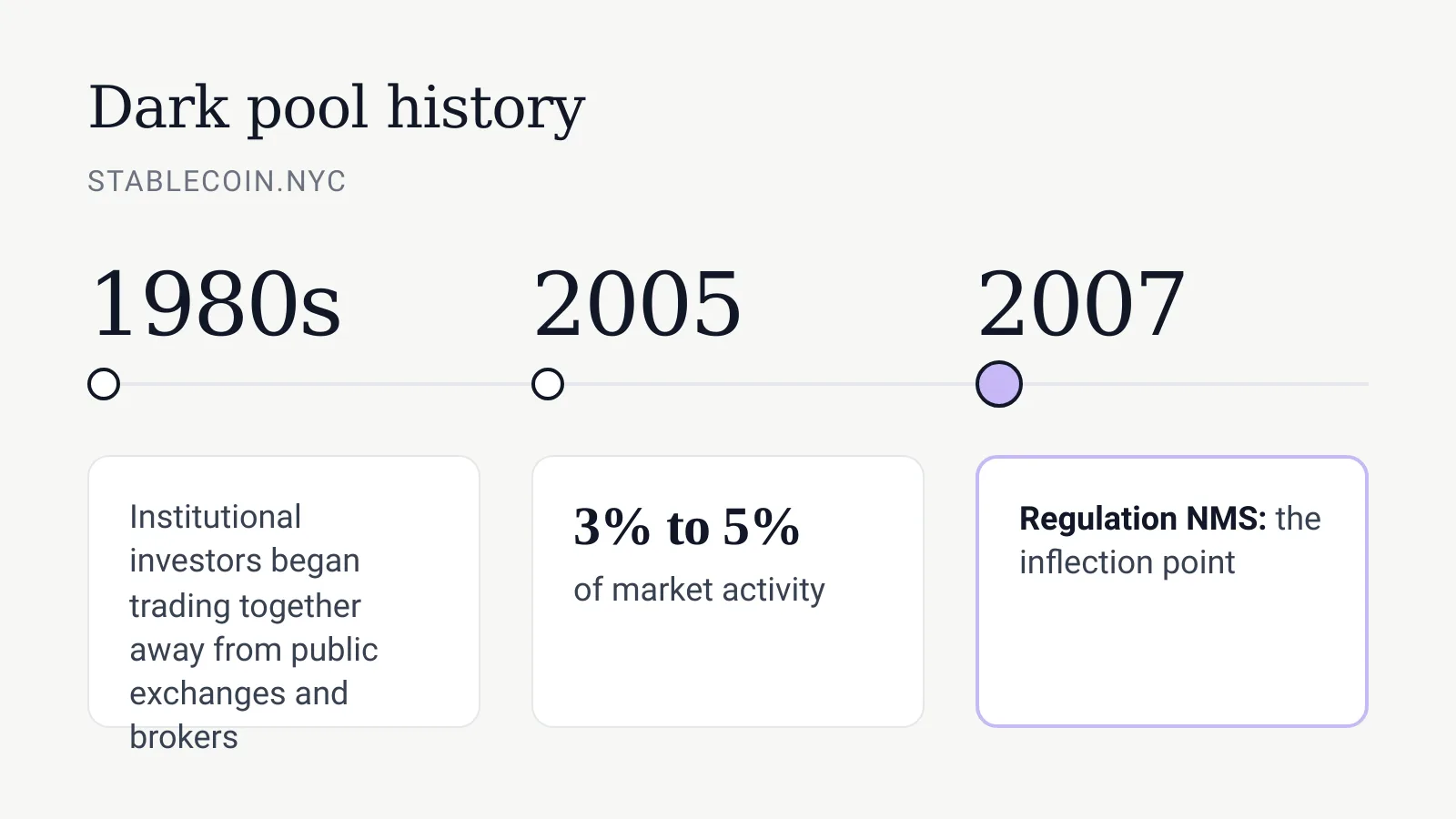
Dark pools date to the 1980s, when institutional investors began trading together away from public exchanges and brokers. Around 2005 they made up only 3% to 5% of market activity, according to Business Insider.
The inflection came in 2007 with Regulation NMS. By removing protections for manual exchange quotations, it let investors bypass exchanges when a better price could be found faster elsewhere. Broker-dealers responded by building their own pools, and institutions followed to cut trading costs. A Wall Street Oasis analysis put the number of operators at about 50.
Share of US volume
Estimates diverge sharply, and the gap is definitional:
- Wall Street Oasis added that combined with wholesale brokers, off-exchange routing took almost one-third of US stock order flow.
The lesson for analysts is not which number is right. It is that "dark" can mean ATS volume only, or all off-exchange volume including internalization. Any share figure needs its denominator stated.
Effect on spreads and price discovery
MIT Sloan's Haoxiang Zhu went further. As summarized by Wall Street Oasis, his work argues that informed traders self-select back to exchanges while uninformed flow stays in the pool, prompting market makers to widen lit spreads to protect themselves. An academic review by Hans Degryse and coauthors, Shedding Light on Dark Liquidity Pools, surveys the theoretical and empirical literature on these trade-offs.
Takeaway: dark liquidity improves execution for the participant and can degrade displayed liquidity for everyone else. Both effects are real.
Common Misconceptions About Dark Pools

Misconception: Dark pool trading is illegal / Reality: ATSs operate under SEC oversight
Dark pools are alternative trading systems monitored by the SEC. Their rules are looser than those for public exchanges, but institutional transactions inside them must still follow established requirements, including trade reporting.
Misconception: Dark pool trades can never be seen / Reality: prints appear post-trade
Only the pre-trade information is hidden. Once executed, trades are reported and the prints, showing size, price and timestamp, are publicly available for analysis.
Misconception: Dark pools are only for the very largest funds / Reality: many participants and venues
Pension funds and mutual funds were the original users, but broker-dealers and banks run their own pools, and the operator count runs to dozens. Retail orders can also reach off-exchange venues through broker routing arrangements.
Misconception: Dark pools exist only in equities / Reality: the same incentive appears in crypto
Any market where a large order leaks information produces demand for hidden execution. Some liquidity providers already describe connecting brokers and crypto exchanges to dark liquidity. Onchain, the incentive surfaces as private transaction routing and off-venue block trading.
Takeaway: dark pools are a regulated, reported, multi-participant market structure feature, and the incentive behind them is asset-class agnostic.
Related Concepts
Alternative trading system
An SEC-regulated trading venue that is not a registered exchange. Most US dark pools are ATSs.
Market impact
The price movement caused by executing an order. Large orders carry high impact, which is the problem dark pools were built to reduce.
Price discovery
The process by which displayed quotes and trades converge on a fair price. Critics argue dark trading weakens it by withdrawing orders from public books.
Post-trade print
The public report of an executed trade. For dark venues, it is the first point at which the market sees the transaction.
Institutional liquidity
The depth available to execute large orders without excessive impact.
Automated market maker
A smart contract that quotes prices from a pooled reserve formula.
Takeaway: an AMM "liquidity pool" and a dark pool share a word and little else.
How to Get Started Analyzing Hidden Liquidity

Four practical steps for an analyst or allocator:
- Read post-trade print data. Data tools analyze print size, price levels and volume. Look for prints well above average trade size.
- Compare dark share to total volume. Data vendors treat dark volume that is high relative to total volume as a sign of institutional activity. State which definition of dark volume you use.
- Review venue disclosures. ATS operators are overseen by the SEC. Understand who runs the pool and how orders are routed into it before drawing conclusions from its flow.
- Track onchain large transfers. Settlement is public, so large stablecoin and token movements are observable after the fact, the closest onchain equivalent to a print. Pair this with an understanding of where blocks trade; our overview of secondary market trading platforms is a useful map.
Takeaway: hidden liquidity is analyzable after execution in both markets; the skill is reading prints in context.
FAQ: Frequently Asked Questions
Is dark pool trading illegal?
No. US dark pools operate as alternative trading systems monitored by the SEC. They face looser rules than public exchanges, but participants must still follow established requirements, including reporting trades after execution.
Why do traders use dark pools?
To execute large orders without moving the market against them. Hiding size and price before execution limits information leakage, and midpoint crosses between the public bid and ask can deliver price improvement for both sides.
Can you see dark pool trades?
Yes, after they execute. Orders are hidden before the trade, but post-trade prints showing size, price and timestamp are publicly available, and data tools aggregate them by volume and price level.
How risky are liquidity pools?
It depends which kind. Dark pools carry execution risk, such as unfilled orders or prices diverging from lit markets. AMM liquidity pools are different: providers face smart contract risk and losses from price moves and arbitrage.
Do dark pools exist onchain?
Not as a formal regulated category, but the function does. Private order flow, RFQ systems and OTC desks let large traders avoid exposing intent in a public mempool before settlement lands on the ledger.
Conclusion
Dark pools exist because displayed size is costly information. Equity markets answered with private venues and post-trade reporting, accepting a debate over spreads and price discovery as the price of better block execution. Public blockchains start from the opposite default: everything is visible, often before it settles.