PayPal Bank Charter Application: What It Means for On-Chain Finance
PayPal's December 15, 2025 application for a Utah-chartered industrial loan company is not a regulatory checkbox. It signals that the largest independent payments network in the U.S. intends to own its liability stack, bypass sponsor banks, and compete directly for the deposits and lending relationships that stablecoin issuers and on-chain credit protocols are also chasing. The structural implications ripple well beyond PayPal's balance sheet, and they land squarely on anyone building regulated dollar rails.
What PayPal Actually Applied For
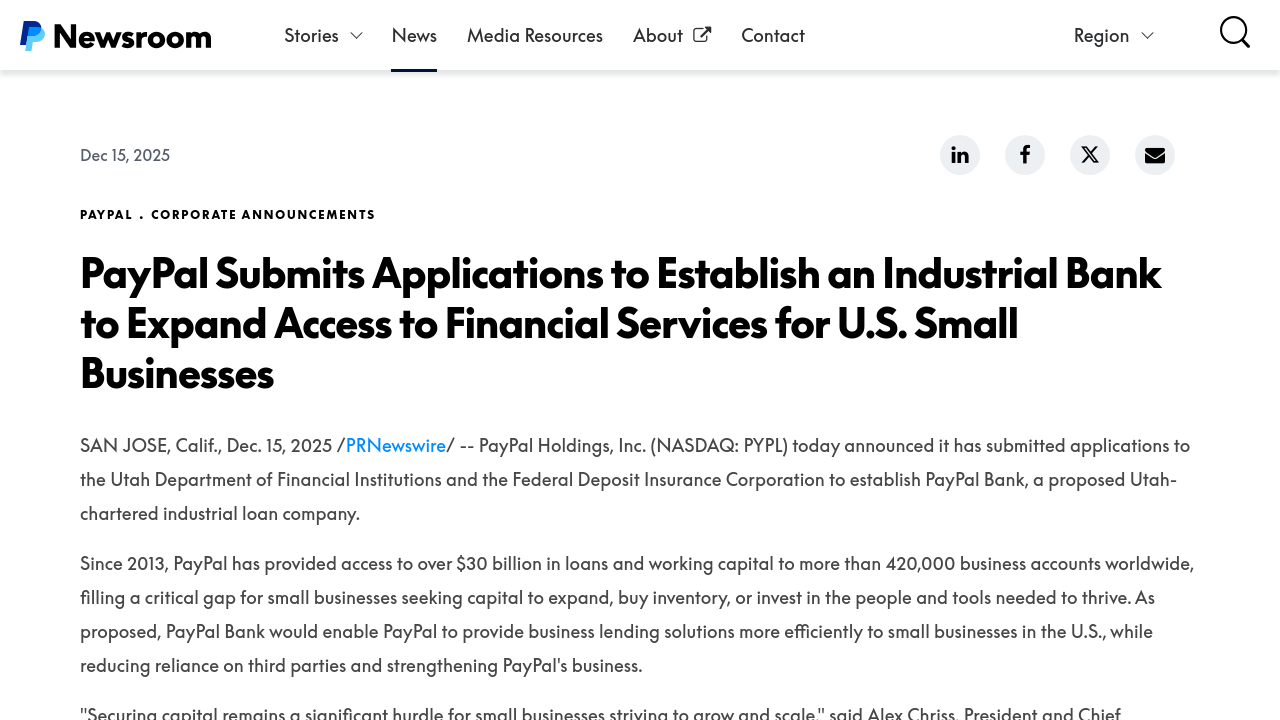
PayPal Holdings submitted applications to the Utah Department of Financial Institutions and the Federal Deposit Insurance Corporation on December 15, 2025 to establish PayPal Bank, a proposed Utah-chartered industrial loan company (ILC). The filing is public, and the PayPal press release is explicit about the scope: FDIC-insured interest-bearing savings accounts, expanded small-business lending, and direct card-network membership.
Industrial Loan Company vs. Full Bank Charter
An ILC is a state-chartered depository institution that can accept deposits, extend credit, and access FDIC insurance without triggering the Bank Holding Company Act. That distinction matters. A full commercial bank charter would subject PayPal Holdings, its parent, to Federal Reserve supervision as a bank holding company, with the activity restrictions, capital rules, and source-of-strength obligations that come with it. The ILC pathway sidesteps that framework while still delivering the two primitives PayPal wants: insured deposits and direct lending authority.
The trade-off is scope. ILCs are chartered in a handful of states, with Utah the dominant jurisdiction. They cannot offer demand deposit accounts to commercial customers in the traditional sense, though that constraint has eroded in practice. For a payments company that primarily serves consumers and small businesses on the credit and savings side, the limitation is close to irrelevant.
The Utah Filing and FDIC Application
PayPal has appointed Mara McNeill as PayPal Bank's President. She previously ran Toyota Financial Savings Bank, itself a Utah-chartered ILC, which signals a staffing choice built around operating an industrial bank rather than retrofitting a payments executive into a regulated depository role.
The company has originated more than $30 billion in loans to over 420,000 business accounts globally since 2013, per the press release. Those loans currently sit on the balance sheets of program banks, principally Goldman Sachs, Wells Fargo, and JPMorgan Chase. A chartered PayPal Bank pulls that origination and the associated deposits in-house.
Takeaway: PayPal is not applying to become a universal bank. It is applying for the narrowest regulated vehicle that lets it fund its own loan book and hold insured customer deposits.
Why the ILC Structure Matters: Economics and Regulatory Arbitrage

The ILC is a cost-of-funds play before it is anything else. Payments companies have been circling this structure for a reason, and the reason is spread.
Eliminating the Sponsor Bank Layer
Under the current model, PayPal relies on sponsor banks to hold customer balances, originate credit, and settle card transactions. Each layer takes a cut. Gary Stein, a managing director in Accenture's North America payments practice, told American Banker that access to FDIC-insured deposits and the Federal Reserve's discount window allows ILCs to fund loan assets at a lower liability cost and at scale, according to American Banker's reporting.
Direct access to the Federal Reserve payment system removes the need for a banking-as-a-service intermediary. Per-transaction costs compress, settlement timelines shorten, and PayPal captures interchange economics that currently flow to program banks. Square Financial Services, Block's banking subsidiary, secured its ILC earlier in 2025 and has publicly described it as a material financial benefit, per American Banker.
Interest Rate Export and Usury Law Preemption
ILCs can export interest rates across state lines, meaning a Utah-chartered institution can lend at Utah's permitted rates to borrowers in states with lower statutory caps. For a nationwide small-business lender, that preemption is structurally meaningful. It is the same regulatory feature that national banks and credit card issuers have used for decades, now available to a payments company without the Bank Holding Company Act overhead.
Chad Polen, a KPMG financial services regulatory partner, told American Banker that the ILC charter "creates a more integrated financial ecosystem" by letting companies accept deposits and extend credit directly. The quote reads as understated. The structure is closer to vertical integration than ecosystem design.
Takeaway: The ILC collapses two or three margin-taking intermediaries into one entity PayPal controls. The economic case does not depend on new product launches; it works on existing loan volume.
The Broader Fintech and Crypto Charter Wave
PayPal's application landed inside a broader regulatory thaw. In the weeks surrounding the filing, the Office of the Comptroller of the Currency granted conditional preliminary national trust charter approvals to Circle Internet Group, Ripple Labs, BitGo, Paxos, and Fidelity Digital Assets. The convergence between payments infrastructure and regulated banking is accelerating, and the chartering regime is bifurcating along functional lines.
OCC National Trust Charters for Crypto Firms
National trust charters are custody-and-fiduciary vehicles. They let the holder hold digital assets, manage reserves, and offer trust services under federal supervision. They do not permit deposit-taking or commercial lending in the conventional sense. For stablecoin issuers and digital asset custodians, that is the exact charter shape they need. For a lender, it is not.
PayPal's ILC application is deliberately distinct. The target is traditional lending and deposits, not crypto custody. But the two charter types are converging in effect: both pull activity that used to depend on sponsor banks onto a directly regulated balance sheet. For readers thinking through where on-chain finance intersects regulated institutions, this is the structural moment to track.
PayPal's PYUSD and the On-Chain Angle
PayPal already issues PayPal USD (PYUSD), a dollar-pegged stablecoin currently issued through Paxos. An ILC does not grant PayPal the authority to issue a stablecoin itself, but it changes the reserve management picture. On-balance-sheet dollar deposits at PayPal Bank could, over time, back or complement stablecoin reserves held elsewhere, and PayPal would have direct access to the Fed's payment rails that stablecoin settlement increasingly brushes up against.
Adyen and SoFi already hold banking charters. Stripe's stablecoin subsidiary Bridge is pursuing a national trust charter. The ICBA has formally opposed PayPal's ILC application, arguing the structure creates a regulatory loophole letting commercial firms avoid oversight applied to traditional banks. That opposition is covered in detail below.
Takeaway: The charter wave is not a single trend. It is two parallel movements, custody charters for crypto-native firms and ILCs or full charters for payments companies, converging on the same outcome: fewer sponsor banks, more directly regulated balance sheets.
Implications for On-Chain Finance and Stablecoin Issuers

This is where the application becomes a competitive event, not just a regulatory one. A chartered PayPal Bank is a direct competitor to stablecoin-based yield products and on-chain SMB lending protocols for the same dollar allocation.
Deposit Competition and Stablecoin Yield Dynamics
PayPal Bank's planned FDIC-insured interest-bearing savings accounts create a regulated, yield-bearing destination for retail and small-business dollars. For a user choosing between an insured savings account at PayPal and an uninsured stablecoin yield product, the risk-adjusted comparison tilts hard toward the insured account at comparable rates. Stablecoin yield has to pay a premium to overcome that insurance gap, which compresses issuer and protocol economics.
The question for stablecoin issuers is not whether PayPal will win every deposit. It is whether the marginal retail dollar now has a frictionless insured option inside the same app where it already sits. For issuers thinking through reserve composition and competitive positioning, the parallels to tokenized money market funds are worth working through: both are attempts to deliver yield on dollar balances through a regulated wrapper, and both now compete with insured deposits held at a payments-native institution.
Card Network Direct Membership and Settlement Rails
PayPal Bank has stated it will seek direct card network membership to complement processing and settlement. Combined with on-balance-sheet reserve capacity and existing PYUSD issuance infrastructure, that gives PayPal a vertically integrated payment and settlement stack. The sequence runs from customer deposit through to card interchange, loan origination, and stablecoin settlement, all under one chartered entity.
On-chain settlement protocols cannot match that regulatory certainty today. They can match the technical efficiency, and in some corridors they beat it, but for a corporate treasurer evaluating counterparty risk, an FDIC-insured chartered bank with direct card network membership is a different risk category than a smart contract. Teams building cross-chain settlement infrastructure will feel this competitive pressure first.
For DeFi lending protocols targeting SMB borrowers, PayPal's ILC approval would signal that regulated, incumbent-grade lending terms are available at scale through traditional rails. That is a cold-start problem on the demand side. The borrowers who were going to use on-chain credit because bank credit was unavailable now have a bank credit option inside their existing payments relationship.
Takeaway: The competitive overlap with on-chain finance is deposits and SMB credit, not custody. Stablecoin issuers compete with insured deposits; on-chain credit protocols compete with a chartered lender distributing through PayPal's existing merchant base.
Regulatory Risk and Opposition
Approval is not guaranteed, and PayPal's own forward-looking statements say so plainly. The ILC pathway has survived earlier political fights, but it has not escaped them.
ICBA Opposition and the Commercial Firm Loophole Argument
The Independent Community Bankers of America has formally opposed PayPal's application. The ICBA's position is consistent with its decades-long stance: the ILC charter lets commercial companies avoid the Bank Holding Company Act consolidation and supervision that applies to traditional banks, concentrating banking and commerce in ways Congress has historically resisted.
The precedent cited most often is Walmart's 2006 ILC application, which was withdrawn in 2007 after sustained opposition from banking trade groups and members of Congress. The arguments then and now are substantively similar. What has changed is the regulatory climate and the composition of the applicant pool. In 2006, Walmart was a general retailer applying for a bank. In 2025, PayPal is a payments company with a two-decade regulated financial services track record applying for an industrial bank. The analogy is weaker, which does not mean the opposition is weaker.
Approval Timeline and Conditions
ILC applications have historically faced lengthy review periods. The FDIC conducts a public comment period, a safety and soundness review, and a community impact assessment. Square's ILC approval took multiple years. PayPal should expect a similar timeline, with the added complication that its parent company is a public commercial entity with businesses outside banking.
The late-2025 regulatory climate appears more permissive than prior cycles. The OCC's simultaneous approvals of five crypto-firm trust charters, the Square ILC earlier in the year, and reported interest from Nissan's financing arm and Sony Group all suggest the chartering gates are open. But commercial-company status may still attract heightened scrutiny, and the ICBA opposition will not be the only objection filed.
For finance teams thinking through parallel legislative risk, the regulatory shifts tracked in European stablecoin frameworks offer a useful comparison point: in both jurisdictions, the chartering and licensing regime for dollar and euro-denominated digital value is being rewritten in real time, with incumbents and new entrants both pushing on the same rules.
Takeaway: The application is unlikely to be rejected outright but likely to be slow. The real risk is conditions, not refusal: FDIC and Utah regulators have the authority to impose activity restrictions, capital requirements, or firewalls between PayPal Holdings and PayPal Bank that constrain the economic case.
What This Means in Practice
For treasurers and allocators, the practical reading is straightforward. A chartered PayPal Bank changes the competitive map for dollar deposits and SMB credit, pulls stablecoin reserve management closer to the regulated banking perimeter, and sets a precedent other large payments and commerce companies will follow. For builders of on-chain credit and stablecoin yield products, the structural case for the product does not disappear, but the pricing of the regulated alternative compresses the margin for error.
The open question is whether PayPal's ILC approval, when it comes, triggers a wave of similar filings from commerce platforms and marketplaces, or whether it remains a payments-company specific pathway. If Sony, Nissan's financing arm, and others follow through, the ILC becomes the default vehicle for any large non-bank distributing financial products at scale.
FAQ: Frequently Asked Questions
What is an industrial loan company and how does it differ from a regular bank?
An ILC is a state-chartered depository that accepts deposits and makes loans with FDIC insurance, but its parent is exempt from the Bank Holding Company Act. A full commercial bank's parent is supervised by the Federal Reserve as a bank holding company.
Why did PayPal apply for a bank charter in Utah specifically?
Utah is the dominant jurisdiction for industrial loan companies, with the longest-running state regulatory framework for them. Most existing ILCs, including Square Financial Services and Toyota Financial Savings Bank, are Utah-chartered, which gives PayPal a well-tested supervisory pathway.
Will PayPal Bank deposits be FDIC insured?
Yes, if the application is approved. PayPal's filing explicitly contemplates FDIC-insured interest-bearing savings accounts, meaning customer deposits at PayPal Bank would carry standard FDIC coverage up to the statutory limit, currently $250,000 per depositor per ownership category.
How does PayPal's ILC application relate to its PYUSD stablecoin?
The ILC does not grant stablecoin issuance authority, which currently sits with Paxos. But it could reshape reserve management, counterparty exposure, and settlement rails around PYUSD by giving PayPal a chartered entity with direct Federal Reserve payment system access.
What happens to PayPal's relationships with Goldman Sachs and JPMorgan Chase if the charter is approved?
PayPal has signaled it would reduce reliance on program banks, including Goldman Sachs, Wells Fargo, and JPMorgan Chase. Those relationships would likely narrow rather than disappear, with PayPal taking lending and deposit activity in-house while retaining selected treasury and capital markets services.
Which other fintech and crypto companies have recently obtained or applied for U.S. bank charters?
Square Financial Services secured an ILC in 2025. Adyen and SoFi already hold banking charters. The OCC granted conditional national trust charters to Circle, Ripple, BitGo, Paxos, and Fidelity Digital Assets. Stripe's Bridge subsidiary is pursuing a national trust charter.
What is the ICBA's objection to PayPal's industrial loan company application?
The Independent Community Bankers of America argues the ILC charter creates a loophole letting commercial firms accept deposits and extend credit without the Bank Holding Company Act supervision applied to traditional banks, concentrating banking and commerce in ways the trade group opposes on principle.
How long does it typically take for an ILC application to be approved by the FDIC?
Historical ILC applications have taken anywhere from twelve months to several years, depending on political environment, applicant complexity, and FDIC workload. Square's ILC took multiple years from application to approval. PayPal should expect a comparable or longer review given its size.
Conclusion
The PayPal bank charter application is a structural event, not a product announcement. It compresses the sponsor-bank layer PayPal has relied on for a decade, puts an insured deposit product in direct competition with stablecoin yield, and gives a large PYUSD-issuing payments company a credible path to a vertically integrated settlement stack. For builders and treasurers tracking how on-chain and traditional dollar rails converge, this is one of the more consequential filings of the cycle. The implication is simple: the regulated perimeter is moving toward the payments stack, and on-chain finance will compete on different terms once it arrives.