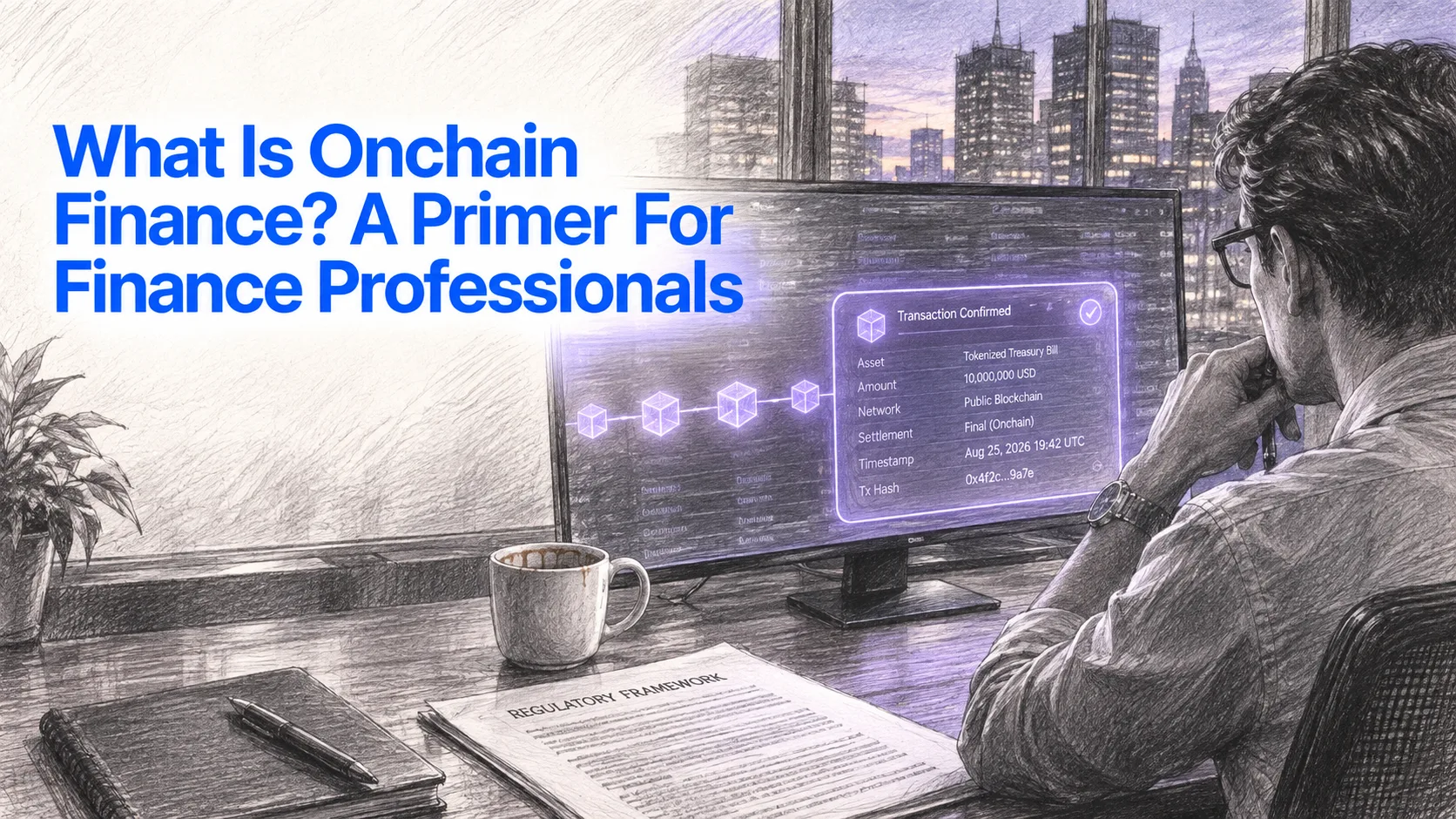
What Is Onchain Finance? A Primer For Finance Professionals
Onchain finance is reshaping how institutions issue, trade, and settle financial assets by moving traditional instruments onto blockchain infrastructure. For finance professionals evaluating where capital markets are headed, understanding this shift is no longer optional. Stablecoin.nyc covers the institutional layer of this transition, from tokenized Treasuries to programmable settlement rails, giving practitioners the context they need to engage with confidence.
Definition: What Onchain Finance Actually Means
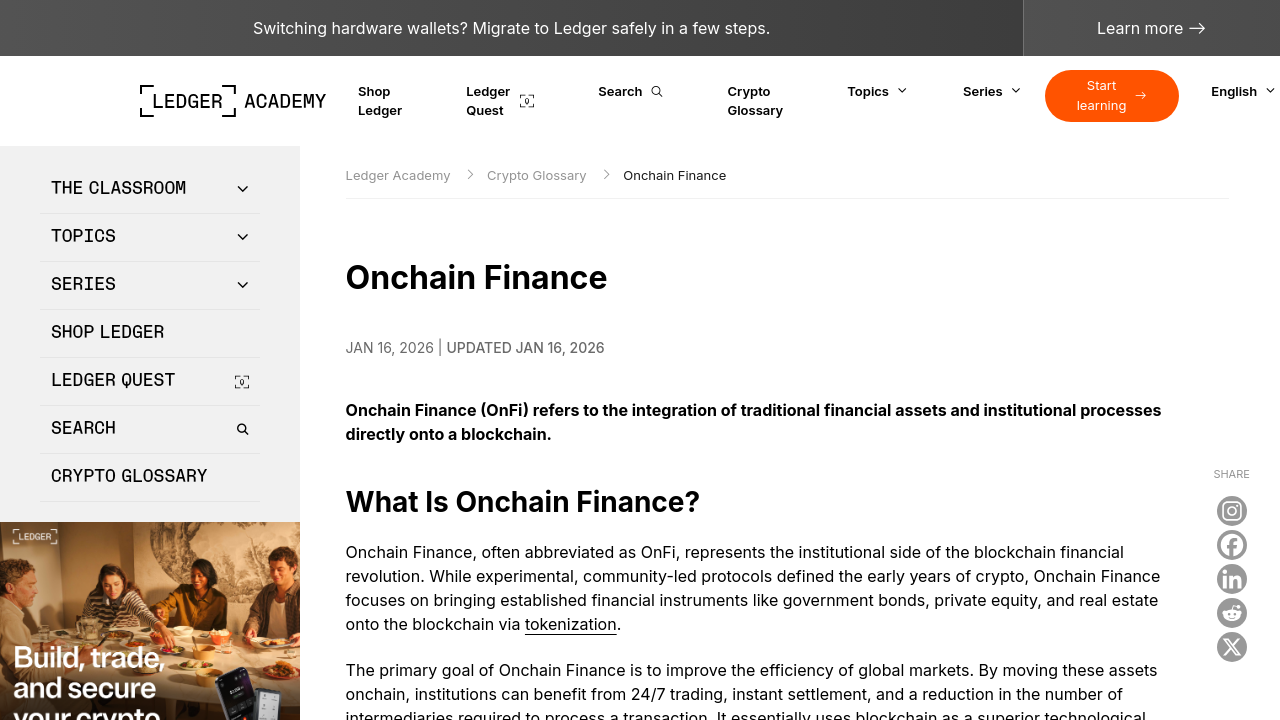
Onchain Finance, often abbreviated as OnFi, refers to the integration of traditional financial assets and institutional processes directly onto a blockchain. It is the institutional counterpart to the earlier, retail-driven crypto experiments, and it treats blockchain as production infrastructure rather than a parallel financial system. Coverage of the institutional side of digital assets has shifted from novelty pilots to procurement-grade evaluation, and OnFi is the vocabulary that shift uses.
The Precise Definition
According to Ledger's glossary, OnFi describes the placement of established financial instruments, such as government bonds, private equity, and real estate, onto a blockchain via tokenization. It is distinct from decentralized finance in three important ways. First, OnFi operates within permissioned, regulated environments requiring KYC/AML, whereas DeFi is typically permissionless and pseudonymous. Second, OnFi's underlying assets are real-world assets (RWAs), not crypto-native tokens. Third, OnFi is governed by regulated financial institutions rather than DAOs. Treatments of tokenization primary market dynamics illustrate how these constraints translate into issuance practice.
In Plain English
OnFi is the plumbing upgrade, not a new financial system. American Banker frames it as the infrastructure layer, with stablecoins and tokenized deposits as assets that live on top of it. The term overlaps with "open finance" and "decentralized finance" in casual writing, but the operative distinction is regulated, institutional participation. If DeFi is a parallel experiment, OnFi is the modernization of the existing one. Practitioners tracking macro conditions around digital assets will recognize the pattern: the incumbents adopt the technology, not the ideology.
Takeaway: OnFi is a technological upgrade to regulated finance, not a philosophical break from it.
How Onchain Finance Works: The Mechanism Step by Step

The mechanism reduces to three moving parts: an issuance pipeline that mints tokens, a lifecycle engine that runs the asset, and a settlement layer that records state. Each part maps to a legacy process, but the interfaces and timing change materially. Fundamentals coverage in the fundamentals category walks through these mechanics in more depth for readers new to the primitives.
Asset Tokenization and Minting
Tokenization begins with asset selection, typically a U.S. Treasury bill, a money market fund share, or a private fund interest. The issuer then performs legal and regulatory mapping to ensure securities law compliance, which drives what compliance logic the smart contract must enforce. Minting follows, and tokens are distributed to qualified investors' wallets under the terms encoded at issuance. Case coverage such as Goldman Sachs expanding its tokenization desk shows how mainstream banks are staffing this pipeline as a permanent function rather than a pilot.
Smart Contract Lifecycle Management
Once minted, the token is not static. Smart contracts automate lifecycle events such as coupon payments, dividend distributions, corporate actions, and voting rights, reducing administrative overhead without manual reconciliation. Compliance rules, including transfer restrictions and jurisdiction checks, are embedded at the asset level, so KYC/AML enforcement is programmatic rather than paper-based. This is what allows Treasury-backed assets to redefine yield at institutional scale: the operating cost of holding and moving those instruments drops sharply.
Settlement and the Read Layer
Blockchain transactions are inherently settlement events. There is no separate two-day settlement cycle as exists in traditional T+2 equities markets. Underneath the tokens sits a "read layer" of normalized, labeled onchain data that feeds dashboards, risk engines, and compliance tools, enabling institutions to monitor positions in real time. Firms already using onchain settlement rails to move regulated products at ETF scale rely on that read layer to reconcile positions across venues.
Takeaway: OnFi collapses issuance, servicing, and settlement into one programmable stack, but only if the read layer is disciplined.
Onchain Finance vs. Traditional Market Infrastructure

The right frame is not "blockchain replaces Wall Street" but "which functions of the existing plumbing does blockchain already do better, and which are still missing." A precise inventory helps allocators avoid both hype and dismissal. Institutional coverage on Stablecoin.nyc tracks the specific gaps as they close.
What Legacy Infrastructure Solves
Traditional market infrastructure solves four core problems: asset identification, registry, pricing, and clearing and settlement. CUSIP, created in 1968, gives every U.S. security a unique nine-character code so buy orders at one broker match sell orders at another. Transfer agents maintain the authoritative shareholder register. Consolidated tapes publish a reference price. DTCC, formed through mergers in 1999, clears and settles the trades. Each of these is decades of accreted engineering, and dismissing them is the fastest way to lose credibility with a treasurer. Recent SEC custody rulemaking shows regulators taking the same functional view.
Where Onchain Systems Already Outperform
Settlement is the clear win. Onchain markets handle settlement natively because a blockchain transaction is itself the transfer of ownership, eliminating the clearing intermediary for that function. Programmability is the second win: corporate actions and compliance can be enforced at the asset level rather than at the account. Transparency is the third: every position is visible to authorized parties in real time. Analyses like how liquidity cycles are shortening show how faster settlement changes downstream market microstructure.
Gaps That Still Exist
Current gaps are specific. There is no universal onchain asset identifier equivalent to CUSIP. There is no single consolidated price tape across chains and venues. There is no standard security master for tokenized assets, per Allium's analysis. Tokenized securities still require reconciliation between onchain records and a firm's internal books, plus tracking of splits, coupons, and redemptions. The infrastructure equivalent of DTCC, transfer agents, and price feeds is still being built, and no single onchain system yet matches legacy coverage. Practitioners watching yield dynamics stall in traditional plumbing recognize that the missing pieces are largely operational, not conceptual.
Takeaway: Onchain systems win on settlement and programmability; legacy still wins on identifiers, price consolidation, and cross-venue reference data.
Key Benefits for Finance Professionals

The benefits fall into three practical categories that map to line items on an operations budget: cost of capital, cost of assurance, and cost of access. Interviews on Stablecoin.nyc's interview series with operators at custodians and asset managers surface the same three themes.
Efficiency, Cost, and Speed
Real-time settlement reduces counterparty exposure and frees collateral that would otherwise be locked in T+2 or T+1 cycles. That is a direct funding cost saving for prime brokerage, repo, and derivatives businesses. Automation of coupon payments, dividends, and corporate actions further reduces manual back-office work. The case for sovereign debt migrating toward digital collateral rests substantially on these funding-cost savings compounding at portfolio scale.
Transparency and Auditability
All transactions are recorded on a shared, immutable ledger, making audits faster and reducing reconciliation costs between counterparties, according to Tokeny's documentation. Regulators, auditors, and internal risk teams can query the same authoritative record. That is a structural change to how assurance is produced, not a marginal one, and it is the reason why bank groups are treating onchain infrastructure as a shared utility rather than a proprietary asset. Broader context on partnerships across the ecosystem shows how that utility framing is spreading.
Accessibility and Programmability
Smart contracts enable 24/7 trading and automated corporate actions, expanding market hours beyond the constraints of traditional exchange sessions. Programmability allows for complex instruments with embedded compliance, such as transfer restrictions limiting holders to accredited investors or specific jurisdictions. Decentralized infrastructure also reduces single points of failure and reliance on central IT systems, improving operational resilience. Coverage of arbitrage loops in automated market makers illustrates what continuous, programmable markets look like at the microstructure level.
Takeaway: OnFi's benefits are measurable in basis points of funding cost, audit hours, and downtime, not in narrative.
Common Misconceptions About Onchain Finance
Three misconceptions come up in almost every institutional evaluation. Each one is worth disarming directly because each one costs deal cycles. A working set of reference resources helps procurement teams pressure-test these assumptions before they harden into policy.
Misconception: OnFi Is the Same as DeFi
DeFi focuses on crypto-native assets and permissionless access. OnFi focuses on real-world assets tokenized within strict legal frameworks. They share a technology stack but almost nothing else operationally. Governance, participant identity, asset class, and regulatory posture all differ. Framing the two as interchangeable is the single most common category error in internal memos. Discussions of DeFi risks for institutions under new EU rules make the distinction concrete.
Misconception: It Operates Outside Regulation
Onchain Finance is designed from the ground up to fit into existing legal structures, including securities law, KYC/AML requirements, and institutional governance frameworks. Tokenized assets governed by OnFi protocols are managed by regulated financial institutions such as banks and asset managers, not DAOs. The misconception persists because early crypto narratives dominated public discourse, but institutional OnFi requires verified participant identity end to end. Coverage of the Stablecoin Act's path through Senate committee shows the regulatory scaffolding hardening in parallel.
Misconception: It Requires Replacing Existing Systems
Onchain infrastructure is positioned as an upgrade layer over existing systems, not a wholesale replacement. Institutions can migrate specific workflows, such as intraday repo or fund subscription settlement, while retaining legacy systems for others. The migration path is workflow-by-workflow, not platform-by-platform, and the failure mode of most first attempts is trying to do everything at once. Programs like global CBDC adoption roadmaps illustrate the same incremental pattern at the central-bank level.
Takeaway: OnFi is regulated, hybrid, and additive; treat it as an operational upgrade path, not a rip-and-replace project.
How Finance Professionals Can Get Started with Onchain Finance
Start with a workflow audit, not a technology audit. The tools follow the use case, and the use case is defined by which internal processes carry the most reconciliation, funding, or servicing cost. The work-with-us page is one starting point for teams that want a structured intake.
First Concrete Steps
- Map which internal workflows, settlement, collateral management, fund reporting, could benefit most from real-time, programmable infrastructure. Prioritize by cost, not by novelty.
- Understand the distinction between public blockchains such as Ethereum, permissioned enterprise networks, and hybrid models. Institutional OnFi deployments span all three, and the choice is governance-driven, not performance-driven.
- Establish an entry position. Tokenized U.S. Treasuries and money market funds have become established categories held by asset managers and trading firms, making them a practical entry point for balance-sheet exposure without a full workflow rebuild.
- Track the regulatory calendar. The U.S. CLARITY Act and SEC rulemaking on crypto fundraising are active legislative tracks that will shape operational constraints on custody, disclosure, and market structure.
- Engage with industry bodies, bank pilot programs, and infrastructure providers such as custodians and tokenization platforms. Operational literacy compounds fastest through direct exposure to production deployments, and the about page lists ways to plug into that network.
Related Concepts to Understand
- Stablecoins: dollar-denominated tokens that function as the settlement asset for most onchain financial activity.
- Tokenized Treasuries: onchain wrappers of U.S. government debt, held primarily by institutional allocators.
- Permissioned blockchains: networks that restrict participation to KYC'd counterparties, often used for interbank settlement.
- Read layer: the normalized, labeled data infrastructure that sits underneath dashboards and compliance tools.
- Smart contract compliance: transfer restrictions and eligibility checks enforced at the token level rather than the account level.
Takeaway: Start with the workflow, pick a small tokenized-Treasury entry position, and build operational literacy from there.
Frequently Asked Questions
What is the difference between onchain finance and DeFi?
OnFi puts regulated real-world assets on permissioned blockchains under securities law with KYC/AML. DeFi is permissionless, pseudonymous, and focused on crypto-native tokens. Both use smart contracts, but their participants, governance, and regulatory posture differ substantially.
What are real-world assets (RWAs) in onchain finance?
RWAs are traditional financial instruments, such as Treasury bills, money market fund shares, corporate bonds, private equity, or real estate, that have been tokenized and recorded on a blockchain while retaining their legal status as regulated securities issued by identifiable entities.
Is onchain finance regulated?
Yes. OnFi is designed to operate within existing securities laws, KYC/AML requirements, and institutional governance frameworks. Tokenized assets are typically issued and managed by regulated banks and asset managers, and compliance checks are frequently encoded directly into the smart contracts themselves.
How does onchain settlement differ from traditional T+2 settlement?
A blockchain transaction is itself the transfer of ownership, so settlement occurs at execution rather than two days later. That collapses the clearing cycle, reduces counterparty exposure, and frees collateral that would otherwise be locked in transit, changing intraday funding economics for participants.
What role do stablecoins play in onchain finance?
Stablecoins are the settlement asset for most OnFi activity. They function as the cash leg against which tokenized securities are delivered, enabling delivery-versus-payment onchain without touching traditional banking rails, and they underpin most of the dollar volume moving across public blockchains today.
Which financial assets can be tokenized on a blockchain?
Practically any transferable financial instrument can be tokenized, but production adoption is concentrated in U.S. Treasuries, money market funds, private credit, private equity fund interests, corporate bonds, and real estate. Equities and structured products are earlier in adoption but active.
What is a permissioned blockchain and why does it matter for institutions?
A permissioned blockchain restricts participation to identity-verified counterparties under a defined governance model. It matters because institutions need to know who they are transacting with for KYC/AML and counterparty risk reasons, and public chains alone rarely satisfy those requirements without additional controls.
How are smart contracts used in onchain finance?
Smart contracts encode issuance terms, transfer restrictions, coupon and dividend payments, corporate actions, and eligibility checks directly on the asset. That automates lifecycle management, reduces reconciliation cost, and enforces compliance programmatically rather than through downstream account-level controls or manual post-trade processes.
Conclusion
Onchain finance is neither a rebranding of DeFi nor a wholesale replacement of Wall Street. It is a targeted rebuild of specific plumbing, settlement, servicing, and identity, on a programmable substrate that regulated institutions can actually use. The gaps in identifiers, price tapes, and security masters are real, but they are engineering problems with visible roadmaps rather than conceptual dead ends. For finance professionals, the practical move is to audit workflows, take a small tokenized-Treasury position, and build literacy before the next cycle prices it in. Ongoing coverage at Stablecoin.nyc tracks that institutional layer as it hardens into market infrastructure.