What Is GHO: Aave's Decentralized Stablecoin Explained
GHO is Aave's native, overcollateralized stablecoin, minted directly within the Aave Protocol and pegged to the U.S. Dollar. Unlike USDC or USDT, no central issuer controls its supply; the Aave DAO governs interest rates, collateral requirements, and expansion decisions. Understanding how GHO is created, stabilized, and distributed across chains is essential for anyone evaluating DeFi-native dollar instruments.
Definition: What GHO Actually Is
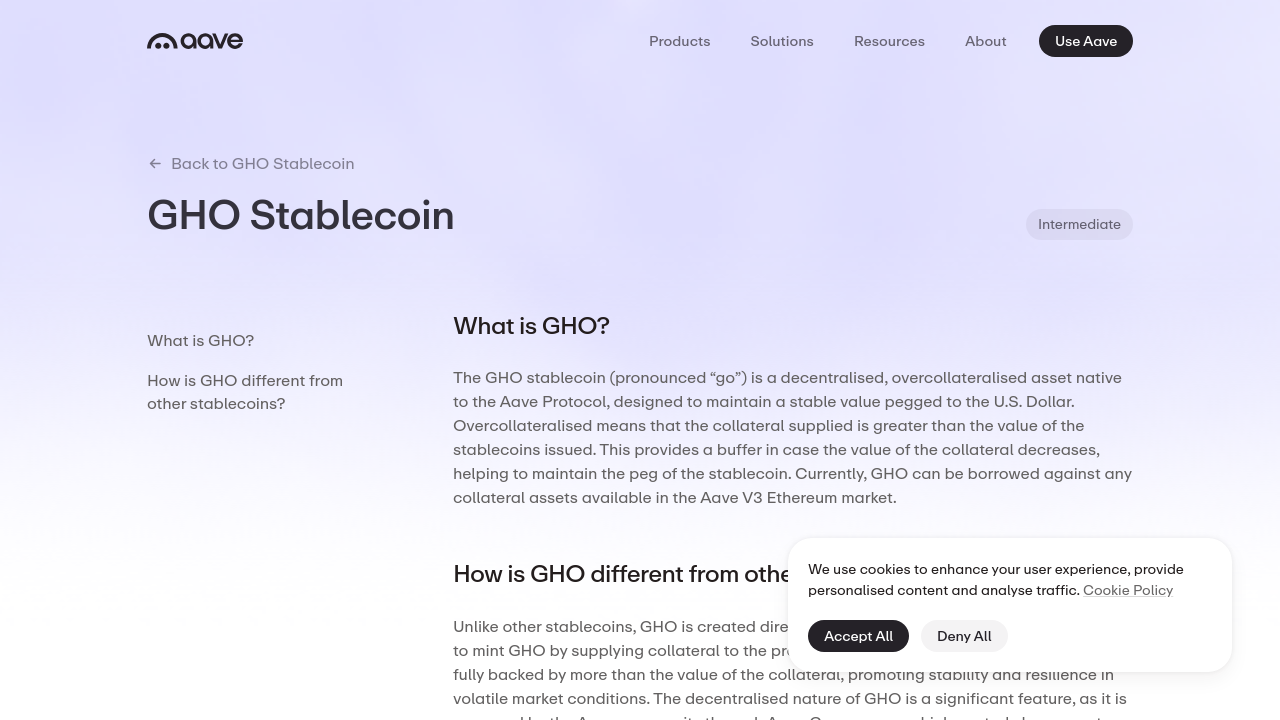
GHO (pronounced "go") is a decentralized, overcollateralized stablecoin native to the Aave Protocol, soft-pegged to the U.S. Dollar. It is not issued by a bank, a fintech, or an off-chain custodian. It is created on-chain when a borrower deposits eligible collateral into the Aave V3 Ethereum market and takes on a GHO-denominated debt position.
The Core Mechanics in Plain Language
Three mechanics define GHO:
- Overcollateralization. The dollar value of collateral posted must exceed the dollar value of GHO minted. That buffer absorbs collateral price drops before the position becomes unsafe.
- Mint-on-borrow, burn-on-repay. GHO does not exist until a borrower draws it. Repaying the loan destroys the GHO. Supply is a direct function of demand for dollar-denominated use on Aave.
- Protocol-captured interest. The interest paid by GHO borrowers does not flow to third-party liquidity providers. It accrues to the Aave DAO treasury, which turns GHO into a direct protocol revenue line rather than a spread business.
In plain language: GHO is a dollar IOU minted by Aave against crypto collateral, governed by Aave token holders, with every unit of fee revenue booked by the DAO.
How GHO Differs From Other Stablecoins
USDC and USDT are fiat-backed liabilities of a centralized issuer. DAI is overcollateralized but issued by a separate protocol (Sky, formerly MakerDAO) with its own governance stack. GHO is the only major stablecoin whose issuance, risk parameters, and revenue capture live inside the same protocol that already runs one of DeFi's largest lending books. Governance over interest rates, collateral eligibility, supply caps, and facilitator approvals is handled by Aave token holders through on-chain votes.
Takeaway: GHO is a protocol-native dollar instrument. Supply is governed, not issued; revenue is captured, not shared.
How GHO Works: Minting, Facilitators, and Supply Management

GHO's architecture separates three functions that are usually bundled in a stablecoin: who can create supply, how supply is backed, and how holders earn yield.
The Minting Process
A user opens a position in the Aave V3 Ethereum market by supplying eligible collateral: ETH, WBTC, stETH, and other listed assets. The user then borrows GHO against that collateral at an interest rate set by Aave Governance. The minted GHO is new supply, created at the moment of the borrow and destroyed when the debt is repaid. Liquidation mechanics are standard Aave V3: if the loan-to-value ratio breaches thresholds, the collateral is sold to repay the GHO debt.
Facilitators: The Supply Control Layer
A facilitator is a whitelisted entity that Aave Governance has granted permission to mint and burn GHO up to a specified bucket limit, which is the facilitator's hard supply cap.
- The Aave Protocol itself is the primary facilitator.
- Additional facilitators can be approved by DAO vote. Historical examples include a Flash Minter contract and the Chainlink CCIP bridge used for cross-chain distribution.
- Each facilitator has an independent cap, so a bug or policy failure in one facilitator cannot inflate GHO supply beyond its bucket.
This design matters because it decouples distribution from issuance policy. New facilitators (payment rails, RWA venues, CEXs) can be added without rewriting the core contract, and governance keeps a quantitative lever on each one.
sGHO and the Savings Rate
sGHO is a savings-bearing wrapper. A GHO holder deposits GHO into the sGHO contract and receives a yield-bearing token whose value accrues over time, funded by the borrowing fees paid into the DAO. It is structurally analogous to sDAI's relationship with DAI.
Takeaway: GHO supply contracts and expands with borrower demand, facilitators gate distribution with hard caps, and sGHO passes a slice of borrowing revenue back to passive holders.
The Peg Problem: Why GHO Traded Below $1 and How It Was Fixed
GHO launched in July 2023 and spent much of its first year below peg. The reason was structural, not accidental, and the governance debate that resolved it is one of the clearest case studies in DeFi stablecoin design.
Structural Pressure on the Peg
For most of late 2023, GHO traded in the $0.96 to $0.98 range. The initial design intent was explicit: offer a GHO borrowing rate below prevailing market rates to attract users and bootstrap supply. In the abstract, cheap credit is a reasonable adoption lever. In practice, it collided with a competing on-chain product.
The Rate Arbitrage Trap
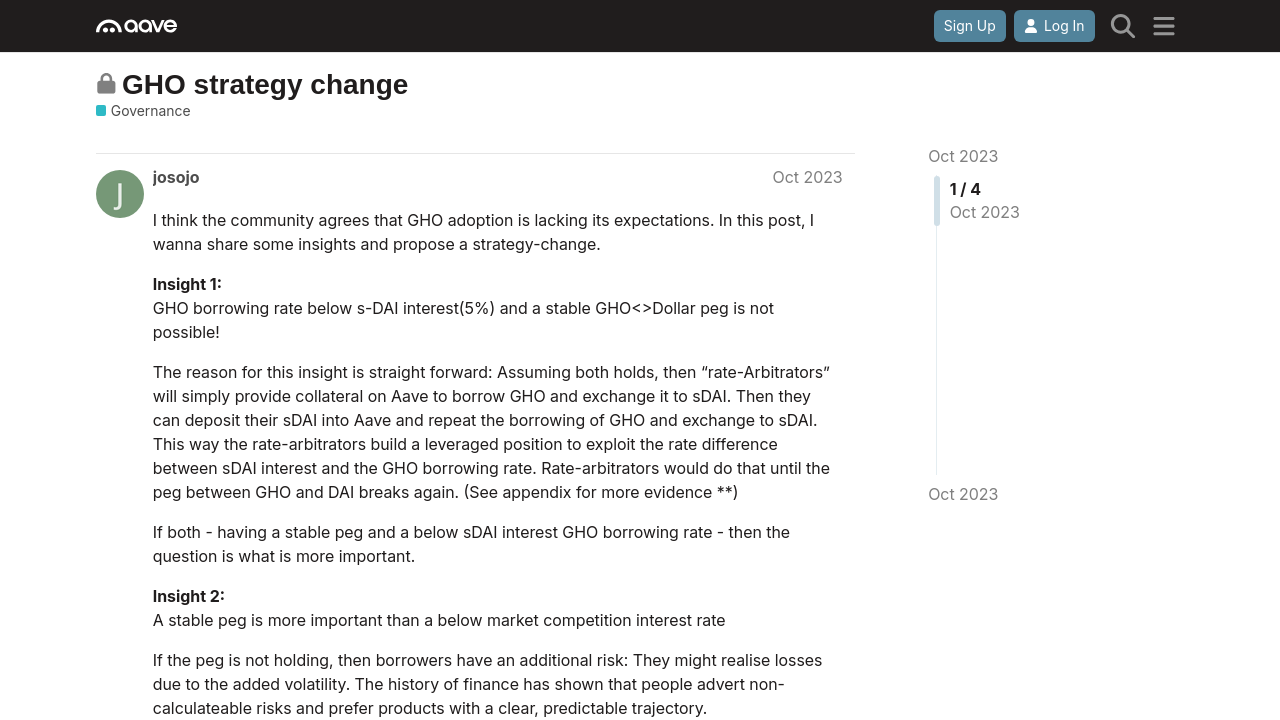
The sDAI savings rate at the time sat near 5%. GHO's borrowing rate was below that. The arbitrage was mechanical and documented in the Aave governance forum:
- Post collateral on Aave.
- Borrow GHO at the subsidized rate.
- Sell GHO on secondary markets for DAI.
- Deposit DAI into sDAI and earn the savings rate.
- Pocket the spread, repeat with use until the spread closes.
Step 3 is the problem. Persistent arbitrage selling of newly minted GHO drove the market price below $1. As forum contributor josojo put it in October 2023, "a GHO borrowing rate below sDAI interest and a stable GHO-Dollar peg is not possible." You can have one; you cannot have both.
Governance Response and Peg Restoration
Aave Governance debated the trade-off explicitly and chose peg stability over subsidized borrowing. The reasoning: a floating peg introduces unpredictable losses for borrowers, breaks downstream accounting, and makes GHO unattractive as a settlement asset. The DAO incrementally raised the GHO borrowing rate until it exceeded the sDAI savings rate, removing the arbitrage incentive. GHO now trades near $1, with Coinbase data showing a recent price around $0.999.
Takeaway: The peg is an interest-rate policy outcome, not an algorithmic property. Keeping GHO at a dollar requires the borrow rate to sit above the prevailing on-chain risk-free rate.
Cross-Chain Expansion: GHO on Arbitrum and Beyond
GHO started as an Ethereum mainnet asset. If it stayed there, it would be a stablecoin whose main use case is Aave mainnet borrowers. Cross-chain expansion is the mechanism for turning it into a general-purpose dollar.
Why Layer 2 Deployment Matters
The Aave DAO voted to deploy GHO on Arbitrum in July 2024, making it a borrowable asset in the Aave Arbitrum pool. Arbitrum was chosen for scale: it was the largest L2 by TVL at the time of deployment, holding roughly $17.7 billion. Lower gas on L2 unlocks use cases, including small-ticket payments and active trading, that mainnet fees priced out. GHO has since deployed on Base and Avalanche C-Chain, with further networks subject to phased DAO governance votes.
The Lock-and-Mint Bridge Model
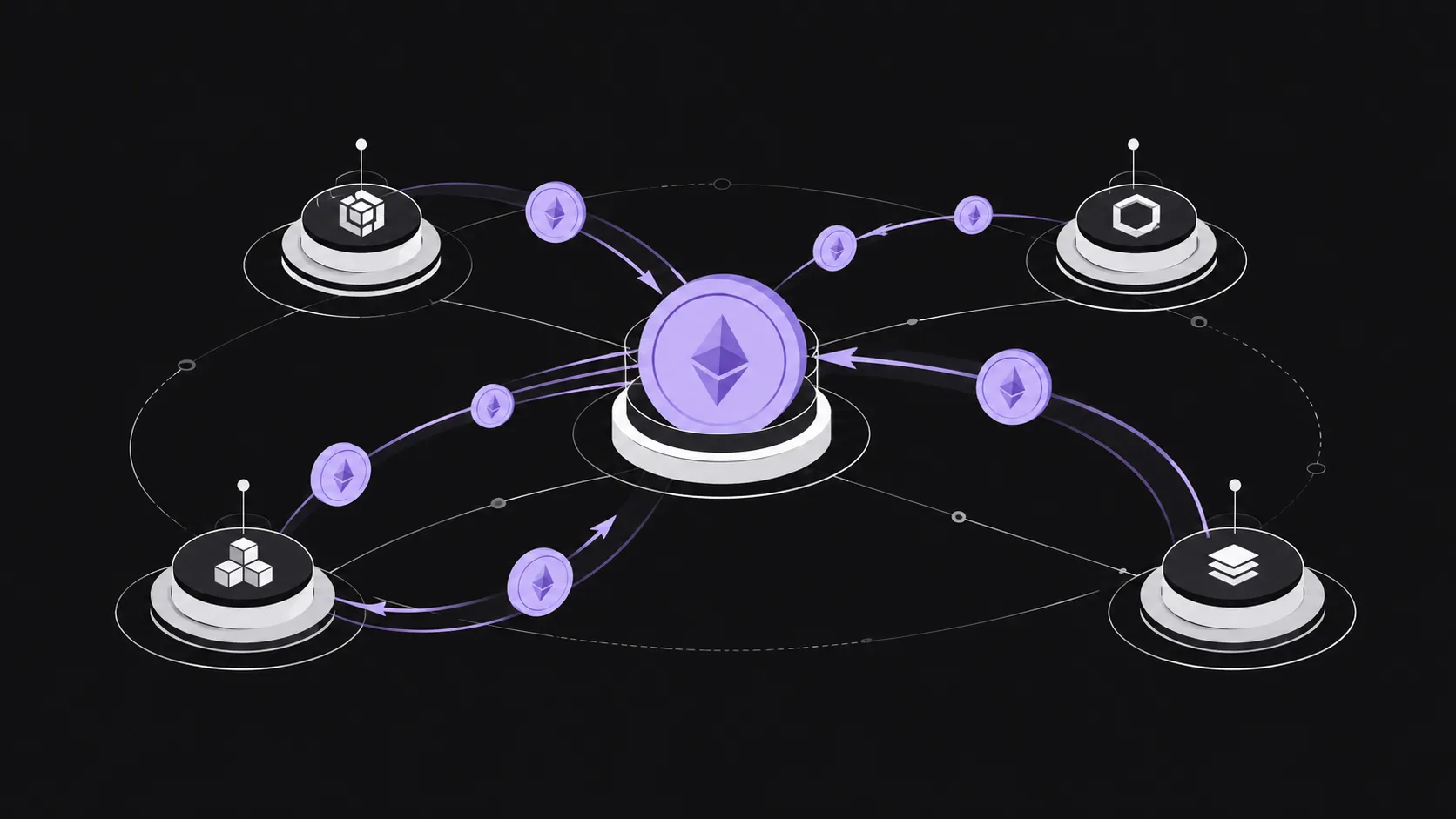
Cross-chain transfers are powered by Chainlink's Cross-Chain Interoperability Protocol (CCIP), selected for EVM and non-EVM compatibility and for programmable rate-limiting on each lane.
The bridge uses a lock-and-mint model going outbound and a burn-and-release model coming back:
| Direction | Source chain action | Destination chain action |
|---|---|---|
| Ethereum → Arbitrum/Base/Avalanche | GHO locked in vault contract | Facilitator mints equivalent GHO |
| L2 or sidechain → Ethereum | GHO burned on source chain | Vault releases equivalent GHO |
Total supply is held constant because every unit minted on a destination chain is matched by an equivalent locked unit on Ethereum. The CCIP facilitator sits inside the standard Aave facilitator framework, with its own bucket cap governed by the DAO.
Takeaway: Multi-chain GHO is not a wrapped asset. It is the same accounting entity bridged by a governed CCIP facilitator, and the supply ceiling on each lane is a governance decision, not a technical one.
GHO's Role in Aave's Business Model
GHO changes Aave's unit economics. In a standard Aave lending market, suppliers earn most of the interest paid by borrowers and the protocol takes a reserve factor cut. With GHO there is no supplier. The interest paid by GHO borrowers flows directly to the Aave DAO treasury.
Three implications follow:
- Full fee capture. Every basis point of GHO borrow interest is DAO revenue, net of any portion routed to sGHO holders. There is no third-party supplier spread to pay away.
- Holder alignment through sGHO. Rather than subsidizing holders externally, Aave can route a share of its own borrowing revenue to sGHO. The incentive is funded by actual protocol cash flow, not emissions.
- Scale-linked revenue. Expansion of GHO supply, new facilitators, and new chains translate directly into additional fee-generating debt outstanding. Growth of GHO is growth of Aave's top line.
Per Coinbase data, GHO's circulating supply sits around 584 million. At a GHO borrow rate in the mid-single digits, that is a non-trivial, recurring revenue stream for the DAO treasury, and one of the clearest examples of a protocol-owned stablecoin funding its own protocol.
Takeaway: GHO is best understood as Aave's margin product. It converts stablecoin demand into protocol revenue without the supplier intermediation that compresses margin in the rest of Aave's lending book.
Common Misconceptions About GHO
GHO gets slotted into the wrong mental model regularly. Three misconceptions are worth addressing directly.
Misconception: GHO Is Algorithmic
Reality: GHO is overcollateralized, not algorithmic. Every GHO in circulation is backed by more than a dollar of collateral locked in Aave V3. There is no seigniorage loop, no reflexive mint-and-burn mechanism tying GHO's price to a volatile sister token. The failure mode of Terra's UST, where the backing was itself endogenous equity, does not apply to GHO. The relevant risks are collateral risk, oracle risk, and governance risk, which are the same risks that apply to the rest of Aave V3.
Misconception: GHO Is Just Another Aave Yield Token
Reality: Holding GHO is holding a stablecoin. It is a liability for the minter and an asset for the holder, not a receipt token that accrues yield by default. If a holder wants yield, they wrap GHO into sGHO, which is the yield-bearing wrapper. Confusing GHO with sGHO is the same category error as confusing DAI with sDAI.
Misconception: GHO Is Fully Decentralized With No Governance Risk
Reality: Governance is on-chain, but the Aave DAO retains broad discretion over GHO parameters: borrow rate, collateral eligibility, facilitator approvals and caps, and bridge configuration. Holders are exposed to the quality of DAO decisions. A bad rate decision can break the peg, as the 2023 history shows. A bad facilitator approval could, in principle, add supply through a lower-quality channel. Governance is a feature and a risk at the same time.
Takeaway: GHO is a collateralized, protocol-issued dollar whose risks are collateral, oracle, and policy, not algorithmic reflexivity.
FAQ: Frequently Asked Questions
What is GHO stablecoin and how does it work?
GHO is a decentralized, overcollateralized stablecoin native to Aave, pegged to the U.S. Dollar. Users mint GHO by borrowing against collateral on Aave V3 Ethereum, and the interest paid flows to the Aave DAO treasury.
How do you mint GHO on Aave?
Open the Aave V3 Ethereum market, supply eligible collateral such as ETH, WBTC, or stETH, then borrow GHO against that collateral at the current governance-set rate. Repaying the loan burns the borrowed GHO, closing the position.
Why did GHO lose its $1 peg?
GHO traded below $1 through late 2023 because its borrow rate sat below the sDAI savings rate, letting arbitrageurs borrow GHO, swap to sDAI, and sell GHO for a risk-free spread. Governance raised the rate to close the arbitrage.
What is the difference between GHO and sGHO?
GHO is the stablecoin itself, a dollar-pegged liability of the minter. sGHO is a savings wrapper: deposit GHO into sGHO and the token accrues yield funded by borrowing fees, similar to how sDAI relates to DAI.
Is GHO safe? What are the risks of holding GHO?
GHO is overcollateralized, but holders carry collateral price risk, oracle risk, smart contract risk, and governance risk. A poor interest-rate decision or an under-managed facilitator could pressure the peg, as the 2023 depeg showed.
What collateral can be used to borrow GHO?
GHO can be borrowed against assets available in the Aave V3 Ethereum market, including ETH, WBTC, stETH, and other listed collateral. Governance can add, remove, or re-parameterize eligible assets through on-chain votes.
Is GHO available on chains other than Ethereum?
Yes. GHO deployed on Arbitrum in July 2024 via Chainlink CCIP and has since launched on Base and Avalanche C-Chain. The bridge uses a lock-and-mint model so total supply stays constant across chains.
How does GHO compare to DAI or USDC?
USDC is a fiat-backed liability of Circle. DAI is overcollateralized but issued by a separate protocol. GHO is overcollateralized and issued inside the same protocol that captures its borrowing revenue, aligning stablecoin supply with Aave DAO cash flow.
Conclusion
GHO is a protocol-native dollar: overcollateralized by Aave V3 collateral, governed by Aave token holders, distributed across chains by a CCIP facilitator, and monetized by routing borrow interest directly into the DAO treasury. The 2023 depeg clarified a design truth: the peg is a function of interest-rate policy relative to the on-chain risk-free rate, not an algorithmic artifact. The open question for allocators and treasurers is whether GHO's facilitator model, sGHO yield stack, and multi-chain footprint can scale supply into the billions without compounding governance risk at the same pace.