Ripple RLUSD Multichain Expansion Explained
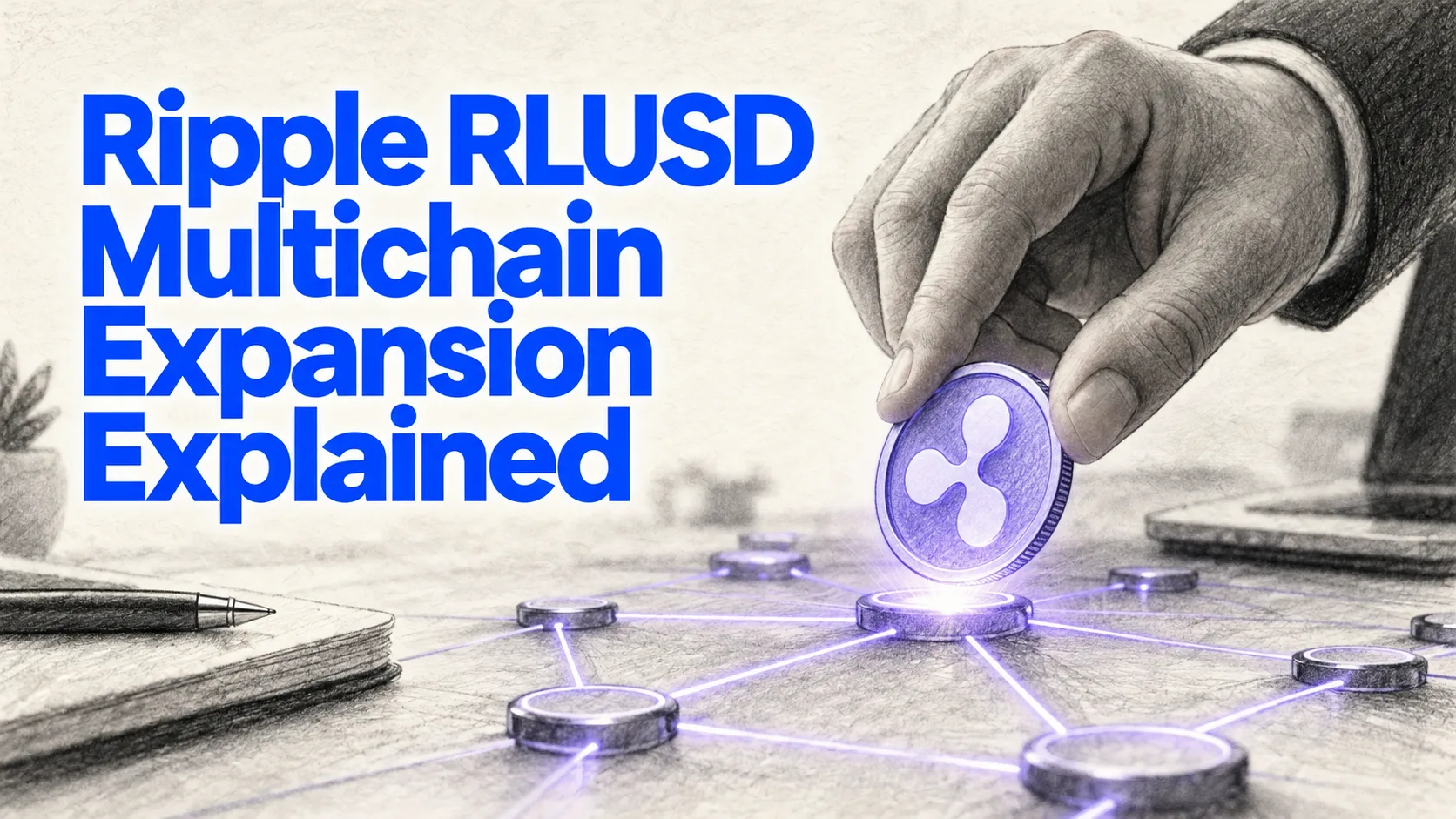
RLUSD's multichain expansion is Ripple's clearest signal yet that it is building regulated stablecoin infrastructure for the broader on-chain economy, not just the XRP Ledger. Announced on December 15, 2025, the rollout deploys RLUSD natively across Ethereum Layer 2 networks using Wormhole's Native Token Transfers standard, making it the first U.S. trust-regulated stablecoin on Optimism, Base, Ink, and Unichain. The implications reach well beyond XRP holders.
Definition: What RLUSD Multichain Expansion Means

What RLUSD Is
RLUSD is a U.S. dollar-backed stablecoin issued by Ripple under a New York Department of Financial Services (NYDFS) Trust Charter. Reserves sit in cash, short-dated U.S. Treasuries, and government money market funds at a 1:1 ratio to circulating supply. The token launched in late 2024 on both Ethereum mainnet and the XRP Ledger, with institutional distribution channels built around payments, trading, and tokenized asset settlement rather than retail speculation.
What 'Multichain' Actually Means Here
Multichain, in this context, means RLUSD now exists as the same canonical token on multiple networks simultaneously, not as a chain of wrapped IOUs minted on top of each other. Native deployment via Wormhole's NTT standard preserves issuer control and liquidity integrity on every chain Ripple approves. Ripple can still mint, burn, and freeze the asset at a single source of record.
In plain language: one regulated dollar, four new networks, one issuer still holding the switch.
Takeaway: the architecture matters as much as the chain count. Wrapped-token sprawl is what multichain stablecoins have historically become; this release is explicitly engineered against that outcome.
How It Works: Wormhole NTT and the Architecture Behind the Move

Wormhole's Native Token Transfers Standard
Wormhole's Native Token Transfers (NTT) framework lets an issuer deploy the same token contract across chains without the intermediate wrapping step that defines traditional bridges. In a bridge model, the asset gets locked on chain A and a synthetic representation is minted on chain B. The synthetic is a claim on the bridge, not on the issuer, which is why bridge exploits have historically been the largest single category of DeFi loss.
NTT inverts that. The token on each chain is native, minted by the issuer, and governed by the same supply controls. Message passing coordinates burns and mints across chains so that total supply reconciles, but no wrapped derivative sits in a bridge contract waiting to be drained.
The L2 Network Stack: Optimism, Base, Ink, Unichain
The test rollout covers four Ethereum L2s:
- Optimism serves as the entry point for the L2 deployment.
- Base, Coinbase's L2, brings exchange-adjacent liquidity and consumer payment flows.
- Ink is Kraken's L2, extending reach to another major exchange's user base.
- Unichain is Uniswap Labs' L2, targeting swap and liquidity venue economics.
All four interconnect through the same NTT infrastructure, which means Ripple does not negotiate a bespoke integration per chain. Add a fifth L2 later, and the pattern repeats rather than restarts.
How XRP Fits In
RLUSD plays the digital-cash role; XRP is the cross-chain liquidity asset. Hex Trust's wrapped XRP (wXRP) runs in parallel, letting XRP pair with RLUSD on each supported L2 for swaps, lending, and payments without routing back to XRPL or Ethereum mainnet. Precedent for the institutional comfort level here comes from BlackRock's BUIDL fund, which already uses Wormhole for cross-chain movement of tokenized Treasury exposure.
Takeaway: NTT is the technical choice that lets Ripple expand surface area without multiplying trust assumptions.
Why This Matters: Regulatory Positioning and Market Context
RLUSD's Regulatory Edge Over USDC and USDT
RLUSD is, per Ripple's December 2025 announcement, the first U.S.-based, trust-regulated stablecoin to deploy natively on Optimism, Base, Ink, and Unichain. That framing matters because the stablecoin league table at the top (USDT, USDC) is defined by scale, not by prudential supervision quality. USDT operates under offshore disclosures. USDC is well-regulated at the operational level but lacks a trust charter structure of the type NYDFS imposes on New York trust companies.
The Dual-Charter Ambition
Ripple has also applied for an OCC national trust bank charter. If approved, RLUSD would be the first stablecoin supervised at both the state (NYDFS) and federal (OCC) levels simultaneously, a structure no existing major stablecoin currently holds. Ripple holds more than 75 licenses globally today, with recent additions in Dubai and Abu Dhabi.
For institutional treasurers evaluating counterparty and regulatory risk, that distinction is not cosmetic. It changes how a stablecoin position maps to internal risk committees, auditors, and in some cases bank regulators reviewing the custodial relationship.
Market data reinforces where current demand sits. DefiLlama data at the time of the announcement showed Ethereum holding roughly 79.2% of RLUSD supply (over $1 billion), with XRPL holding the remaining 20.8%. On-chain volume on the XRP Ledger grew significantly in the months after launch, per third-party trackers, but Ethereum is where the balances concentrated.
Takeaway: RLUSD is competing on regulatory structure, not on size. The L2 expansion is designed to meet that supply where DeFi activity already lives. Readers tracking the broader institutional thesis can see our Ripple institutional DeFi roadmap for allocators for the longer arc.
Why It Matters: DeFi, Liquidity, and Institutional Use Cases

Hot-Start Liquidity vs Cold-Start Fragmentation
A new stablecoin deploying to a new chain usually faces a cold-start liquidity problem: shallow pools, wide spreads, and no credible venue for size. Bridged versions compound the issue because the liquidity on chain B is structurally separate from the depth on chain A.
NTT changes the shape of that problem. A single canonical supply can be rebalanced toward whichever chain shows demand without fracturing depth. Market makers quoting RLUSD on Base are not quoting a different asset than those on Optimism; they are quoting the same instrument, which lets them hedge and recycle inventory more efficiently.
Institutional DeFi Applications
The practical use cases this unlocks are well-rehearsed by now:
- Collateral posting in lending markets on Base, Optimism, Ink, or Unichain without a wrapping round-trip.
- Cross-border settlement between fintechs and PSPs operating on different L2s.
- Tokenized fund liquidity, where a fund administrator on one chain can accept subscriptions in RLUSD originating from another.
- Stablecoin-backed card programs that settle on-chain and off-chain against the same underlying asset.
Ripple's SVP of Stablecoin Jack McDonald framed the expansion as the point where "compliance and on-chain efficiency converge." RLUSD is also rated "A, very low risk" by Bluechip, an independent stablecoin ratings agency evaluating governance, reserves, transparency, and redemption, which gives treasurers an external citation to reference internally.
For teams thinking about settlement rails more broadly, our comparison of the best platforms for multi-chain B2B settlement walks through the operational layer that sits above tokens like RLUSD. For adjacent custody questions, the piece on multisig wallets for businesses covers the signer policies that typically govern institutional stablecoin balances.
Takeaway: the economic design here is a bet that regulated collateral with coherent cross-chain liquidity is undersupplied in DeFi today, and that institutional balance sheets will route to whichever instrument closes that gap first.
Common Misconceptions About RLUSD's Multichain Strategy
Misconception: Multichain Means Ripple Is Abandoning XRPL
Reality: The XRPL EVM Sidechain remains the anchor for RLUSD's multichain presence. L2 expansion routes additional transactional value and liquidity pairs back toward the XRP Ledger ecosystem rather than replacing it. XRPL retains the role of settlement venue for the issuer, and wXRP is explicitly the connective tissue between XRPL economics and L2 DeFi.
Misconception: NTT Is Just Another Bridge
Reality: Wormhole's NTT is architecturally distinct from the lock-and-mint bridges that produced the Ronin, Wormhole 2022, and Nomad exploits. NTT preserves native issuance; there is no large bridge contract holding wrapped collateral that becomes a honeypot. The attack surface shrinks because the thing an attacker would normally target, a pool of locked underlying, does not exist in the same form.
That does not make the design risk-free. Message passing still has to be secured, and the guardian or verifier set still has to behave honestly. The point is that the failure modes are different and, in Ripple's assessment, more tractable than wrapped-bridge failure modes.
Misconception: Multichain Expansion Removes Regulatory Control
Reality: Ripple retains issuer control and regulatory oversight on every supported chain through the NTT framework. Mint, burn, and freeze functions remain at the issuer level. The broader deployment beyond the initial test phase is explicitly subject to NYDFS approval before launch, meaning the regulator is in the loop on the rollout cadence rather than reviewing it after the fact.
Takeaway: the correct mental model is one issuer, multiple runtimes, same supervision.
Related Concepts and What to Watch Next
Key Terms: NTT, wXRP, NYDFS Trust Charter
Native Token Transfers (NTT): Wormhole's standard for moving assets across chains while retaining the original token structure, issuer controls, and liquidity coherence rather than minting a wrapped derivative.
Wrapped XRP (wXRP): A representation of XRP issued by Hex Trust for use on EVM-compatible chains, enabling XRP to function as collateral or liquidity on networks where native XRP cannot settle directly.
NYDFS Trust Charter: A state-level regulatory framework administered by the New York Department of Financial Services that governs reserve requirements, redemption standards, custody, and operational oversight for stablecoin issuers.
XRPL EVM Sidechain: An EVM-compatible execution environment anchored to the XRP Ledger, giving developers Ethereum tooling while retaining XRPL settlement.
Dual charter: The structure Ripple is pursuing, in which a stablecoin issuer is supervised simultaneously at state (NYDFS) and federal (OCC) levels.
Hot-start vs cold-start liquidity: The distinction between a market that opens with existing depth routed from an adjacent venue versus one that must bootstrap depth from zero.
Forward-Looking Signals
Ripple has indicated plans to expand RLUSD to additional chains in 2026 beyond the initial L2 cohort, subject to regulatory approval. That phrasing is important: the four-chain test is a template rather than a ceiling. Each additional integration should get cheaper to execute because the NTT pattern is reused.
A few signals worth tracking:
- OCC charter outcome. Approval materially changes the regulatory story and the eligible institutional buyer set.
- wXRP/RLUSD pool depth on each L2. This is the proxy for whether the dual-asset flywheel is working in practice.
- Share of RLUSD supply migrating to L2s from Ethereum mainnet. Supply that stays on mainnet suggests institutional holders are not yet comfortable with L2 custody; supply that moves suggests they are.
- Comparable moves from USDC and USDT toward NTT-style distribution. If native-not-wrapped becomes the default, the architectural edge narrows.
- Tokenized asset settlement volumes denominated in RLUSD, particularly against funds like BUIDL. Our note on Goldman Sachs expanding its asset tokenization desk sketches the institutional backdrop for that trend.
Takeaway: the interoperability thesis is broad, but the regulatory-compliant subset of it is narrow. RLUSD is explicitly positioning in the narrow part.
FAQ: Frequently Asked Questions
What is Wormhole's NTT standard and how does it differ from a traditional bridge?
NTT lets an issuer mint the same token natively on multiple chains with coordinated supply, rather than locking the asset on one chain and minting a wrapped claim on another. The result is lower bridge-exploit risk and unified issuer control.
Which blockchain networks is RLUSD expanding to?
The initial multichain deployment covers four Ethereum Layer 2 networks: Optimism (the entry point), Base, Ink (Kraken's L2), and Unichain (Uniswap Labs' L2). RLUSD remains live on Ethereum mainnet and the XRP Ledger, with additional chains planned for 2026.
Is RLUSD the first regulated stablecoin on Ethereum Layer 2 networks?
Ripple states that RLUSD is the first U.S. trust-regulated stablecoin to deploy natively on Optimism, Base, Ink, and Unichain. Other regulated stablecoins such as USDC are available on L2s but typically arrive via bridged or standard-contract deployments.
What role does XRP play in RLUSD's multichain expansion?
XRP, via Hex Trust's wrapped XRP (wXRP), acts as the cross-chain liquidity asset paired against RLUSD on supported L2s. RLUSD handles stable payment and settlement flows; wXRP provides the trading, collateral, and liquidity leg within DeFi venues on each chain.
Does Ripple still control RLUSD issuance after it goes multichain?
Yes. The NTT framework preserves centralized issuer control, meaning Ripple retains mint, burn, and freeze authority on every supported chain. Supply reconciliation happens through cross-chain messaging rather than through decentralized minting.
When will RLUSD's full multichain launch go live?
Ripple began a test phase in December 2025 and has stated that broader deployment will occur in 2026, subject to NYDFS regulatory approval. The sequencing means the full launch is explicitly gated on supervisory sign-off rather than a self-imposed engineering timeline.
How does RLUSD compare to USDC and USDT in terms of regulatory standing?
RLUSD is issued under an NYDFS Trust Charter, and Ripple has applied for an OCC charter that would layer federal supervision on top. USDC is well-regulated operationally but lacks that dual structure; USDT operates under offshore disclosure regimes that most U.S. institutional policies treat as a different risk category.
What DeFi use cases does RLUSD's multichain expansion enable?
Users and institutions can swap, lend, borrow against, or make payments with RLUSD and wXRP directly on supported L2s without bridging back to XRPL or Ethereum mainnet. Priority institutional cases include collateral posting, cross-border settlement, and tokenized fund liquidity.
Conclusion
RLUSD's multichain move is less a product announcement than a distribution strategy. The architectural choice, native issuance via Wormhole NTT rather than bridged copies, is designed to let regulated supply reach DeFi venues without inheriting the historical failure modes of wrapped stablecoins. The regulatory choice, NYDFS today and an OCC application pending, is designed to let that supply onto institutional balance sheets without a separate risk conversation at each counterparty.
Whether RLUSD closes the gap on USDC and USDT depends on execution across 2026: how quickly the NYDFS-approved full launch arrives, how deep the wXRP/RLUSD pools on each L2 become, and whether tokenized asset issuers choose RLUSD as a settlement unit. The implication for allocators and treasurers is narrower: a credible second regulated option in the stablecoin stack is now reachable on the chains where their DeFi exposure actually sits.