Ripple's institutional DeFi roadmap for the XRP Ledger outlines how a public blockchain is being engineered for balance-sheet-eligible finance, covering live features, near-term builds, and compliance infrastructure. For allocators evaluating on-chain credit, FX settlement, and tokenized assets, the critical distinction is what is already deployed versus what is still a commitment. Stablecoin.nyc tracks this infrastructure layer for institutional capital allocators, and this piece unpacks the roadmap as an institutional research note rather than a token narrative.
Definition: What Is the Ripple Institutional DeFi Roadmap
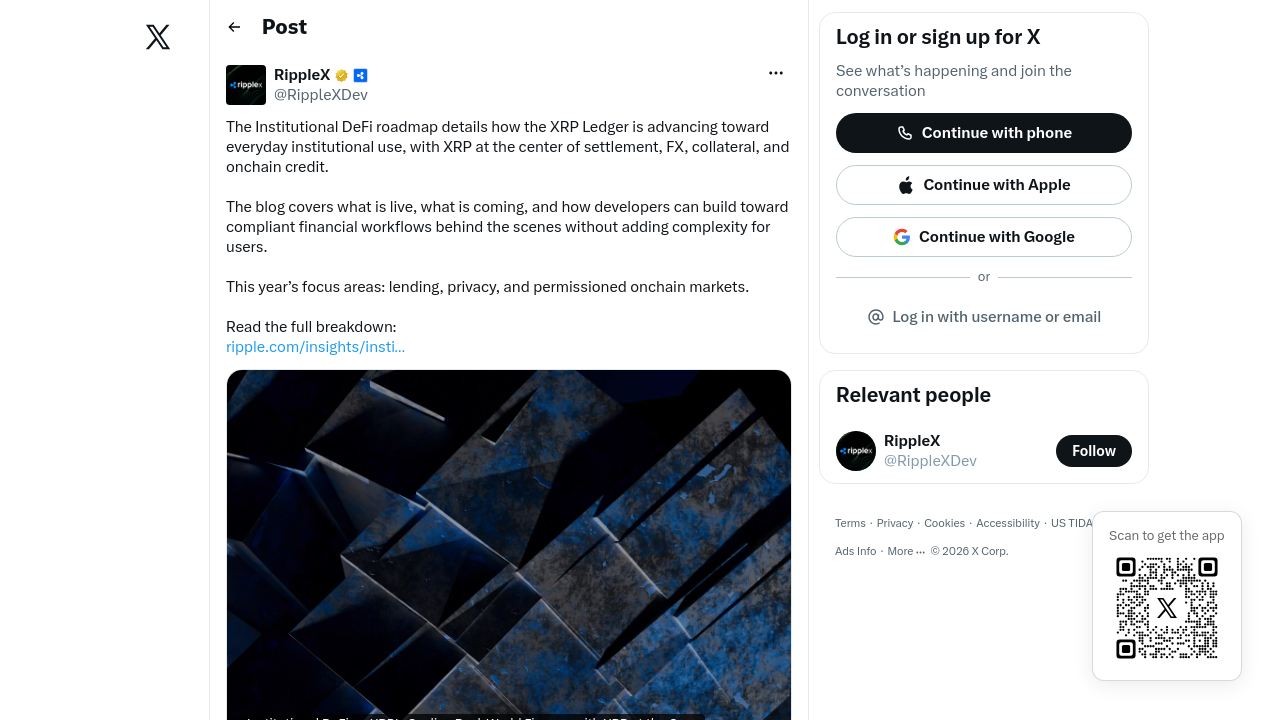
The roadmap is Ripple's published framework for evolving the XRP Ledger (XRPL) into infrastructure that regulated financial entities can transact on without leaving the public chain. It is not a whitepaper. It is a sequenced product plan covering settlement, FX, collateral, on-chain credit, and the compliance primitives needed to make each of those workflows survive an internal risk review. The RippleX team published the current version on February 5, 2026, positioning XRP at the center of settlement, FX, collateral, and on-chain credit workflows.
Scope of the Roadmap
The scope is deliberately narrow relative to general-purpose L1 roadmaps. Ripple is not pitching XRPL as a venue for consumer applications, gaming, or generalized smart contracts. The design target is regulated capital, and every listed feature maps back to a workflow a treasurer, custodian, or asset manager already runs off-chain. Similar framing is emerging across other regulated on-chain venues, and readers tracking that shift can dig into the wider institutional adoption analysis our team maintains.
How It Differs From Retail DeFi
Retail DeFi is optimized for permissionless composability. The institutional roadmap is optimized for permissioned composability, which is a meaningfully different constraint. Permissioned domains, credential primitives, and identity-aware token transfers make assets "balance-sheet eligible" for entities that cannot legally hold bearer tokens on an open ledger. The plumbing is the same, the gating is not. For readers new to this distinction, our DeFi and stablecoin fundamentals hub covers the underlying primitives in more depth.
In plain English: the roadmap is a plan to make XRPL usable by entities whose lawyers currently say no to public chains, without abandoning the public chain itself.
How It Works: The XRPL Architecture Underpinning the Roadmap

Understanding the roadmap requires separating three cohorts of capability: what shipped, what is in flight for 2026, and what remains research. Allocators who blur those categories end up underwriting features that do not exist yet. The broader tokenization stack that XRPL is competing inside gives useful context for how these categories map to product timelines across chains.
Live Features Already Deployed
Several core primitives are live on XRPL today:
- Multi-Purpose Tokens (MPT): a native token standard supporting programmable financial instruments, including structured credit and tokenized fund shares.
- Permissioned domains: issuer-defined transfer restrictions that limit token movement to credentialed wallets without moving off the public ledger.
- Native DEX: on-chain FX routing with XRP as the bridge asset between token pairs.
- Stablecoin throughput: per Ripple's September 2025 update, XRPL crossed $1B+ in monthly stablecoin volume and entered the top-10 chains for real-world asset activity.
That last data point matters because it moves XRPL from "designed for institutions" to "measurably used by them." A useful comparative read on how stablecoin flows are being reshaped by treasury-grade collateral sits in our note on treasury-backed assets and yield.
Features in Active Development for 2026
Ripple has identified three concrete 2026 focus areas: lending, privacy, and expanded permissioned on-chain markets. The lending protocol is the most consequential; it introduces a native on-chain credit facility while explicitly keeping underwritten risk management off-chain, per Ripple's roadmap and CryptoSlate's reporting. That design choice sidesteps the largest failure mode in DeFi lending, which is attempting to price idiosyncratic credit risk with automated liquidation logic. Our recent read on on-chain lending yield dynamics frames why that separation matters for institutional participants.
Longer-Horizon Capabilities
Privacy primitives, advanced permissioned market microstructure, and deeper credential tooling sit further out on the timeline. These items are the ones most likely to shift as regulatory guidance evolves, and allocators should treat them as directional signal rather than a delivery commitment. The parallel regulatory workstreams around custody, market structure, and stablecoin issuance will shape how quickly these primitives can be productionized.
Takeaway: live capability is enough to run stablecoin settlement, DEX-based FX, and tokenized asset issuance today. Credit and privacy require patience.
Why It Matters: Use Cases for Institutional Allocators

The roadmap creates three distinct entry points for allocator capital. Each maps to a workflow allocators already run through traditional rails, and each has a measurably different maturity level on XRPL today.
Settlement and FX
XRP is positioned as the native settlement and FX asset within institutional workflows. The value proposition is not that XRP is cheap, it is that XRP-mediated settlement collapses the counterparty and latency exposure inherent in correspondent banking. A trade that clears atomically on ledger removes intraday funding risk, nostro-vostro reconciliation, and the operational overhead of managing pre-funded accounts across jurisdictions. Institutions weighing this against traditional rails should also review the sovereign debt and digital collateral shift that is reshaping settlement asset choice.
Collateral Management and On-Chain Credit
Collateral mobility is the second use case, and arguably the more valuable one for balance-sheet-heavy institutions. XRPL's atomic settlement and MPT standard allow collateral to be posted, transferred, netted, and redeemed within a single transaction. Combined with the planned native lending protocol, that opens a path to on-chain repo, tri-party arrangements, and secured credit facilities where the collateral leg and the funding leg settle simultaneously. Allocators evaluating this design should benchmark it against the traditional prime brokerage stack; our institutional infrastructure coverage tracks that comparison.
Real-World Asset Activity on XRPL
XRPL's top-10 position in RWA activity as of September 2025 is not a promise, it is a measured on-chain figure. Tokenized bond and fund activity is already generating settled volume on the ledger, which gives allocators something to actually diligence. Ripple has framed compliant financial workflows as operating "behind the scenes without adding complexity for users," per the February 2026 RippleX announcement, and that framing matters for operations teams estimating adoption friction. A parallel read on tokenization desks moving in the same direction sits in our note on Goldman Sachs' tokenization desk expansion.
Common Misconceptions About the Ripple Institutional DeFi Roadmap

The roadmap sits in a communication environment dominated by retail token discussion, and that produces predictable misreads. Three matter for allocators. Our analysis desk unpacks the underlying market structure debates in more depth.
Misconception: The Roadmap Is Primarily About XRP Price Appreciation
Reality: the roadmap is infrastructure-oriented. Permissioned domains, credential primitives, and the lending protocol are engineered to remove institutional blockers, not to manufacture token demand. XRP's role as a bridge asset does produce settlement utility, but the roadmap's documents describe workflows, not price mechanics. Readers who want a clean framing of how utility-driven token designs are being assessed can review the de-pegging and liquidity cycle analysis.
Misconception: XRPL Is a Permissioned Private Chain
Reality: XRPL remains a public ledger. Permissioned domains are an issuer-controlled overlay on top of the public chain, not a pivot to a private consortium model. The public settlement layer continues to operate for anyone; the credentialing layer simply restricts which wallets can hold or transfer specific tokens. Our fundamentals library covers the public-versus-permissioned distinction in more depth.
Misconception: All Roadmap Features Are Already Live
Reality: the native lending protocol and advanced privacy primitives are still in development as of early 2026. Risk management for the lending protocol is explicitly kept off-chain, which means XRPL is not attempting to replicate credit underwriting on-ledger. Allocators should build any exposure thesis around live capability and treat 2026 items as forward optionality. For regulatory context on how off-chain risk functions interact with on-chain settlement, see our note on SEC custody rules for digital asset managers.
Related Concepts: Terms Allocators Need to Understand
A short glossary of the primitives underneath the roadmap. Each term below is referenced elsewhere in Ripple's documentation and matters for internal diligence memos. Additional context sits across our institutions coverage.
Permissioned Domains
Issuer-defined restrictions on which credentialed wallets may hold or transfer a given token. They allow KYC/AML enforcement without leaving the public ledger and are the mechanism that makes tokenized bank deposits or regulated fund shares transferable on-chain.
Multi-Purpose Tokens (MPT)
An XRPL-native token standard designed for programmable financial instruments including structured notes, fund shares, and debt tokens. MPT extends the ledger beyond fungible-only issuance without adopting a general-purpose smart contract runtime. Our primary-market tokenization primer walks through where MPT-style standards fit in the tokenization stack.
Decentralized Identifiers (DID)
A credential layer that permissioned domains reference to verify counterparty eligibility at the protocol level. DIDs allow a wallet to prove attributes (accreditation, jurisdiction, KYC status) without exposing the underlying identity data on-chain.
Native DEX on XRPL
An order-book DEX embedded in the ledger, with XRP as the bridge asset routing between tokenized currency pairs. Unlike AMM-only venues, the native DEX supports order-book market microstructure that maps closer to how institutional FX desks already operate. Related market structure reading sits in our note on arbitrage loops in automated market makers.
On-Chain Lending Protocols
The 2026 target introduces native credit facilities with settlement on-chain and underwriting off-chain. This bifurcation is deliberate: the ledger handles collateral movement and repayment logic, while credit risk is priced by regulated counterparties using their existing models.
How to Get Started: Evaluating XRPL for an Institutional Portfolio
The evaluation path is more workmanlike than most crypto research suggests. Three concrete steps.
Step 1: Audit Which Features Are Live vs. Roadmap
Before writing any infrastructure commitment, separate live XRPL capability (MPT, permissioned domains, DEX, $1B+ monthly stablecoin volume) from planned features (native lending, expanded privacy). An exposure thesis built on live features can go into production this year. A thesis built on 2026 commitments needs a fallback. Our macro coverage tracks how those timelines interact with broader adoption cycles.
Step 2: Assess Compliance Infrastructure Fit
Compliance due diligence should focus on how permissioned domain credentials map to the allocator's existing KYC/AML obligations and whether the on-chain credential model satisfies internal legal review. This is not a technology question, it is a legal-operations question, and it tends to be the actual gating item for adoption. Our work-with-us page outlines how our research team supports allocators running that diligence workflow.
Step 3: Identify Entry Points in RWA and Stablecoin Markets
XRPL's measurable stablecoin and RWA activity gives allocators an initial market sizing input that does not depend on forecast. Third-party analytics platforms index XRPL transaction data for institutional due diligence purposes, and developers can access open XRPL documentation and the RippleX developer program to prototype compliant workflows ahead of the native lending protocol launch. Additional entry-point analysis sits in our ETF flows note, which frames how regulated wrappers are pulling capital toward on-chain venues.
Takeaway for allocators: treat XRPL's institutional roadmap the way you would treat a bank's product pipeline. Live features underwrite exposure today. Roadmap items are options on future capability, priced accordingly. Stablecoin.nyc will continue tracking delivery against that pipeline as 2026 features ship.
Frequently Asked Questions
What is Ripple's institutional DeFi roadmap?
It is Ripple's published plan for evolving the XRP Ledger into infrastructure for regulated financial workflows, covering settlement, FX, collateral, and on-chain credit. The February 2026 update names lending, privacy, and permissioned markets as focus areas.
Which features on the XRPL institutional DeFi roadmap are already live?
Multi-Purpose Tokens, permissioned domains with compliance tooling, the native DEX, and stablecoin issuance are all live. XRPL crossed $1B+ in monthly stablecoin volume and entered the top-10 chains for real-world asset activity as of September 2025.
How does XRP fit into Ripple's institutional DeFi plans?
Ripple positions XRP as the central settlement and bridge asset for institutional workflows, spanning FX, collateral movement, and on-chain credit. The role is utility-driven rather than speculative, with XRP mediating value transfer between tokenized currency pairs on-ledger.
What is a permissioned domain on the XRP Ledger?
A permissioned domain is an issuer-controlled restriction that limits which credentialed wallets may hold or transfer a specific token. It enforces KYC/AML at the protocol level without moving the asset off the public XRPL chain.
When will XRPL's native lending protocol launch?
Ripple has targeted 2026 for the native lending protocol, alongside privacy primitives and expanded permissioned markets. Underwritten credit risk management remains explicitly off-chain, with the ledger handling collateral movement, repayment logic, and settlement finality.
How does XRPL compare to other blockchains for institutional DeFi?
XRPL competes on compliance primitives and settlement finality rather than general-purpose programmability. Its permissioned domain model, native DEX, and MPT standard are engineered around regulated workflows, positioning it closer to financial market infrastructure than to a smart contract platform.
What are Multi-Purpose Tokens (MPT) and why do they matter for allocators?
MPT is an XRPL-native standard for programmable financial instruments including structured notes, fund shares, and debt tokens. For allocators, MPT enables issuance of balance-sheet-eligible tokenized assets without adopting a full general-purpose smart contract runtime and its associated risk surface.
Is the XRP Ledger a public or private blockchain for institutional use?
XRPL is a public ledger. Permissioned domains and credential primitives are overlays that restrict token transfers to eligible counterparties, not a shift to a private consortium chain. The public settlement layer continues to operate openly beneath the compliance layer.
Conclusion
The Ripple institutional DeFi roadmap is best read as a delivery schedule for financial market infrastructure, not as a token narrative. Live capability, including MPT, permissioned domains, the native DEX, and measurable stablecoin and RWA volume, is already sufficient to run several institutional workflows. The 2026 items, lending, privacy, and expanded permissioned markets, extend that surface into credit and confidential settlement. Allocators should underwrite the live layer today and treat forward commitments as optionality. Our team at Stablecoin.nyc will keep marking the roadmap to delivery as features ship.