
Genius Act Passed: What The Stablecoin Law Changes Now
The GENIUS Act, signed into law by President Trump on July 18, 2025, is the first comprehensive federal regulatory framework for payment stablecoins ever enacted by the United States Congress. For regulators, policy researchers, and compliance teams navigating digital asset oversight, this law redraws jurisdictional lines, sets reserve and disclosure standards, and establishes new AML obligations. Stablecoin.nyc tracks how these changes reshape issuer economics and secondary-market liquidity in real time.
Definition: What the GENIUS Act Actually Is
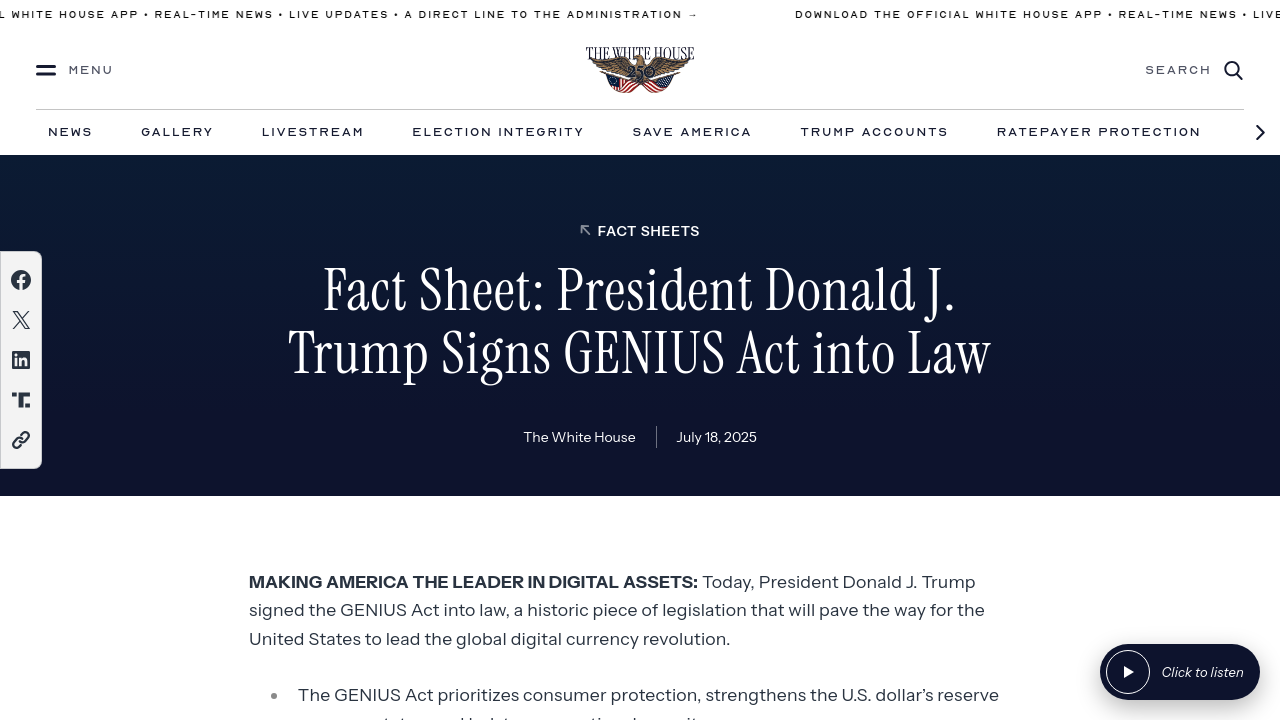
The Guiding and Establishing National Innovation for U.S. Stablecoins Act, enacted as Public Law 119-27, is a targeted statute. It does not cover crypto broadly. It covers one instrument type: payment stablecoins redeemable at par. That narrow scope is the source of most of its regulatory use, and the reason it cleared Congress ahead of the broader market-structure bill.
In plain English: The GENIUS Act tells you who can issue a dollar-pegged token, what has to sit behind it, and which regulator holds the leash.
Full Name and Legislative History
Senator Bill Hagerty (R-TN) introduced the bill on May 21, 2025. The Senate passed it 68-30 on June 17, 2025. The House followed 308-122 on July 17, and the President signed it the next day. Its House companion was the STABLE Act, which shared the same core architecture but diverged on custody, audit cadence, and the treatment of algorithmic designs. Our running coverage of the stablecoin bill in Senate committee captured the earlier friction points that were negotiated out before final passage.
What Counts as a Payment Stablecoin
The statute defines payment stablecoins as digital assets redeemable at a fixed value, and explicitly excludes them from SEC and CFTC definitions of "security" and "commodity." That jurisdictional carve-out is doing heavy lifting. It moves compliant payment stablecoins out of the capital-markets regime entirely and into a bespoke prudential category. The Brookings Institution frames the resulting instrument as separate from both bank deposits and capital-market instruments, which is the analytical starting point for anyone modelling the fundamentals of the new asset class. Takeaway: this is not securities law with a crypto label. It is a purpose-built regime.
How the GENIUS Act Works: Core Regulatory Mechanisms

The mechanics reduce to three levers: what backs the token, who supervises the issuer, and what enforcement powers attach when things break. Each lever imports established banking-law concepts, but the calibration is new.
Reserve Requirements and Disclosure Rules
Issuers must hold 100% reserves in liquid assets, defined narrowly as U.S. dollars and short-term Treasuries. Reserve composition must be disclosed publicly on a monthly cadence. This closes the door on the reserve opacity that dominated the 2021-2023 stablecoin cycle and mirrors the collateral discipline institutional allocators already apply to money-market funds. Our note on Treasury-backed assets redefining yield walks through why the Treasury bill layer becomes the dominant reserve asset under this rule.
Tiered Oversight: Federal vs. State
Issuers with more than $10 billion in outstanding stablecoin issuance fall under direct federal oversight, primarily from the Office of the Comptroller of the Currency. Smaller issuers may opt into qualifying state regimes if those regimes meet substantially similar standards. This produces a genuine two-tier structure rather than a federal preemption. Coverage of the institutional side of the market shows why the $10B threshold matters: it defines which issuers can distribute through federally supervised bank channels versus which will scale within state trust-charter perimeters.
AML, Sanctions, and Enforcement Powers
All issuers, regardless of tier, are explicitly subjected to the Bank Secrecy Act. That means documented AML programs, sanctions-list verification, and customer identification procedures. Federal regulators are granted cease-and-desist and civil money penalty authority. Issuers must also possess the technical capability to seize, freeze, or burn stablecoins when legally required. In insolvency, holder claims are prioritized above all other creditors, which is a stronger position than depositors receive under the FDIC receivership waterfall. According to the White House fact sheet, this priority ranking is the statute's primary consumer-protection backstop.
Section takeaway: the reserve rule handles solvency, OCC oversight handles supervision, and BSA integration handles illicit finance. Three distinct problems, three distinct mechanisms.
Why the GENIUS Act Was Passed: Policy Goals

The bipartisan margins (68-30 Senate, 308-122 House) reflect goal-stacking rather than consensus on any single objective. Three policy vectors sit inside the same statute.
Strengthening the U.S. Dollar's Reserve Status
By requiring reserves in dollars and Treasuries, the law converts every dollar of stablecoin issuance into structural Treasury demand. This is not incidental. The Administration frames stablecoin adoption as a mechanism to reinforce the dollar's global reserve role, particularly as sovereign debt dynamics shift toward digital collateral rails. If stablecoin float scales into the trillions, the marginal buyer of front-end Treasuries becomes a private token issuer domiciled in U.S. jurisdiction.
Consumer Protection Provisions
Issuers are forbidden from making misleading claims that stablecoins are backed by the U.S. government, federally insured, or constitute legal tender. Marketing conduct rules attach. Combined with the insolvency priority, this addresses the deceptive-practices layer that regulators repeatedly flagged during the previous liquidity cycle's de-pegging events. The law does not eliminate run risk; it clarifies what issuers cannot promise about that risk.
National Security and Illicit Finance
Registering all issuers and integrating them into Treasury's sanctions architecture expands enforcement reach. The technical seize-freeze-burn requirement is the operational counterpart. For ongoing macro coverage, the relevant point is that regulated stablecoins now carry the same sanctions-enforcement obligations as traditional payment intermediaries, which changes the risk calculus for offshore issuers routing dollars through U.S.-facing venues.
Common Misconceptions About the GENIUS Act

The statute has been mischaracterized in both directions. Below are the three misreadings that matter for policy analysis.
Misconception: Stablecoins Are Now FDIC-Insured / Reality: They Are Not
Brookings analyses are explicit: GENIUS-regulated stablecoins lack FDIC insurance and lack direct Federal Reserve access. They sit outside the traditional banking safety net. Holder priority in insolvency is a claims-waterfall rule, not deposit insurance. That distinction matters when institutional treasurers model tail scenarios, and it links directly to the custody-rule questions the SEC continues to work through for digital asset managers holding these instruments.
Misconception: All Issuers Face Federal Oversight / Reality: A Two-Tier System Applies
The $10 billion threshold is the pivot. Large issuers face direct OCC supervision. Smaller issuers can operate under qualifying state regimes provided those regimes meet substantially similar standards. This is not a loophole. It is a deliberate federalist design that lets state trust charters continue to serve as issuance vehicles while keeping systemically material issuers inside a federal perimeter. Practitioners tracking analytical framing across the market should treat the two tiers as distinct compliance products, not variations on one theme.
Misconception: The Law Eliminates All Regulatory Risk / Reality: Critics Identify Significant Gaps
Consumer Reports argued the bill does not provide sufficient consumer protection and allows large technology companies to engage in bank-like activities without equivalent banking regulation. New York Attorney General Letitia James and other prosecutors noted the statute lacks provisions requiring issuers to return stolen funds to fraud victims. Economists Max Harris and Kenneth Rogoff drew explicit parallels between the GENIUS Act's regulatory environment and the free banking era of 1837-1862, flagging systemic risk. These are load-bearing critiques, not fringe objections, and they map onto the structural liquidity questions we have been tracking around front-end Treasury demand.
Related Concepts: The Broader Legislative Context
GENIUS is one statute inside a wider legislative program. Reading it in isolation understates what is happening in U.S. digital asset regulation.
The CLARITY Act
The Digital Asset Market Clarity Act passed the House 294-134 on the same day GENIUS cleared the House. It splits digital asset jurisdiction between the CFTC (digital commodities) and the SEC (restricted digital assets), creates a provisional registration pathway while regulators finalize rules, and expands safe-harbor provisions for non-custodial DeFi participants including developers and validators. It still requires Senate approval. According to the Jones Day analysis of both bills' passage, CLARITY is where the market-structure fight lands next, and Senate amendments are widely expected.
State Stablecoin Regimes
State stablecoin frameworks can satisfy GENIUS Act requirements if they meet substantially similar standards. New York's BitLicense regime and comparable state trust charters remain live issuance venues under this design. This preserves state-level regulatory competition, which historically shaped how tokenization desks like Goldman's structured their institutional products. Expect divergence between state regimes on audit cadence, capital treatment, and permitted reserve composition within the federal floor.
International Stablecoin Regulation
The Oxford Business Law Blog describes the jurisdictional carve-out from SEC and CFTC as a structural choice with few direct counterparts globally. The EU's MiCA framework, by contrast, applies existing e-money and securities perimeters to stablecoins rather than creating a bespoke category. Our reading of MiCA 2.0's implications for funds captures the transatlantic divergence: MiCA integrates stablecoins into existing financial-services law, while GENIUS builds a new category next to it.
How to Get Started Under the GENIUS Act Framework
The statute passed; implementing regulations have not. The immediate compliance window is narrow and the analytical window is wide.
Immediate Compliance Steps for Issuers
Four actions matter now:
- Assess whether total outstanding issuance exceeds $10 billion to determine federal OCC registration versus state-regime opt-in.
- Stand up documented AML programs, sanctions-screening procedures, and customer identification processes consistent with BSA obligations.
- Build audit and reporting infrastructure for monthly public reserve disclosures before enforcement rulemaking begins.
- Verify technical capability to seize, freeze, and burn tokens under lawful order, and document the operational playbook.
Issuers should also review distribution partnerships against the two-tier oversight map. Our partnerships coverage explores how bank and exchange counterparties are already re-papering agreements to reflect the new registration status.
What Regulators and Researchers Should Monitor
Federal rulemaking timelines from the OCC and Treasury will define most of the operational detail the statute leaves open. Comparative developments in MiCA, the UK's stablecoin regime, Singapore's MAS framework, and Hong Kong's SFC rules will indicate how quickly the GENIUS template travels. Reserve composition disclosures, once they begin, will provide the first public data on how issuers actually deploy backing assets. For researchers building longitudinal datasets, the resources hub collects the primary-source filings and regulator statements as they publish.
Frequently Asked Questions
What does the GENIUS Act stand for?
GENIUS stands for Guiding and Establishing National Innovation for U.S. Stablecoins Act. It was enacted as Public Law 119-27 and creates the first comprehensive federal regulatory framework for payment stablecoins in the United States.
When was the GENIUS Act signed into law?
President Trump signed the GENIUS Act on July 18, 2025, one day after the House passed it 308-122. The Senate had approved the bill 68-30 on June 17, 2025, following its introduction by Senator Bill Hagerty in May.
What reserve requirements does the GENIUS Act impose on stablecoin issuers?
Issuers must hold 100% reserves in liquid assets, specifically U.S. dollars or short-term U.S. Treasuries. Reserve composition must be publicly disclosed on a monthly cadence, closing the reserve-opacity issues that defined earlier stablecoin market cycles.
Does the GENIUS Act apply to all stablecoin issuers or only large ones?
It applies to all payment stablecoin issuers, but oversight is tiered. Issuers above $10 billion in outstanding issuance face direct federal supervision from the OCC. Smaller issuers can opt into qualifying state regimes meeting substantially similar standards.
Are stablecoins regulated under the GENIUS Act considered securities?
No. The statute explicitly excludes compliant payment stablecoins from the federal definitions of "security" and "commodity," creating a jurisdictional carve-out from SEC and CFTC oversight and placing them in a bespoke prudential category instead.
Are GENIUS Act stablecoins FDIC insured?
No. GENIUS-regulated stablecoins are not FDIC insured and do not have direct Federal Reserve access. The statute prioritizes holder claims in issuer insolvency, but that is a claims-waterfall rule, not deposit insurance or a federal guarantee.
How does the GENIUS Act address money laundering and sanctions compliance?
The law explicitly subjects issuers to the Bank Secrecy Act, requiring documented AML programs, sanctions-list verification, and customer identification. Issuers must also possess the technical capability to seize, freeze, or burn stablecoins under lawful orders.
What is the difference between the GENIUS Act and the CLARITY Act?
GENIUS regulates payment stablecoins and is now law. The CLARITY Act, still pending in the Senate, would split broader digital asset jurisdiction between the CFTC and SEC, create a provisional registration pathway, and expand safe harbors for non-custodial DeFi participants.
Conclusion
The GENIUS Act converts payment stablecoins from a regulatory gray zone into a defined prudential category with reserve rules, tiered supervision, and integrated AML obligations. It does not solve every question, notably the fraud-restitution gap and the systemic-risk concerns economists have flagged, but it establishes a workable federal floor and preserves state-level issuance channels. The next twelve to twenty-four months of OCC and Treasury rulemaking will determine how the statute actually operates in practice. For continued analysis of stablecoin regulation, market structure, and issuer economics, follow the Stablecoin.nyc analysis desk as implementing rules land.