What Are Tokenized Treasuries And How Do They Work
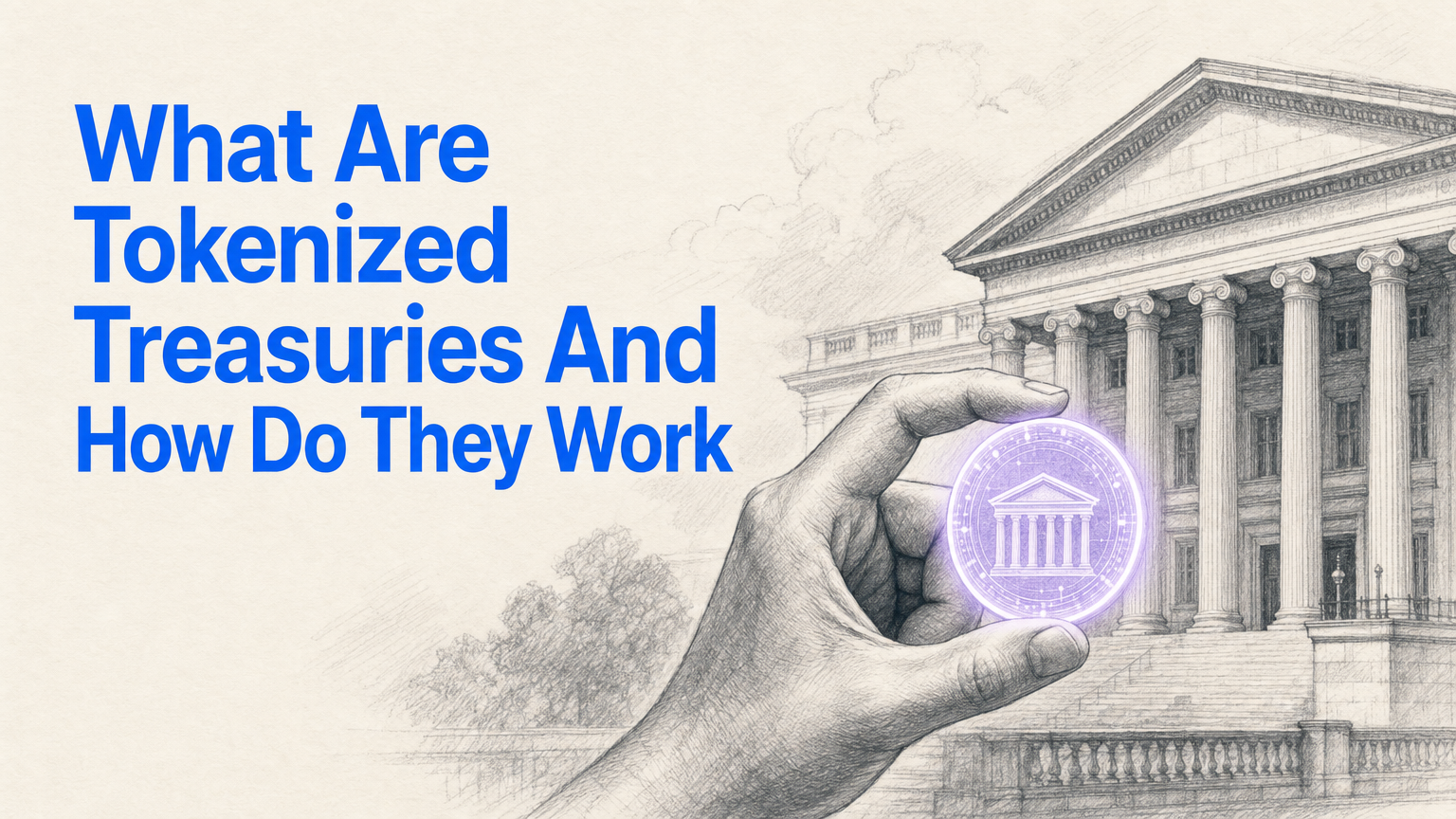
Tokenized treasuries are digital representations of U.S. government debt securities recorded on a blockchain, combining the stability of sovereign bonds with the efficiency of programmable finance. As of mid-2026, the market has grown past $17 billion in assets onchain, attracting BlackRock, Franklin Templeton, and crypto-native issuers in the same order book. Stablecoin.nyc covers the full landscape of tokenized real-world assets, and this piece unpacks the fastest-growing corner of onchain fixed income.
Definition: What Are Tokenized Treasuries
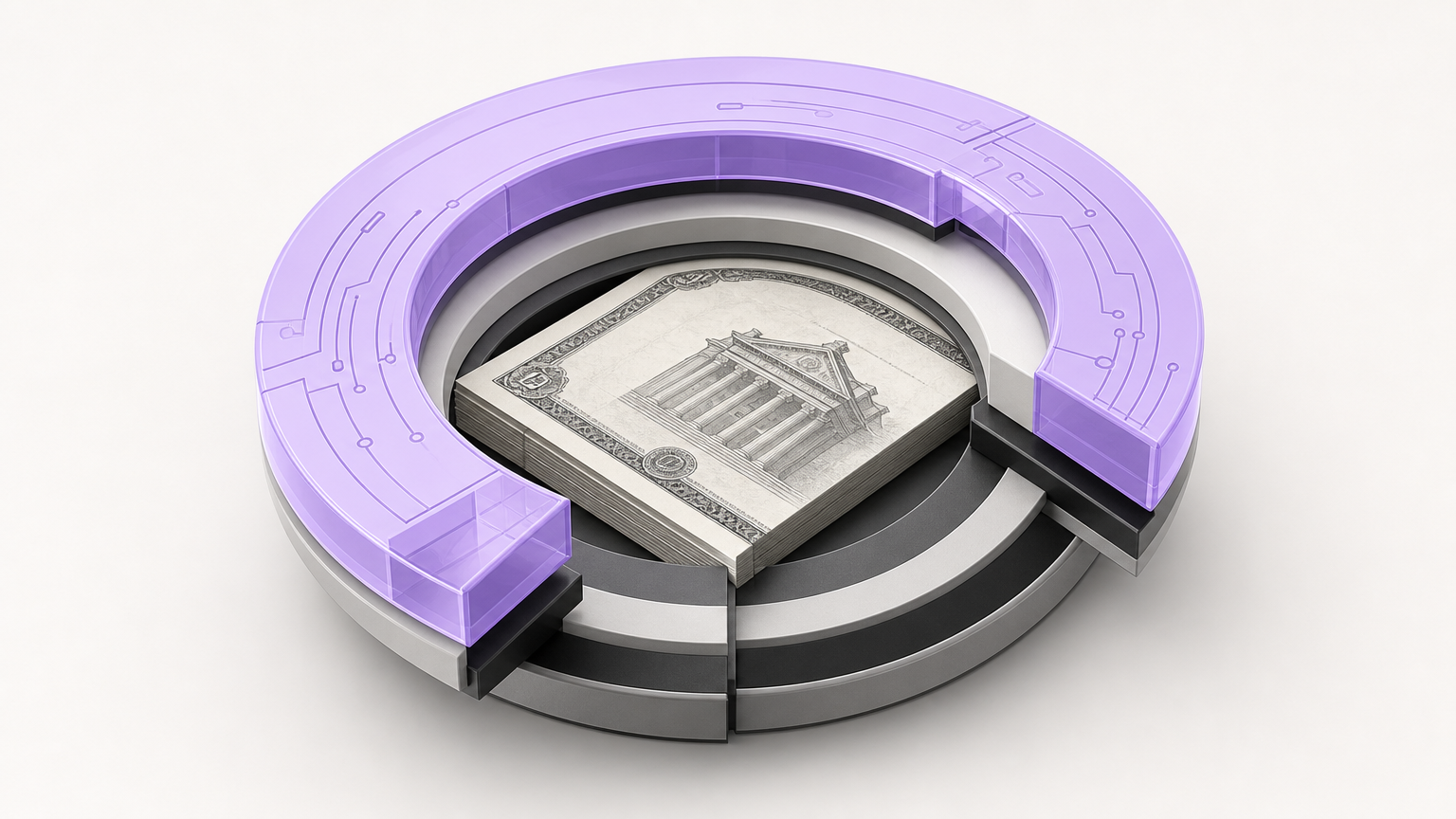
Tokenized treasuries are blockchain-issued tokens that represent a direct or indirect claim on U.S. government debt, most often short-dated Treasury bills or the money market funds that hold them. Each token corresponds to underlying assets held offchain by a regulated custodian, and the smart contract manages transfer, yield accrual, and redemption. The instrument sits at the intersection of sovereign credit and programmable settlement, which is why it has become the fixed-income backbone of the RWA market.
In plain English: a tokenized treasury is a crypto token whose value is backed 1:1 by a T-bill or a fund holding T-bills, and it earns interest while sitting in your wallet.
The Plain-English Explanation
Instead of a brokerage line item or a paper certificate, an investor holds a cryptographic token that signifies ownership of a share in a Treasury-backed portfolio. The token settles like any ERC-20, but the balance is anchored to a real, custodied bond. This structural link is what separates tokenized treasuries from purely synthetic yield products, and it is why treasurers have started treating them as a genuine dollar-collateral primitive.
Types of Tokenized Treasury Structures
Three structures dominate the market today:
- Tokenized fund or ETF shares. The most common model. A regulated fund holds T-bills; token holders own shares in the fund. BlackRock's BUIDL and Franklin Templeton's BENJI use this design.
- Directly tokenized T-bills. A rarer, one-to-one onchain representation of the underlying government security itself, without a fund wrapper.
- Money market fund tokens. Similar to the fund model but backed by a broader mix of short-dated government paper and repo, closer to a traditional MMF.
According to Chainlink's tokenized treasuries explainer, smart contracts automate the full lifecycle across these structures, from issuance to interest payments to redemption, replacing manual back-office processes. Tokenized treasuries sit within the broader real-world asset category, which reached $31.8 billion onchain as of August 2026 in Allium's crosschain RWA dataset, and are the largest single slice of that total. For a broader read on how these instruments fit institutional balance sheets, see our analysis category.
Takeaway: the token is a wrapper. What determines quality is the custody chain, the fund structure, and the legal claim the wrapper actually confers.
How Tokenized Treasuries Work: The Full Lifecycle

The mechanics vary by issuer, but every serious product follows the same three-phase lifecycle: purchase and mint, yield distribution, and redemption. Understanding each phase is how allocators separate a real onchain Treasury product from a synthetic. Our fundamentals category covers the underlying plumbing in more depth.
Purchase, Custody, and Minting
The issuer accepts cash or stablecoins from an eligible investor, converts the balance into short-dated T-bills or MMF shares, and delivers those assets to a qualified custodian. Once the underlying is settled offchain, a corresponding token supply is minted onchain. The token contract's supply is intended to match assets under custody one-to-one, and the best issuers publish attestations or proof-of-reserve feeds to confirm the ratio. This offchain-to-onchain handshake is the same architectural pattern used by fiat-backed stablecoins, and it inherits the same custody sensitivities regulators are now pricing in.
Yield Accrual and Distribution
Yield reaches token holders through one of three mechanisms:
- Rebasing. The token balance in each wallet increases as interest accrues. USDY-style products use this design.
- NAV appreciation. The token price rises against a stable reference, similar to a mutual fund share price.
- Separate yield token. The principal token is kept stable while a distinct token distributes yield, useful for products that want to preserve a fixed reference price.
Transfers are gated at the smart contract level with whitelist or KYC logic, reflecting the securities status of the instrument. That is a meaningful design constraint: unlike a stablecoin, a tokenized treasury generally cannot move to any address, which shapes how it can be used in onchain lending and collateral markets.
Redemption and Settlement
Redemption reverses the mint. The holder submits tokens to the issuer, the contract burns the supply, the custodian liquidates or rolls the underlying, and the investor receives cash or stablecoins back. Redemption windows vary widely: some products settle same-day in USDC, others operate on T+1 or T+2 wire cycles that mirror traditional fund settlement. That gap between 24/7 onchain trading and traditional-hours redemption is a real liquidity consideration that our macro category tracks across market cycles.
Takeaway: the token trades onchain around the clock, but the underlying still settles on TradFi rails. Redemption speed is a product-selection variable, not a given.
Why Tokenized Treasuries Matter: Key Benefits
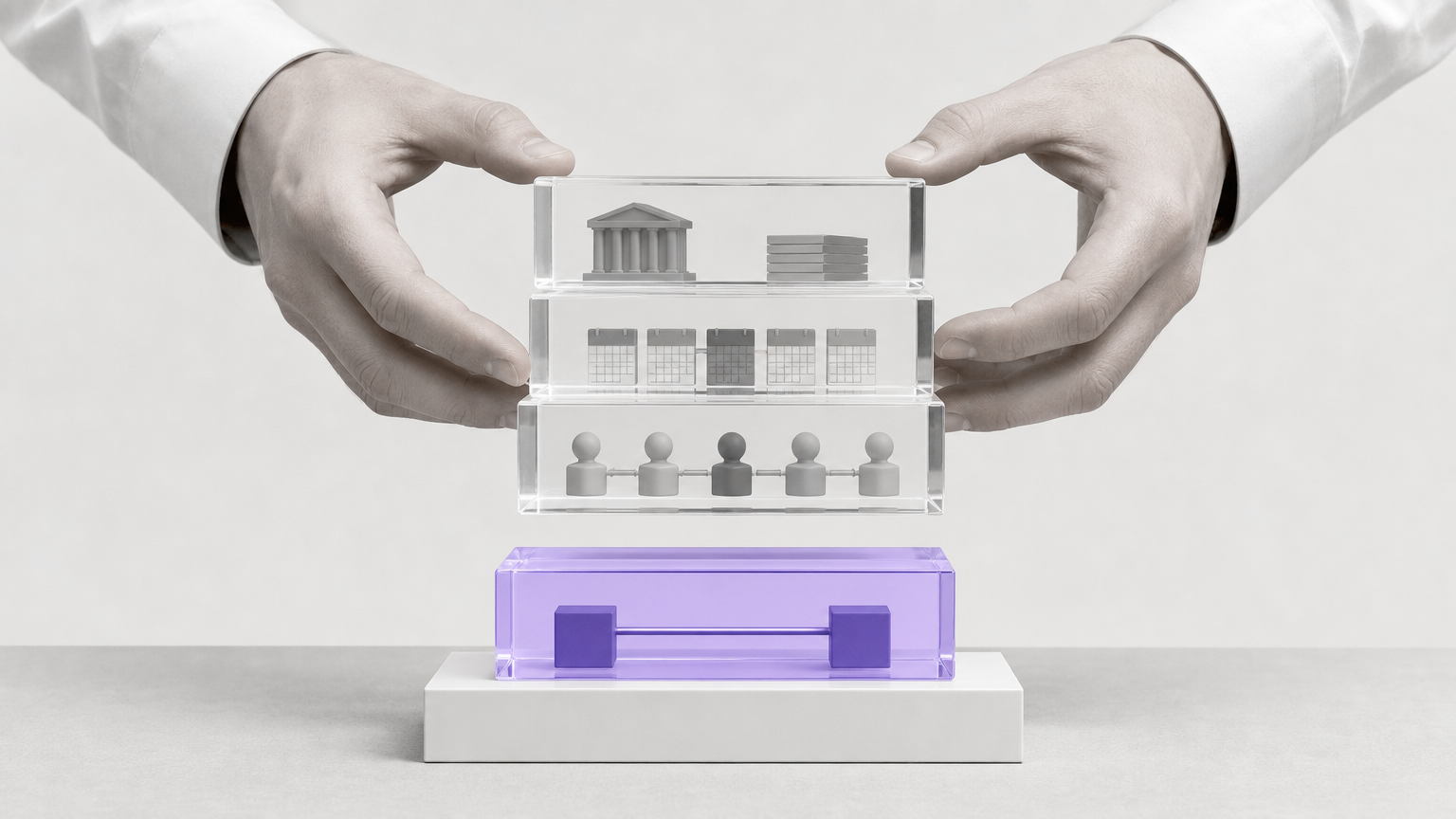
Traditional Treasury markets operate on fragmented infrastructure with T+1 settlement, closed weekends, and a chain of intermediaries between the buyer and the security. Tokenized versions collapse that stack. The result is a T-bill claim that trades 24/7, moves instantly between wallets, and slots into DeFi as native collateral. According to Allium's dataset, tokenized treasuries and money market funds reached $17.3 billion onchain by August 2026, up roughly 191% year-over-year, making them the single largest RWA category. Our institutions category tracks how large allocators are integrating these products into treasury operations.
Capital Efficiency and 24/7 Settlement
Idle stablecoin balances carry a real opportunity cost when short rates sit well above zero. A tokenized T-bill wrapper lets a treasurer earn close to the risk-free rate without leaving the blockchain, without wiring to a brokerage, and without giving up the ability to redeploy at any hour. The U.S. Treasury Department has noted that tokenized treasuries enable near-instant, 24/7 settlement and could support timelier collateral management, an operational shift explored in our note on sovereign debt and digital collateral.
DeFi Integration as Collateral and Reserves
The second benefit is compositional. Tokenized treasuries plug directly into onchain venues in three roles:
| Role | Example use | Why it works |
|---|---|---|
| Exchange margin | Perp DEX collateral | 24/7 mark-to-market, high credit quality |
| Lending collateral | Borrow stables against T-bill tokens | Predictable NAV, yield-accretive |
| Stablecoin reserves | Reserve backing for regulated issuers | Yield offsets float costs |
That turns a static holding into working capital: posted as margin, borrowed against, or moved between venues in seconds. It is also why stablecoin issuers have leaned on Treasury-backed structures as reserve assets, a dynamic covered in our partnerships page with issuers and infrastructure providers.
Takeaway: the value is not just yield, it is that the yield-bearing instrument is also programmable collateral.
The Tokenized Treasury Market Today: Key Players and Scale
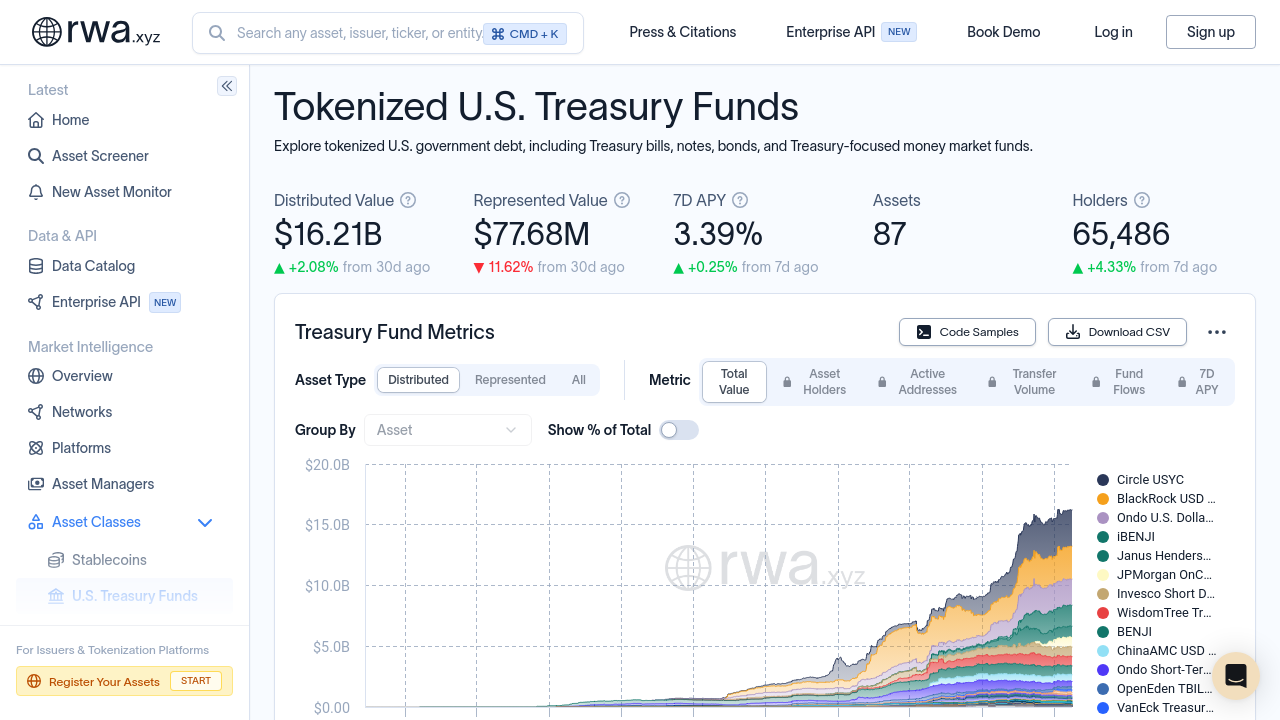
The market has consolidated around a handful of platforms with strong distribution and institutional relationships. RWA.xyz's tokenized U.S. Treasury funds dashboard tracked $16.21 billion in distributed value across 87 distinct assets and 65,486 holders as of mid-August 2026, with a 7-day average APY of 3.39%. For a running read on how flows shift between issuers and networks, our analysis coverage monitors platform-level share weekly.
Leading Issuers and Platforms
Per RWA.xyz data, the top platforms by total value are:
| Rank | Platform | Total Value | Notable Product |
|---|---|---|---|
| 1 | Circle | $3.0B | USYC |
| 2 | Securitize | $3.0B | BlackRock BUIDL ($2.7B) |
| 3 | Ondo | $2.6B | OUSG, USDY |
| 4 | Franklin Templeton Benji | $2.5B | FOBXX |
| 5 | Kinexys Digital Assets | $911M | JPMorgan-issued |
| 6 | Centrifuge | $893M | Multi-asset structures |
| 7 | Superstate | $792M | USTB |
BlackRock's BUIDL fund, distributed via Securitize, is the largest single product on the board and a proxy for institutional confidence in the category. Our reporting on Goldman Sachs expanding its tokenization desk covers a parallel move from another Tier-1 bank into the same market.
Blockchain Networks Hosting Tokenized Treasuries
Products are distributed across Ethereum, Polygon, Base, Solana, and Avalanche, giving investors a choice of settlement environment. Ethereum remains the dominant venue by value, but recent transaction data from RWA.xyz shows meaningful activity on Base (wtSGOV) and Polygon (USTBL). Network choice is not cosmetic: it affects fees, MEV exposure, and which lending markets can accept the token as collateral, factors we treat in our ETF and market-structure coverage.
Takeaway: the league table is concentrated. Five issuers control the majority of AUM, and product choice is increasingly a distribution and integration question rather than a credit question.
Common Misconceptions About Tokenized Treasuries
The category is often conflated with stablecoins or dismissed as unregulated crypto. Both framings miss the structure. Our fundamentals coverage unpacks the distinctions in more depth.
Misconception: Tokenized Treasuries Are the Same as Stablecoins
Stablecoins are designed to hold a fixed peg and function as payment instruments. Tokenized treasuries are yield-bearing investment products whose value fluctuates with rates and fund NAV. USDC and BUIDL both live on Ethereum, but one is a dollar substitute and the other is a security. The distinction matters for accounting, tax, and regulatory treatment, as our note on stablecoin legislation makes clear.
Misconception: They Are Unregulated or Unsafe
Most tokenized treasury products are structured as regulated securities, requiring KYC and AML verification and often restricted to accredited or institutional investors. Access varies significantly by jurisdiction, and flagship products like BUIDL carry high minimum investments. The regulatory perimeter is tighter than crypto commentary tends to acknowledge, particularly in the EU where MiCA 2.0 is now shaping fund distribution.
Misconception: Anyone Can Access Them Instantly
Retail access is limited. Whitelisting at the smart contract layer means transferring a BUIDL token to a random wallet will simply revert. Even for eligible investors, subscription and redemption windows can lag the 24/7 secondary trading of the token itself, a mismatch worth understanding before treating these as cash-equivalent, and one our macro coverage revisits under stress scenarios.
Takeaway: these are regulated funds in a token wrapper. Treat them like securities, not stablecoins.
Risks and Considerations for Tokenized Treasuries
The credit risk of the underlying Treasury is low. The interesting risks live in the wrapper, the custody chain, and the market microstructure around redemption.
Regulatory and Compliance Risks
Tokenized treasuries are almost always classified as securities. Issuers must comply with securities law in every distribution jurisdiction, and frameworks continue to evolve. The Federal Reserve has cited Allium's tokenized asset data in research on onchain markets, a signal that policymakers now treat this dataset as a serious input. Investors evaluating cross-border access should follow the SEC's revised digital-asset custody rules alongside EU and APAC regimes.
Operational and Counterparty Risks
Five practical risk vectors:
- Custody counterparty. The regulated custodian holds the offchain assets. Quality and jurisdiction vary by issuer, and a custody failure can slow or block redemption even when the underlying bonds are fine.
- Redemption liquidity under stress. Some products have redemption windows that do not match 24/7 secondary trading, which can produce meaningful discounts in a rush.
- Interest rate risk. Long-duration tokenized bonds carry more price sensitivity than short-dated T-bills. Most current products stick to the front end for that reason.
- Smart contract risk. Bugs in the token contract or in downstream lending markets can affect holdings independent of the underlying credit.
- Depeg dynamics. In secondary markets, tokens can trade away from NAV under stress, as covered in our note on shortening liquidity cycles.
Takeaway: the credit is the easy part. The wrapper, the custodian, and the redemption path are where diligence pays.
Frequently Asked Questions
What is the difference between tokenized treasuries and stablecoins?
Stablecoins target a fixed $1 peg and function as payment instruments. Tokenized treasuries are yield-bearing securities whose value tracks a Treasury-backed fund NAV, requiring KYC, and typically restricted to accredited or institutional investors under securities law.
Are tokenized treasuries safe investments?
The underlying U.S. Treasuries are among the lowest-credit-risk assets available. The wrapper adds custody, smart contract, and redemption-liquidity risk. Well-structured products from regulated issuers are generally considered low risk, but not risk-free or cash-equivalent.
How do I invest in tokenized treasuries?
Most flagship products require onboarding through the issuer's platform, including KYC and accreditation checks. Eligible investors subscribe with cash or stablecoins, receive tokens in a whitelisted wallet, and redeem back through the issuer when they exit the position.
What yield can I expect from tokenized treasury products?
The 7-day average APY across tokenized Treasury funds stood at 3.39% as of mid-August 2026, per RWA.xyz. Individual product yields track short-term Treasury rates net of management fees, and shift with Federal Reserve policy and prevailing bill auction yields.
Which blockchains support tokenized treasuries?
Ethereum hosts the largest share of value, but Polygon, Base, Solana, and Avalanche all support meaningful products. BUIDL is Ethereum-native, USDY spans multiple chains, and wtSGOV activity on Base has grown steadily through 2026 based on RWA.xyz transaction data.
Are tokenized treasuries available to retail investors?
Access varies. Products like BUIDL are limited to qualified purchasers with high minimums. Others, including some Ondo and OpenEden structures, extend to non-U.S. retail through offshore vehicles. U.S. retail access remains constrained by securities registration requirements.
How large is the tokenized treasury market?
Allium's crosschain dataset put tokenized Treasuries and money market funds at $17.3 billion in August 2026, roughly 55% of the $31.8 billion total real-world assets onchain. The category has grown roughly 191% year-over-year and continues to lead RWA growth.
What happens to my tokens if the issuer or custodian fails?
Token holders hold a legal claim on the underlying assets held by the custodian, but enforcement depends on the fund's legal structure and jurisdiction. Operational failure can delay redemption and, in a worst case, complicate recovery even when underlying Treasuries are intact.
Conclusion
Tokenized treasuries have shifted from experiment to infrastructure. A $17 billion market, five dominant issuers, and active adoption as collateral and reserve backing put this category at the center of onchain fixed income. The interesting work now is on the wrapper: better custody, faster redemption, cleaner regulatory perimeters, and deeper integration with lending and margin systems. For treasurers and allocators evaluating where to route dollars while keeping optionality onchain, tokenized treasuries are the current answer. Stablecoin.nyc publishes ongoing coverage of issuer flows, regulatory shifts, and integration patterns across this market.