TL;DR
- Best overall: Safe{Wallet}
- Best for beginners: Trust Wallet
- Best for cold storage: Ledger
Safe{Wallet} leads this comparison because it replaces a single private key with a multisig account governed by a threshold configuration, so no individual signer can move funds alone, backed by $27.24B in self-custodied assets across more than 25 networks, per Safe's Q2 2026 quarterly report. Every approval and every execution is verifiable onchain. Trust Wallet and Ledger remain solid choices for individual users who need a simpler setup or offline key storage, and both are covered below alongside MetaMask and Zengo.
How we evaluated these wallets
Disclosure: This comparison is published by Safe, the organization behind Safe{Wallet}. Competitor features and security architectures were checked against each provider's official documentation and are current as of August 2026.
Methodology: Wallets were compared across authorization architecture, key protection, recovery model, transaction verification, multi-user controls, chain support, and operational complexity.
What actually matters when choosing a self-custody wallet
Most wallet comparisons list features. The decision actually comes down to five structural questions.
- Control model. Does one key control the funds, or does a defined group have to agree first.
- Transaction execution. Who approves a transfer, and does the wallet enforce that approval before funds move.
- Security assumptions. Where does risk concentrate: a seed phrase, a hardware device, a server-side key share, or a distributed signer set.
- Flexibility. Is the wallet's logic fixed, or can you add spending limits, module permissions, and custom rules.
- Multi-chain usage. Does one account work across networks, or do you manage separate setups per chain.
Most comparisons focus on features, but the real difference is how transactions are controlled and executed.
What is a self-custody wallet (and why architecture matters)
A self-custody wallet is a wallet where you, not an exchange or a custodian, control the private keys that authorize transactions.
That definition covers a wide range of architectures, and the architecture is what actually determines your risk. A basic externally owned account ("EOA") ties every asset to one private key, generated from one seed phrase. A smart account replaces that single key with programmable logic, most commonly a multisig requiring several independent approvals. Both are self-custodial. Only one removes the single point of failure. Advanced power users and teams evaluating self-custody need to look past the "self-custody" label and compare what actually authorizes a transaction.
Quick comparison table
Five wallets come up consistently when people search for the best self-custody wallet: Safe{Wallet}, MetaMask, Zengo, Trust Wallet, and Ledger. Each represents a distinct custody model, not just a different brand.
| Wallet | Custody model | Approval model | Supported chains | Key limitation | Best for |
|---|---|---|---|---|---|
| Safe{Wallet} | Multisig smart account | Threshold configuration, defined signers approve onchain | More than 25 EVM-compatible networks | Requires coordinating multiple signers, more setup than a single-key wallet | Teams, treasuries, and power users who want shared control |
| MetaMask | EOA, single private key and seed phrase | One signature from the device holding the key | Ethereum and EVM-compatible networks | Seed phrase is a single point of failure | Individual users who want broad dApp access |
| Zengo | MPC wallet, key split between device and server | Threshold signature computed across key shares | Multiple chains via app support | Signing ceremony is not independently onchain-verifiable like a multisig transaction | Individual users who want to remove the seed phrase |
| Trust Wallet | EOA, single private key and seed phrase | One signature from the mobile app holding the key | Broad multi-chain support | Same single-key exposure as any EOA wallet | Beginners who want a mobile-first, self-custody wallet |
| Ledger | Hardware wallet, keys stored offline on device | Physical confirmation on the device | Broad support via companion app | Still a single key, tied to one physical device | Cold storage and offline security for long-term holding |
The pattern across the table is not features. It is where control sits: with one key, with server-assisted key shares, with an offline device, or with a defined group of signers.
Top options compared
Safe{Wallet}
How it works. Safe{Wallet} replaces a single private key with a multisig wallet, a smart account that requires a set number of independent signers to approve a transaction before it executes. You define the threshold configuration, for example three approvals out of five signers, and the account enforces it onchain. Safe does not hold your assets. The smart contract governs how they move.
Why it matters. In a Safe{Wallet} configuration where the signing threshold is greater than one, compromising a single signer is not enough to move funds. The Safe smart account enforces that threshold onchain at execution; signer confirmations can be collected off-chain through the Safe Transaction Service beforehand, and every pending transaction can be simulated before execution, so signers see the outcome before they approve it.
What it doesn't protect against. Multisig does not eliminate all wallet risk. Signers can still approve a malicious transaction, smart contract vulnerabilities can exist in any onchain system, and a poorly configured module or an unnecessarily low signer threshold can introduce its own attack surface. That is why Safe's contracts are independently audited and why transaction simulation exists, to catch exactly this kind of risk before signers approve.
Where it fits. Safe{Wallet} is built for teams, treasuries, and advanced power users coordinating funds across multiple wallet setups, DeFi positions, and multiple stakeholders. More than 200 teams managing over $10 million in treasury run on Safe, including GnosisDAO, Aave, ENS, Worldcoin, Mantle, and 1inch.
Pros
- Removes single-key risk through multisig approvals and a defined threshold configuration
- Open source, audited contracts you can verify directly
- Transaction simulation before execution
- Supports more than 25 EVM-compatible networks from one account
- Programmable via Safe Modules for spending limits and custom policy
Cons
- Setup takes longer than a single-key wallet because you configure signers and threshold upfront
- Execution is an onchain transaction and carries gas cost, though signer confirmations themselves can be collected off-chain beforehand at no cost
- Protection scales with the threshold configuration; a 1-of-1 Safe does not provide the same single-point-of-failure protection as a higher threshold
MetaMask
How it works. MetaMask's standard account is a self-custodial EOA wallet, available as a browser extension and mobile app. It generates one seed phrase, which derives one private key, and that key signs every transaction directly. MetaMask also offers a Smart Accounts Kit for developers building account-abstraction functionality on supported networks, but that is separate developer tooling, not the default consumer setup.
Why it matters. MetaMask is the most widely used self-custodial entry point to Ethereum and EVM-compatible DeFi, with a large ecosystem of dApp integrations built around it.
Where it fits. MetaMask works well for an individual managing their own DeFi activity with one wallet.
Pros
- Broadest dApp and protocol compatibility of any self-custodial wallet
- Familiar, well-documented setup with a large user base
- Works across desktop and mobile
Cons
- The seed phrase is a single point of failure. Anyone who obtains it controls every asset in the wallet
- No native mechanism for requiring a second approver before a transaction executes
- A phishing signature or malicious approval affects the same single key that holds everything
Zengo
How it works. Zengo is a self-custodial MPC wallet. Instead of one seed phrase, it splits the private key into two shares using secure multi-party computation, one stored on the user's device, one on Zengo's servers. Signing a transaction combines both shares into a threshold signature without ever reconstructing a full private key in one place. Authentication runs through biometrics rather than a written recovery phrase.
Why it matters. MPC abstracts the key. Multisig distributes it.. These are different security models with different audit surfaces. Zengo's approach removes the classic seed-phrase loss and theft scenario that affects EOA wallets like MetaMask and Trust Wallet.
Where it fits. Zengo suits an individual user who wants self-custody without managing a written seed phrase.
Pros
- No seed phrase to write down, lose, or leak
- Biometric-based access and recovery flow
- Onboarding designed for users new to key management
Cons
- The signing ceremony happens off-chain between device and server key shares. Onchain verifiability is the trade-off advantage of multisig: you can verify every Safe transaction, but you cannot verify an MPC signing event the same way
- Recovery depends on Zengo's infrastructure remaining available
- Built for one user's key, not for a defined group of signers approving team or treasury transactions
Trust Wallet
How it works. Trust Wallet is a self-custodial EOA wallet available as a mobile app, browser extension, and software wallet for desktop. It generates a single seed phrase, sometimes called a recovery phrase, that derives the private key controlling every asset in the wallet, and that one key signs each transaction directly.
Why it matters. Trust Wallet is built for simplicity: a beginner can set up a wallet, buy crypto, and start using decentralized finance apps within minutes, with built-in support for staking tokens across Ethereum and a broad range of other EVM and non-EVM networks.
Where it fits. Trust Wallet fits a beginner or casual user who wants a mobile-first, self-custody wallet without configuring hardware or coordinating multiple signers.
Pros
- Simple setup, a strong option for beginners new to self-custody
- Broad multi-chain support, including Ethereum and non-EVM networks
- Built-in staking and dApp browser in a single mobile app
Cons
- A single seed phrase is the only backstop; losing it means losing access permanently
- No native mechanism for a second approver: convenient because there is no third-party gatekeeper, but every asset still rests on one key
- Less suited to teams or treasuries than to individual holdings
Ledger
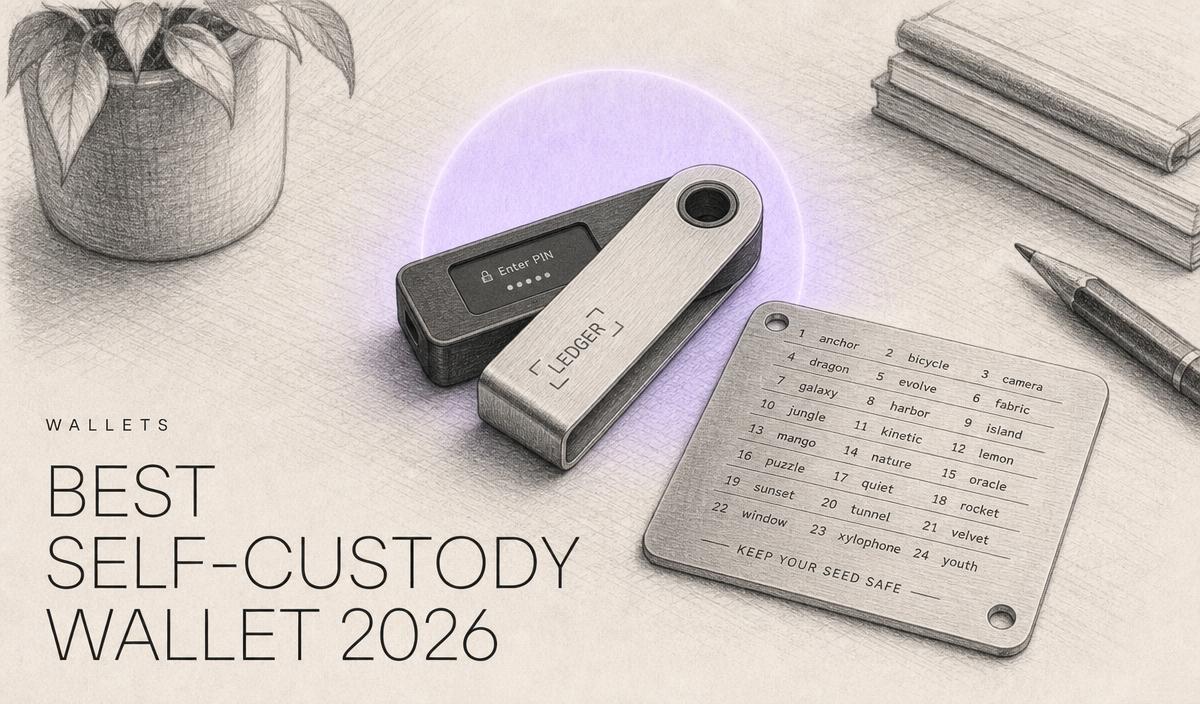
How it works. Ledger is a hardware wallet, often described as a cold wallet, that stores a private key inside a secure physical device isolated from the internet and signs transactions on the device itself. A Secret Recovery Phrase serves as the backup if the device is lost or damaged. Trezor is a comparable hardware wallet built on the same single-key, offline-storage model.
Why it matters. Keeping keys offline removes the always-connected attack surface that hot, software-based wallets carry, a well-established tradeoff for anyone protecting digital assets long-term rather than transacting daily.
Where it fits. Ledger fits an individual holding cryptocurrencies and other digital assets for long-term cold storage who is comfortable managing a physical device, such as a Ledger Nano, and its recovery phrase.
Pros
- Private key never leaves the physical device during normal use
- Widely adopted hardware wallet, with broad multi-chain support for Ethereum wallets and other networks through its companion app
- A direct, well-understood setup for a single holder
Cons
- Recovery depends entirely on the Secret Recovery Phrase being stored correctly; losing only the device is recoverable, losing the phrase too is not
- No native mechanism for shared approval among multiple people
- Advanced features like spending limits or module permissions are not part of a standard hardware wallet's design
Key differences that actually matter
Every wallet in this comparison is self-custodial. The real differences sit one layer deeper.
Individual control versus shared control. MetaMask, Trust Wallet, Ledger, and Zengo all authorize a transaction through one user's key or key shares. Safe authorizes through a defined group of signers meeting a threshold configuration.
Manual execution versus programmable execution. A single-key wallet executes the instant its one key signs. Safe enforces rules, threshold approvals, module permissions, and simulation, before a transaction executes.
Simplicity versus scale. Single-key and MPC wallets set up faster and suit one person moving their own funds. They do not scale to a team that needs review, coordinated approval, and an audit trail.
Convenience versus security concentration. One signer moving funds instantly is convenient. It also means one compromised key, device, or signing session can move everything. Distributed approval adds a coordination step and removes that concentration.
None of this makes MetaMask, Zengo, Trust Wallet, or Ledger weak products. It means each was built for individual key management, and Safe was built for coordinated control.
When Safe is the better choice
Safe is the better choice once more than one person has a stake in how funds move.
That includes treasuries approving grants, funds and trading firms enforcing internal controls, protocol teams executing governance decisions, and power users who want self-custody without concentrating risk in one device or one seed phrase.
Four conditions point to Safe specifically:
- Multiple stakeholders need to review a transaction before it executes, not after
- High-value funds make a single point of failure an unacceptable risk
- Coordinated operations, like recurring payouts or protocol upgrades, need defined approval workflows
- Auditability matters, and every approval needs to be verifiable onchain rather than trusted after the fact
Safe held more than $27B in self-custodied assets across more than 25 networks at the end of Q2 2026 per its Q2 2026 report, and safe.global's current site states $60B+ secured across 28+ networks, evidence that this control model already runs at institutional scale.
When other self-custody options are enough
Not every use case needs a multisig account. If you are managing your own funds, executing your own DeFi transactions, and comfortable being the sole approver, a single-key or MPC wallet is often enough.
MetaMask and Trust Wallet fit daily DeFi use for one person managing amounts they are comfortable securing with one key. Zengo fits a user who wants self-custody without the operational overhead of a written seed phrase. Ledger fits long-term, low-frequency cold storage where a physical device offline is the priority. None of these require the coordination that a multisig account is built for, and adding one would be unnecessary complexity for a single user.
The verdict
The right wallet depends on control, complexity, and scale, not on which product has the most features.
- Best for teams, institutions and treasuries: Safe{Wallet} because a threshold configuration removes single-key risk and keeps every approval onchain and auditable
- Best for individual DeFi use: MetaMask or Trust Wallet, for one person managing their own key
- Best for offline, long-term storage: Ledger, for keys that rarely need to move
- Best for seedless individual self-custody: Zengo, for a user who wants to avoid a written seed phrase
Your keys. Your rules. Safe enforces them at the account level instead of leaving that enforcement to a single device or a single person.
FAQs
What is the best self-custody wallet?
Safe is the best self-custody wallet for teams, treasuries, and power users because it replaces a single point of failure with a multisig account and a threshold configuration.
- Individual users managing their own DeFi activity are often well served by MetaMask or Trust Wallet
- Users who want to avoid a written seed phrase can consider Zengo's MPC model
- Long-term, low-frequency storage is a strong fit for a hardware wallet like Ledger
- The right answer depends on whether one person or a defined group controls the funds
Is Safe{Wallet} a self-custody wallet?
Yes, Safe{Wallet} is a self-custody wallet. Safe never holds your assets.
- The Safe smart contract governs how assets move, based on rules you set
- Funds move only when the required number of signers approve, per your threshold configuration
- Every transaction is onchain and auditable, matching the standard for secure crypto wallet infrastructure
- Safe is open source and independently audited
What's the difference between multisig and single-key wallets?
A single-key wallet, like MetaMask or Trust Wallet, authorizes a transaction with one private key. A multisig wallet, like Safe, requires a defined number of independent signers to approve before a transaction executes.
- Single-key wallets execute instantly once the one key signs
- Multisig accounts enforce a threshold configuration, for example two of three signers, before execution
- A compromised single key can move all funds in an EOA wallet
- A compromised signer in a multisig account cannot move funds alone
Which wallet is best for enterprise teams?
Safe is built for enterprise teams because it lets multiple stakeholders review and approve transactions before execution.
- Threshold configurations map directly to internal approval policies
- Every signer's approval is recorded onchain
- Treasury managers, fund operators, and protocol teams can enforce the same controls a finance team would expect offchain
- Single-key wallets have no native mechanism for requiring a second approver
Can I use multiple wallets together?
Yes, using multiple wallets for different purposes is common practice among self-custody users.
- A hardware wallet like Ledger can serve as one signer in a Safe multisig account for added offline security
- A single-key wallet like MetaMask can act as a day-to-day signer while a Safe account holds treasury funds
- Separating a high-value Safe account from a lower-value personal wallet limits exposure if one setup is compromised
- Combining wallet types lets you match each account's control model to how much is at stake
Are self-custodial wallets safe?
Self-custodial wallets remove reliance on a third-party custodian, but the security model still depends on the wallet's architecture.
- A single-key wallet is only as secure as that one seed phrase or device
- An MPC wallet removes the seed phrase but shifts trust to the availability of the key-share provider
- A multisig account distributes control across independent signers, so no single compromise is sufficient
- Don't trust. Verify. Every Safe transaction is onchain and auditable, which is a different guarantee than trusting a single device to stay secure
What is the safest non-custodial wallet?
There is no single safest non-custodial wallet for every use case, because "safest" depends on how many people need control and how much is at stake.
- For solo cold storage, a hardware wallet like Ledger or Trezor keeps keys offline
- For solo DeFi use, a well-secured EOA or MPC wallet is adequate for smaller amounts
- For teams, treasuries, and high-value funds, a multisig account like Safe reduces risk by requiring multiple approvals instead of trusting one key or one device
- Custody means someone else can move your assets. Safe means only you, and the signers you define, can
Can the IRS know about self-custody crypto wallets?
Self-custody does not make a wallet invisible to tax authorities. Onchain activity is public and traceable, and exchanges you interact with may report transaction data.
- Blockchain transactions are recorded on a public ledger, not hidden by self-custody
- Moving funds through an exchange or fiat off-ramp typically triggers reporting obligations for that platform
- Self-custody changes who controls the keys, not your tax reporting responsibilities
- Consult a tax professional for guidance specific to your jurisdiction