Stablecoin Companies: Issuers, Infrastructure, Key Players
Last updated: October 12, 2026
TL;DR
Stablecoin companies fall into five layers: issuers that mint the tokens (Tether, Circle, Paxos), issuance platforms that let others launch their own, payment infrastructure that moves stablecoins in and out of bank accounts (Bridge, BVNK, Zerohash), card networks and payment giants (Visa, Mastercard, Stripe), and banks building competing products. The biggest money has followed infrastructure: Stripe paid $1.1 billion for Bridge and Mastercard up to $1.8 billion for BVNK.
What counts as a stablecoin company?
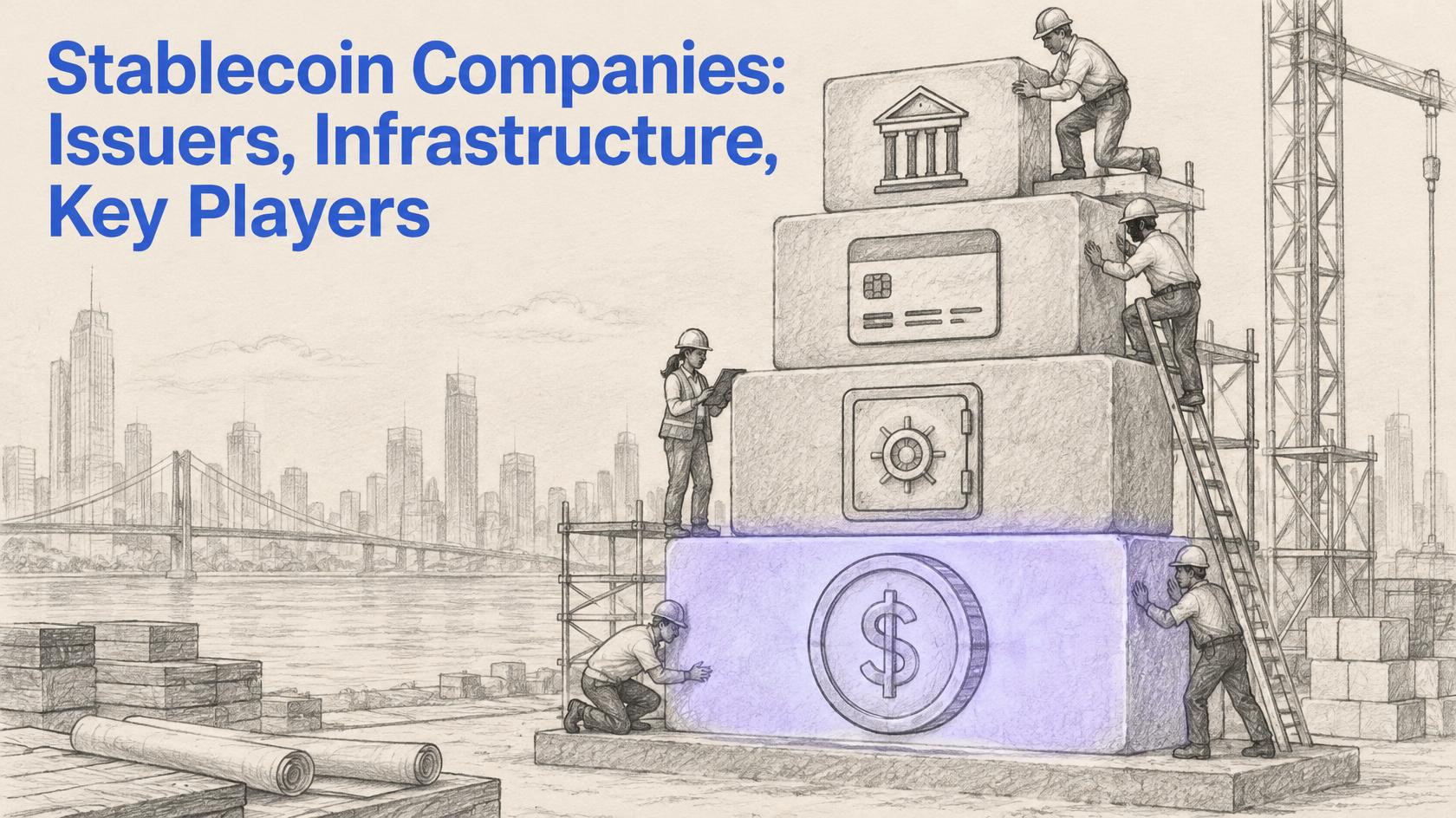
The category has outgrown "companies that issue stablecoins." One industry map shared widely on LinkedIn put the field at more than 300 companies across issuers, wallets, infrastructure, orchestration, banks and neobanks. The useful way to read it is as a stack: each layer depends on the one below and earns money differently.
| Layer | What they do | How they make money | Examples |
|---|---|---|---|
| Issuers | Mint and redeem stablecoins, hold reserves | Interest on reserves | Tether, Circle, Paxos, Sky, Ethena, Ripple |
| Issuance platforms | Let brands and fintechs launch their own stablecoin | Platform fees and reserve revenue sharing | Bridge Open Issuance, Paxos, Bastion, Brale, Agora |
| Payment infrastructure | Convert between fiat and stablecoins, move money across borders, provide wallets | Transaction and FX fees | Bridge, BVNK, Zerohash, Velocity |
| Networks and payment giants | Connect stablecoins to cards, merchants and existing payment rails | Network and processing fees | Visa, Mastercard, Stripe, PayPal |
| Banks | Issue tokenized deposits or bank stablecoins, offer stablecoin services to clients | Deposit spread and fees | JPMorgan, Qivalis consortium, Stablecore for community banks |
The framing I keep coming back to: issuers own the float, infrastructure owns the customer. That is why the largest acquisitions have been infrastructure companies, not issuers.
Stablecoin issuers
The issuer layer is concentrated. Tether's USDT and Circle's USDC held about 83% of total stablecoin supply in mid-2026, per our stablecoin market cap breakdown.
- Tether (USDT). The largest issuer, with about $186 billion in USDT in June 2026. Dominant on Tron and in emerging-market transfers.
- Circle (USDC, EURC). The second-largest issuer and the leading regulated euro stablecoin issuer. Circle listed on the New York Stock Exchange in 2025 under the ticker CRCL.
- Paxos. Issues USDG for the Global Dollar Network and PayPal's PYUSD, and offers issuance for other brands.
- Sky (formerly Maker). Issues USDS and DAI, crypto-collateralized dollars governed onchain.
- Ethena (USDe). A synthetic dollar backed by hedged crypto positions rather than cash.
- Ripple (RLUSD), Agora (AUSD), First Digital (FDUSD) and World Liberty Financial (USD1) round out the next tier.
Under the US GENIUS Act, issuers serving US users need a federal or state license and may not pay interest to holders, which pushes yield-sharing toward distributors instead.
Issuance platforms
A growing share of new stablecoins are launched by companies that never built issuance in-house. Bridge, now part of Stripe, offers Open Issuance so platforms can launch their own branded dollar. Bastion markets custody, orchestration and issuance under its own licenses or a client's. Paxos and Agora also issue on behalf of partners, and Brale focuses on issuance for businesses.
This layer matters because it turns stablecoins from a two-player market into a distribution game: any fintech, exchange or brand with users can issue a dollar and keep part of the reserve income.
Payment infrastructure and orchestration
This is where most of the deal activity has been.
| Company | Owner | Deal | Notes |
|---|---|---|---|
| Bridge | Stripe | About $1.1 billion, closed February 2025 | Powers Stripe stablecoin accounts and issuance; preliminary conditional approval from the OCC for a national trust bank charter in February 2026 |
| BVNK | Mastercard | Up to $1.8 billion including $300 million contingent, announced March 2026, closed August 3, 2026 | Operates in 130+ countries; reported about $30 billion in annualized volume |
| Zerohash | Independent | Mastercard weighed a $1.5 billion to $2 billion acquisition before talks ended | Crypto and stablecoin infrastructure for banks and fintechs |
| Velocity | Independent, backed by Haun Ventures | Visa partnership announced September 2026 | Filled the gap after Visa's former partner BVNK went to Mastercard |
Sources: CNBC, CoinDesk, Forbes, Tech Times.
The price trajectory tells the story. BVNK was valued at about $750 million in late 2024, and Mastercard paid more than double that within 18 months. With Bridge and BVNK absorbed, the pool of large independent infrastructure companies is thinner, which raises the strategic value of the ones that remain.
Card networks and payment giants
Incumbents are not ceding the category. Visa runs more than 130 stablecoin-linked card programs across more than 50 countries and settles across nine blockchains, according to Forbes. Stripe has assembled the broadest end-to-end stack through Bridge, the wallet company Privy and its Tempo payments chain. And in June 2026, Open Standard, founded by Bridge co-founder Zach Abrams, launched Open USD with more than 140 partners including Visa, Mastercard, Stripe, Coinbase, BlackRock and BNY.
Banks
Banks are entering on two tracks: tokenized deposits, which keep money on the bank's balance sheet, and bank-issued stablecoins. JPMorgan's JPMD deposit token runs on Base, and in Europe the Qivalis consortium of 37 banks is preparing a euro stablecoin. Smaller institutions are reached through vendors such as Stablecore, which provides stablecoin and tokenized deposit products to banks and credit unions.
How to evaluate a stablecoin company
For a business choosing a partner, five criteria separate options:
- Licensing. Which entity holds the money transmission, e-money or trust licenses, and in which jurisdictions?
- Rails covered. Which local payment networks and blockchains are supported for pay-ins and payouts?
- Reserve and custody model. Who holds client funds, and are they segregated?
- Counterparty stability. Is the company independent, acquired, or likely to be? Roadmaps shift after acquisitions.
- Transparency. Are attestations and fee schedules published?
FAQs
What are the biggest stablecoin companies?
The largest stablecoin issuers are Tether and Circle, which together held about 83% of stablecoin supply in 2026. The largest infrastructure companies are Bridge, owned by Stripe, and BVNK, owned by Mastercard. Visa, Mastercard, Stripe and PayPal are the biggest established payment companies building stablecoin products.
How do stablecoin companies make money?
Issuers make most of their money from interest on reserves, typically short-term US Treasuries, since holders do not receive that interest. Infrastructure companies earn transaction, conversion and FX fees. Issuance platforms charge platform fees or share reserve income with the brands that launch stablecoins through them.
Which stablecoin companies are publicly traded?
Circle trades on the New York Stock Exchange as CRCL. Companies with significant stablecoin exposure that are also public include Coinbase, which shares in USDC economics, PayPal, which offers PYUSD, and the card networks Visa and Mastercard. Tether, Paxos and Ripple are private.
Who owns Bridge?
Stripe owns Bridge. It acquired the stablecoin infrastructure company for about $1.1 billion, closing in February 2025. Bridge now powers Stripe's stablecoin financial accounts and Open Issuance product, and also serves businesses that are not Stripe merchants through its own platform.
Are stablecoin companies safe to use?
Safety depends on licensing, reserve management and custody. Regulated issuers and infrastructure providers publish attestations, segregate client funds and operate under money transmission or e-money licenses. Check which entity holds your funds, which regulator supervises it, and whether reserves are independently attested before choosing a provider.
The takeaway
The stablecoin industry has split into a concentrated issuer layer and a fast-consolidating infrastructure layer, with card networks and payment platforms buying their way in. The open question is whether distribution-led issuance, where every platform launches its own dollar, erodes Tether and Circle's share, or whether liquidity keeps the market at two dominant issuers. If you are building in this stack, reach out.