Stablecoin Market Cap: Total Size, Leaders and Growth
Last updated: October 12, 2026. Figures move daily; for a live number, see DefiLlama's stablecoin dashboard.
TL;DR
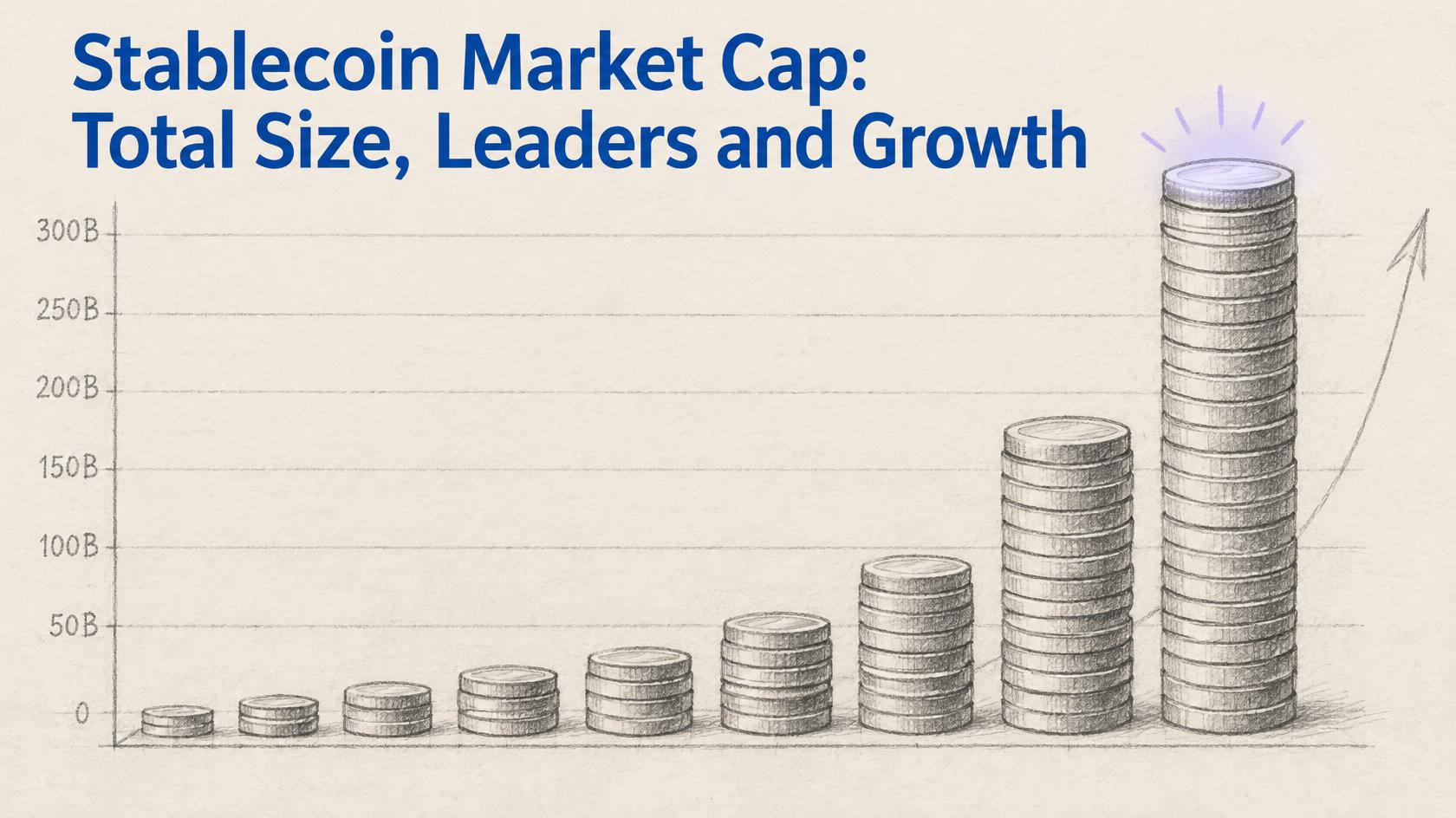
The total stablecoin market cap is the combined value of all stablecoins in circulation, roughly $304 billion in October 2026 after an all-time high of about $322 billion in May 2026. Tether's USDT and Circle's USDC hold about 83% of it. Almost all supply is pegged to the US dollar, and the market has grown roughly 40-fold since early 2020.
What stablecoin market cap measures
Stablecoin market cap is circulating supply multiplied by price. Because a working stablecoin trades at about $1, its market cap is effectively its outstanding supply: the number of dollars, or dollar claims, sitting on blockchains.
That makes it a different metric from a volatile crypto asset's market cap. A rise in bitcoin's market cap usually means the price went up. A rise in stablecoin market cap means new money was minted: someone sent dollars to an issuer and received tokens. It is a measure of demand for on-chain dollars, not of speculation on a price.
Top stablecoins by market cap
| Rank | Stablecoin | Issuer | Market cap | Share |
|---|---|---|---|---|
| 1 | USDT | Tether | About $186 billion | About 59% |
| 2 | USDC | Circle | About $75 billion | About 24% |
| 3 | USDS | Sky (formerly Maker) | About $8 billion | About 3% |
| 4 | USDe | Ethena | About $4.5 billion | About 1.5% |
| 5 | DAI | Sky (formerly Maker) | About $4.4 billion | About 1.4% |
Source: DefiLlama data as of June 2026, compiled by CoinLaw and Transak.
Concentration is the defining feature. As of June 21, 2026, DefiLlama tracked 382 stablecoins, yet the top two held 83.02% of the total and the top five 88.57%. Behind them sits a long tail of newer issuers, including PayPal's PYUSD, Ripple's RLUSD and World Liberty Financial's USD1.
The currency split is even more lopsided. Euro stablecoins, the largest non-dollar segment, totaled under $1 billion in 2026, as our euro stablecoins explainer covers.
How stablecoin market cap has grown
| Date | Total stablecoin market cap | Source |
|---|---|---|
| March 2020 | About $6.8 billion | Spark tracker |
| September 24, 2025 | $294.6 billion, then a record | DefiLlama via crypto.news |
| October 2025 | First move above $300 billion | DefiLlama via Coinspeaker |
| April 21, 2026 | Above $321 billion | DefiLlama via Bitcoin Foundation |
| May 2026 | All-time high of about $322.4 billion | Spark tracker |
| August 2026 | About $308 billion | Spark tracker |
| October 2026 | About $304 billion | Stablecoin Beat |
Sources: Spark, crypto.news, Bitcoin Foundation, Stablecoin Beat.
Two things stand out. First, growth is not one-directional: supply contracted for 16 straight months during the 2022 to 2023 bear market before resuming. Second, the 2026 pullback from the May peak has been modest, about 6%, compared with the much larger drawdowns in volatile crypto assets over the same period.
Where stablecoins live: supply by blockchain
Supply is concentrated by chain as well as by issuer. Ethereum held about $170 billion in stablecoins, roughly 60% of the total in April 2026, and Tron about $87 billion, of which more than 97% was USDT. Each chain also has a different leader: USDC is about 85% of stablecoin supply on Base, while USDT dominates Tron.
The pattern reflects use. Tron's USDT base is driven by low-cost transfers in emerging markets; Ethereum's supply is anchored by DeFi and institutional holdings; Base and Solana skew toward USDC and app-driven payments.
Why trackers show different numbers
Searchers often find three different totals on the same day. The gaps are methodological:
- What counts as a stablecoin. Some trackers include yield-bearing synthetic dollars such as USDe and gold-backed tokens; others exclude them.
- Double counting. Bridged tokens can appear on two chains if a tracker does not net out the locked supply.
- Data source. On-chain aggregators like DefiLlama read supply directly from contracts, while price sites may rely on issuer-reported figures.
For consistency, pick one source and track the trend rather than comparing a number from one site with a number from another.
What stablecoin market cap tells you
The framing I keep coming back to: stablecoin market cap is the closest thing crypto has to an M2 money supply. It measures how many dollars are available on-chain to trade, lend, pay and settle.
- Rising supply usually means fresh capital entering crypto markets or new payment and treasury use.
- Falling supply means redemptions: money leaving the on-chain system.
- Shifts in share reveal where trust and regulation are moving, such as licensed issuers gaining in the EU after MiCA, or new bank and fintech issuers entering after the US GENIUS Act.
It is also a growing factor in traditional markets. Stablecoin issuers hold most reserves in short-term US Treasuries, so supply growth translates directly into Treasury demand.
Limitations of the metric
Market cap shows how many stablecoins exist, not how much they are used. A token can have large supply and little transfer activity, and a large share of supply sits idle in exchange wallets or DeFi protocols. Transfer volume, active addresses and payment flows tell you more about real-world adoption, and each has its own measurement problems.
FAQs
What is the total stablecoin market cap?
The total stablecoin market cap was about $304 billion in October 2026, according to Stablecoin Beat's daily tracker, down from an all-time high of about $322 billion in May 2026. Numbers vary by tracker, so for a live figure use an on-chain source such as DefiLlama's stablecoin dashboard.
Which stablecoin has the largest market cap?
Tether's USDT has the largest market cap, at about $186 billion and roughly 59% of all stablecoin supply in June 2026, according to DefiLlama data. Circle's USDC is second at about $75 billion and 24%. Together they hold about 83% of the market.
How is stablecoin market cap calculated?
Stablecoin market cap is calculated as circulating supply multiplied by price. Because stablecoins trade near $1, the result is effectively the number of tokens outstanding. Totals differ between trackers depending on which tokens they include and whether they net out bridged supply across chains.
Why does stablecoin market cap matter?
Stablecoin market cap measures how many dollars are available on blockchains for trading, lending, payments and settlement. Rising supply signals new capital or new payment use entering the system, while falling supply signals redemptions. Because issuers hold Treasuries as reserves, it also affects demand for US government debt.
What share of the stablecoin market do USDT and USDC hold?
USDT and USDC held about 83% of total stablecoin supply in June 2026, according to DefiLlama data compiled by CoinLaw: USDT about 59% and USDC about 24%. The top five stablecoins held about 89%, leaving the remaining hundreds of tokens with roughly 11% combined.
The takeaway
Stablecoin market cap passed $300 billion in late 2025, peaked near $322 billion in May 2026 and remains overwhelmingly a two-issuer, dollar-denominated market. The open question is whether new regulated issuers, from banks to card networks, can dilute that concentration, or whether regulation simply entrenches the incumbents. For where those dollars earn a return, see how stablecoin yield works.