Euro Stablecoins Explained: EURC, Qivalis and More
Last updated: October 9, 2026
TL;DR
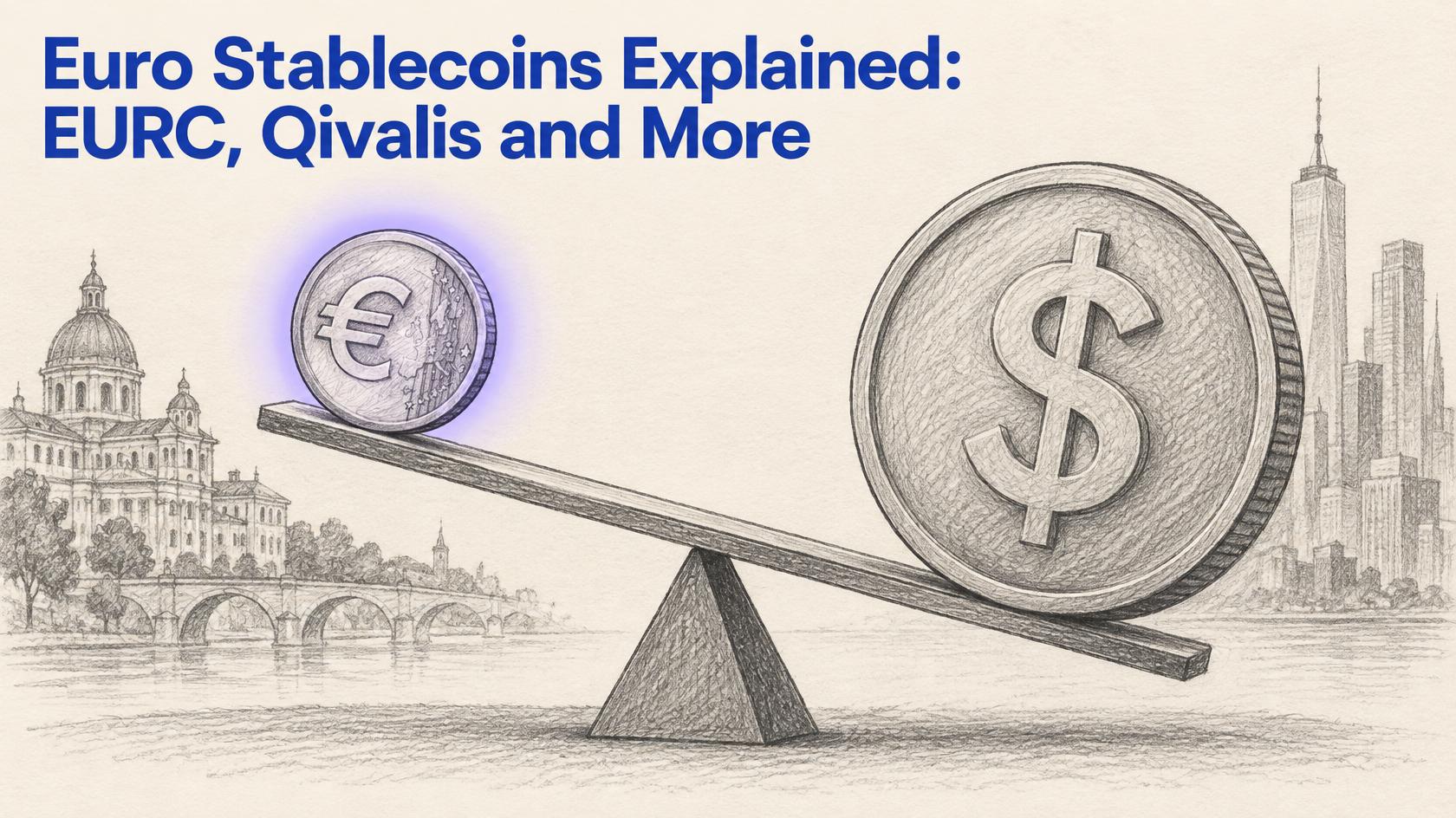
A euro stablecoin is a token pegged 1:1 to the euro and backed by euro reserves, usually issued as an e-money token under the EU's MiCA regulation. Circle's EURC is the largest. The whole euro segment was worth about $896 million in May 2026, under 0.3% of a stablecoin market of more than $300 billion that is almost entirely dollar-denominated.
Euro stablecoins: definition and positioning
A euro stablecoin works like USDC or USDT, with one difference: one token is redeemable for one euro, not one dollar. Inside the EU, most are regulated as e-money tokens (EMTs) under MiCA, which means the issuer must be a licensed bank or e-money institution, must redeem at par on request, and may not pay interest.
Three neighbors are often confused with euro stablecoins:
| Euro stablecoin | Digital euro | Tokenized euro deposit | |
|---|---|---|---|
| Issuer | Private bank or e-money institution | European Central Bank | A commercial bank |
| What you hold | Claim on segregated reserves | Central bank money | Claim on the bank's balance sheet |
| Status | Live, regulated under MiCA | ECB project, not issued | Live in pilots and wholesale services |
| Runs on | Public blockchains | ECB-controlled infrastructure | Mostly permissioned ledgers |
The distinction that matters: euro stablecoins are the only one of the three that already circulates on public blockchains, where crypto trading and decentralized finance happen. See our explainer on tokenized deposits for the bank-issued alternative.
How euro stablecoins work
- Issuance. A business sends euros to the issuer through a bank transfer and receives the same number of tokens. Circle calls this channel Circle Mint.
- Reserves. The issuer holds the euros in segregated accounts and short-term high-quality assets. MiCA requires a significant share in bank deposits and imposes liquidity rules.
- Circulation. Tokens move on public chains such as Ethereum, Solana, Base, Avalanche and Stellar, where anyone with a compatible wallet can hold or trade them.
- Redemption. A holder returns tokens to the issuer and receives euros at par. MiCA gives holders this right at any time.
Retail users rarely mint or redeem directly. They buy on an exchange, which is why exchange listings and liquidity decide which euro stablecoin wins.
The main euro stablecoins compared
| Stablecoin | Issuer | Regulatory status | Notes |
|---|---|---|---|
| EURC | Circle | E-money token under a French e-money license | Largest by supply; launched June 2022 as EUROC |
| EURCV | SG-Forge (Société Générale) | MiCA-compliant e-money token | Bank-issued, institutional focus |
| EURI | Banking Circle | Bank-issued, supervised in Luxembourg | Marketed as an early MiCA-regulated euro token |
| EURe | Monerium | E-money institution | Strong direct redemption to IBAN accounts |
| EURR | Revolut | Launched in 2026 | Fintech distribution into a large retail base |
| EURS | Stasis | Long-running | Predates MiCA |
| Qivalis euro token | Consortium of 37 banks | E-money license applied for with the Dutch central bank | Target launch second half of 2026, pending approval |
Sources: issuer websites, The Block, Yahoo Finance on Revolut.
Euro stablecoins in practice
The market is small and concentrated. CoinGecko data cited by The Block put total euro stablecoin capitalization at $896 million in May 2026, with EURC at $443 million, close to half the segment. Dollar stablecoins passed $300 billion over the same period. Circle reported EURC passing €400 million in circulation as it extended listings across chains and exchanges.
MiCA helped the compliant issuers. Because USDT does not have EMT authorization, EU-regulated venues restricted it, and euro tokens issued by licensed institutions became the default regulated option for European users. MiCA also limits the use of non-euro stablecoins as a means of exchange within the EU, which creates structural room for euro tokens in payments.
Banks are coming in at scale. Qivalis, an Amsterdam-based joint venture, began in September 2025 with nine banks including ING, UniCredit and CaixaBank. BNP Paribas and BBVA joined, and in May 2026 the consortium added 25 more lenders, bringing membership to 37 banks across 15 countries. Its stated reserve design holds at least 40% in bank deposits, with the rest in short-term eurozone sovereign bonds, and it selected Fireblocks for its tokenization and custody stack in April 2026. Some reporting suggests an interbank pilot before a broader commercial launch, so treat the second-half 2026 date as a target.
The framing I keep coming back to: euro stablecoins do not have a regulation problem anymore. They have a demand problem. Crypto markets price everything in dollars, so trading liquidity pools around USDT and USDC. A euro token wins only where the euro is the natural unit: EU business payments, payroll, euro-denominated treasury and cross-border settlement within Europe.
Why are euro stablecoins so small?
- Dollar gravity. Crypto pairs, DeFi collateral and offshore savings demand all run in dollars.
- Negative carry for issuers. For years, low or negative euro rates made reserves unprofitable. Issuers earn on reserves, so the business only became attractive once rates rose.
- No yield for holders. MiCA forbids interest on e-money tokens, so euro stablecoins compete with bank accounts that may pay something.
- Strong existing rails. SEPA Instant already settles euro payments in seconds, which narrows the domestic use case.
Trade-offs and limitations
Euro stablecoins offer regulated, programmable euros on public chains with clear redemption rights. Their limits are thin secondary liquidity outside the largest token, fragmentation across many small issuers, issuer concentration risk, and the fact that no single token yet has network effects comparable to USDC. Moving between chains also depends on issuer tooling; Circle's CCTP supports EURC, but smaller tokens rely on third-party bridges.
FAQs
What are euro stablecoins?
Euro stablecoins are cryptocurrency tokens designed to hold a value of one euro each, backed by euro reserves held by the issuer. Inside the EU, most are regulated as e-money tokens under MiCA, which requires a licensed issuer, redemption at par on request and no interest payments to holders.
What is the largest euro stablecoin?
Circle's EURC is the largest euro stablecoin. CoinGecko data cited by The Block in May 2026 put EURC at about $443 million, roughly half of a euro stablecoin market worth $896 million. Other notable options include SG-Forge's EURCV, Banking Circle's EURI, Monerium's EURe and Revolut's EURR.
Are euro stablecoins safe?
Regulated euro stablecoins under MiCA must hold segregated reserves, publish disclosures and redeem at par, which lowers risk compared with unregulated tokens. They still carry issuer, custody and smart contract risk, and smaller tokens can trade below one euro when liquidity is thin. Check the issuer's license and reserve reports before holding large amounts.
Is EURC MiCA compliant?
Yes. Circle issues EURC as an e-money token under an e-money license supervised in France, which allows it to be offered across the EU under MiCA. That status is why EURC remains available on MiCA-licensed exchanges while tokens without authorization, such as USDT, have been restricted for EU users.
What is the difference between a euro stablecoin and the digital euro?
A euro stablecoin is issued by a private company or bank and runs on public blockchains. The digital euro is a proposed central bank digital currency issued by the European Central Bank, which would be a direct claim on the central bank. Euro stablecoins are live today; the digital euro has not been issued.
Why is the euro stablecoin market so small?
Crypto markets are priced in dollars, so most liquidity concentrates in dollar stablecoins. Low euro interest rates long made issuance unprofitable, MiCA bars paying interest to holders, and SEPA Instant already provides fast euro payments. Together these keep euro stablecoins under 1% of the total stablecoin market.
The takeaway
Euro stablecoins now have a complete regulatory framework and a clear leader in EURC, but they remain a rounding error next to dollar tokens because demand, not permission, is the binding constraint. The open question is whether a 37-bank consortium can create euro liquidity that a single issuer could not. If you are building euro payment flows on stablecoin rails, reach out.