Tether's Reserves Explained: What Backs USDT in 2026
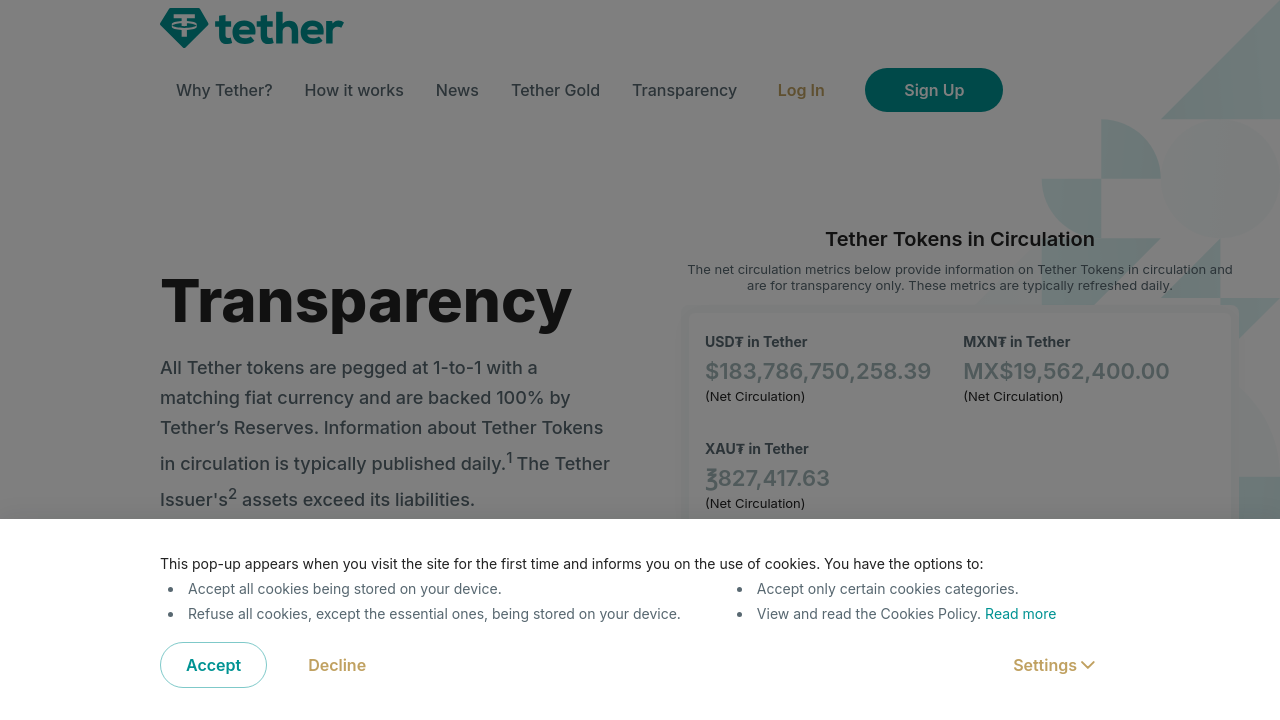
USDT is the largest stablecoin in circulation, with roughly $183 to $189 billion outstanding as of mid-2026, and the single most important question about it is the same one it has faced since 2014: what actually backs it. The answer, drawn from Tether's quarterly attestation reports and regulatory filings, is more legible than critics allow and more constrained than Tether's marketing implies. This piece unpacks the reserve composition, the attestation regime, and the structural risks that matter for anyone allocating around USDT.
Definition: What Does It Mean for USDT to Be 'Backed'
Tether Holdings Limited, a British Virgin Islands entity operating principally out of El Salvador since 2024, claims every USDT in circulation is backed 1:1 by reserve assets. That claim is the entire product. The mechanics behind it are less familiar than the marketing suggests.
The 1:1 peg mechanism
The peg is not maintained by an algorithm or a central bank. It is maintained by a redemption channel. New USDT is minted only when approved institutional counterparties wire fiat to Tether-controlled accounts; the corresponding tokens are issued to the counterparty's wallet on the chain they specify. Redemption runs the same channel in reverse, subject to a $100,000 minimum.
Retail users almost never touch that channel. They buy and sell USDT on exchanges and through OTC desks that hold Tether-mint accounts and arbitrage the primary market when secondary prices drift. This structure is the reason USDT holds close to $1 even though most holders cannot redeem directly.
How reserves are held and custodied
Reserves do not sit in a single bank account. They span U.S. Treasury bills, overnight and term reverse repo, secured loans, gold, and Bitcoin across multiple custodians. The BVI and El Salvador legal domicile means Tether operates outside U.S. regulatory jurisdiction for most purposes, a structural fact that shapes every downstream risk question about custody, disclosure, and enforcement.
Takeaway: USDT is backed by a diversified reserve pool intermediated by institutional counterparties, not by a directly redeemable retail claim on a bank deposit.
Reserve Composition: What Tether Actually Holds in 2026
The reserve mix has shifted meaningfully since 2021, when commercial paper and unsecured receivables were sizable line items. The 2026 book is heavier on Treasuries and cleaner in category, though not in every line.
U.S. Treasury bills: the core holding
Per Tether's June 30, 2026 reserves report, cash, cash equivalents, and short-term deposits represent 74.91% of total reserves. Inside that tranche, 81.75% sits in U.S. Treasury bills, 13.25% in overnight reverse repo, and 4.97% in term reverse repo. Direct cash and bank deposits are just 0.03%. In other words, Tether is one of the larger private holders of short-duration U.S. sovereign paper, and almost none of the "cash" line is actually held at a bank.
That composition is important for two reasons. First, T-bills and reverse repo are the most liquid dollar-denominated assets available, which limits fire-sale risk if redemptions spike. Second, the yield on those instruments is what funds Tether's reported profitability, without which the business model does not work.
Secured loans, Bitcoin, gold, and other assets
Outside the cash tranche, the composition is roughly:
- Secured loans: 4 to 6%, described as loans collateralized by liquid assets
- Bitcoin: 4 to 5%, held as a strategic reserve allocation
- Precious metals (gold): 3 to 4%
- Other investments and corporate bonds: the remainder
The secured loans line is the one that has historically drawn scrutiny. Tether does not publicly name borrowers, and prior to 2022 the category included loans to affiliated entities. The Bitcoin and gold allocations, while volatile, are marked to market in each attestation and sit outside the dollar-liability matching pool.
Reported excess reserves
Total assets were $187.75 billion against $183.64 billion of total liabilities in the June 30, 2026 report, per Tether's transparency page. That leaves $4.1 billion of reported excess reserves, the buffer that absorbs mark-to-market drawdowns on the Bitcoin, gold, and secured-loan lines without breaking the 1:1 claim.
Takeaway: In 2026, the reserve book is dominated by short-duration U.S. sovereign exposure, with roughly 8 to 10% in market-price-sensitive assets (BTC + gold) and 4 to 6% in secured loans that remain the least transparent line.
How It Works: Attestations vs. Full Audits

The most persistent source of confusion in USDT coverage is the difference between what BDO Italia produces every quarter and what a Big Four audit would produce. They are not interchangeable.
What a BDO attestation does and does not cover
An attestation is a point-in-time snapshot. On a single date, the accountant confirms that reported reserve figures match Tether's books. It does not test internal controls, verify custody arrangements independently, or confirm that reserves were not borrowed, pledged, or rehypothecated for the remainder of the quarter. The scope is narrow by design.
A full audit is a continuous opinion over a period, typically a fiscal year. It tests controls, samples transactions, verifies custody with third parties, and produces a formal opinion under PCAOB or equivalent standards. The two exercises answer different questions.
Why Tether has never produced a Big Four audit
Tether has stated publicly that Big Four firms were reluctant to take it on, citing perceived reputational and regulatory risk in the crypto sector. That reluctance was industry-wide until Circle's Deloitte relationship and the KPMG engagement described below started to break it. For a fuller comparison of what each transparency regime actually covers, see proof-of-reserves methodology beyond the marketing.
KPMG's 2026 milestone
In August 2026, KPMG U.S. completed Tether International's first full independent audit of its financial statements and issued an unqualified opinion under U.S. GAAP, per Wikipedia's sourced summary). This is a meaningful shift after a decade of attestation-only reporting, though it applies to the Tether International entity and does not retroactively change what the BDO attestations cover for prior periods.
For a direct benchmark, USDC publishes monthly attestations from Deloitte and is moving toward a full audit as part of Circle's post-IPO reporting cycle. The gap between USDC and USDT disclosure has narrowed, but the cadence and scope still differ. See the USDC versus USDT institutional comparison for a side-by-side of what each issuer publishes.
Takeaway: Attestations confirm a balance on a date. Audits confirm a system over a period. Tether now has one of each; USDC has continuous attestations moving toward audit.
Regulatory History: CFTC, NYAG, and MiCA

Tether's regulatory record is public and worth reading in the primary documents rather than summarized in secondary press. Three episodes matter for any current risk assessment.
The 2021 CFTC and NY AG settlements
In October 2021, the U.S. Commodity Futures Trading Commission fined Tether $41 million for "untrue or misleading statements" about its reserves between June 2016 and February 2019. The order found that USDT was not fully backed by U.S. dollars as claimed; reserves during that period included unsecured receivables and non-cash assets that were not disclosed to the market.
Earlier in 2021, the New York Attorney General settled a separate investigation with Tether and Bitfinex for $18.5 million. The NYAG action explicitly addressed the relationship between Tether reserves and Bitfinex liabilities, stemming from an $850 million shortfall at Bitfinex that was covered by Tether funds. Tether and Bitfinex sit under the same parent, iFinex, and the shared ownership was the structural fact that made the NYAG action possible.
Both settlements addressed historical conduct. Neither found the reserve pool insolvent at the time of settlement. The material takeaway is that non-cash reserve categories have been misrepresented before, which is why the composition of secured loans and "other investments" continues to draw analyst attention.
MiCA delistings and European compliance
Under the EU's Markets in Crypto-Assets regulation, USDT has been delisted from several European exchanges in 2025 and 2026 because Tether has not obtained the e-money institution license MiCA requires for euro-area distribution. The consequence is not that USDT is illegal to hold in the EU, it is that regulated venues cannot list it. Retail liquidity in Europe has migrated to USDC and to euro-denominated stablecoins with the required authorizations.
In the United States, the proposed GENIUS Act would impose reserve and audit requirements on stablecoin issuers. Tether's offshore domicile means its compliance path under any final U.S. framework remains uncertain and depends on whether foreign issuers are permitted access via a comparable-supervision regime or must onshore.
Takeaway: The most likely near-term risk to USDT is not reserve insolvency, it is market access under MiCA and any final U.S. federal framework.
Where USDT Circulates: Chain Distribution and Market Role

Where USDT lives on-chain says as much about who uses it as any survey. The distribution is uneven and instructive.
TRON vs. Ethereum and other chains
As of September 2026, USDT had net circulation of approximately $183.4 billion, representing roughly 59% of the $312 billion total stablecoin supply tracked by DeFiLlama. TRON carries the largest single-chain share at roughly $92.3 billion, driven by emerging-market remittance flows where TRON's low transaction fees dominate retail use. Ethereum is a distant second in units but hosts most institutional and DeFi activity.
Tether originally launched on Bitcoin's Omni layer in 2014 and has since expanded to 14 or more chains including Ethereum, Solana, Avalanche, Polygon, Arbitrum, and Toncoin. Chain distribution is a policy decision as much as a demand signal; Tether can, and has, chosen to expand or throttle issuance on specific chains.
USDT in DeFi and payments
Large USDT mints and burns are visible on-chain and are widely watched as a market-sentiment signal: large mints correlate with risk-on positioning, large burns with risk-off. Tether holds roughly 70% market share among stablecoins and surpassed Bitcoin to become the most-traded cryptocurrency globally by volume in 2019.
Two use cases dominate. In DeFi, USDT is the base liquidity leg on most non-U.S. venues and a large share of perpetuals collateral. In payments, USDT-on-TRON is the settlement rail for a meaningful slice of cross-border remittances into Latin America, Africa, and parts of Southeast Asia, competing directly with correspondent banking and money-transfer operators.
Takeaway: USDT is the default dollar of non-U.S. crypto liquidity. Its chain distribution reflects that: TRON for retail and remittances, Ethereum for institutional and DeFi.
Structural Risks and What to Monitor
The risks worth pricing are not the ones that dominate crypto Twitter. They are narrower and, in most cases, more measurable.
Reserve opacity and rehypothecation risk
The core residual risk is not that reserves fail to exist at the reported scale. It is that quarterly point-in-time attestations cannot rule out intra-quarter rehypothecation or collateral reuse. The KPMG audit narrows this window for the periods it covers; it does not eliminate it prospectively. Secured loans remain the least transparent line item, and the 2021 CFTC action established that non-cash reserve categories have been misrepresented in the past.
Regulatory and legal risk vectors
MiCA enforcement and a potential U.S. GENIUS Act framework are the highest-probability risk vectors for USDT availability in regulated markets. Neither implies reserve insolvency; both imply forced substitution toward compliant alternatives inside those jurisdictions. Institutions with EU or U.S. distribution obligations should treat this as a distribution-access question, not a solvency question.
A separate compliance data point: by February 2026, Tether reported freezing $4.2 billion in tokens connected to illicit activity in cooperation with law enforcement. That number is relevant for compliance officers evaluating counterparty exposure and for anyone modeling the operational risk of holding an asset the issuer can unilaterally freeze.
The peg track record
USDT depegged to approximately $0.95 in May 2022 during the Terra/LUNA collapse and recovered within hours. Across a decade-plus track record and multiple exchange failures, no permanent loss of peg has occurred. That is the empirical record; it does not, of itself, price the tail.
Takeaway: For most institutional allocators the binding constraints on USDT exposure in 2026 are jurisdictional access and freeze risk, not the reserve pool.
FAQ: Frequently Asked Questions
Is USDT actually fully backed by real assets?
Per the June 30, 2026 BDO attestation, Tether reports $187.75 billion in assets against $183.64 billion in liabilities, a $4.1 billion buffer. The reserve pool exists at reported scale as of each attestation date, though attestations do not cover intra-quarter activity.
What percentage of Tether's reserves are U.S. Treasury bills?
In the June 30, 2026 report, cash and cash equivalents represent 74.91% of reserves, and 81.75% of that tranche is held in U.S. Treasury bills. That works out to roughly 61% of total reserves in direct T-bill exposure, before counting reverse repo.
Has Tether ever been audited by a Big Four accounting firm?
Yes, as of August 2026. KPMG U.S. completed Tether International's first full independent audit and issued an unqualified opinion under U.S. GAAP. Prior to that, Tether had published only quarterly attestations, most recently from BDO Italia.
What is the difference between a Tether attestation and a full audit?
An attestation confirms reserve figures match the books on a single date. A full audit tests controls, samples transactions, and verifies custody across a continuous period, producing a formal opinion under PCAOB or equivalent standards. The scopes are materially different.
Why is USDT being delisted from European exchanges?
Under MiCA, stablecoin issuers distributing in the EU need an e-money institution license. Tether has not obtained one, so regulated European venues cannot list USDT. The delistings are a licensing outcome, not a solvency or reserve-quality judgment.
How does Tether maintain the $1 peg?
The peg is maintained by a primary-market redemption channel: approved counterparties can mint or redeem USDT 1:1 for fiat, subject to a $100,000 minimum. Arbitrage between that primary market and exchange prices pulls secondary-market USDT back toward $1.
What happened during the 2021 CFTC and NY AG settlements?
The CFTC fined Tether $41 million for misleading reserve statements from 2016 to 2019. The NYAG settled a related investigation with Tether and Bitfinex for $18.5 million, addressing an $850 million Bitfinex shortfall covered by Tether reserves and the shared iFinex ownership.
How much Bitcoin does Tether hold in reserves?
Roughly 4 to 5% of total reserves is held in Bitcoin, categorized as a strategic reserve allocation. At $187.75 billion in total assets as of June 30, 2026, that implies a Bitcoin position on the order of $7.5 to $9.4 billion, marked to market each quarter.
Conclusion
The interesting questions about Tether in 2026 are not whether the reserves exist. They exist, at reported scale, dominated by short-duration U.S. sovereign paper, with a KPMG audit now on the record. The interesting questions are jurisdictional: whether USDT retains distribution access in the EU under MiCA, how it fits any final U.S. federal framework, and how compliance officers weight the operational risk of an asset the issuer can freeze. Allocators pricing USDT exposure should focus on those vectors, not the reserve headline.