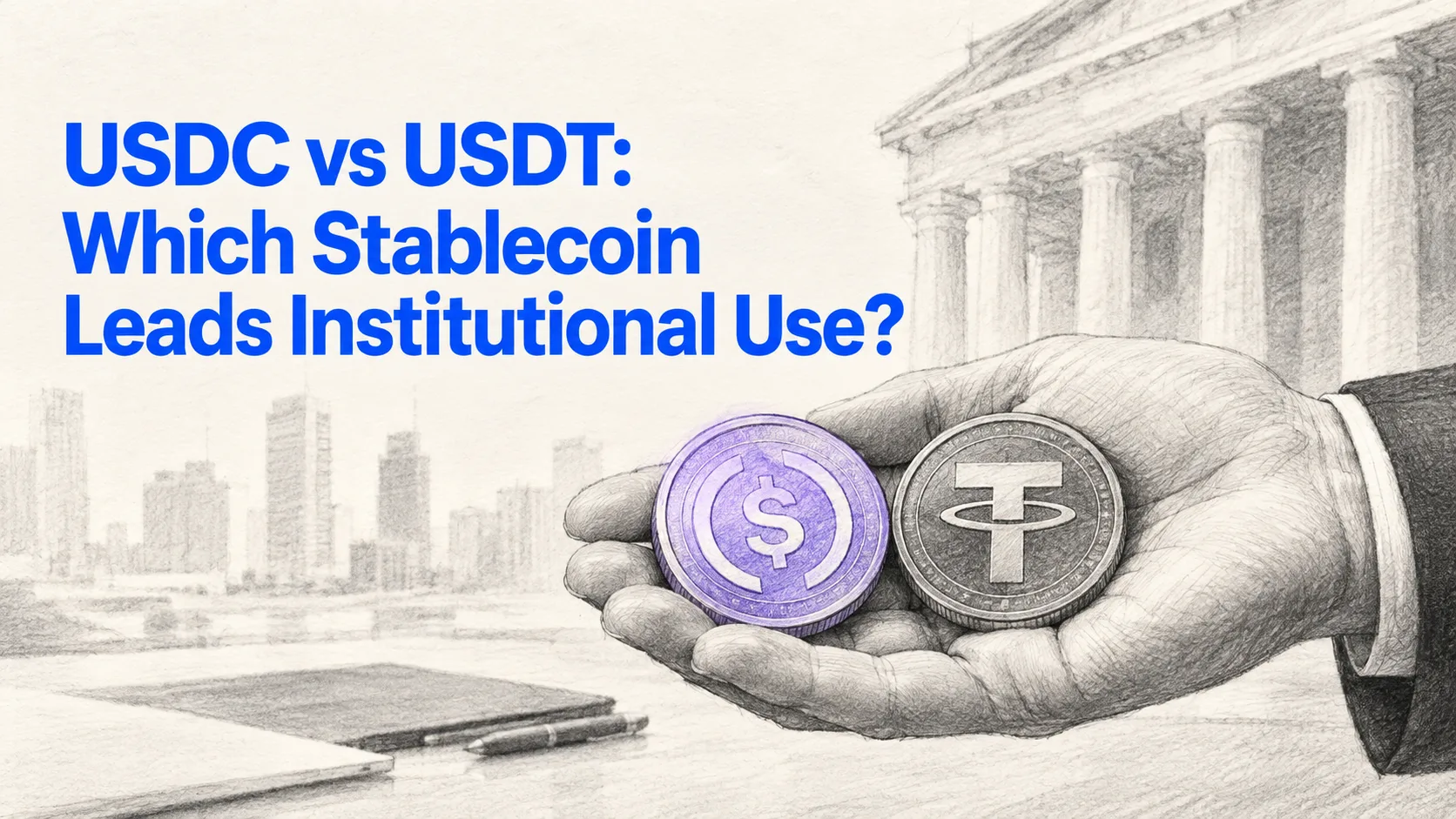
USDC vs USDT: Which Stablecoin Leads Institutional Use?
USDC is the stronger choice for regulated institutional use; USDT still leads on raw liquidity and global reach. The two largest dollar-pegged stablecoins, Circle's USDC and Tether's USDT, together dominate the market yet make fundamentally different bets on reserve transparency, regulatory alignment, and counterparty risk. For treasurers and allocators, those differences are not cosmetic. Stablecoin.nyc tracks the compliance and structural nuances that matter most to institutional operators picking a default settlement asset.
Quick Verdict
The short version, before the deeper analysis:
- USDC: Best for regulated entities, DeFi protocols requiring transparent reserves, and U.S.-domiciled treasury operations that need to sit cleanly inside existing banking oversight.
- USDT: Best for high-frequency traders, emerging-market operators, and platforms where liquidity depth and exchange breadth outweigh compliance sensitivity.
USDC's market capitalization sits above $30 billion; USDT exceeds $100 billion. Tether owns the dominant liquidity position globally by a roughly 3-to-1 ratio. Reserve transparency, however, tilts clearly toward USDC, which publishes monthly third-party attestations against Tether's quarterly attestations and prior regulatory settlements. For a broader survey of how these dynamics play out across the institutional stablecoin landscape, the split between transparency and liquidity is the defining tension of the asset class.
The rest of this brief unpacks the mechanics, the numbers, and the use-case-led recommendations.
At a Glance: Feature Comparison
Both tokens serve the same headline function, a 1:1 USD peg, but the plumbing underneath diverges sharply. A quick comparison before the section-by-section detail:
| Feature | USDC | USDT | Winner |
|---|---|---|---|
| Pricing (peg) | $1.00 | $1.00 | Tie |
| Market cap | $30B+ | $100B+ | USDT |
| Reserve transparency | Monthly attestations | Quarterly attestations | USDC |
| Ease of integration (U.S.) | High (Circle APIs, CCTP) | Moderate | USDC |
| Target user | Regulated institutions, DeFi | Traders, EM operators | Split |
| Exchange breadth | Broad | Broadest globally | USDT |
| Support / compliance posture | Direct issuer relationships | Offshore-heavy | USDC |
| Free retail redemption | No minimum | $100K min, $150 fee | USDC |
The framing questions for a treasury desk are less "which is better" and more "which reserve profile and which liquidity venue set matches our operating model." That analysis is what our fundamentals coverage tends to prioritize over headline market cap comparisons.
Issuers and Launch History
USDT launched in 2014 under Tether Limited and has held first-mover status ever since. USDC arrived in 2018 under the Centre Consortium, a joint effort by Circle and Coinbase, with Circle now the primary issuer. The four-year head start explains a meaningful share of USDT's liquidity moat, particularly on offshore venues that integrated Tether before regulated U.S. alternatives existed. Circle, by contrast, built USDC inside the perimeter of U.S. money transmission law from day one, which frames much of the stablecoin category positioning we see today.
Reserve Composition
USDC reserves sit entirely at regulated U.S. financial institutions in cash and short-term Treasuries. USDT's reserves have historically included commercial paper, corporate bonds, and more recently secured loans and bitcoin. Both tokens are natively issued across Ethereum, Solana, Tron, and other major chains. Circle additionally operates the Cross-Chain Transfer Protocol (CCTP) for USDC, a native burn-and-mint bridge that removes wrapped-asset counterparty risk for cross-chain flows. Redemption terms differ too: USDC has no minimum floor for individuals, while USDT imposes a $100,000 redemption minimum and a $150 verification fee, a structural reason retail rarely redeems USDT directly. For payment engineers weighing settlement mechanics, stablecoin payment rails design turns on exactly these redemption and bridging primitives.
Transparency and Regulatory Compliance: Where USDC Holds the Edge

Reserve transparency is the dimension where the two issuers diverge most, and it is the dimension institutional risk committees weight most heavily. The gap is not marginal. A framework for evaluating it sits inside the broader regulatory and macro backdrop that shapes stablecoin issuance rules in the U.S. and abroad.
Circle's Attestation Framework
Circle publishes monthly reserve attestations conducted by independent accounting firms, confirming that reserves match circulating USDC supply. Reserves are held with regulated U.S. banks and in short-duration U.S. Treasury instruments, placing USDC squarely inside federal banking oversight structures. That posture makes USDC eligible for use cases that require documented reserve backing, including many regulated fintech and payments integrations. The compliance model resembles that used by other regulated payment issuers analyzed in digital asset payments coverage.
Tether's Regulatory History
Tether's history is more complicated. In 2021, Tether and Bitfinex settled with the New York Attorney General for $18.5 million over misleading reserve disclosures, and the CFTC separately imposed a $41 million fine the same year, per CoinLedger's reporting on the settlements. The NYAG investigation found Tether held only 27.6% of its reserves in cash at one point during the period reviewed, with the balance in commercial paper and other instruments. Tether now publishes quarterly attestations rather than full audits, and the disclosed reserve mix has broadened to include bitcoin and secured loans alongside Treasuries. That is a materially improved posture versus 2018, but it still falls short of the audit standard Circle operates against, an important distinction for any risk framework grounded in institutional adoption benchmarks.
Takeaway: For any allocator whose mandate requires documented reserve composition and third-party verification, USDC clears the bar more cleanly than USDT.
Liquidity, Market Presence, and Trading Utility: Where USDT Wins

Transparency is one axis. Liquidity is the other. On liquidity, USDT holds the structural advantage, and pretending otherwise misreads the market. This is why our stablecoin analysis desk tends to treat USDC and USDT as complements rather than substitutes at scale.
Exchange and DeFi Depth
USDT dominates stablecoin trading pairs on virtually every centralized exchange globally, including venues outside U.S. jurisdiction. Higher market cap translates directly to tighter spreads and lower slippage on large block trades, a practical advantage for active treasury desks moving significant size in and out of positions. That said, USDC records higher on-chain transaction volumes than USDT despite its smaller market cap, a data point reported by CoinLedger's stablecoin comparison that reflects strong DeFi and payments integration inside U.S.-centric ecosystems, particularly on Ethereum, Base, and Solana. For teams building settlement flows, the difference between exchange liquidity and on-chain velocity is a key input into payment orchestration decisions.
Emerging-Market Dominance
USDT is the default quote currency in most emerging-market crypto trading, giving it structural dominance across Asia, Latin America, and Africa. On-the-ground use cases, remittances, dollar savings hedges against local currency inflation, offshore trading, tend to route through USDT first because that is where the liquidity and merchant acceptance already exist. USDC is growing faster internationally as regulatory clarity improves, but USDT's first-mover moat in pure trading volume remains substantial. Enterprises building consumer-facing flows in these regions often integrate USDT before USDC for exactly this reason, a pattern also visible in stablecoin cross-border payments infrastructure.
Takeaway: If your operating footprint requires deep offshore liquidity or emerging-market user coverage, USDT is not optional. It is the incumbent settlement asset in those markets.
Where USDT Still Wins for Institutional Operators

Beyond raw liquidity, several structural advantages keep USDT in institutional workflows even at desks that would otherwise default to USDC. Ignoring them produces bad allocation decisions. Similar practical trade-offs appear in open versus closed stablecoin network design.
- Cross-border execution risk: For desks moving large size in markets with limited USDC liquidity, USDT's exchange ubiquity meaningfully reduces execution risk and slippage.
- Non-U.S. platform integrations: Protocols and platforms targeting non-U.S. retail and institutional users often integrate USDT first because offshore order books are deeper. Ignoring that reality means shipping product with a smaller addressable market.
- Operational track record: USDT has more than a decade without a sustained depeg. That operational continuity carries weight for smaller allocators and newer treasury functions that weight tenure heavily in vendor selection.
- Tron-based payment flows: For high-volume payment applications requiring multi-chain flexibility without CCTP dependency, USDT's native Tron support (low fees, high throughput) remains a practical advantage. This shows up in remittance corridors and merchant payment flows more than in DeFi.
For finance teams already running mixed stablecoin exposure, these considerations inform wallet and custody selection as much as the transparency question does.
Who Should Pick Which: Use-Case-Led Recommendations

The right answer is rarely "one and only one." It is a defaulted allocation with a rules-based override for specific flows.
Regulated and Compliance-First Environments
Regulated financial institutions, fintech companies with U.S. banking relationships, and DAOs with on-chain treasury mandates should default to USDC. The reasons are structural: monthly attestations, regulated U.S. bank custody, cleaner accounting treatment, and direct issuer APIs. Enterprises building payment infrastructure on Ethereum, Base, or Solana will find Circle's CCTP and native APIs more developer-friendly, particularly for teams designing push-payment stablecoin flows that need deterministic cross-chain settlement.
Liquidity-First and Emerging-Market Environments
High-frequency trading desks, crypto-native market makers, and businesses serving emerging-market users should prioritize USDT for liquidity depth and exchange breadth. The counterparty risk is real, and any allocator with a strict framework should treat USDT's reserve opacity as a material risk factor, especially after the 2021 NYAG settlement, and size positions accordingly. Both stablecoins have experienced brief depegs; neither offers zero counterparty risk, and diversification across both is a common institutional hedge. For teams building consumer-facing flows in these markets, pull-payment stablecoin architectures often need to support both tokens from day one.
Takeaway: Default to USDC for regulated and DeFi-native flows. Route USDT for offshore liquidity, emerging-market coverage, and Tron-based payment corridors. Treat the split as a policy, not a preference.
FAQ: Frequently Asked Questions
Is USDC safer than USDT?
USDC has stronger reserve transparency, monthly attestations, and regulated U.S. bank custody, which reduces counterparty and disclosure risk. Both are centralized issuers with residual risk. For most regulated use cases, USDC carries a lower documented risk profile.
Why does USDT have a higher market cap than USDC if USDC is more transparent?
USDT launched in 2014, four years before USDC, and captured offshore exchange liquidity early. That first-mover position compounds through trading pair inertia and emerging-market adoption, neither of which regulatory transparency alone can dislodge quickly among global crypto traders.
Can USDC or USDT lose its dollar peg?
Yes, both have. USDC briefly depegged in March 2023 during the Silicon Valley Bank exposure incident, and USDT has had multiple short depegs during periods of market stress. Both recovered within days, but neither offers absolute peg guarantees to holders.
What are the reserve assets backing USDT versus USDC?
USDC is backed by cash and short-term U.S. Treasuries at regulated U.S. banks. USDT reserves are broader and include Treasuries, commercial paper historically, secured loans, corporate bonds, and bitcoin, per Tether's most recent quarterly attestations to its reserve holdings.
Which stablecoin is better for DeFi: USDC or USDT?
USDC dominates DeFi on Ethereum, Base, and Solana, with deeper integration in lending markets like Aave and Morpho. USDT still leads on Tron and appears widely on multi-chain DEXs. Protocol choice usually decides the answer for a given deployment.
What is the minimum redemption amount for USDC and USDT?
USDC has no minimum redemption floor for verified individuals through Circle. USDT imposes a $100,000 minimum redemption and a $150 verification fee, which is why most retail users exit USDT through exchanges rather than direct issuer redemption.
Are USDC and USDT regulated by U.S. financial authorities?
Circle operates USDC under U.S. state money transmission licenses and holds reserves at regulated U.S. banks, placing it inside federal banking oversight. Tether operates offshore and has settled with U.S. regulators, but is not U.S.-regulated in the same operational sense.
Which stablecoin has higher on-chain transaction volume?
USDC has recorded higher on-chain transaction volumes than USDT in recent measurement periods despite its smaller market cap, reflecting stronger DeFi and U.S.-payments integration. USDT still leads on centralized exchange trading volume and offshore settlement flows globally.
Conclusion
USDC and USDT are not interchangeable. USDC wins on reserve transparency, regulatory posture, and integration inside U.S.-regulated flows. USDT wins on liquidity depth, exchange ubiquity, and emerging-market coverage. For most institutional operators, the correct stance is a defaulted allocation to USDC with a rules-based override to USDT for specific offshore and emerging-market flows. The tickers matter less than the reserve profile, the redemption terms, and the venue set behind each token. Ongoing coverage from Stablecoin.nyc continues to track the compliance disclosures and market-structure shifts that move this analysis over time.