Institutional Crypto Adoption: What It Means (2026)
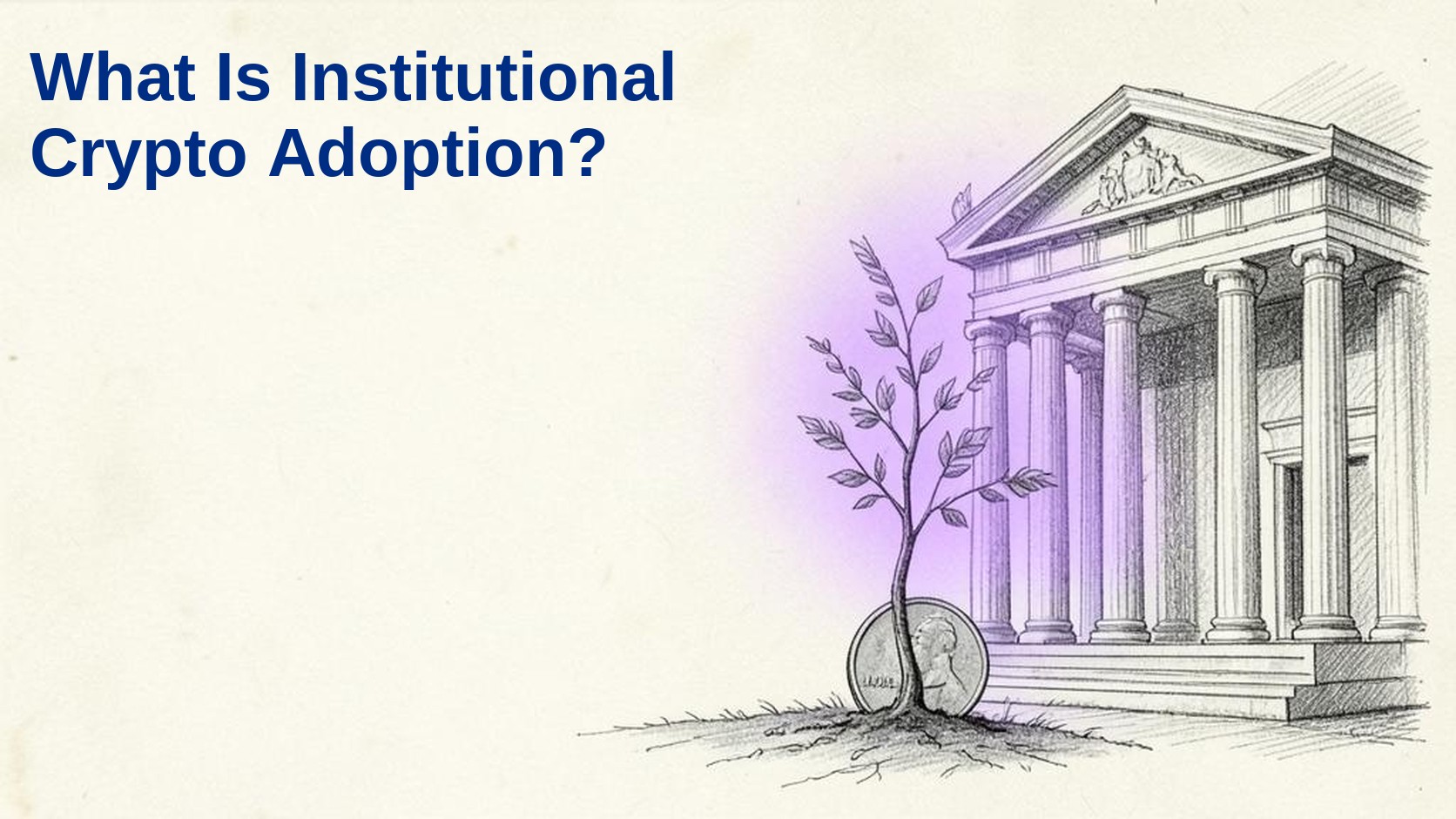
What Is Institutional Crypto Adoption?
TL;DR
Institutional crypto adoption refers to banks, asset managers, corporate treasuries, and other regulated financial institutions integrating digital assets, predominantly stablecoins and tokenized cash-equivalents rather than volatile cryptocurrencies, into their core operations for settlement, treasury management, and payments. In 2026, this looks less like institutions speculatively holding Bitcoin and more like institutions using stablecoin rails for cross-border settlement, routing large trades through dedicated OTC desks, and allocating treasury balances to tokenized money market funds alongside traditional cash-equivalents.
Institutional crypto adoption: definition and positioning
The phrase "institutional crypto adoption" is often used loosely to describe anything from a hedge fund trading Bitcoin futures to a bank piloting blockchain settlement. The more precise and currently relevant meaning, for the businesses this site covers, centers on stablecoin and tokenized-asset infrastructure specifically: institutions using dollar-pegged digital assets as a settlement and treasury tool rather than as a speculative position. This distinction matters because the infrastructure, regulatory considerations, and risk profile differ substantially between an institution holding volatile crypto as an investment and an institution using stablecoins as operational payment infrastructure.
How institutional crypto adoption actually happens
Institutional adoption typically follows a recognizable sequence. An institution first evaluates a specific operational pain point, commonly slow, expensive cross-border settlement or fragmented treasury liquidity across many banking relationships. It then selects infrastructure providers matched to its regulatory requirements: a chartered custodian like Anchorage Digital if its mandate requires a specific charter type, an OTC desk like Cumberland or B2C2 for large block trades that cannot move through public exchange order books without price impact, and increasingly a compliance stack combining blockchain analytics with Travel Rule infrastructure for any cross-border stablecoin flow. Only after this infrastructure is in place does the institution move meaningful volume, typically starting with a narrow use case before expanding.
Institutional crypto adoption in practice
The scale is now measurable rather than anecdotal. The Bank for International Settlements estimates that OTC crypto desks intermediate 60 to 65 percent of institutional spot flow above 1 million dollars, reflecting how thoroughly large institutional trades have moved away from public exchange order books toward bilateral RFQ execution through desks like Cumberland, B2C2, Wintermute, and Galaxy. On the treasury side, tokenized cash-equivalents are pulling meaningful allocations onchain, with BlackRock's BUIDL fund reaching approximately 3.0 billion dollars and Ondo's USDY reaching approximately 2.1 billion dollars, sitting alongside pure stablecoins like USDC and USDT, which together account for the bulk of the roughly 315.3 billion dollar total stablecoin supply as of mid-2026.
Payment company acquisitions offer another concrete signal. Stripe's 1.1 billion dollar acquisition of Bridge, closed in February 2025, and Mastercard's March 2026 agreement to acquire BVNK for up to 1.8 billion dollars, including 300 million in contingent payments and still pending closing, both represent large, established financial institutions treating stablecoin infrastructure as core to their business rather than an experimental side project. This is a meaningfully different signal than institutional Bitcoin allocation news, since it reflects operational infrastructure investment rather than speculative position-taking.
Trade-offs and limitations
Institutional crypto adoption remains uneven and jurisdiction-dependent. Regulatory frameworks are maturing quickly, with 85 of 117 surveyed jurisdictions now having passed Travel Rule legislation and the EU's MiCA transitional window closed as of July 1, 2026, but coverage is not universal, and institutions operating across many jurisdictions still face a patchwork of requirements rather than a single global standard. Custody and audit infrastructure, while increasingly institutional-grade through providers like Fireblocks, Anchorage Digital, and BitGo, is newer than the equivalent infrastructure built over decades for traditional assets, meaning some institutional risk committees remain more cautious than the underlying technology alone might justify. And the distinction between genuine operational adoption, using stablecoins for actual settlement and treasury functions, and more superficial adoption, holding a small allocation for optionality without meaningful operational integration, is not always clear from headline adoption statistics.
For related coverage, see our comparisons of Digital Asset Payments, and Enterprise Stablecoin Treasury.
FAQs
What does institutional crypto adoption actually mean in 2026?
It primarily means banks, asset managers, and corporate treasuries using stablecoins and tokenized cash-equivalents for operational functions like cross-border settlement and treasury management, rather than institutions speculatively holding volatile cryptocurrencies as an investment position.
How much institutional volume moves through crypto OTC desks?
The Bank for International Settlements estimates that OTC desks intermediate 60 to 65 percent of institutional spot flow above 1 million dollars, reflecting how thoroughly large institutional trades have shifted to bilateral RFQ execution away from public exchange order books.
Are tokenized cash-equivalents part of institutional crypto adoption?
Yes. Tokenized money market fund products like BlackRock's BUIDL and Ondo's USDY represent a growing, if still smaller, slice of institutional treasury allocation moving onchain alongside pure stablecoins like USDC and USDT, reflecting institutions treating tokenized assets as part of a broader digital dollar liquidity stack rather than a separate speculative category.
Last updated: September 8, 2026 Written by the stablecoin.nyc Editorial Desk