Judge stablecoin treasury platforms on five things: settlement and conversion, compliance and audit trail, reconciliation and ERP fit, custody and counterparty risk, and policy controls. The right choice then depends on one prior question: does the team need a treasury system of record, or a payments rail? Many guides ranking for this topic are written by vendors, so their framing deserves scrutiny. This one applies the same criteria to every option and marks plainly where the evidence stops.
What to Look for in a Stablecoin Treasury Platform

A stablecoin is only as useful to treasury as the plumbing around it. The token moves in minutes; the conversion, controls and books around it decide whether that speed survives contact with month-end close.
Settlement and conversion
Verify which assets the platform supports (USDC, USDT, others) and on which chains. Then verify the fiat on/off ramps: whether conversion between USD and stablecoins is native or requires a separate on-ramp vendor. Modern Treasury is a useful reference point here, describing automated fiat-to-stablecoin conversion with no separate on-ramp vendor and native USDC support across multiple chains.
Compliance and audit trail
Ask where KYB/KYC checks and wallet screening happen, and whether fiat and on-chain activity land in one audit trail. Request SOC reports and read their scope, not just their existence. A split audit trail means auditors reconcile two systems by hand.
Reconciliation and ERP integration
On-chain transactions must tie out to internal records and, eventually, the general ledger. Ask whether matching happens automatically, how unmatched items surface, and how entries flow into the ERP. Manual tie-out is the hidden cost that erases settlement gains.
Custody and counterparty risk
Establish who holds the keys, who issues the token and what backs it. Fiat-backed stablecoins hold reserves such as cash and Treasury bills, so reserve composition and attestation frequency belong in due diligence. Teams weighing direct key control should review self-custody options for institutions before choosing a platform.
Policy controls and approvals
Look for approval workflows, role permissions, limits by wallet or counterparty, and whitelisting. These controls are how a written treasury policy becomes enforceable rather than aspirational.
The scorecard
| Criterion | What to verify | Kyriba | Stripe |
|---|---|---|---|
| Settlement and conversion | Supported tokens and chains; native fiat on/off ramps | See vendor | Stablecoin payments and global payouts via Stripe Crypto |
| Compliance and audit trail | KYB/KYC, wallet screening, single audit trail, SOC reports | See vendor | Guide covers regulatory uncertainty as a risk; product detail: see vendor |
| Reconciliation and ERP fit | Automatic on-chain matching; GL and ERP tie-out | See vendor | Guide flags accounting complexity; product detail: see vendor |
| Custody and counterparty risk | Key control, issuer, reserve composition, attestations | Guide frames fiat-backed reserves as most relevant to treasury | Guide covers peg stability, issuer exposure, counterparty risk |
| Policy controls | Approvals, limits, whitelisting, written policy support | See vendor | Guide covers developing treasury policies |
Takeaway: score every vendor on all five rows, and treat "See vendor" as a diligence question to close before signing.
Why Finance Teams Are Looking at Stablecoin Treasury

The pitch is first-principles simple. Cross-border transfers avoid correspondent banks and cut-off windows.
The market context is no longer marginal. According to Stripe, stablecoin trading volume reached $10.3 trillion in Q3 2025, which Stripe describes as the most active quarter in more than three years. That is a vendor figure, and should be read as one, but it points to liquidity that did not exist a few cycles ago.
Stripe's guide groups treasury use into four workflows:
- Simplifying cross-border payments
- Collecting revenue
- Expediting internal liquidity between regions
- Programming payouts
These are different jobs. A team moving intercompany liquidity has different needs from one paying thousands of contractors.
Takeaway: define the use case first. The use case determines which scorecard rows carry the most weight.
Kyriba: Judged Against the Criteria

Kyriba publishes a stablecoin guide for treasury teams, and it should be read as vendor content. The guide's central position is that fiat-backed stablecoins are the most common model and the most relevant to treasury operations, with the issuer holding reserves such as cash and Treasury bills.
Against the scorecard:
- Custody and counterparty risk: the guide's emphasis on reserve-backed models aligns with the issuer-diligence row.
- Settlement and conversion: see vendor.
- Compliance and audit trail: see vendor.
- Reconciliation and ERP fit: see vendor.
- Policy controls: see vendor.
Four "See vendor" cells is not a verdict against Kyriba. It is a statement about what has been evidenced. A vendor that publishes treasury guidance may be a candidate for the reconciliation and policy rows, but every candidate still needs demos and documentation.
Takeaway: Kyriba fits teams that want stablecoins considered inside a treasury system of record. Close the open rows in diligence.
Stripe: Judged Against the Criteria
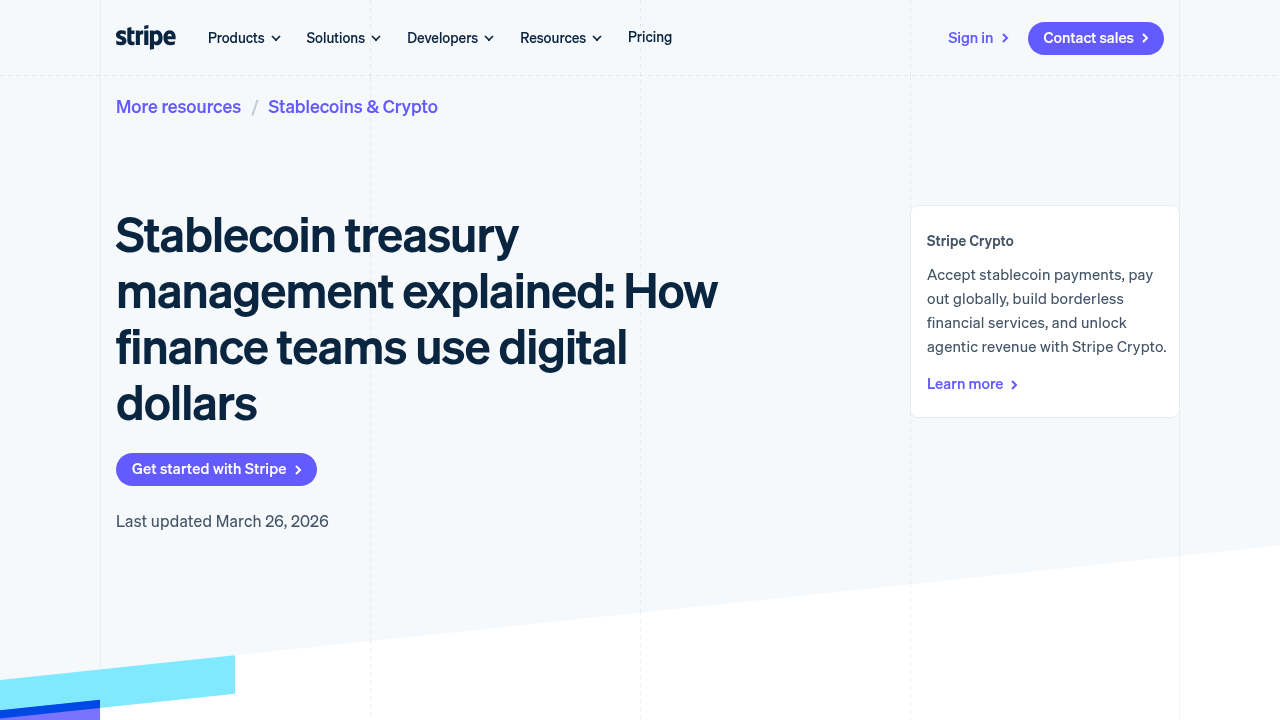
Stripe approaches the topic from the payments side. Stripe Crypto covers accepting stablecoin payments and paying out globally, and its guide on stablecoin treasury management lists a clear risk taxonomy: peg stability and issuer exposure, regulatory uncertainty, security integrity, accounting complexity, liquidity constraints and counterparty risk. It also addresses how teams can develop stablecoin treasury policies.
Against the scorecard:
| Criterion | Assessment |
|---|---|
| Settlement and conversion | Strong orientation: payments acceptance and payouts |
| Compliance and audit trail | Risk framing present; product controls: see vendor |
| Reconciliation and ERP fit | Accounting complexity named as a risk; tooling: see vendor |
| Custody and counterparty risk | Issuer, peg and counterparty risk covered in guide |
| Policy controls | Policy development addressed in guide |
The distinction matters. A payments rail optimizes money in and money out. A treasury system optimizes position, forecast and control. Stripe's evidence points toward the first.
Takeaway: Stripe fits teams whose stablecoin need is acceptance and payouts, with treasury policy layered on top.
Other Places to Look and How to Judge Them
Only two options are judged in full here because only two have enough evidence to judge. Any shortlist will be longer, and every addition should face the same five rows.
Modern Treasury is a useful reference example of what a combined approach looks like. It describes stablecoin payments on the same infrastructure used for fiat, with conversion, compliance and reconciliation in one platform. Its product page cites KYB/KYC and compliance checks and one audit trail across fiat and stablecoin rails.
Use that as a benchmark for questions, not a recommendation:
- Can the vendor show conversion without a third-party on-ramp?
- Do fiat and on-chain flows share one audit trail?
- Does reconciliation run automatically, and how are exceptions handled?
- Who controls keys, and under what custody arrangement?
- Which policy controls are configurable without engineering work?
Takeaway: a vendor that cannot answer all five in writing is not ready for a treasury mandate.
Red Flags and What to Avoid
Write these as checks and run them on every vendor.
- No issuer or reserve disclosure. If the platform cannot state which issuers it supports and how their reserves are attested, the counterparty risk is unpriced.
- No single audit trail. Separate logs for fiat and on-chain activity push reconciliation onto the controller.
- Manual reconciliation. Spreadsheet tie-out of wallet transactions to the GL does not scale past pilot volumes.
- Unclear custody. Ambiguity about who holds keys, or whether assets are segregated, is disqualifying.
- Regulatory uncertainty treated as solved. Stripe's own guide lists it as a live risk.
- Accounting complexity waved away. Classification and measurement of stablecoin holdings need sign-off from auditors before go-live.
- Liquidity constraints ignored. Redemption paths and off-ramp capacity matter most on the day they are needed.
Takeaway: a red flag on custody or audit trail ends the evaluation; the others are negotiable with compensating controls.
FAQ: Frequently Asked Questions
What is stablecoin treasury management?
It is the use of stablecoins, usually fiat-backed and dollar-pegged, within a company's everyday cash operations: paying vendors, collecting revenue, moving liquidity between regions and holding short-term balances while funds are routed.
Which stablecoins suit corporate treasury?
Fiat-backed stablecoins such as USDC and USDT are the usual starting point because issuers hold reserves like cash and Treasury bills. Choose based on issuer disclosure, attestation frequency, regulatory status and the liquidity your corridors need.
How do stablecoins differ from bank cash?
Stablecoins are digital assets designed to hold a stable value, typically pegged 1:1 to a fiat currency like the U.S. dollar. Compared with bank cash, they settle in minutes rather than days, operate 24/7 and move across borders without correspondent banking friction. They also add issuer exposure and depend on the reserves behind the token, so issuer disclosure and attestation frequency belong in due diligence.
What risks should a treasurer weigh first?
Start with issuer exposure and peg stability, then counterparty and custody risk. After that, assess regulatory uncertainty, security, accounting complexity and liquidity constraints, especially the capacity to redeem or off-ramp under stress.
How should teams handle accounting and reconciliation?
Agree classification with auditors before the first transaction. Then require automatic matching of on-chain transactions to internal records, a clear exception queue and a documented path into the ERP and general ledger.
Do we need a written stablecoin policy?
Yes. A written policy defines permitted issuers, balance limits, approved counterparties, approval thresholds and custody arrangements. Without it, platform controls have nothing to enforce, and auditors have nothing to test against.
Conclusion: The Open Question for Treasurers
The scorecard resolves most of the vendor question. Settlement speed is now table stakes; reconciliation, custody and policy controls separate a pilot from a production treasury function. Kyriba points toward the system-of-record path, Stripe toward the payments-rail path.
The unresolved question is architectural. Will stablecoins sit inside the treasury system as another cash account, or will the payments rail become the treasury system? Teams that answer that first will buy once.