TL;DR
Crypto treasury management is how a company decides which digital assets to hold, where to hold them, and how to move, account for, and protect them. It covers two very different jobs: holding Bitcoin as a reserve asset on the balance sheet, and using stablecoins as operating cash for payments, payroll, and cross-border settlement. Most companies need the second far more than the first.
Crypto treasury management: definition and positioning
Traditional treasury management covers cash, liquidity, currency risk, and funding for a business. The corporate treasurer makes sure money is where it needs to be, in the right currency, at the lowest cost and risk. Crypto treasury management applies the same discipline to digital assets.
The term gets used for two strategies that share almost nothing except the word "treasury":
Reserve strategy. Holding Bitcoin, and sometimes Ether, as a long-term reserve asset, a store of value or a hedge against inflation and currency risk. This is the model popularized by Strategy, formerly MicroStrategy, and copied by the wave of public companies tracked on sites such as BitcoinTreasuries.net.
Operating strategy. Holding stablecoins, digital dollars pegged to the US dollar, as working cash: receiving crypto payments, paying suppliers and contractors abroad, and managing liquidity across entities in real time.
The framing that matters: a reserve strategy is an investment decision that changes your risk profile. An operating strategy is an infrastructure decision that changes your cost and speed. Treasury teams should evaluate them separately, with different owners, limits, and approval processes.
How crypto treasury management works
Whatever the strategy, the same five components appear in every well-run crypto treasury.
- Policy. A written treasury policy that sets which crypto assets the company may hold, maximum allocation as a share of the balance sheet, approved counterparties, and who can approve transactions. No policy, no treasury.
- Custody. Where the keys live. Options range from qualified custodians and exchange custody to self-custody with multi-signature wallets or MPC (multi-party computation) wallets, where no single person can move funds. Cold storage keeps long-term reserves offline.
- Liquidity management. How the company converts between fiat and crypto, which on-ramps and off-ramps it uses, and how much it keeps liquid versus in long-term holdings. Managing liquidity in crypto runs 24/7, unlike bank cut-off times.
- Accounting and tax. Recording holdings, gains, and losses correctly. In the US, FASB's ASU 2023-08 requires fair value measurement for many crypto assets, which removed the old impairment-only rule that made Bitcoin holdings look worse on the balance sheet than they were.
- Risk management. Price volatility, counterparty risk, smart contract risk, and fraud. Controls include allocation caps, approval workflows, address allowlists, and regular reconciliation against on-chain data.
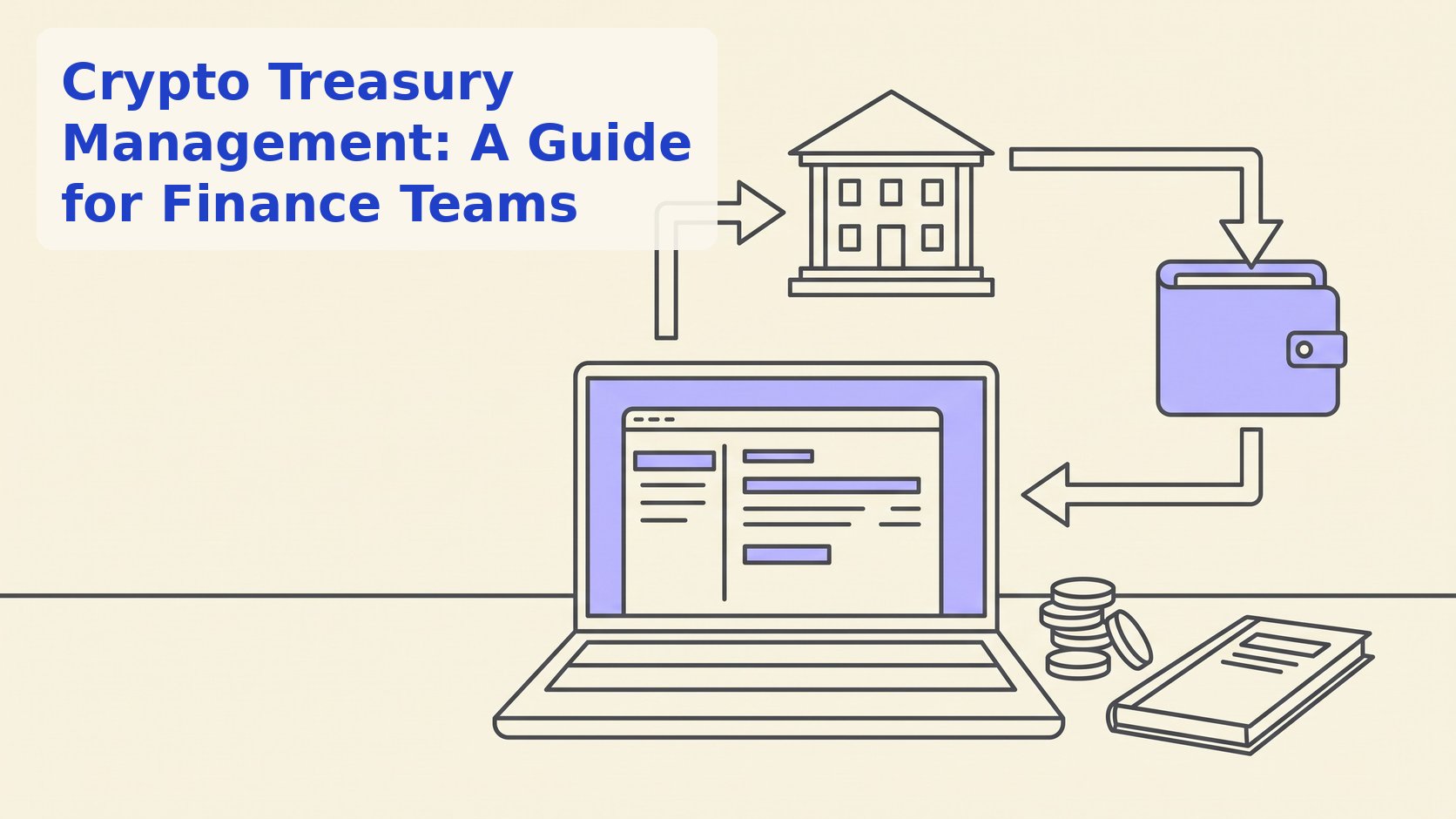
Operationally, the flow looks like this: fiat moves from a bank account to a regulated exchange or payment provider, converts to stablecoins or Bitcoin, and settles to custody. Outflows reverse the path, or pay counterparties directly on-chain. Treasury teams track positions in real time because blockchain settlement is final; there is no recall on a mistaken transfer.
Crypto treasury management in practice
The Bitcoin treasury model. Strategy turned holding Bitcoin into its core business, funding purchases with equity and debt. Its success spawned a category of public "treasury companies" holding BTC, and later Ether and other assets, and some traded at a premium to the value of their holdings. The lesson for ordinary corporate finance teams is limited: those companies are effectively investment vehicles, not operating businesses managing cash.
The stablecoin operating model. This is where most practical value sits. A company paying contractors in Latin America or Asia can send USDC that settles in minutes, around the clock, instead of a SWIFT wire taking days. Payment providers such as Stripe and Bridge, along with infrastructure firms like BVNK, now let businesses accept, hold, and pay out stablecoins without running wallets themselves. In the US, the GENIUS Act, signed in July 2025, created a federal framework for payment stablecoins, which gives treasurers clearer rules on reserves and issuers.
Government holdings. In March 2025, a US executive order created a Strategic Bitcoin Reserve and a Digital Asset Stockpile, funded from crypto the government already held through forfeiture, rather than through purchases.
Choosing tools. Crypto treasury management tools fall into three layers: custody solutions (Coinbase Prime, BitGo, Anchorage, or self-custody through Safe multisig and MPC providers), payment and conversion (stablecoin payment platforms and exchanges), and accounting (crypto sub-ledgers that reconcile on-chain activity with the general ledger). For the full field, see our guides to the best multisig wallets for businesses and stablecoin payment infrastructure.
A hybrid is common: companies keep most cash in a business bank or fintech account, such as Revolut Business for multi-currency operations, and hold a stablecoin float for the payments where crypto rails are faster and cheaper.
Trade-offs and limitations
Volatility. Bitcoin can fall 50% or more in a downturn. A reserve allocation sized as if it were cash can turn a profitable year into a reported loss under fair value accounting. Size reserves as investments, not liquidity.
Stablecoin risk is not zero. Stablecoins depend on their issuer's reserves and redemption process. Regulated, fully reserved stablecoins reduce that risk; they do not remove it. Diversify across issuers for large balances.
Operational risk. Lost keys, approval failures, and phishing cause more losses than market moves. Multi-signature controls and tested recovery procedures matter more than any yield.
Accounting and tax complexity. Every conversion can be a taxable event, and jurisdictions treat stablecoins differently. Treasury teams need accounting support before the first transaction, not after.
Yield temptation. Lending or staking idle crypto for yield adds counterparty and smart contract risk. Several lenders failed in 2022, taking customer assets with them. For most corporate treasuries, yield generation should be an explicit, capped decision, not a default.
FAQs
What is crypto treasury management?
Crypto treasury management is the set of policies, tools, and controls a company uses to hold, move, account for, and protect digital assets. It includes custody, liquidity management, accounting, and risk management, applied either to reserve assets such as Bitcoin or to stablecoins used as operating cash.
Why do companies hold Bitcoin in their treasury?
Companies that hold Bitcoin usually treat it as a long-term store of value and a hedge against inflation and currency debasement. It is an investment decision with significant volatility, so most allocate a small, capped share of the balance sheet rather than operating cash.
How do businesses use stablecoins for treasury operations?
Businesses use stablecoins to receive crypto payments, pay suppliers and contractors abroad, move liquidity between entities, and settle cross-border transactions outside banking hours. Stablecoins settle in minutes, which reduces float and wire costs compared with traditional international payments.
Is crypto treasury management safe?
It can be, with the right controls: a written treasury policy, qualified custody or multi-signature self-custody, allocation limits, approval workflows, and regular reconciliation. Most losses come from operational failures such as lost keys or phishing, not from the assets themselves.
How are crypto treasury holdings accounted for?
In the US, FASB's ASU 2023-08 requires fair value measurement for many crypto assets, with changes reported in net income. Stablecoins may be treated differently depending on their terms. Companies should confirm treatment with their auditors before building a position.
Building stablecoin treasury or payment infrastructure? See our deep dive on enterprise stablecoin treasury, or reach out if you are building in this space.
Last updated: October 13, 2026.