Best Self-Custody Solutions for Teams and Institutions: Top Options Compared
Best Self-Custody Solutions for Teams and Institutions: Top Options Compared
TL;DR
Best overall for institutions wanting proven, widely deployed MPC infrastructure is Fireblocks. Best for institutions wanting a choice between fully self-custodial and managed custody on one platform is Cobo. Best for trading-active institutions needing custody integrated with off-exchange settlement is Copper, through its ClearLoop product. Best for institutions wanting on-premise deployment rather than a cloud-hosted platform is Ripple Custody. The distinction that matters most in this category, and the one most "best custody" content blurs: self-custody means the institution holds and manages all private key material directly, no third party has signing authority. Qualified custody means a regulated third party holds the assets on the institution's behalf. These are not two flavors of the same thing, they carry different regulatory treatment, different recovery models, and different risk, and a team evaluating this space needs to know which one it actually needs before comparing vendors.
What actually matters when choosing institutional self-custody
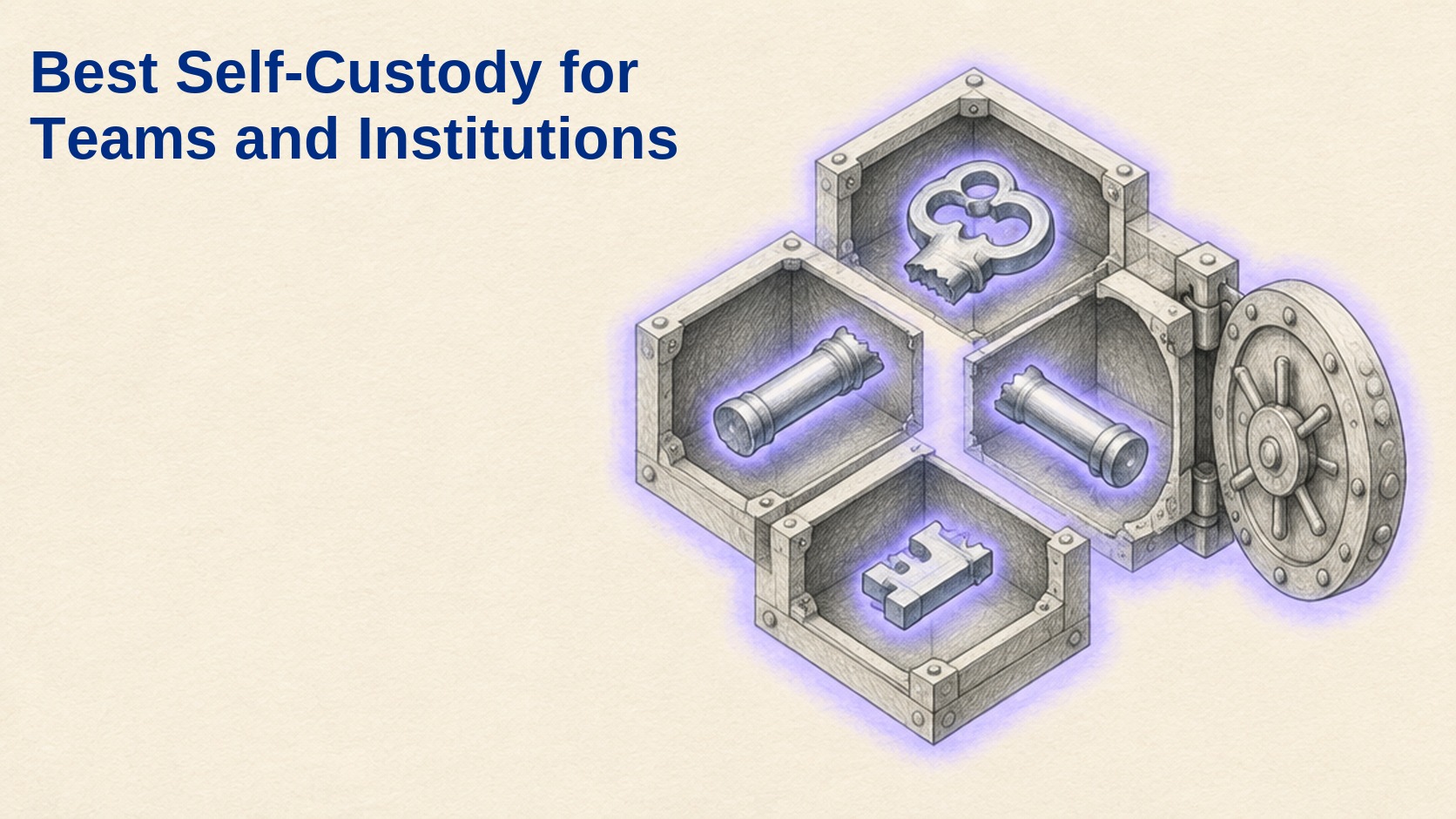
Key-share architecture, specifically. MPC (multi-party computation) has become the dominant architecture for new institutional deployments, splitting a private key into shares distributed across multiple parties so no single party ever holds the complete key. Confirm whether the platform offers genuinely self-custodial MPC, where the institution holds all shares, versus custodial MPC, where the platform itself holds one or more shares on the institution's behalf, that distinction changes who actually controls the assets.
Recoverability without reintroducing a single point of failure. A lost device, an unavailable keyholder, or a vendor outage all need a recovery path that doesn't require trusting one party enough to hand them signing authority outright. Ask specifically how each scenario is handled before deploying.
Compliance-ready integrations. Self-custody doesn't mean compliance-free. Institutional platforms increasingly ship integrations with AML and Travel Rule providers like Chainalysis and Notabene directly, so compliance obligations can be met without giving up key control.
Deployment model. Cloud-hosted SaaS, on-premise installation inside the institution's own secure environment, or a hybrid, changes both the operational burden and the trust model. An institution that cannot outsource infrastructure to a vendor's cloud needs to confirm on-premise support specifically.
Policy engine for operational risk. Spending caps, destination whitelists, and role-based access controls sit above the raw key-management layer and matter as much for day-to-day risk management as the cryptography underneath.
Quick comparison table
| Platform | Key-share model | Compliance integrations | Deployment | Best for |
|---|---|---|---|---|
| Fireblocks | MPC, supports self-custodial configuration | Broad institutional adoption, widely integrated with analytics and compliance tooling | Cloud-hosted | Institutions wanting proven, widely deployed MPC infrastructure |
| Cobo | MPC, both self-custodial and managed custody models on one platform | [more information required: confirm current compliance-integration list] | Cloud-hosted (Singapore-based), APAC-focused | Institutions wanting a choice between self-custody and managed custody without switching platforms |
| Copper | MPC with ClearLoop off-exchange settlement, one key share kept offline | SOC 2 Type II reported | Cloud-hosted | Trading-active institutions needing custody integrated with prime brokerage and off-exchange settlement |
| ChainUp Custody | MPC-TSS, key shards co-computed off-chain, never compiled in server memory | Programmable policy engine with RBAC and destination whitelists | Cloud-hosted | Web3 enterprises and trading desks wanting a non-custodial stack with verifiable recoverability |
| Ripple Custody | MPC or HSM, institution's choice | [more information required: confirm current compliance-integration list] | On-premise or cloud-hosted, institution's choice | Institutions that cannot or will not outsource infrastructure to a vendor's cloud |
Top options compared
Fireblocks is the most widely deployed MPC infrastructure among exchanges, custodians, and financial institutions, and its scale is itself a signal, a platform this broadly adopted has had its security model tested across a large and varied set of real institutional deployments. It supports self-custodial configuration directly, keeping the institution in control of its own key shares rather than defaulting to a managed model. Where it breaks: [more information required: confirm current asset coverage and deployment flexibility directly relative to platforms offering on-premise installation].
Cobo stands out specifically for offering both self-custodial and managed custody models on one platform rather than forcing an institution to choose a vendor based on custody philosophy alone, with hot, warm, and cold vault configurations available under either model. This matters for an institution whose custody needs might genuinely shift over time, a growing fintech might start managed and move toward self-custody as its own compliance and security operations mature. Where it breaks: it's Singapore-based and APAC-focused in its primary market orientation, an institution needing deep US or EU regulatory alignment should confirm current licensing coverage directly.
Copper built its custody architecture around MPC combined with ClearLoop, an off-exchange settlement network that lets institutional clients trade across connected exchanges without moving assets out of custody, with one MPC key share kept offline specifically to strengthen the cold-storage profile. This is the strongest fit among these five for a trading-active institution running strategies across multiple venues. Where it breaks: its core differentiation is trading-and-settlement integration specifically, an institution whose primary need is simple long-term holding rather than active multi-venue trading gains less from ClearLoop's specific value.
ChainUp Custody uses an MPC-TSS framework where key shards are co-computed off-chain across isolated security perimeters and never compiled anywhere in server memory, paired with a programmable policy engine giving risk managers direct control over approval workflows, role-based access, and destination whitelists. Where it breaks: [more information required: confirm current institutional track record and deployment scale directly, relative to more established platforms like Fireblocks].
Ripple Custody is the clearest answer for an institution that specifically cannot or will not outsource its custody infrastructure to a vendor's cloud, supporting installation inside the institution's own secure IT environment rather than requiring assets and key material to sit in Ripple's infrastructure. It offers a choice between MPC and HSM key management and supports hot, warm, or cold vault configurations. Where it breaks: on-premise deployment shifts real operational burden onto the institution's own infrastructure team, a meaningful trade-off against a fully managed cloud platform's lower setup overhead.
Key differences that actually matter
The decisive question, again, is self-custody versus qualified custody, and this category answers only the former. Every platform compared here lets an institution retain direct control of its own keys. None of them are a substitute for a qualified custodian relationship if that's what a specific regulatory mandate requires, that's a different category entirely, covered by chartered custodians like Anchorage Digital rather than by MPC infrastructure providers. Past that filter, the real differences are deployment model (cloud versus on-premise), trading integration depth (Copper's specific strength), and whether an institution wants the flexibility to run self-custodial and managed models side by side (Cobo's specific strength).
When qualified custody is the right answer instead
An institution whose mandate specifically requires a qualified custodian, a registered investment adviser bound by SEC custody rules, for instance, should not evaluate this category as a solution to that requirement. Self-custody, however well-architected, does not satisfy a qualified custody mandate. That institution needs a chartered custodian relationship instead, a different category of provider entirely.
FAQs
What is the difference between self-custody and qualified custody for an institution?
Self-custody means the institution holds and manages all private key material directly, with no third party ever holding signing authority. Qualified custody means a regulated third-party custodian holds the assets on the institution's behalf, a status that specific regulatory frameworks, like SEC rules for registered investment advisers, may require. The two are not interchangeable, and confirming which one a specific regulatory mandate requires should come before evaluating any vendor.
Is MPC the same as self-custody?
Not automatically. MPC (multi-party computation) is a key-management architecture, splitting a private key into shares held by multiple parties. Whether that counts as genuine self-custody depends on who holds those shares: if the institution holds all of them, it's self-custodial MPC. If the platform itself holds one or more shares, it's custodial or co-custodial MPC, a meaningfully different arrangement.
What is the best self-custody platform for institutions?
Fireblocks is the strongest default for proven, widely deployed MPC infrastructure. Cobo fits institutions wanting flexibility between self-custodial and managed models. Copper is the strongest pick for trading-active institutions needing custody integrated with off-exchange settlement. Ripple Custody is the right choice for institutions that need on-premise deployment specifically.
Does self-custody mean giving up compliance capability?
No. Institutional self-custody platforms increasingly integrate directly with AML and Travel Rule providers, so an institution can retain full key control while still meeting compliance obligations, rather than treating self-custody and compliance as a trade-off against each other.
For multisig specifically as one governance layer within this broader custody landscape, see Best Multisig Wallets for Businesses. For how a wallet provider or custodian layers payment infrastructure on top of a custody model like these, see Best Stablecoin Infrastructure for Wallet Providers & Custodians and Enterprise Stablecoin Treasury.
Last updated: September 28, 2026 Written by the stablecoin.nyc Editorial Desk