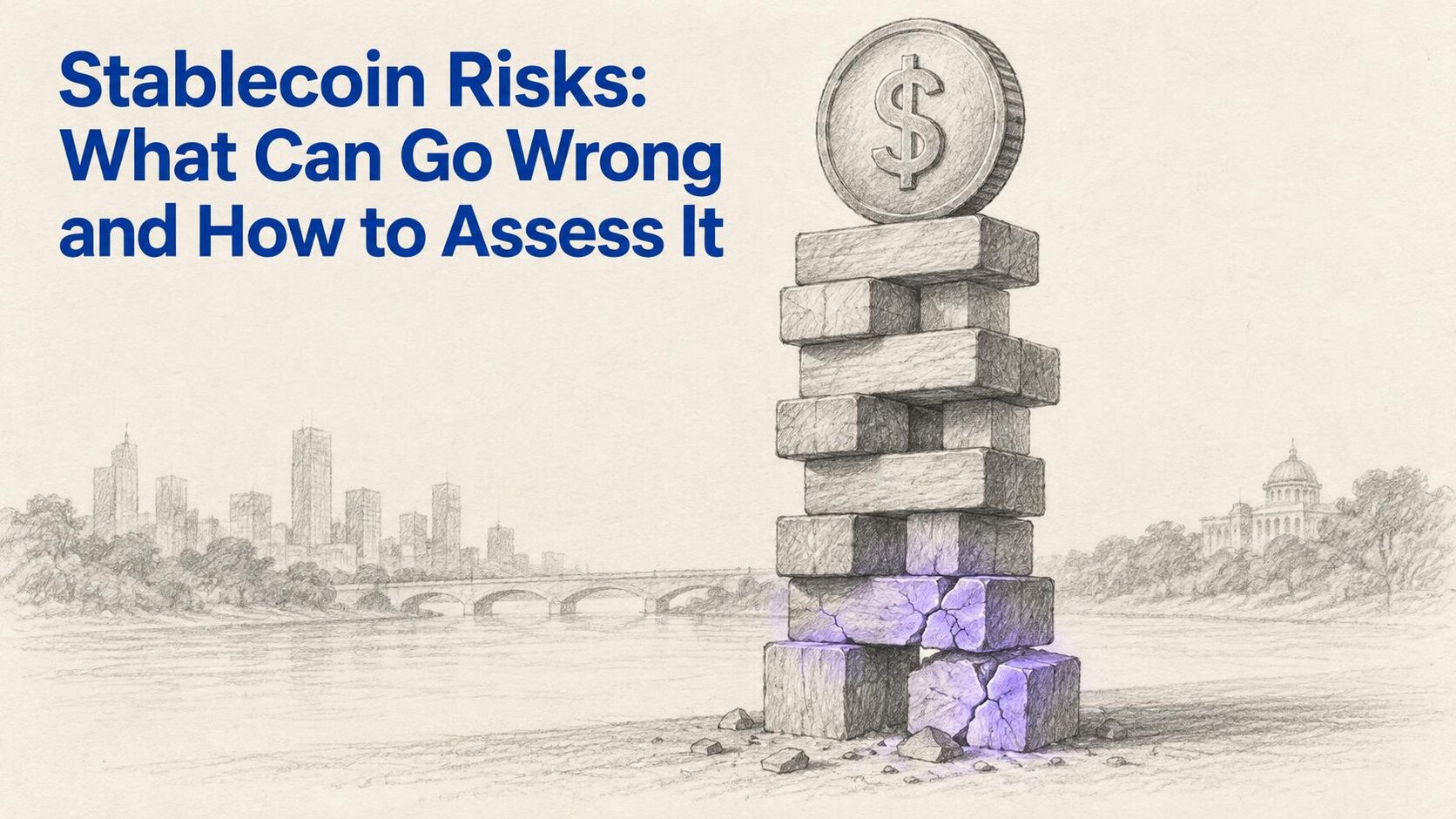
Stablecoin Risks: What Can Go Wrong and How to Assess It
Last updated: October 12, 2026
TL;DR
The main stablecoin risks are reserve and issuer risk, run and depeg risk, freeze and censorship risk, smart contract and bridge risk, contagion through DeFi, regulatory risk and concentration risk. Fiat-backed stablecoins with cash and Treasury reserves carry the least; algorithmic and synthetic dollars carry the most. Stablecoins are not deposit-insured, so the issuer's reserves and redemption policy are the main protection a holder has.
Why stablecoins carry risk at all
A stablecoin is a promise that one token can be exchanged for one dollar. Every risk is a way that promise can fail: the dollars are not there, they cannot be reached quickly enough, the holder is blocked from using them, or the token itself is compromised.
The Federal Reserve's April 2026 note on stablecoin developments summarized the trade-off. Regulation and higher-quality reserves have lowered run risk for the largest tokens, but stablecoins' growing ties to banks, Treasury markets and decentralized finance mean that when something does break, it can travel further.
The seven core stablecoin risks
| Risk | What goes wrong | Who is most exposed | Example |
|---|---|---|---|
| Reserve and issuer | Backing is impaired, illiquid or misreported | Holders of opaque or weakly regulated tokens | USDC's $3.3 billion stuck at Silicon Valley Bank, 2023 |
| Run and depeg | Mass redemptions push the market price below $1 | Holders who sell during stress | USDT briefly near $0.95 in May 2022 |
| Freeze and censorship | Issuer blacklists an address; funds cannot move | Anyone whose address is flagged | USDT and USDC freezes tied to sanctions and hacks |
| Smart contract and bridge | Code bug, exploit or compromised bridge | Holders of wrapped or bridged versions | Bridge exploits on wrapped stablecoins |
| DeFi contagion | One protocol's failure spreads through others that hold its tokens | Yield-seekers and DeFi users | Elixir's deUSD collapsing after exposure to Stream Finance, 2025 |
| Regulatory | Token restricted or delisted in a jurisdiction | Users in regulated markets | USDT restricted on EU-regulated venues under MiCA |
| Concentration | Market depends on a few issuers and chains | The whole market | USDT and USDC holding about 82% of supply |
Reserve and issuer risk
This is the foundational risk. A stablecoin is only as good as what backs it and who holds it. Fed Governor Michael Barr warned in March 2026 that issuers have an incentive to push reserves further out the risk spectrum to earn more. The protection is regulation: the US GENIUS Act and the EU's MiCA require high-quality liquid reserves and regular disclosure. Our proof of reserves guide explains how to read those disclosures.
Run and depeg risk
Stablecoins are runnable. If holders doubt redemption, they sell on secondary markets faster than the issuer can redeem, and the price falls. Fiat-backed tokens have recovered from every depeg so far; algorithmic tokens like TerraUSD did not. Our stablecoin depeg guide covers every major event.
There is also a reverse channel into traditional markets. Stablecoin reserves are concentrated in short-term Treasuries. A New York Fed analysis estimated reserves were about 60% in Treasury bills at the end of 2024, roughly 2% of the bill market, and a 2025 BIS paper warned that a large run could force fire sales. The larger the market grows, the more a stablecoin run becomes a Treasury market event.
Freeze and censorship risk
Fiat-backed issuers can freeze tokens at specific addresses, usually to comply with sanctions or recover stolen funds. That is a feature for regulators and a risk for users: funds sent to or from a flagged address can become unusable. Decentralized stablecoins avoid issuer freezes but replace that risk with collateral and governance risk.
Smart contract, bridge and chain risk
A token's code can contain bugs, admin keys can be compromised, and bridged versions depend on the bridge staying solvent. Native issuance on each chain, or canonical transfer protocols like Circle's CCTP, reduce bridge exposure. Chain outages can also delay transfers even when the token itself is sound.
DeFi composability and contagion risk
The framing I keep coming back to: in DeFi, you inherit the risks of everything your stablecoin touches. Composability means one token can be collateral in a lending market, a pool in an exchange and the backing for another token at once. When one link fails, losses propagate.
Two 2025 events showed both sides. When Stream Finance failed in November 2025, Elixir's deUSD, which had lent most of its backing to Stream, collapsed to about two cents, spreading losses to protocols that accepted it. During the October 2025 liquidation cascade, by contrast, Aave's decision to price USDe from its redemption value rather than one exchange's order book meant it saw no USDe-driven liquidations. Design choices determine whether stress spreads or stops. Yield-bearing tokens add this layer by design, as our yield-bearing stablecoins guide explains.
Regulatory and concentration risk
Rules differ by jurisdiction and are still changing. A token can be fully available in one market and restricted in another, as USDT is in the EU. Meanwhile, two issuers hold most of the supply, so problems at either would affect the whole market rather than a corner of it.
How to assess a stablecoin's risk
- Who issues it, and who regulates them? Look for a licensed issuer under GENIUS, MiCA or an equivalent regime.
- What backs it? Cash and short-term Treasuries are lowest risk; crypto collateral and strategies add risk.
- How often are reserves disclosed, and by whom? Monthly attestations from a recognized accounting firm are the benchmark.
- Can you redeem directly at par? Know your redemption path before you need it.
- How did it behave under stress? Check the depeg history.
- Which version are you holding? Native tokens are safer than bridged or wrapped versions.
- What else does it touch? For DeFi use, map the protocols and collateral behind it.
FAQs
Are stablecoins safe?
Regulated fiat-backed stablecoins are among the lower-risk crypto assets, but they are not risk-free. They are not deposit-insured, they can briefly lose their peg under stress, and issuers can freeze tokens. Algorithmic and synthetic stablecoins carry significantly higher risk, as several collapses have shown.
What is the safest stablecoin?
There is no risk-free stablecoin, but lower-risk tokens share common features: a licensed issuer, reserves in cash and short-term Treasuries, frequent independent attestations, direct redemption at par and a record of recovering from stress. Large regulated fiat-backed stablecoins meet most of these criteria; algorithmic tokens meet none.
Can stablecoins lose value?
Yes. Stablecoins can trade below $1 when holders doubt redemption or when an exchange's liquidity breaks down. USDC fell to about $0.87 in March 2023 before recovering. Tokens whose backing fails can lose almost all their value, as TerraUSD did in May 2022.
Are stablecoins FDIC insured?
No. Payment stablecoins are not bank deposits and are not covered by FDIC deposit insurance. Holders rely on the issuer's reserves and regulatory protections such as segregation and redemption rights. Tokenized bank deposits, a different product, are treated as deposits under existing banking law.
What happens to my stablecoins if the platform holding them fails?
It depends on custody. Stablecoins in a self-custody wallet are unaffected by a platform's failure. Stablecoins held on an exchange or custodial app become a claim against that company, and recovery depends on whether customer assets were segregated and on bankruptcy proceedings.
What is run risk for stablecoins?
Run risk is the danger that many holders try to redeem or sell at once, faster than the issuer can turn reserves into cash. That pressure can push the market price below $1 and force the issuer to sell assets quickly. High-quality, liquid reserves and clear redemption rights reduce it.
The takeaway
Stablecoin risk has shifted from "is the money there?" toward "what is it connected to?" as reserves improve and integration with banks, Treasury markets and DeFi deepens. The open question is whether regulation keeps pace with that interconnection, or whether the next stablecoin crisis starts in a protocol rather than an issuer.