What Is a Stablecoin Depeg? Causes, History and Risks
Last updated: October 12, 2026
TL;DR
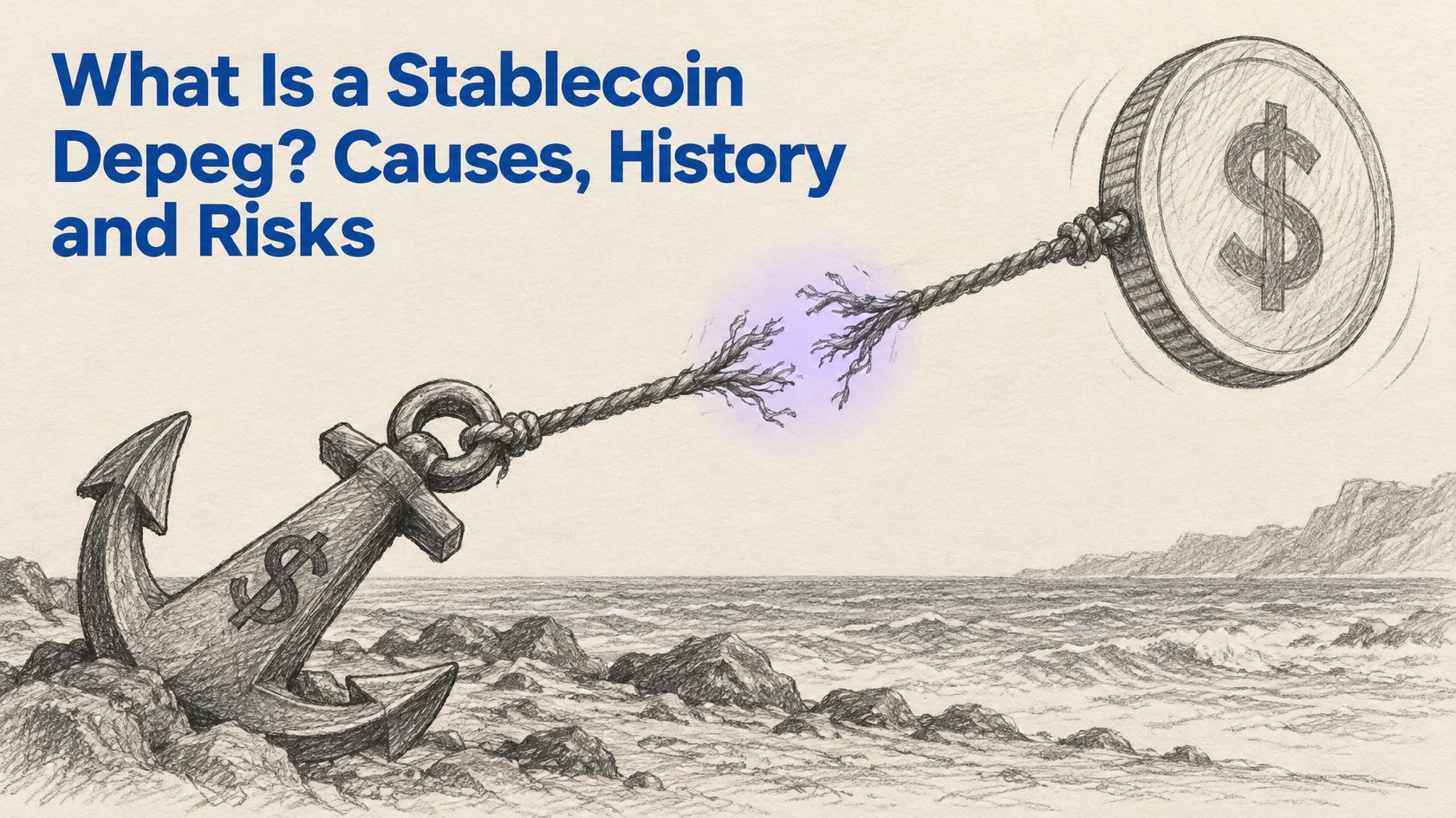
A depeg is when a stablecoin trades meaningfully away from its target value, usually $1. It happens when holders doubt they can redeem at par, or when liquidity on a venue breaks down. Most depegs are brief: USDC fell to about $0.87 during the Silicon Valley Bank failure in March 2023 and recovered within days. A few are terminal, like TerraUSD's collapse in May 2022, which wiped out roughly $40 billion.
What a depeg means
A stablecoin's price is held near $1 by a redemption promise plus arbitrage. If a fiat-backed token trades at $0.99, a trader can buy it, redeem it with the issuer for $1 and pocket the difference. That trade pulls the price back up. A depeg is what happens when that loop stops working, either because redemption looks unsafe or because the trade cannot be executed fast enough.
Not every deviation is a depeg. Stablecoins routinely trade a fraction of a cent either side of $1. Most analysts treat a move beyond about 1% that persists as a genuine depeg, and the important distinction is between three types:
| Type | What breaks | Typical outcome | Example |
|---|---|---|---|
| Venue depeg | Liquidity or pricing on one exchange | Recovers within hours | USDe at $0.65 on Binance, October 2025 |
| Confidence depeg | Doubt about reserves or redemption | Recovers if reserves prove intact | USDC at about $0.87, March 2023 |
| Terminal depeg | The backing itself fails | Does not recover | TerraUSD, May 2022 |
The framing I keep coming back to: a depeg is a price, but the question is always about redemption. If a large holder can still convert tokens to dollars at par somewhere, the depeg will close. If they cannot, it will not.
Why stablecoins depeg
- Reserve loss. The issuer's backing is impaired or temporarily inaccessible, as when part of USDC's reserves was trapped at Silicon Valley Bank.
- Bank run. Holders redeem faster than the issuer can liquidate reserves, pushing secondary-market prices below par.
- Algorithmic failure. Tokens backed by a volatile sister asset rather than cash enter a reflexive spiral when that asset falls.
- Collateral exposure. Yield-bearing or synthetic dollars lose value when the assets or strategies behind them fail.
- Exchange-specific dislocation. Thin order books, faulty price oracles or withdrawal freezes on one venue cause a local price crash.
- Regulatory action. A regulator orders an issuer to stop minting, and redemptions shrink supply under pressure.
Major stablecoin depeg events
| Date | Stablecoin | Low | Cause | Outcome |
|---|---|---|---|---|
| March 2020 | DAI | Traded above $1 | Black Thursday collateral liquidations | Recovered |
| May 2022 | TerraUSD (UST) | Near zero | Algorithmic design failed as LUNA collapsed | Terminal, roughly $40 billion lost |
| May 2022 | USDT | About $0.95 | Redemption wave in the Terra contagion | Recovered |
| March 2023 | USDC | About $0.87 | $3.3 billion of reserves held at the failed Silicon Valley Bank | Recovered after US authorities guaranteed SVB deposits |
| October 10, 2025 | USDe | $0.65 on Binance only | Binance pricing and order book dislocation during a record liquidation cascade | Recovered the same night |
| November 2025 | deUSD (Elixir) | About $0.02 | Backing lent to Stream Finance | Terminal |
| September 22, 2026 | USDe | $0.92 on Binance only | Large sell order into a thin order book | Recovered within minutes |
Sources: CoinPaprika depeg history, 21Shares, Cryptopolitan.
Two patterns stand out. First, every terminal depeg involved a token whose backing was not cash and short-term government debt. Second, the recent incidents have been venue depegs. During the October 2025 cascade, which saw more than $19 billion of liquidations, USDe hit $0.65 on Binance while trading within about 1% of parity on Curve. Binance later paid about $283 million to compensate affected users and changed how it prices the token. USDe's supply still fell from $14.8 billion to $12.6 billion over two days as holders reacted.
As of September 2026, no major fiat-backed or crypto-collateralized stablecoin, including USDT, USDC, USDS, DAI and PYUSD, had broken 1% on aggregated pricing during the year, according to CoinPaprika.
How to spot depeg risk early
Price is a late signal. Earlier warnings include:
- Redemption gaps. Large mints and redemptions out of line with normal patterns, or delays in redemption processing.
- Reserve disclosures. Missing, late or qualified attestations. Our proof of reserves explainer covers what to look for.
- Pool imbalance. A stablecoin making up a growing share of a decentralized exchange pool means holders are selling it for alternatives.
- Spreads across venues. A token trading at different prices on different exchanges signals local stress before it spreads.
- Concentration in backing. Exposure to one bank, one lending counterparty or one strategy.
How to protect yourself
- Prefer tokens with cash and Treasury reserves, frequent attestations and direct redemption rights.
- Diversify across issuers for large balances rather than holding one stablecoin.
- Know your redemption path. Holding through a platform that offers direct redemption at par matters most during stress.
- Avoid selling into a venue depeg if the token is holding parity elsewhere.
- Consider depeg cover from onchain insurance providers for large DeFi positions, after reading exactly what triggers a payout.
Will regulation stop depegs?
Regulation reduces confidence depegs but cannot eliminate them. The US GENIUS Act requires permitted issuers to hold high-quality liquid reserves, publish monthly reserve reports and honor redemptions, which addresses the reserve and run risks behind most historical events. It does not prevent venue depegs on exchanges, and it does not cover synthetic or algorithmic dollars that fall outside its definition of a payment stablecoin.
FAQs
What does depeg mean in crypto?
A depeg in crypto is when a stablecoin trades away from the value it is designed to hold, usually $1. Small fluctuations are normal; a depeg usually means a move of more than about 1% that persists. It signals that holders doubt redemption at par or that liquidity on a trading venue has broken down.
Has USDC ever depegged?
Yes. USDC fell to about $0.87 in March 2023 after Circle disclosed that $3.3 billion of its reserves were held at Silicon Valley Bank, which had failed. The token recovered to $1 within days after US authorities guaranteed SVB's deposits and Circle confirmed its reserves were intact.
Has Tether ever depegged?
USDT has briefly traded below $1 during periods of stress, most notably falling to about $0.95 in May 2022 during the TerraUSD collapse, when holders redeemed billions of dollars. It recovered as Tether processed the redemptions. It has not had a sustained or terminal depeg.
Why did UST depeg?
TerraUSD was an algorithmic stablecoin backed not by cash but by its sister token LUNA, with a mechanism that minted LUNA to absorb UST redemptions. When large withdrawals hit in May 2022, LUNA's price collapsed, which made the backing worthless and triggered a death spiral that wiped out roughly $40 billion.
Did USDe depeg?
USDe fell to $0.65 on Binance on October 10, 2025, but traded within about 1% of $1 on decentralized venues like Curve. Ethena argued it was a single-venue dislocation rather than a true depeg. A smaller Binance-only dip to about $0.92 followed on September 22, 2026 and recovered within minutes.
Can a depegged stablecoin recover?
Yes, if its backing is intact and holders can still redeem at par. USDC and USDT both recovered from depegs once redemption confidence returned. Tokens whose collateral is lost or whose mechanism fails, such as TerraUSD and Elixir's deUSD, generally do not recover, because there is nothing left to redeem against.
The takeaway
Depegs are a test of redemption, not of price: tokens backed by cash and Treasuries have recovered every time, while algorithmic and exposed synthetic dollars have produced the terminal failures. The open question is whether venue depegs, now the most common type, get solved by exchanges pricing against redemption value, or keep recurring as liquidity fragments across platforms. For the bigger picture, see our stablecoin market cap breakdown.