What Is Proof of Reserves? How It Works and What It Misses
Last updated: October 12, 2026
TL;DR
Proof of reserves (PoR) is a method for a crypto exchange, custodian or stablecoin issuer to show it holds enough assets to cover what it owes customers. Exchanges typically combine a cryptographic snapshot of customer balances, using a Merkle tree, with evidence of the wallets they control. It became standard after FTX collapsed in November 2022. Its key limit: a snapshot of assets says nothing about hidden debts.
Proof of reserves: definition and positioning
Proof of reserves answers one question: at a given moment, did this company hold at least as many assets as its customers' balances? It is not the same as solvency, and it is not an audit.
| Proof of reserves | Reserve attestation | Financial statement audit | |
|---|---|---|---|
| Who uses it | Exchanges and custodians | Stablecoin issuers | Any company |
| What it checks | Customer balances vs wallets controlled | Reserve assets vs tokens outstanding | Full balance sheet, including all liabilities |
| Method | Merkle tree plus onchain wallet proofs | Accountant examines reserve holdings | Accountant examines books, controls and debts |
| Frequency | Often monthly | Monthly or quarterly | Annually |
| Catches hidden debts | No | Partly | Yes |
The distinction matters because the failures PoR was meant to prevent, like FTX, came from liabilities and misused customer funds, which a reserves snapshot does not capture on its own.
How proof of reserves works
An exchange proof of reserves has two halves.
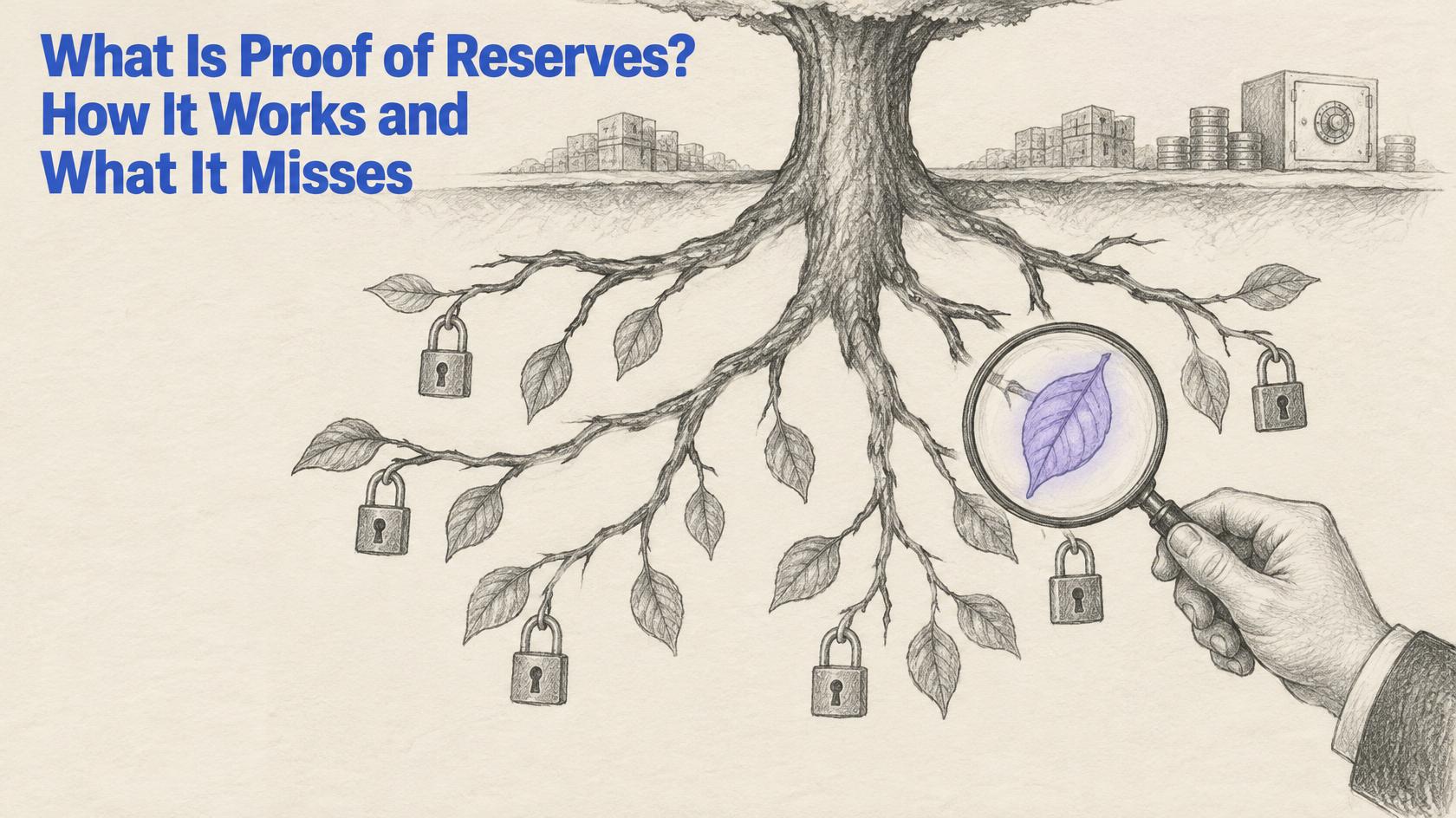
1. Proof of liabilities. The exchange takes a snapshot of every customer balance, hashes each one and combines them pairwise into a Merkle tree, a data structure that reduces millions of balances to a single fingerprint called the Merkle root. The exchange publishes the root. Each customer can then check that their own balance was included, using a short Merkle proof, without seeing anyone else's data.
2. Proof of assets. The exchange shows it controls wallets holding at least the total in the tree, usually by signing messages with those wallets' keys or publishing the addresses so anyone can check balances onchain.
Comparing the two gives a reserve ratio: assets divided by liabilities, ideally at or above 100%.
Zero-knowledge proofs close a loophole in basic Merkle trees. Without them, an exchange could insert fake negative balances to shrink its apparent liabilities. A zk-proof proves every balance is non-negative and the total is correct without revealing individual balances. Vitalik Buterin proposed this approach in November 2022, and Binance added zk-SNARKs to its PoR in February 2023; OKX uses zk-STARKs.
Proof of reserves in practice
Within days of FTX's bankruptcy, nine major exchanges announced they would publish Merkle tree reserve proofs. The methods now differ in meaningful ways:
| Exchange | Method | Verifier |
|---|---|---|
| Binance | Merkle tree plus zk-SNARKs | Self-published, open-source code |
| OKX | Merkle tree plus zk-STARKs | Hacken |
| Kraken | Merkle tree plus independent attestation | Independent accounting firm |
| Bybit | Merkle tree | Hacken |
| Bitget | Merkle tree with public wallets | Self-published |
Sources: Spark exchange PoR tracker, Spark research on PoR standards.
The accounting profession has been cautious. Accounting firm Mazars paused, in December 2022, its proof-of-reserves work for crypto clients, which is why several exchanges moved to self-published or security-firm verification instead of auditor sign-off.
For stablecoins, proof of reserves looks different. Issuers do not need a Merkle tree, because token supply is already public onchain. The question is whether reserve assets match it, which is answered by accountant attestations. Circle publishes monthly attestations for USDC; in February 2026, it reported $74.9 billion in reserves against $74.6 billion in circulation. Tether publishes quarterly attestations, covered in our Tether reserves breakdown.
This is becoming law. The US GENIUS Act requires permitted stablecoin issuers to publish monthly reserve reports examined by a registered public accounting firm, with those obligations expected to apply from 2027. The EU's MiCA imposes similar reserve disclosure rules on e-money token issuers.
Real-time PoR is the next step. Oracle networks such as Chainlink publish reserve data onchain continuously, so smart contracts can react automatically. Chainlink's Secure Mint, for example, can block new tokens from being minted unless reserves cover them.
Trade-offs and limitations
The framing I keep coming back to: proof of reserves proves half a balance sheet, once. Its main gaps:
- Liabilities beyond customer balances. Loans, legal claims and other debts are not in the Merkle tree.
- Point-in-time snapshots. Assets can be borrowed for the snapshot and returned afterward.
- Ownership versus control. Signing with a wallet proves control, not that the assets are unencumbered.
- Scope. Reports may cover only some tokens, or exclude certain account types.
- Verifier independence. Self-published proofs depend on trusting the exchange's own process.
A proof of reserves is useful evidence, not a guarantee. A reserve shortfall is also one of the classic early signals of a stablecoin depeg.
How to check a proof of reserves
- Find the latest report date. Monthly is the norm; stale reports are a warning sign.
- Verify your own balance using the exchange's Merkle proof tool.
- Check the reserve ratio for each asset you hold, not just the overall figure.
- See who verified it and what they actually examined.
- Look for zk-proofs or independent attestation rather than self-reporting alone.
FAQs
What does proof of reserves mean?
Proof of reserves means a crypto platform demonstrating that it holds enough assets to cover its customers' balances. Exchanges usually publish a cryptographic snapshot of customer balances and evidence of the wallets they control. It shows reserves at one point in time but does not prove the company has no other debts.
Is proof of reserves an audit?
No. Proof of reserves is a narrow check that compares customer balances with assets held at one moment. A financial statement audit examines the full balance sheet, including all liabilities, internal controls and accounting policies. Many PoR reports are self-published or verified by security firms rather than accountants.
Can proof of reserves be faked?
It can be gamed. Basic Merkle tree proofs can hide liabilities through fake negative balances, which zero-knowledge proofs are designed to prevent. Exchanges can also borrow assets temporarily for the snapshot. Frequent reports, zk-proofs and independent verification make manipulation harder but not impossible.
Did FTX have proof of reserves?
No. FTX did not publish proof of reserves before it collapsed in November 2022, and it was later found to have used customer funds. Its failure is why most major exchanges, starting with nine in the following days, began publishing Merkle tree reserve proofs.
Do stablecoins publish proof of reserves?
Major stablecoin issuers publish reserve attestations rather than Merkle tree proofs, because token supply is already visible onchain. Circle publishes monthly attestations for USDC, and Tether publishes quarterly attestations for USDT. The US GENIUS Act will require monthly reserve reports examined by a registered accounting firm.
How often should an exchange publish proof of reserves?
Monthly is the common standard among major exchanges in 2026, and some publish more often. Less frequent reports leave longer windows in which reserves could change unnoticed. Real-time oracle feeds, already used for some stablecoins and wrapped tokens, update reserves continuously.
The takeaway
Proof of reserves turned "trust us" into "check us," but only for the asset side of the ledger and only at the moment of the snapshot. The open question is whether real-time onchain reserve feeds and mandatory monthly attestations close those gaps, or whether full audits remain the only real test of a platform's solvency.