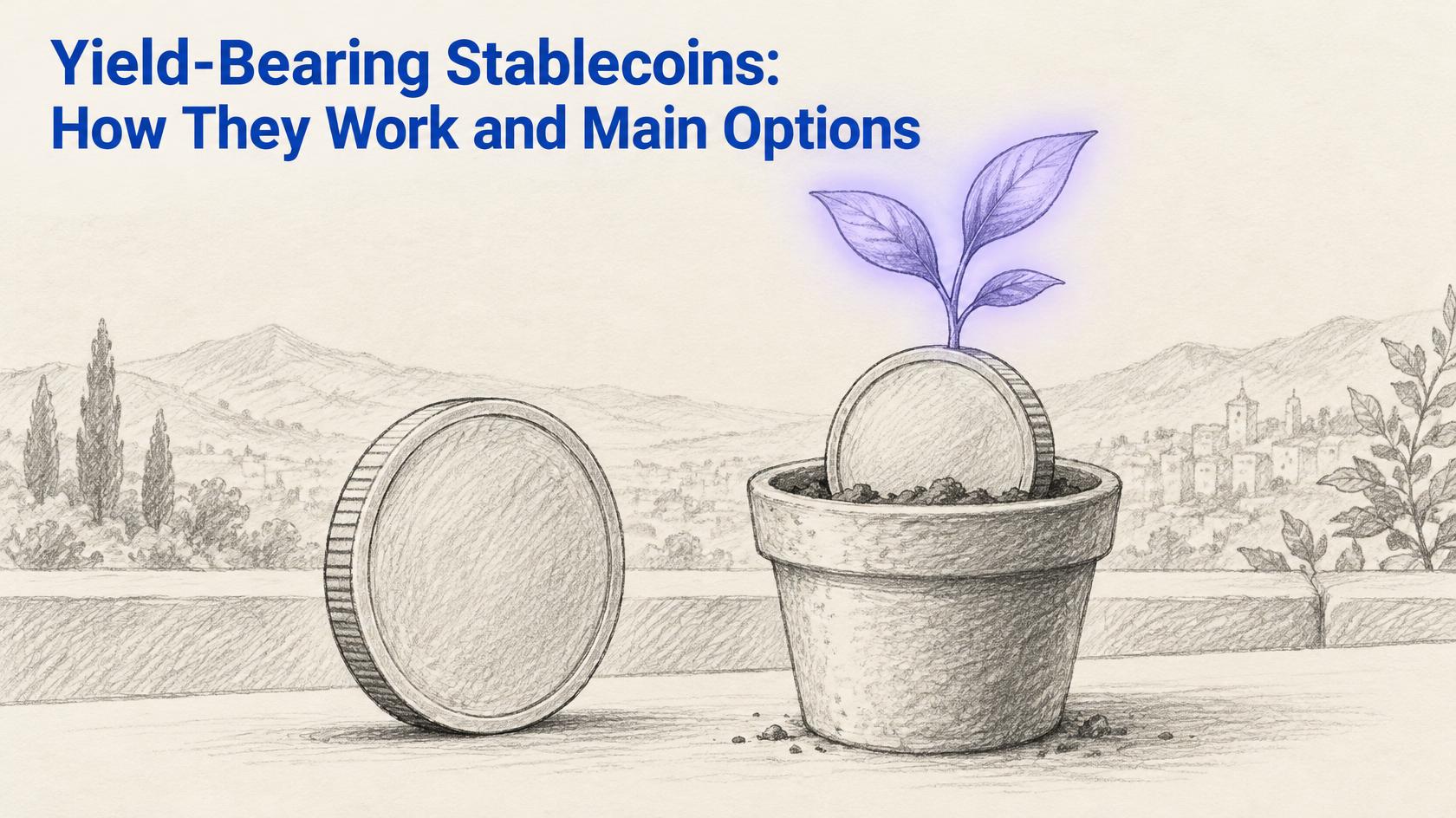
Yield-Bearing Stablecoins: How They Work and Main Options
Last updated: October 12, 2026
TL;DR
A yield-bearing stablecoin is a dollar-linked token that passes a return to the holder automatically, either by rising in value or by increasing the holder's balance. The yield comes from Treasuries, onchain lending, private credit or crypto derivatives trades. The category held about $16.4 billion across 99 tokens in September 2026, led by Sky's sUSDS. Most are structured to sit outside the US GENIUS Act's ban on issuer-paid interest.
Yield-bearing stablecoins: definition and positioning
A regular payment stablecoin like USDC or USDT pays nothing to holders; the issuer keeps the interest earned on reserves. A yield-bearing stablecoin passes some of that return through. This guide covers the tokens themselves. For where stablecoin yield comes from in general, including lending and liquidity pools, see our stablecoin yield explainer.
There are two delivery mechanisms:
| Value-accruing | Rebasing | |
|---|---|---|
| How yield shows up | Each token is worth more over time | Your token balance increases |
| Price | Trades above $1 and rises | Stays near $1 |
| Examples | sUSDS, sUSDe, syrupUSDC | Some tokenized Treasury and savings tokens |
| Why it matters | Easier to integrate as DeFi collateral | Simpler for users who expect $1 per token |
The distinction that matters most: a yield-bearing stablecoin is not quite a stablecoin. It is closer to a share in a cash or credit strategy that happens to be denominated in dollars. That is why trackers such as Stablecoin Beat count them separately from the stablecoin total.
How yield-bearing stablecoins work
Every yield-bearing token wraps one of four yield sources:
- Treasury bills and cash. The issuer or protocol holds short-term government debt and passes through the interest.
- Onchain lending. The underlying dollars are lent to overcollateralized borrowers in DeFi.
- Private credit. Dollars are lent to institutions such as trading firms and market makers, usually against collateral.
- Derivatives basis. The protocol holds crypto and shorts the same amount in perpetual futures, earning funding payments from traders holding borrowed long positions.
The user deposits a base stablecoin, receives the yield-bearing token, and redeems later for more base stablecoins than they put in, minus any fees.
The main yield-bearing stablecoins compared
| Token | Issuer | Yield source | Size (2026) | Yield (2026) |
|---|---|---|---|---|
| sUSDS | Sky (formerly Maker) | Sky Savings Rate, funded by protocol lending and Treasury holdings | About $4.65 billion, the largest | About 3.5% |
| sUSDe | Ethena | Perpetual futures funding plus staked ETH and reserve yield | About $1.3 billion, down from about $5 billion in May | About 4.2% |
| syrupUSDC | Maple | Overcollateralized loans to institutions | Second-largest in Stablecoin Beat's tracker | Varies with credit demand |
| USDY | Ondo | Short-term Treasuries and bank deposits | Not available to US persons | Tracks Treasury yields |
| sDAI | Sky | Legacy DAI savings wrapper | Shrinking as users migrate to sUSDS | Linked to the Sky Savings Rate |
| sfrxUSD | Frax | Frax savings strategies | Smaller | Varies |
Sources: Stablecoin Beat, September 4, 2026; CoinPaprika, August 2026.
Two things stand out. First, headline yields have compressed. sUSDe paid more than 60% at launch and about 4% by 2026 as borrowing appetite in crypto markets normalized. Second, the safest products now yield less than Treasuries. The Federal Reserve raised its target range to 3.75% to 4.00% on September 16, 2026, while the Sky Savings Rate sat near 3.5%. Holders are paying for onchain convenience and composability, not earning a premium. Our stablecoin interest rates page tracks how these compare with exchange rewards and lending.
How big is the yield-bearing stablecoin market?
It depends on the definition, and the gap is enormous. Stablecoin Beat counted $16.4 billion across 99 tokens in September 2026. CoinGecko's narrower definition of natively yield-bearing tokens put the figure near $4.6 billion earlier in the year. One exchange report put it at over $300 billion by counting any stablecoin that can earn yield somewhere, which is effectively the whole market. Messari data cited by BlockEden put the March 2026 peak at $22.7 billion.
The framing I keep coming back to: the narrow figure is the honest one. Tokens that embed yield are a few percent of stablecoin supply. Yield on stablecoins is everywhere; yield in stablecoins is still a niche.
What the GENIUS Act means for yield-bearing stablecoins
Section 4(a)(11) of the GENIUS Act bars permitted payment stablecoin issuers from paying interest or yield to holders. Yield-bearing tokens are structured to sit outside that definition: sUSDe and sUSDS are not issued as permitted payment stablecoins, and USDY is offered as a security to non-US investors. The result is a two-tier market, with plain stablecoins for payments and separate wrappers or securities for yield. The fight over whether exchanges can pay rewards on payment stablecoins was a central reason the CLARITY Act stalled in the Senate.
Risks of yield-bearing stablecoins
- Smart contract risk. The wrapper or underlying protocol can be exploited.
- Funding rate risk. Basis strategies like sUSDe earn less, or lose, when funding turns negative.
- Credit risk. Private credit and lending products depend on borrowers repaying. Elixir's deUSD collapsed to about two cents in November 2025 after its backing was lent to a failed counterparty, as our depeg guide covers.
- Liquidity and exit risk. Redemptions can involve cooldown periods, and secondary prices can slip during stress.
- Regulatory risk. Products can be restricted by jurisdiction, and US persons are excluded from several.
FAQs
What are yield-bearing stablecoins?
Yield-bearing stablecoins are dollar-linked tokens that pay holders a return automatically, either by rising in value or by increasing the holder's token balance. The yield comes from Treasury bills, onchain lending, private credit or crypto derivatives trades. Examples include Sky's sUSDS, Ethena's sUSDe, Maple's syrupUSDC and Ondo's USDY.
What is the largest yield-bearing stablecoin?
Sky's sUSDS is the largest yield-bearing stablecoin, at about $4.65 billion in September 2026 according to Stablecoin Beat. It earns the Sky Savings Rate, funded by the Sky protocol's lending and Treasury holdings. Ethena's sUSDe was larger in early 2026 but contracted to about $1.3 billion by late August.
Are yield-bearing stablecoins safe?
They carry more risk than plain fiat-backed stablecoins. Beyond the base stablecoin's risk, holders take on smart contract risk and the risk of the yield strategy itself, such as negative funding rates for sUSDe or borrower defaults for private credit tokens. Treasury-backed products sit at the lower end of that range.
Is a yield-bearing stablecoin the same as a stablecoin?
Not exactly. A payment stablecoin is designed to hold $1 and pay nothing. A yield-bearing stablecoin usually trades above $1 and rises as yield accrues, making it closer to a tokenized savings or fund share. Data trackers increasingly count the two categories separately for that reason.
Does the GENIUS Act ban yield-bearing stablecoins?
The GENIUS Act bars issuers of permitted payment stablecoins from paying interest or yield to holders. It does not ban every yield-bearing token. Products like sUSDe and sUSDS are not issued as permitted payment stablecoins, and USDY is offered as a security to non-US investors, so they fall outside the ban.
How do yield-bearing stablecoins compare with savings accounts?
Bank savings accounts carry deposit insurance up to legal limits; yield-bearing stablecoins do not. Yields are now similar or lower: the Sky Savings Rate was about 3.5% in 2026, below the Federal Reserve's policy rate. The advantages of the onchain versions are 24/7 transferability and use as collateral in decentralized finance.
The takeaway
Yield-bearing stablecoins turn idle onchain dollars into productive ones, but the category is smaller than headlines suggest and its safest products now pay less than the Treasury rate. The open question is whether regulated issuers find a compliant way to share reserve income, or whether yield stays in wrappers and securities that sit beside the payment stablecoins most people actually use.