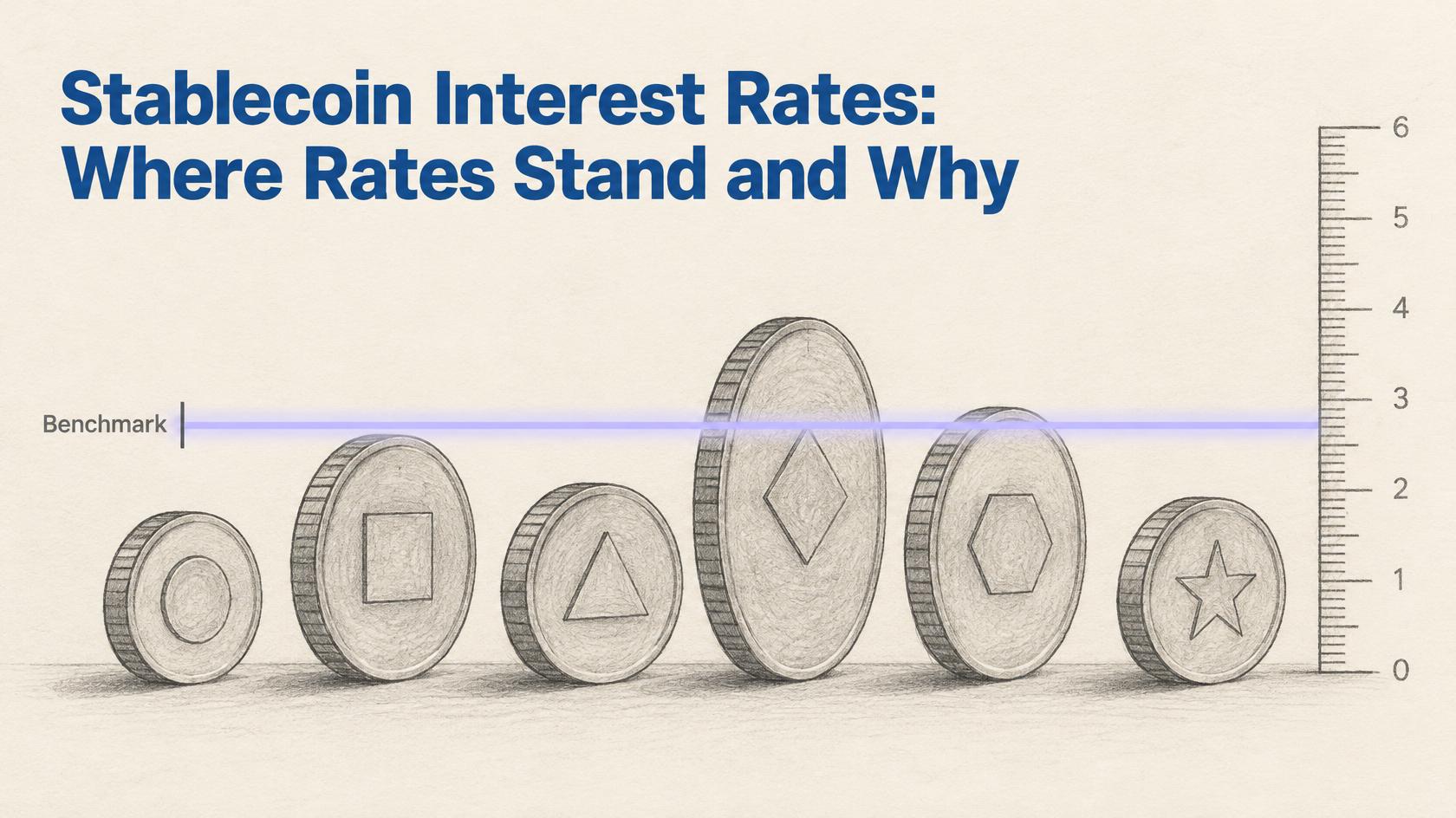
Stablecoin Interest Rates: Where Rates Stand and Why
Last updated: October 12, 2026. Rates change daily; verify on each platform before depositing.
TL;DR
Stablecoin interest rates in 2026 cluster around 3.5% to 4% for mainstream options: Coinbase pays 3.5% on USDC for Coinbase One members, Aave's USDC lending rate sat near 3.6% in September 2026, and the Sky Savings Rate was about 3.5%. Those rates track the US Federal Reserve, which raised its target range to 3.75% to 4.00% on September 16, 2026. Offers far above that range carry extra risk.
Where stablecoin interest rates stand
The table below compares the main ways to earn on a dollar stablecoin, using the latest dated figures available. For how each yield source works in depth, see our stablecoin yield explainer.
| Venue | Type | Rate | Date | Main risk |
|---|---|---|---|---|
| Coinbase USDC rewards | Custodial exchange reward | 3.50% (Coinbase One members) | September 2026 | Platform custody and terms changes |
| Aave v3 USDC, Ethereum | DeFi lending | 3.57% | September 15, 2026 | Smart contract and borrowing demand |
| Aave v3 USDC, Base | DeFi lending | 3.65% | September 15, 2026 | Smart contract and borrowing demand |
| Sky Savings Rate (sUSDS) | Protocol savings rate | About 3.5% | August 2026 | Protocol and governance |
| Ethena sUSDe | Derivatives basis | About 4.2% | August 2026 | Funding rate turning negative |
| Tokenized Treasury funds | Pass-through T-bill yield | Tracks short-term Treasury rates | Ongoing | Eligibility limits and fund structure |
| US federal funds target | Benchmark | 3.75% to 4.00% | Set September 16, 2026 | None (benchmark) |
Sources: DefiLlama data compiled by Eco, September 15, 2026; CoinPaprika, August 2026; Federal Reserve decision of September 16, 2026.
The framing I keep coming back to: the mainstream stablecoin rate is now the Fed rate minus a convenience discount. Holders accept a little less than Treasuries in exchange for 24/7 access, instant transfer and onchain use.
What drives stablecoin interest rates
1. The Federal Reserve. Fiat-backed stablecoin reserves sit in Treasury bills and cash, so issuer income rises and falls with the policy rate. Exchange rewards are funded from that income, and DeFi rates are anchored by it, because few lenders accept less onchain than they could earn in T-bills.
2. Borrowing demand. DeFi lending rates are set by how much of the deposited stablecoins is currently borrowed. Demand rises when traders want to borrow for bigger positions, so rates spike in bull markets and compress in quiet ones. Aave's USDC rate was about 2.6% in April 2026, below conventional cash management accounts at the time, before rising to about 3.6% by September.
3. Funding rates. Basis strategies like Ethena's earn the premium traders pay to hold borrowed long perpetual futures positions. That premium can disappear or turn negative.
4. Incentives. Some advertised rates include token rewards that are temporary and paid in volatile assets. Strip them out to see the sustainable rate.
5. Regulation. The US GENIUS Act bars stablecoin issuers from paying interest to holders, which is why yield reaches users through exchange rewards, DeFi protocols and separate wrapper tokens instead of from the issuer directly.
How to read an advertised stablecoin rate
- Check APY versus APR. APY includes compounding; APR does not. Compare like with like.
- Separate base rate from incentives. A 12% headline might be 3.5% base plus 8.5% in a token that can fall in value.
- Find the source of yield. If the platform cannot say where the return comes from, treat it as a warning sign.
- Check custody. Custodial rewards depend on the platform staying solvent; self-custody DeFi depends on code.
- Look for caps and conditions. Membership requirements, balance tiers, lockups and regional restrictions all change the real rate.
Offers far above the benchmark, such as 15% to 30% on USDC, usually involve lockups, lending to riskier borrowers, borrowed exposure or token incentives. They are not free money. Our guide to yield-bearing stablecoins covers the higher-risk end of the market.
Why stablecoin rates are a political issue
Who gets to pay stablecoin holders a return is one of the most contested questions in US crypto policy. Banks argue that exchange rewards on stablecoins compete directly with deposits and could reduce lending. Exchanges argue rewards are a legitimate customer benefit funded by their own revenue. The dispute over this question, centered on stablecoin rewards provisions, was a major reason the CLARITY Act stalled in the Senate in September 2026. The outcome will decide whether rates like Coinbase's 3.5% remain available to US users.
Stablecoin interest rates vs savings accounts
Mainstream stablecoin rates and high-yield savings accounts now sit in a similar range. The trade-off is structural: savings accounts carry deposit insurance up to legal limits; stablecoin rewards and DeFi deposits do not. Stablecoins, in return, move at any hour, settle globally and can be used as collateral onchain. For idle cash with no need for those features, an insured account remains the lower-risk option.
FAQs
What is the current interest rate on stablecoins?
Mainstream stablecoin rates were about 3.5% to 4% in late 2026. Coinbase paid 3.5% on USDC for Coinbase One members, Aave's USDC lending rate was about 3.6% in September 2026, and the Sky Savings Rate was about 3.5%. Rates move with the Federal Reserve's policy rate and with borrowing demand.
Where do stablecoin interest rates come from?
They come from what is done with the dollars. Issuers earn interest on reserve Treasuries and some platforms share it as rewards. DeFi lenders earn interest paid by borrowers. Basis strategies earn funding paid by traders holding borrowed positions. Tokenized Treasury funds pass through government bond yields directly.
Are stablecoin interest rates going up or down?
They follow US interest rates and crypto borrowing demand. The Federal Reserve raised its target range to 3.75% to 4.00% in September 2026, which supports reserve-funded rewards. DeFi lending rates rose from about 2.6% in April 2026 to about 3.6% in September as borrowing demand recovered.
Why are some stablecoin interest rates so high?
Rates far above the Federal Reserve's policy rate usually come from added risk: lending to less creditworthy borrowers, borrowed exposure, lockups, or temporary token incentives paid in volatile assets. Before depositing, identify where the yield comes from and how much of the headline rate is a sustainable base rate.
Do you pay taxes on stablecoin interest?
Rewards and interest earned on stablecoins are generally treated as taxable income when received in most jurisdictions, including the US. Treatment varies by country and by product structure, such as whether a token's value rises instead of paying out. This is not tax advice; confirm with a qualified tax professional.
The takeaway
Mainstream stablecoin interest rates now track the Fed closely, landing just below the policy rate, which means anything well above that range is a bet on risk, not a better deal. The open question is regulatory: whether US rules preserve platform rewards or push yield entirely into DeFi and wrapper tokens.