TL;DR
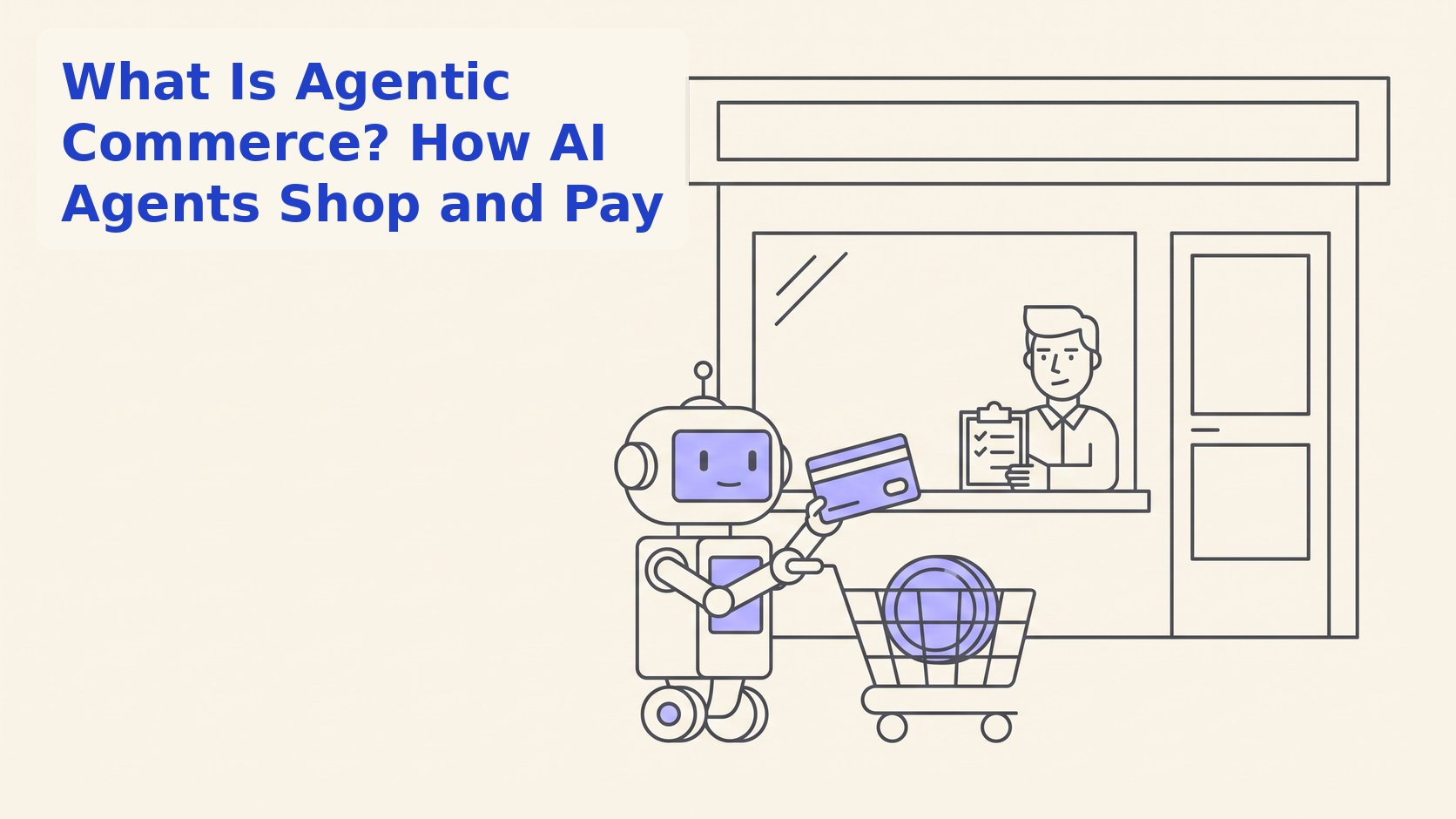
Agentic commerce is shopping and payments carried out by AI agents on a person's or company's behalf: finding products, comparing options, checking out, and paying, with the human setting goals and limits rather than clicking through every step. It runs on a new stack of open protocols, including OpenAI and Stripe's ACP, Google's AP2 and UCP, Visa and Mastercard agent programs, and the x402 standard for stablecoin payments.
Agentic commerce: definition and positioning
Ecommerce assumes a human at a screen. Agentic commerce assumes software that acts. An agent might reorder office supplies when stock runs low, book the cheapest refundable flight within a budget, or pay per request for the data it needs to finish a task.
It differs from earlier automation in two ways. The agent decides among options rather than following a fixed rule, and it transacts across many merchants it has never seen before. That creates three problems traditional payments were not designed for: proving the human authorized the purchase, letting merchants trust an agent, and paying in amounts too small or too frequent for cards.
The useful framing: agentic commerce is not one protocol but a stack, with discovery, checkout, authorization, and payment handled at different layers.
How agentic commerce works
- Intent and limits. The user sets a goal and constraints, such as a budget, approved merchants, or a spending cap.
- Discovery. The agent finds and compares products through merchant catalogs and feeds exposed in agent-readable formats.
- Checkout. The agent builds a cart and completes checkout through a protocol the merchant supports.
- Authorization. Cryptographic proof shows the human approved this purchase, within these limits.
- Payment. Funds move over card networks using tokens scoped to the agent, or over stablecoin rails for machine-to-machine payments.
The agentic commerce protocol stack
| Protocol or program | Backers | Launched | Layer |
|---|---|---|---|
| MCP (Model Context Protocol) | Anthropic, donated to the Linux Foundation's Agentic AI Foundation in December 2025 | 2024 | Connects agents to tools and data |
| ACP (Agentic Commerce Protocol) | OpenAI and Stripe | September 2025 | Agent checkout with merchants |
| AP2 (Agent Payments Protocol) | Google, donated to the FIDO Alliance in April 2026 | September 2025 | Signed mandates proving user authorization |
| UCP (Universal Commerce Protocol) | Google and Shopify, with major retailers | January 2026 | Full shopping journey, discovery to post-purchase |
| Mastercard Agent Pay | Mastercard | April 2025 | Tokenized agent credentials on cards |
| Visa Intelligent Commerce and Trusted Agent Protocol | Visa | 2025 | Agent identity and card payments |
| Stripe MPP (Machine Payments Protocol) | Stripe and Tempo | March 2026 | Machine payments for Stripe merchants |
| x402 | x402 Foundation (Linux Foundation), created by Coinbase | May 2025 | Stablecoin micropayments over HTTP |
Agentic commerce in practice
Consumer shopping. ChatGPT Instant Checkout launched with ACP in September 2025 and was shut down in March 2026, while the protocol itself continues. The episode is a useful lesson: the checkout experience is still being worked out, but the underlying standards keep moving.
Card networks. Mastercard and Visa have moved fastest among incumbents, issuing agent-scoped tokens so merchants can see that a transaction comes from a verified agent acting within a user's permissions. Both have reported live agentic transactions in multiple markets in 2026.
Machine-to-machine payments. Agents paying for APIs, data, and compute in fractions of a cent cannot use card rails economically. This is where stablecoins fit: x402 lets an agent pay in USDC per request, and Stripe's MPP supports stablecoins alongside cards.
Business procurement. Agents that reorder supplies or pay vendors need spending limits, approvals, and audit trails, which is why authorization layers such as AP2 matter as much as payment rails. For the tools businesses use to connect agents to payments, see our guide to the best MCP servers for payments.
Why stablecoins matter for agentic commerce
Stablecoins solve three problems for agents: they settle in seconds around the clock, they make sub-cent payments economical, and an agent can hold them in its own wallet without a bank account. Card rails remain better for consumer purchases with refunds and buyer protection. Most likely, both coexist: cards for people buying through agents, stablecoins for agents buying from machines. For wallets built for agents, see our guide to the best agentic wallets.
Trade-offs and limitations
Fragmented standards. Several overlapping protocols compete, and merchants cannot support all of them yet.
Trust and liability. When an agent buys the wrong thing, who pays? Dispute rules for agent purchases are still forming.
Fraud. Agent impersonation and prompt injection create new attack paths, which is why agent identity programs exist.
Early adoption. Volumes are growing but small compared with ecommerce, and some headline numbers include speculative activity.
FAQs
What is agentic commerce?
Agentic commerce is buying and paying done by AI agents on behalf of people or businesses. The human sets goals and limits; the agent discovers products, checks out, and pays using protocols designed for agents.
What protocols power agentic commerce?
Key protocols include MCP for connecting agents to tools, ACP from OpenAI and Stripe for checkout, Google's AP2 for authorization and UCP for the shopping journey, Visa and Mastercard agent programs for card payments, and x402 for stablecoin payments.
How do AI agents pay?
Through card tokens scoped to the agent and a specific purchase, or through stablecoins such as USDC held in agent wallets. Cards suit consumer purchases; stablecoins suit frequent, small machine-to-machine payments.
Is agentic commerce safe?
It can be when agents operate within strict spending limits, use scoped payment credentials, and require human approval for large or unusual purchases. Authorization standards such as AP2 exist to prove what the user approved.
Last updated: October 26, 2026.