TL;DR
x402 is an open payment protocol that uses the HTTP 402 "Payment Required" status code to let software, including AI agents, pay for APIs and content instantly in stablecoins, usually USDC, with no account, card, or subscription. Coinbase launched it in May 2025, and since July 2026 it has been governed by the x402 Foundation under the Linux Foundation, with more than 40 members including Visa, Mastercard, Stripe, Google, AWS, and Circle.
x402: definition and positioning
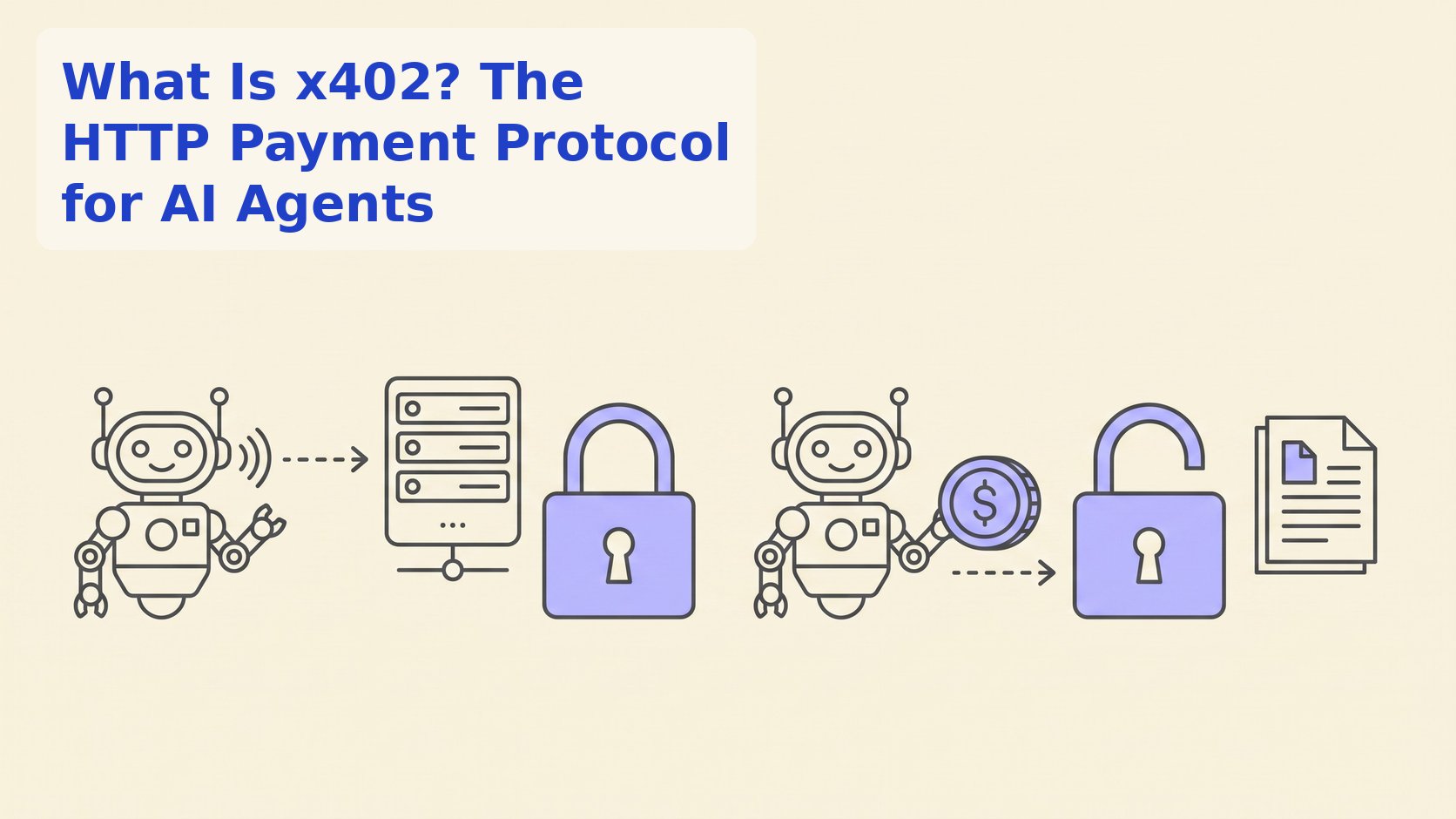
HTTP, the protocol behind every web page, reserved status code 402 "Payment Required" in the 1990s but never defined how to use it. x402 fills that gap. When a client requests a paid resource, the server answers 402 with payment instructions; the client pays and retries; the server delivers.
That makes x402 a payment layer for machines. A human checkout assumes a person filling in card details, accounts, and minimum charges. An AI agent calling hundreds of APIs needs something else: payments of fractions of a cent, settled instantly, with no sign-up. x402 does that by settling in stablecoins onchain.
x402 is not a payment processor, a wallet, or a blockchain. It is a standard that different companies implement: Coinbase, Cloudflare, Circle, and others each provide parts of the stack.
How x402 works
- Request. A client, often an AI agent, requests a resource: an API call, a dataset, an article, or a tool.
- 402 response. The server replies with HTTP 402 and machine-readable payment terms: amount, accepted token (typically USDC), network, and where to pay.
- Payment. The client signs a stablecoin payment from its wallet and resends the request with the payment attached in a header.
- Verification and settlement. A facilitator verifies the payment and settles it onchain, so the seller does not need to run blockchain infrastructure.
- Delivery. The server returns the resource with a 200 response. On fast networks the round trip takes seconds.
Facilitators are the key operational piece. Coinbase runs the reference facilitator through its Developer Platform, with 1,000 free transactions a month and $0.001 per transaction after that. One third-party tracker counted 18 active facilitators across seven chains by mid-July 2026, up from essentially one at launch. Base and Solana carry most activity; the protocol itself charges no fee.
x402 in practice
Paid APIs and data. Developers charge per request instead of selling subscriptions. An agent can buy one weather lookup, one search result, or one model inference.
Content and crawlers. Cloudflare built x402 support into its Workers platform, so sites can charge AI crawlers and agents per page rather than blocking them.
Paid MCP tools. Developers wrap MCP servers, the tools AI assistants call, behind x402 so each tool call can carry a payment. See our guide to the best MCP servers for payments.
Agent-to-agent payments. Google's Agent Payments Protocol (AP2) includes an x402 extension for crypto settlement between agents.
Adoption, read carefully. Chainalysis counted over 100 million cumulative x402 transactions on Base through the first quarter of 2026, but noted that much of the late-2025 surge was meme coin activity rather than agents buying services. Volume figures vary widely by tracker, so treat headline numbers as directional.
x402 vs other agent payment protocols
| Protocol | Backer | Settles in | Best for |
|---|---|---|---|
| x402 | x402 Foundation (Linux Foundation), created by Coinbase | Stablecoins onchain | Micropayments for APIs, content, and tools |
| Stripe MPP (Machine Payments Protocol) | Stripe and Tempo, launched March 2026 | Cards, Stripe tokens, stablecoins | Merchants already on Stripe |
| ACP (Agentic Commerce Protocol) | OpenAI and Stripe | Card rails via Shared Payment Tokens | Agent checkout with retailers |
| AP2 (Agent Payments Protocol) | Google, now FIDO Alliance | Any rail, with signed authorization mandates | Proving who authorized an agent purchase |
These protocols mostly sit at different layers and can work together. For the full picture, see our guide to agentic commerce.
Trade-offs and limitations
Stablecoin dependency. Buyers need a funded crypto wallet, which most consumers and many businesses still do not have.
Facilitator concentration. The protocol is open, but most early volume flows through Coinbase's facilitator.
Identity and compliance. By design, x402 asks nothing about who the payer is. That suits micropayments but leaves KYC, fraud, and refunds to other layers.
No chargebacks. Onchain payments are final, which protects sellers but removes the buyer protections card networks offer.
Noisy metrics. Adoption numbers mix genuine agent payments with speculative activity.
FAQs
What is x402 in simple terms?
x402 is a way for software to pay for things on the internet automatically. A server says "payment required" using the HTTP 402 code, the client pays in a stablecoin such as USDC, and the server delivers the content or API response within seconds.
Who created x402?
Coinbase created x402 and launched it in May 2025. Coinbase and Cloudflare announced a foundation for it in September 2025, and in 2026 the protocol moved to the x402 Foundation under the Linux Foundation, which became operational in July 2026.
Does x402 charge fees?
The protocol itself charges no fee. Facilitators may: Coinbase's facilitator includes 1,000 free transactions a month, then $0.001 per transaction. Blockchain network fees on Base and Solana are typically fractions of a cent.
Is x402 only for crypto?
x402 settles in stablecoins onchain, most commonly USDC. Buyers do not need to hold volatile crypto, but they do need a wallet funded with a supported stablecoin.
How is x402 different from Stripe's Machine Payments Protocol?
x402 is an open, foundation-governed standard settling in stablecoins. Stripe's Machine Payments Protocol, launched in March 2026 with Tempo, is designed for merchants on Stripe and supports card and token payments as well as stablecoins.
Last updated: October 26, 2026.