Best Agentic Wallets for Crypto DeFi: Top Options Compared
Best Agentic Wallets for Crypto DeFi: Top Options Compared
TL;DR
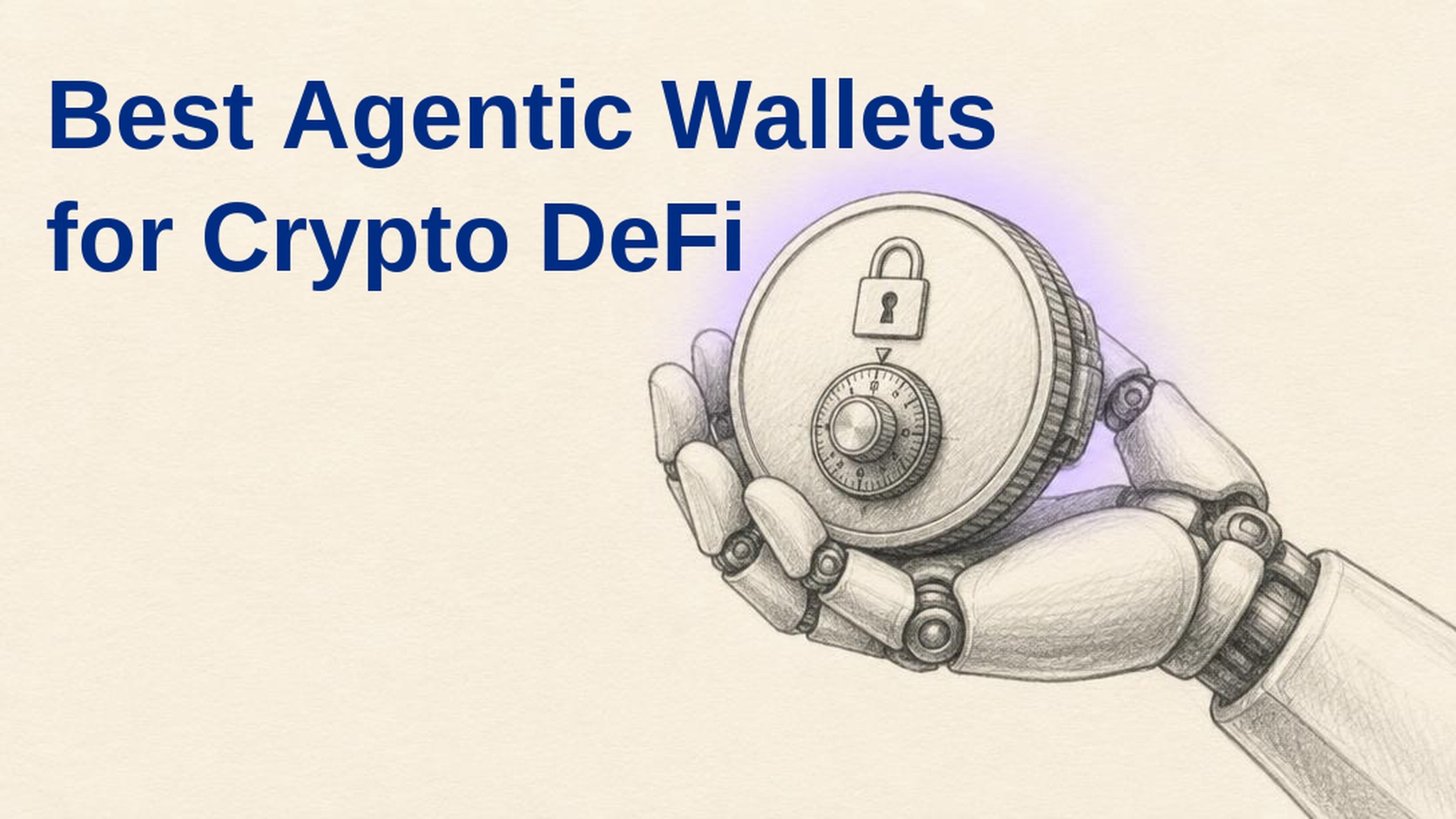
Best for on-chain, independently verifiable policy enforcement is Safe, using programmable modules for spending limits, delay conditions, and role-based access control enforced by the smart contract itself, not a provider's off-chain API. Best for developers wanting a single wallet primitive to plug into many agent frameworks is Coinbase AgentKit, supporting EVM chains and Solana with LangChain, Eliza, and Vercel AI SDK integration out of the box. Best for MPC-based security without on-chain gas overhead is Cobo Agentic Wallet. Best for combining DeFi automation with real-world fiat payment rails, letting an agent pay cloud bills or vendor invoices alongside on-chain trades, is GOAT. This is a different layer than a complete agent product like the ones compared in Best DeFi AI Agents, an agentic wallet is the underlying primitive a developer builds an agent on top of, not a finished consumer product.
What actually matters when choosing an agentic wallet
Where the policy is enforced. A spending limit or protocol whitelist can be enforced on-chain, encoded directly into a smart account or session key and independently verifiable by anyone, or off-chain, checked by the provider's API before it agrees to sign. On-chain enforcement is harder to bypass even if the provider's own infrastructure is compromised; off-chain enforcement is typically faster and cheaper to set up.
What happens when the agent is wrong. The core risk this whole category exists to solve: a traditional wallet uses a single private key, so a compromised or hallucinating agent has no barrier between "decided to act" and "funds moved." A genuine agentic wallet needs a real circuit breaker, a spending cap, a protocol whitelist, a human-approval step for anything outside pre-set bounds, not just a UI warning.
Framework and chain support. Confirm which agent frameworks, LangChain, Eliza, Vercel AI SDK, MCP, OpenAI Agents SDK, a wallet actually integrates with, and which chains, since EVM-only and Solana-only wallets are both common and neither covers everything.
Payment rails beyond pure crypto. Some wallets speak only stablecoin and crypto rails. Others, GOAT specifically, bridge to fiat payment rails as well, letting an agent handle a real-world expense like a cloud bill alongside an on-chain trade.
Quick comparison table
| Wallet | Policy enforcement | Frameworks | Chains | Best for |
|---|---|---|---|---|
| Safe | On-chain, via programmable modules (spending limits, delay modules, role-based access) | Framework-agnostic, agent proposes, Safe's modules verify | Ethereum, Polygon, Optimism, Arbitrum, and more | On-chain, independently verifiable policy enforcement |
| Coinbase AgentKit | Off-chain by default, no built-in spending limits until added at the application layer | LangChain, Eliza, Vercel AI SDK, OpenAI Agents SDK | Base and other EVM chains, plus Solana | Developers wanting one wallet primitive across many frameworks |
| Cobo Agentic Wallet | MPC-based, policy and spending limits enforced via Cobo's infrastructure | [more information required: confirm current framework integration list] | Multi-chain | MPC-based security without on-chain gas overhead |
| GOAT | Policy enforced at the framework/application layer, compatible with CDP, Lit Protocol, and custom key management | Vercel AI, LangChain, LlamaIndex, MCP, OpenAI (5 frameworks) | 30+ chains | Combining DeFi automation with fiat payment rails in one agent |
Top options compared
Safe is the strongest pick for anyone who wants policy enforcement that doesn't depend on trusting a provider's off-chain infrastructure. Its programmable modules add spending limits, delay conditions, and role-based access control directly on-chain, and in practice this can mean an agent proposing a transaction, a "Guard" module verifying a condition, like a destination protocol's safety score, before execution, and the transaction being blocked outright if the check fails, all enforced by the contract itself rather than a server that could be compromised or simply go down. Where it breaks: on-chain enforcement means every logic check happens on-chain too, which costs more in gas than an off-chain MPC-based alternative, a real trade-off for high-frequency agent activity.
Coinbase AgentKit is the right choice for a developer who wants one wallet primitive that plugs into whichever agent framework they're already using, provisioning CDP smart wallets and supporting LangChain, Eliza, the Vercel AI SDK, and the OpenAI Agents SDK, across Base, other EVM chains, and Solana. Where it breaks: it ships with no built-in spending limits, that protection has to be added at the application layer by the developer, which is a meaningful responsibility to take on rather than get by default.
Cobo Agentic Wallet uses MPC (multi-party computation) to secure agent-controlled funds without the on-chain gas overhead Safe's module-based approach carries, appealing to a team that wants strong custody security with lower per-transaction cost. Where it breaks: [more information required: confirm current framework integration breadth directly, published detail on Cobo's agent-framework support is thinner than for Safe or Coinbase AgentKit].
GOAT stands out for scope rather than security architecture specifically: it works across five major agent frameworks and two programming languages, offers a library of more than 200 onchain tools, and is the only wallet compared here that bridges on-chain assets with fiat payment rails, letting an agent pay for cloud fees, API subscriptions, or vendor invoices via virtual cards alongside its DeFi activity. It isn't tied to one embedded wallet provider either, working with Coinbase's CDP, Lit Protocol, and custom key management systems. Where it breaks: this breadth comes from sitting one layer up, coordinating whichever underlying wallet and key-management system a developer chooses, rather than providing its own custody or policy-enforcement primitive the way Safe or Cobo do.
Key differences that actually matter
The decisive question is where trust sits. Safe's on-chain enforcement means the policy holds even if every off-chain system around it fails or is compromised, at the cost of gas overhead on every check. Coinbase AgentKit and Cobo both lean on off-chain or MPC-based enforcement, faster and cheaper, but ultimately trusting the provider's own infrastructure to actually apply the rules correctly. GOAT sits above this question entirely, it's a coordination layer, not a custody primitive, so its security profile inherits whatever underlying wallet a developer plugs into it.
When a narrower, security-first choice beats a broader one
A team building an agent that will move meaningful treasury value and needs the policy enforcement to survive even a compromised backend should default to Safe's on-chain model over the convenience of an off-chain alternative, despite the higher gas cost. A team building a lower-stakes, high-frequency agent, small repeated trades, frequent rebalancing, is better served by an MPC-based option like Cobo, where gas overhead on every single check would be prohibitive.
FAQs
What is an agentic wallet?
An agentic wallet is a wallet architecture that lets an AI agent execute blockchain transactions autonomously within predefined boundaries, spending limits, protocol whitelists, time windows, rather than requiring a human to click "confirm" on every action. It differs from a standard wallet in having a genuine circuit breaker built in, so a compromised or hallucinating agent can't move funds outside the bounds a human has set.
Is an agentic wallet the same thing as a DeFi AI agent?
No. An agentic wallet is the underlying primitive, the wallet infrastructure a developer builds on. A DeFi AI agent, like the products compared in our Best DeFi AI Agents roundup, is a complete, often consumer-facing product built using one or more of these wallet primitives underneath.
Is on-chain or off-chain policy enforcement safer for an agentic wallet?
On-chain enforcement, Safe's approach, means the policy is independently verifiable and holds even if the provider's own backend is compromised, at the cost of gas fees on every enforced check. Off-chain or MPC-based enforcement, used by Coinbase AgentKit and Cobo, is typically faster and cheaper but ultimately depends on trusting that provider's infrastructure to apply the rules correctly.
Can an agentic wallet pay for things outside of crypto?
Most are crypto and stablecoin-only. GOAT is the notable exception among the wallets compared here, bridging on-chain assets with fiat payment rails so an agent can pay real-world expenses like cloud fees or vendor invoices via virtual cards alongside its on-chain activity.
Last updated: September 24, 2026 Written by the stablecoin.nyc Editorial Desk