TL;DR
Fully reserved, regulated dollar stablecoins such as USDC are generally safe for holding and moving dollars, but they are not risk-free and not bank deposits. Their safety depends on what backs them, who holds the reserves, and how they are regulated. History shows the range: USDC briefly fell to $0.87 in 2023 and recovered within days, while the algorithmic TerraUSD collapsed to zero in 2022.
Stablecoin safety: what the question really means
A stablecoin is a crypto token designed to hold a steady value, usually $1. Dollar stablecoins now total about $308 billion, according to Federal Reserve Bank of New York research published in July 2026. When people ask whether stablecoins are safe, they usually mean one of four different things:
Will it stay worth $1? That is peg risk, and it depends on reserves.
Can I always redeem it for dollars? That is issuer and liquidity risk.
Can my tokens be lost or frozen? That is custody and control risk.
Is it protected like a bank account? No. Stablecoins are not covered by FDIC deposit insurance.
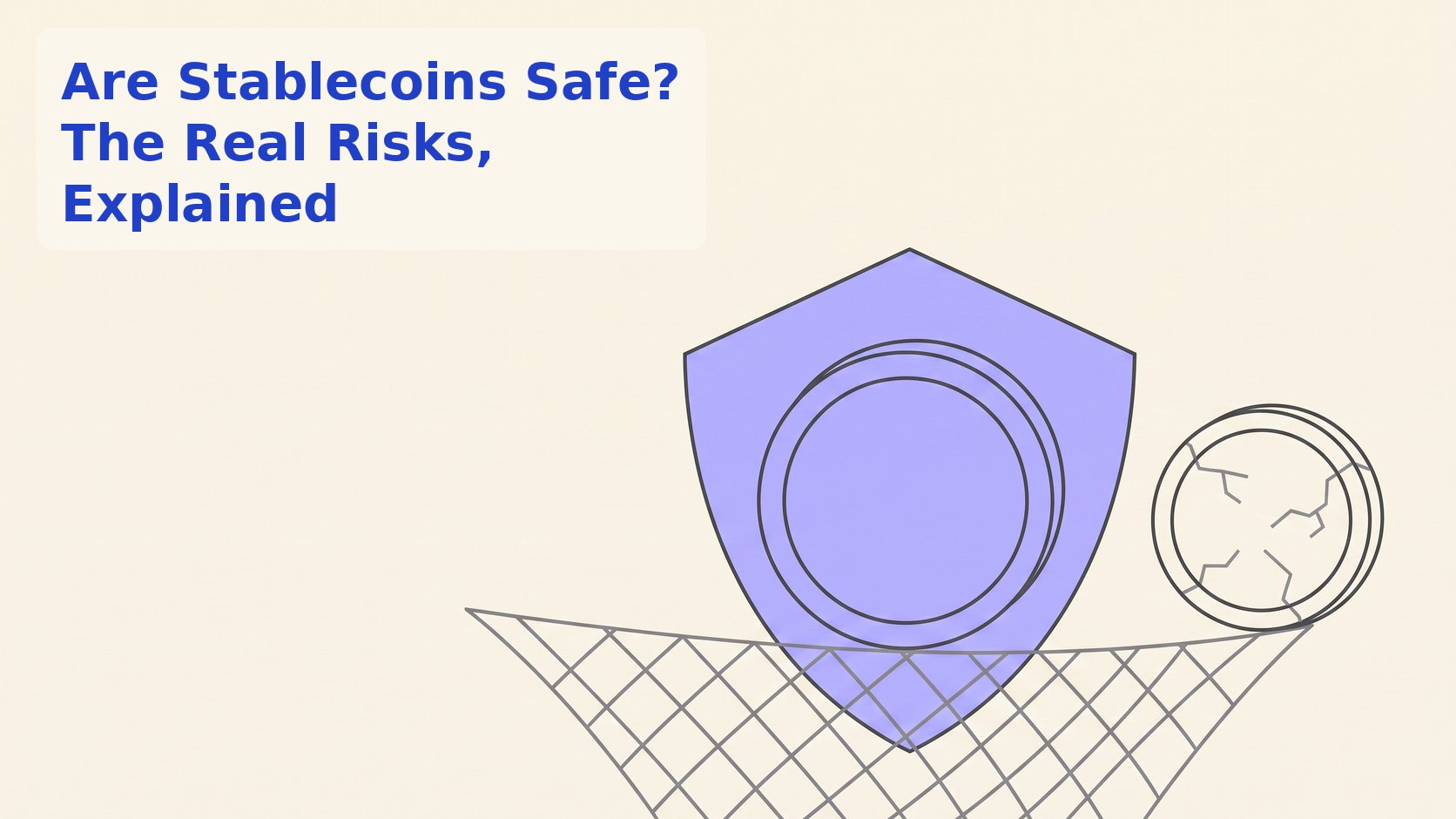
The useful framing: a stablecoin is as safe as the weakest of its issuer, its reserves, the blockchain it runs on, and the wallet or platform where you hold it.
How stablecoins keep their value
Fiat-backed stablecoins, such as USDC and USDT, hold cash, Treasury bills, and similar assets against every token. Verified customers can redeem tokens for dollars, and arbitrage keeps the market price near $1.
Crypto-backed stablecoins, such as DAI, are backed by more crypto than the stablecoins issued, held in smart contracts that liquidate collateral if prices fall.
Algorithmic stablecoins try to hold the peg through supply mechanisms rather than full reserves. This is the design that has failed most spectacularly.
Stablecoin risks in practice
Reserve and banking risk: USDC, March 2023. When Silicon Valley Bank failed, Circle disclosed that about 8% of USDC's reserves, roughly $3.3 billion, sat at the bank. USDC fell as low as $0.87 before recovering to $1 within days, once depositors were made whole. Circle afterwards moved most reserves into a dedicated government money market fund and spread bank deposits across the largest banks.
Design failure: TerraUSD, May 2022. TerraUSD (UST) was an algorithmic stablecoin paired with the LUNA token. When confidence broke, the mechanism spiralled, UST lost its peg permanently, and tens of billions of dollars of value disappeared. It is the reason most regulators now exclude algorithmic designs from "payment stablecoin" status.
Reserve composition: USDT. Tether's USDT has held its peg through many market crises, but part of its reserves sits in assets riskier than Treasury bills, such as gold, Bitcoin, and secured loans, and it publishes quarterly attestations rather than full audits. See our explainer on what USDT is and what backs it.
Freezes. Major issuers can freeze tokens at specific addresses, usually at law enforcement request. That protects victims of crime but means fiat-backed stablecoins are not censorship-resistant.
Custody and user error. Most actual losses come from exchange failures, hacks, phishing, and sending tokens on the wrong network, not from stablecoins losing their peg.
How regulation changes stablecoin safety
The GENIUS Act, signed in July 2025, created the first US federal framework for payment stablecoins. It requires issuers to be licensed, to back tokens one-for-one with cash and short-term Treasuries, and to publish regular reserve disclosures, and it gives stablecoin holders priority in an issuer insolvency. In the EU, the MiCA regulation imposes similar reserve and licensing rules.
Regulation reduces risk; it does not remove it. A fully reserved stablecoin can still face a short depeg if a reserve bank fails or if markets panic, as USDC showed in 2023.
How to judge whether a stablecoin is safe
- Check the reserves. Cash and short-term Treasuries are safest. Anything else adds risk.
- Check the reporting. Look for monthly attestations or audits from a recognized accounting firm.
- Check the regulation. Prefer issuers licensed under the GENIUS Act, MiCA, or a strong state regime.
- Check redemption. Confirm the issuer redeems at $1 and how quickly.
- Check track record. How did it behave in past stress events?
- Check where you hold it. A safe stablecoin on an unsafe platform is still at risk.
Trade-offs and limitations
Even the safest stablecoins carry risks that a bank deposit does not: no deposit insurance, possible freezes, smart contract risk on some chains, and dependence on a private issuer. In exchange, they move globally in minutes, 24/7, and can be held directly. For many uses, such as cross-border payments, dollar savings in high-inflation countries, and business settlement, that trade is worth it. For emergency savings you cannot afford to lose, a bank account with deposit insurance remains the safer home.
If you do hold stablecoins, the biggest safety upgrade is usually custody. See our guides to the best USDC wallets and what a cold wallet is.
FAQs
Are stablecoins safe to hold?
Regulated, fully reserved stablecoins such as USDC are relatively safe for holding dollars, but they are not risk-free. They are not FDIC insured, can be frozen by the issuer, and can briefly depeg in a crisis. Safety also depends on the wallet or platform holding them.
Can stablecoins lose value?
Yes. USDC briefly fell to $0.87 in March 2023 during the Silicon Valley Bank failure before recovering, and the algorithmic TerraUSD lost its peg permanently in 2022. Fiat-backed stablecoins with strong reserves have recovered from short depegs; algorithmic designs have not.
Which stablecoin is the safest?
Stablecoins backed only by cash and short-term Treasuries, with monthly attestations and federal or MiCA licensing, carry the least risk. USDC is the most widely cited example. USDT is larger but holds some riskier reserve assets.
Are stablecoins FDIC insured?
No. Stablecoins are not bank deposits and are not covered by FDIC insurance. The GENIUS Act gives holders priority claims on reserves if an issuer fails, which is a different and weaker protection than deposit insurance.
Is it safe to keep stablecoins on an exchange?
It depends on the exchange. Regulated exchanges are generally reliable, but exchange failures have caused major losses in the past. For larger or long-term balances, a self-custody wallet removes that counterparty risk.
Last updated: October 26, 2026.