TL;DR
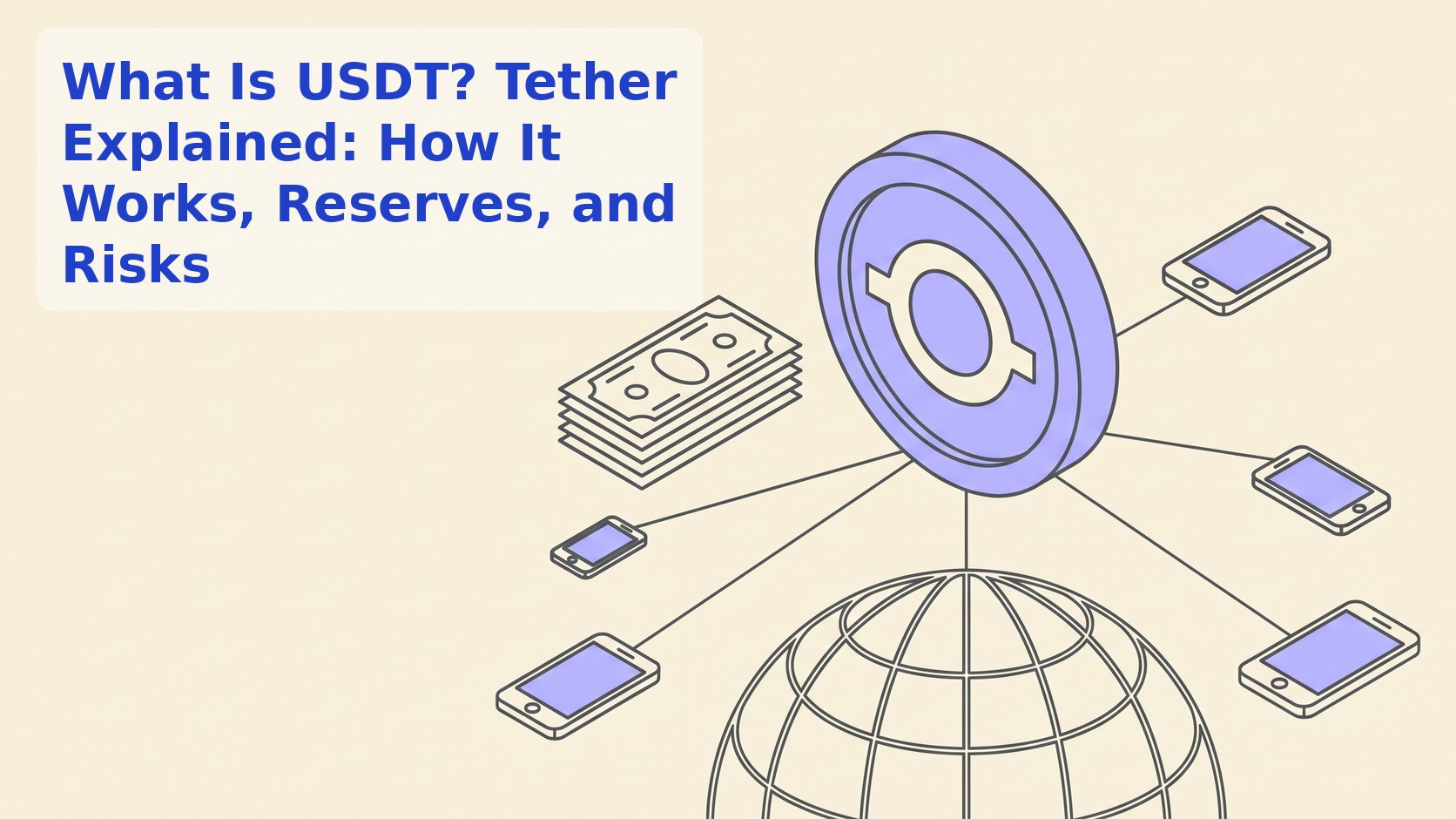
USDT, or Tether, is the largest stablecoin: a digital token designed to stay worth $1, issued by Tether and backed by reserves that are mostly US Treasury bills. It runs on many blockchains, including Tron and Ethereum, and is used worldwide for trading, savings, and cross-border payments. With roughly $184 billion in circulation as of October 2026, it is the most used digital dollar outside the United States.
USDT: definition and positioning
A stablecoin is a cryptocurrency pegged to a stable asset, usually the US dollar. USDT is the original and largest dollar stablecoin, launched in 2014. Each USDT is meant to be redeemable for one US dollar through Tether, and the company holds reserve assets to back the tokens in circulation.
USDT is issued by Tether, a company headquartered in El Salvador and operating outside US banking regulation. That offshore position is the key to understanding it. USDT dominates in markets where people want dollars but cannot easily get them, across Latin America, Africa, Turkey, and Asia, and on offshore trading platforms.
The main alternative is USDC, issued by Circle, a US company. USDC has about $74 billion in circulation and leans into US regulatory alignment; USDT leans into global reach and liquidity. For a side-by-side, see our USDC vs USDT comparison.
How USDT works
- Issuance. Verified customers, mostly exchanges, trading firms, and large holders, send dollars to Tether. Tether mints the same amount of USDT and sends it to them.
- Circulation. USDT moves freely on blockchains. Anyone can hold it in a wallet and send it to anyone else, 24/7, typically in seconds to minutes. Tron carries a large share of USDT transfers because fees are low, with Ethereum and other networks also widely used.
- Redemption. Verified customers return USDT to Tether, which burns the tokens and pays out dollars. Most individual users never redeem directly; they sell USDT for dollars or local currency on an exchange.
- The peg. USDT stays near $1 because arbitrage traders can mint and redeem at par. If USDT trades below $1, they buy it cheaply and redeem it for $1, pushing the price back up.
Tether can freeze USDT held at specific addresses, which it does in response to law enforcement requests. That makes USDT a centrally controlled token, not a decentralized one.
What backs USDT?
Tether publishes quarterly attestations of its reserves, prepared by the accounting firm BDO Italia. Its Q2 2026 attestation reported about $187.75 billion in assets against about $183.64 billion in liabilities, an excess reserve of about $4.1 billion.
Most reserves are short-term US Treasury bills and cash equivalents, which has made Tether one of the largest holders of US government debt. The rest is the controversial part: according to reporting on Tether's Q1 2026 attestation, roughly a quarter of reserves sat in assets such as gold, Bitcoin, and secured loans. Those assets earn returns for Tether but carry more risk than Treasuries. Our explainer on Tether's reserves breaks the composition down.
An attestation is a point-in-time check that reserves exist, not a full audit of the company. Critics have long pushed Tether for a complete audit by a major accounting firm.
USDT and US regulation
The GENIUS Act, signed in July 2025, created the first US federal framework for payment stablecoins. It requires reserves in cash and short-term Treasuries, monthly attested disclosures, and licensed issuers, with a transition period before non-compliant stablecoins lose access to US platforms.
Tether's response was to launch a separate token rather than change USDT. USAT, a US-focused stablecoin issued through federally chartered Anchorage Digital Bank, launched in January 2026 and was designed to comply with the GENIUS Act from day one. USDT continues to operate globally as an offshore product. Whether USDT itself will qualify for US market access in the long term remains an open question, largely because of its non-Treasury reserve assets.
USDT in practice
Trading. USDT is the most traded pair currency in crypto markets. Traders hold USDT between positions instead of converting to bank dollars.
Dollar savings. In countries with high inflation or capital controls, such as Argentina, Turkey, Nigeria, and Venezuela, people hold USDT as a digital dollar account.
Cross-border payments. Businesses and freelancers use USDT to move value across borders faster and more cheaply than international wires, then convert to local currency through exchanges or local payment providers. See our coverage of converting USDT to Brazilian reais for a business example.
Trade-offs and limitations
Issuer risk. USDT is only as good as Tether's reserves and its willingness and ability to redeem. Holders do not get deposit insurance.
Reserve composition. The non-Treasury share of reserves adds risk compared with stablecoins backed only by cash and Treasuries.
Regulatory uncertainty. USDT's future access to US platforms depends on how the GENIUS Act's foreign issuer rules are applied.
Freezes. Tether can freeze tokens at an address, which protects against crime but means USDT is not censorship-resistant.
Network mistakes. Sending USDT on the wrong network, for example Tron USDT to an Ethereum-only address, can make funds hard or impossible to recover.
FAQs
What is USDT used for?
USDT is used to trade crypto, to hold dollar value in countries with unstable currencies, to send money across borders, and to pay for goods and services where stablecoins are accepted. It is the most used stablecoin worldwide by volume.
Is USDT safe?
USDT has held its $1 peg through several market crises, but it carries issuer risk. Tether publishes quarterly attestations rather than full audits, and part of its reserves sits in assets riskier than Treasury bills. USDT is not covered by deposit insurance.
Is USDT the same as a US dollar?
No. USDT is a token designed to track the dollar's value, backed by Tether's reserves. It is not legal tender, not a bank deposit, and not insured. Its value depends on Tether redeeming tokens at $1.
What is the difference between USDT and USDC?
Both are dollar stablecoins. USDT, issued offshore by Tether, is larger and dominant in global and emerging markets. USDC, issued by US-based Circle, holds cash and Treasury reserves with monthly attestations and is more aligned with US regulation.
Which network should I use to send USDT?
Use whichever network both sender and receiver support. Tron is popular for low fees; Ethereum is widely supported but costs more. Always confirm the network before sending, since a mismatch can lose funds.
Last updated: October 13, 2026.