TL;DR
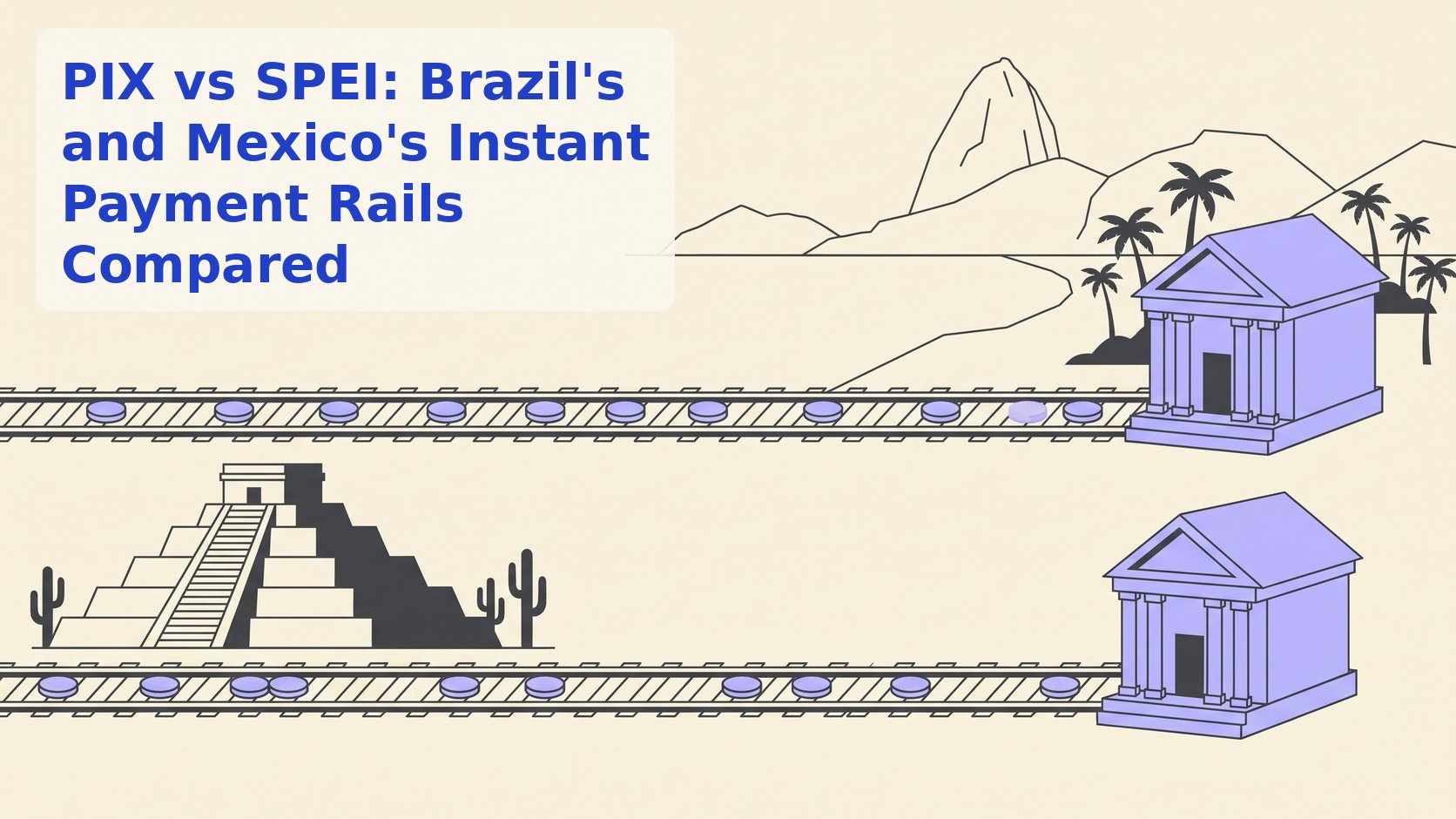
PIX and SPEI are the instant payment systems of Latin America's two largest economies, both run by their central banks. PIX, launched by Brazil's central bank in 2020, is free for individuals and uses simple keys such as a phone number or tax ID. SPEI, run by Banco de México since 2004, moves money between accounts using an 18-digit CLABE. Both settle in seconds, 24/7, and both are the last mile for stablecoin payouts in their markets.
How PIX and SPEI differ
PIX is a consumer-first instant payment scheme designed for everyday use: paying a shop by QR code, splitting a bill, or getting paid by phone number. SPEI is an interbank transfer system that became the backbone of Mexican digital payments, used for everything from salaries to e-commerce, with consumer features layered on top.
Both are operated by central banks, which is why both reached near-universal bank participation. The structural difference that drives everything else: PIX was built around the payer's experience, with aliases and QR codes at the core, while SPEI was built around accounts, with the CLABE as the core identifier and newer phone-number features added later.
The difference that actually matters
For anyone building payments into Brazil or Mexico, the deciding difference is identifiers and adoption pattern.
PIX identifies people by keys. A recipient registers a "chave Pix": their CPF or CNPJ tax number, phone number, email, or a random key. Payers do not need bank details at all. That design drove explosive consumer adoption and made PIX the default way Brazilians pay each other and many merchants.
SPEI identifies accounts by CLABE. Every Mexican bank account has an 18-digit CLABE, and SPEI routes on it. Mexico added phone-number payments on top through DiMo and QR payments through CoDi, but CLABE-based transfers remain the norm, especially for business.
In practice: paying out in Brazil, you can often pay a person with just their PIX key. Paying out in Mexico, you almost always need the recipient's CLABE. That changes onboarding, data collection, and error rates in any payout product.
Quick comparison: PIX vs SPEI
| Criteria | PIX (Brazil) | SPEI (Mexico) |
|---|---|---|
| Operator | Banco Central do Brasil | Banco de México (Banxico) |
| Launched | November 2020 | 2004 |
| Availability | 24/7 | 24/7 |
| Settlement | Seconds | Seconds |
| Main identifier | PIX key: tax ID, phone, email, or random key | 18-digit CLABE |
| Cost to individuals | Free for person-to-person transfers | Set by each bank; many free |
| QR payments | Native, widely used at merchants | Via CoDi, adoption limited |
| Phone-number payments | Native (PIX key) | Via DiMo, layered on SPEI |
| Recurring payments | Pix Automático for recurring debits | Domiciliación and bank-level options |
| Stablecoin off-ramp | Multiple exchanges and payment firms pay out USDC and USDT to PIX | Bitso and others pay out USDC to SPEI |
Feature and capability comparison
Consumer payments. PIX wins clearly. It replaced cash and boleto for a huge share of everyday payments in Brazil because paying by QR or phone number is instant and free. In Mexico, cash remains common in retail, and CoDi never achieved the same merchant adoption.
Business and payroll. Both handle salaries, supplier payments, and marketplace payouts at scale. SPEI's long history means it is deeply embedded in Mexican corporate banking and ERP systems. PIX has caught up fast, and businesses can pay out in bulk through banks and payment providers.
E-commerce. PIX is one of the leading online payment methods in Brazil through QR codes and "copy and paste" codes at checkout. In Mexico, SPEI transfers, along with cards and cash vouchers, are used for online payments, often through a reference CLABE generated per order.
Cross-border and stablecoins. Neither rail is cross-border by itself. Money from abroad converts to reais or pesos at a licensed provider, then pays out on PIX or SPEI. Stablecoins have become a common way to bridge that gap: USDC or USDT moves internationally, then an exchange or payment firm converts and pays out locally. In Mexico, Bitso's USDC to SPEI route is the best-known example.
Pros and cons
PIX: instant, free for individuals, simple keys, and dominant consumer adoption. Limitations: fraud and social engineering scams rose with adoption, prompting nighttime limits and new security rules, and payouts still require local licensing or a licensed partner.
SPEI: mature, reliable, deeply integrated with Mexican banks and businesses, and fully real time. Limitations: CLABE-based identification is less convenient for consumers, and consumer-facing add-ons such as CoDi saw weak uptake.
Which should you choose
You rarely choose between them: the market chooses for you. Choose PIX if you pay or collect in Brazil, where key-based payouts reduce friction and consumers expect it at checkout. Choose SPEI if you pay or collect in Mexico, and design onboarding to capture and validate CLABEs. For a business serving both, the practical question is which payment provider covers both rails, at what FX cost, and how it handles the cross-border leg, increasingly through stablecoins.
FAQs
Is PIX the same as SPEI?
No. Both are central bank instant payment systems, but PIX is Brazil's and SPEI is Mexico's. PIX routes payments using keys such as a phone number or tax ID, while SPEI routes using an 18-digit CLABE bank account number.
Can I send money from PIX to SPEI?
Not directly. They are separate national systems. A cross-border provider must collect funds in Brazil, convert reais to pesos, and pay out through SPEI, often settling the international leg in dollars or stablecoins.
Which is faster, PIX or SPEI?
Both settle in seconds and operate 24/7, so speed is effectively equal. Differences show up in identifiers, consumer features, fees set by banks, and fraud controls rather than settlement time.
Are PIX and SPEI free?
PIX is free for person-to-person transfers by individuals; businesses may pay fees set by their bank or provider. SPEI fees are set by each Mexican bank, and many offer free transfers to personal customers.
How do stablecoins connect to PIX and SPEI?
Exchanges and payment providers convert stablecoins such as USDC into reais or pesos and pay out to a PIX key or CLABE. This lets businesses move value internationally on blockchain rails and settle locally in seconds.
Building cross-border payments for Latin America? See our guide to stablecoin payment infrastructure or reach out if you are building in this space.
Last updated: October 13, 2026.