TL;DR
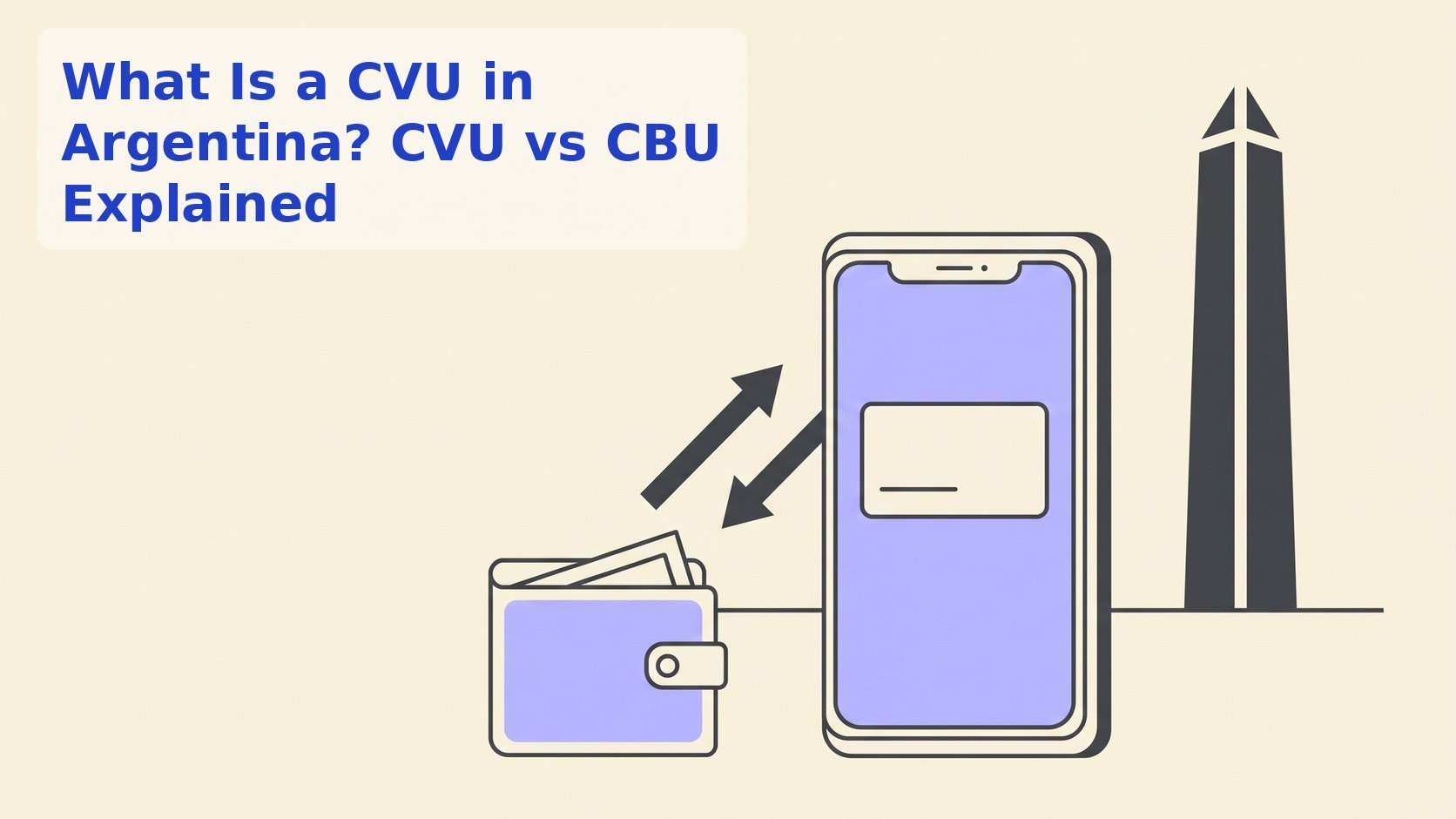
A CVU (Clave Virtual Uniforme) is a 22-digit account number assigned to accounts at virtual wallets and fintechs in Argentina, such as Mercado Pago, Ualá, and other payment service providers. It works like a CBU (Clave Bancaria Uniforme), the equivalent number for traditional bank accounts, and the two are interoperable: money moves instantly between CVU and CBU accounts.
CVU: definition and positioning
Argentina gives every account a standardized 22-digit key so that money can be sent between any two institutions. Bank accounts use the CBU. Accounts at non-bank payment service providers, the fintechs and digital wallets regulated by the Banco Central de la República Argentina (BCRA), use the CVU.
The CVU was introduced so that fintech accounts could join the national transfer system on equal terms with banks. Before it, wallet balances were siloed; after it, a Mercado Pago user could receive a transfer from any bank, and vice versa.
Both numbers can be replaced by an alias: a memorable text label of words linked to the CVU or CBU. Most Argentines share their alias rather than the 22 digits, and you can usually change your alias at any time.
Why the distinction matters: a CVU is not a bank account. Funds sit with a payment service provider, under BCRA rules for those providers, rather than in a bank deposit.
How CVU transfers work
- Account opening. When you open an account with a fintech or virtual wallet in Argentina, it assigns you a CVU and an alias.
- Sharing details. To get paid, you share your CVU or alias. The sender sees your name and identification before confirming, which reduces misdirected transfers.
- Sending. Transfers between CVU accounts, and between CVU and CBU accounts, run through Argentina's immediate transfer infrastructure and arrive in seconds, around the clock.
- QR payments. CVU accounts also support interoperable QR payments at merchants, so customers can pay from any participating wallet.
CVU vs CBU
| Feature | CVU | CBU |
|---|---|---|
| Stands for | Clave Virtual Uniforme | Clave Bancaria Uniforme |
| Issued by | Payment service providers and virtual wallets | Banks |
| Length | 22 digits | 22 digits |
| Alias | Yes | Yes |
| Typical examples | Mercado Pago, Ualá, other fintech wallets | Accounts at Argentine banks |
| Transfers between the two | Interoperable and immediate | |
CVU in practice
For individuals, a CVU from a wallet is often the easiest account to open in Argentina, and it receives transfers from anyone in the country.
For people sending money to Argentina, many remittance and crypto services pay out to a CVU or CBU. Because of Argentina's history of inflation and currency controls, a large share of cross-border flows into the country now moves through dollars and stablecoins, then converts to pesos and pays out to a local CVU or CBU. Our guide to sending money to Argentina covers those routes.
For businesses, paying contractors in Argentina to a CVU reaches people who live mainly in fintech wallets. It is the Argentine equivalent of SPEI in Mexico or Nequi in Colombia: the local last mile.
Trade-offs and limitations
Not a bank deposit. CVU balances sit with payment service providers, which follow BCRA rules for those firms rather than bank rules.
Domestic only. A CVU receives transfers inside Argentina. International payments reach it only through a provider that converts and pays out locally.
Typos and fraud. Transfers are immediate and hard to reverse, so check the name shown before confirming.
FAQs
What does CVU mean?
CVU stands for Clave Virtual Uniforme. It is the 22-digit number that identifies an account at a virtual wallet or fintech in Argentina, used to send and receive transfers, much like a CBU identifies a bank account.
What is the difference between CVU and CBU?
A CBU identifies an account at a bank; a CVU identifies an account at a non-bank payment service provider such as a digital wallet. Both have 22 digits, both can use an alias, and transfers between them are immediate.
Where do I find my CVU?
In your wallet or fintech app, usually under your account details or "your data" section, alongside your alias. You can copy and share either one to receive transfers.
Can I receive money from abroad to a CVU?
Not directly from a foreign bank. You need a remittance or crypto service that converts the funds and pays out locally in Argentina to your CVU or CBU.
Is an alias the same as a CVU?
No. An alias is a memorable text label linked to your CVU or CBU. Senders can use either; the alias simply points to the 22-digit number.
Last updated: October 13, 2026.