USDT to BRL: How Businesses Convert at Scale
USDT to BRL: How Businesses Convert at Scale
TL;DR
Converting USDT to Brazilian real at business scale runs through a licensed Brazilian off-ramp, BRLA, Bitso, Mercado Bitcoin, and Transfero are the main liquidity providers, that receives the stablecoin on-chain and pays out via PIX, typically within minutes. The real cost isn't the on-chain transfer itself, it's the FX conversion leg, subject to Brazil's IOF-câmbio tax at roughly 3.5% for most outbound transactions as of 2026, plus whatever spread the off-ramp charges against its quoted rate. As of October 1, 2026, Brazilian Central Bank Resolution 561 changes which licensed channel a regulated FX provider can use for the cross-border leg specifically, worth confirming directly with any provider before committing to a corridor at scale.
How the conversion actually works
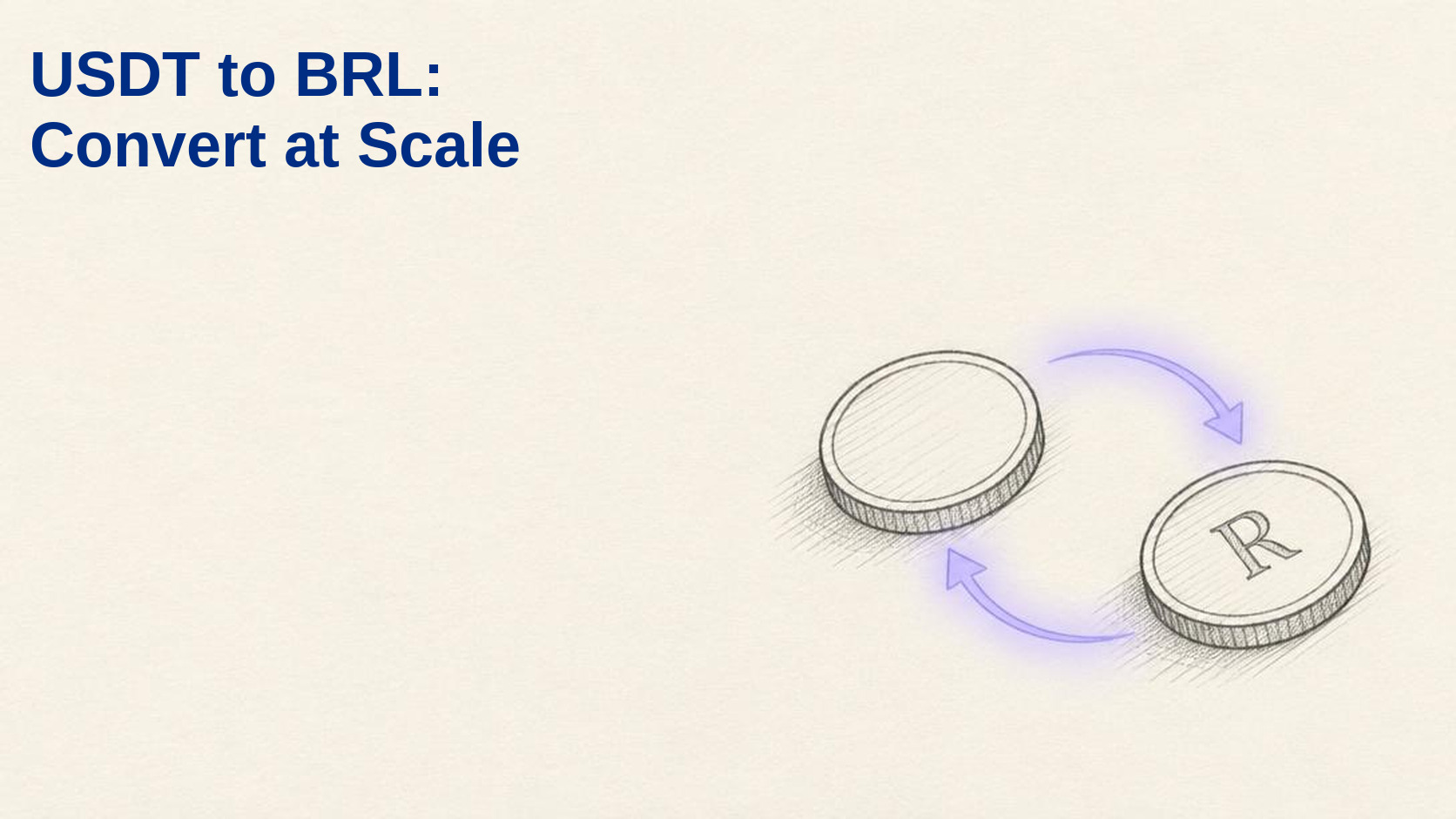
USDC or USDT settles on-chain to a licensed off-ramp's wallet, commonly on Tron, Polygon, Base, or Ethereum. The off-ramp converts the stablecoin to BRL at its quoted rate and pushes the payment to the beneficiary's Brazilian bank account via PIX, which clears in minutes given PIX's own sub-10-second domestic settlement speed.
What actually determines your realized cost
Quoted versus realized spread. Pre-test at your actual ticket size, 10,000, 100,000, and 1,000,000 dollar equivalents all realize differently, and a quoted rate at small scale doesn't guarantee the same spread at larger volume.
IOF-câmbio. Brazil treats the fiat-conversion leg as an FX operation, taxed at roughly 3.5% for most outbound flows as of 2026. This applies regardless of which off-ramp partner you use, confirm current rates directly given how frequently Brazilian FX tax policy shifts.
Chain selection. Network fees vary meaningfully by chain, Tron's network fees are typically near-zero for a properly staked account, while other chains can add real cost at high transaction volume.
Licensing status under Resolution 561. Effective October 1, 2026, regulated electronic FX providers can no longer settle the offshore leg of a cross-border payment directly in stablecoins, that leg now runs through a traditional FX transaction or a non-resident BRL account instead. Confirm your off-ramp partner's current licensing path reflects this change.
Operational checklist before converting at scale
- Confirm the off-ramp partner holds current, valid licensing under BCB Resolutions 519, 520, 521, and 561.
- Test realized spreads, not quoted spreads, at your actual transaction size.
- Reconcile on-chain settlement IDs against the off-ramp's internal references, this is where manual reconciliation errors most commonly occur.
- Confirm sanctions and AML screening happens at both the source and destination side of the transaction.
FAQs
How do I convert USDT to BRL as a business?
Through a licensed Brazilian off-ramp provider, BRLA, Bitso, Mercado Bitcoin, and Transfero are the main options, which receives the stablecoin on-chain and pays out to a Brazilian bank account via PIX.
What is the real cost of converting USDT to BRL?
The main cost is Brazil's IOF-câmbio tax on the FX conversion leg, roughly 3.5% for most outbound transactions as of 2026, plus whatever spread the off-ramp charges against its quoted exchange rate. On-chain network fees are typically a small fraction of the total cost.
What changed with BCB Resolution 561?
Effective October 1, 2026, regulated electronic FX providers, payment institutions, e-money issuers, and acquirers, can no longer settle the offshore leg of a cross-border payment directly in stablecoins, that leg must run through a traditional FX transaction or a non-resident BRL account instead.
Which blockchain is cheapest for converting USDT to BRL?
Network fees vary by chain, Tron's fees are typically near-zero for a properly staked account, while other chains can add real cost at high transaction volume. Confirm your off-ramp partner's supported chains and their current fee structure directly.
Last updated: September 28, 2026 Written by the stablecoin.nyc Editorial Desk